Why Do People Use Captions? 15 Reasons and 225 Creative Ideas
Ever wondered why people use captions, even when a picture or video seems to explain everything? The answer goes far beyond adding a few words. Captions help viewers understand videos without sound, make content more accessible, express emotions, and connect with audiences. From Instagram selfies to TikTok videos, the right caption can transform an ordinary moment into something memorable. But what makes captions so important, and why do millions of people rely on them every day? Discover 15 powerful reasons people use captions, plus 225 creative caption ideas to make your social media posts more meaningful, relatable, and engaging.
Captions are everywhere. They appear beneath Instagram photos, across TikTok videos, inside YouTube tutorials, and alongside meaningful moments shared with friends. But have you ever wondered why do people use captions, even when the image or video already tells a story?
The answer goes beyond adding words to a screen.
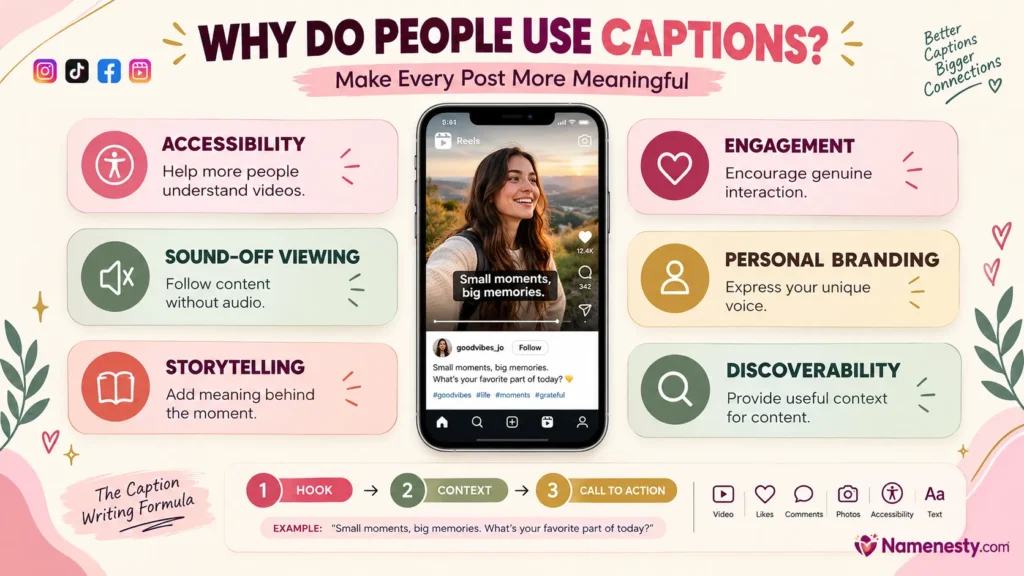
People use captions to make videos accessible, understand conversations without sound, express emotions, explain experiences, connect with audiences, and make content easier to follow. For creators, captions can also support storytelling, engagement, and personal branding.
Whether you’re watching a video in a quiet room, learning something new, or trying to find the perfect words for your next Instagram post, captions can make the experience more meaningful.
In this guide, you’ll discover 15 important reasons people use captions, how captions work across popular platforms, and 225 original caption ideas for different moods and moments.
Quick Answer: Why Do People Use Captions?
People use captions because they make content easier to understand, more accessible, and more expressive. Video captions help deaf and hard-of-hearing viewers, people watching without sound, and language learners. Social media post captions help users communicate emotions, add context, tell stories, and encourage interaction.
There are two common meanings worth understanding:
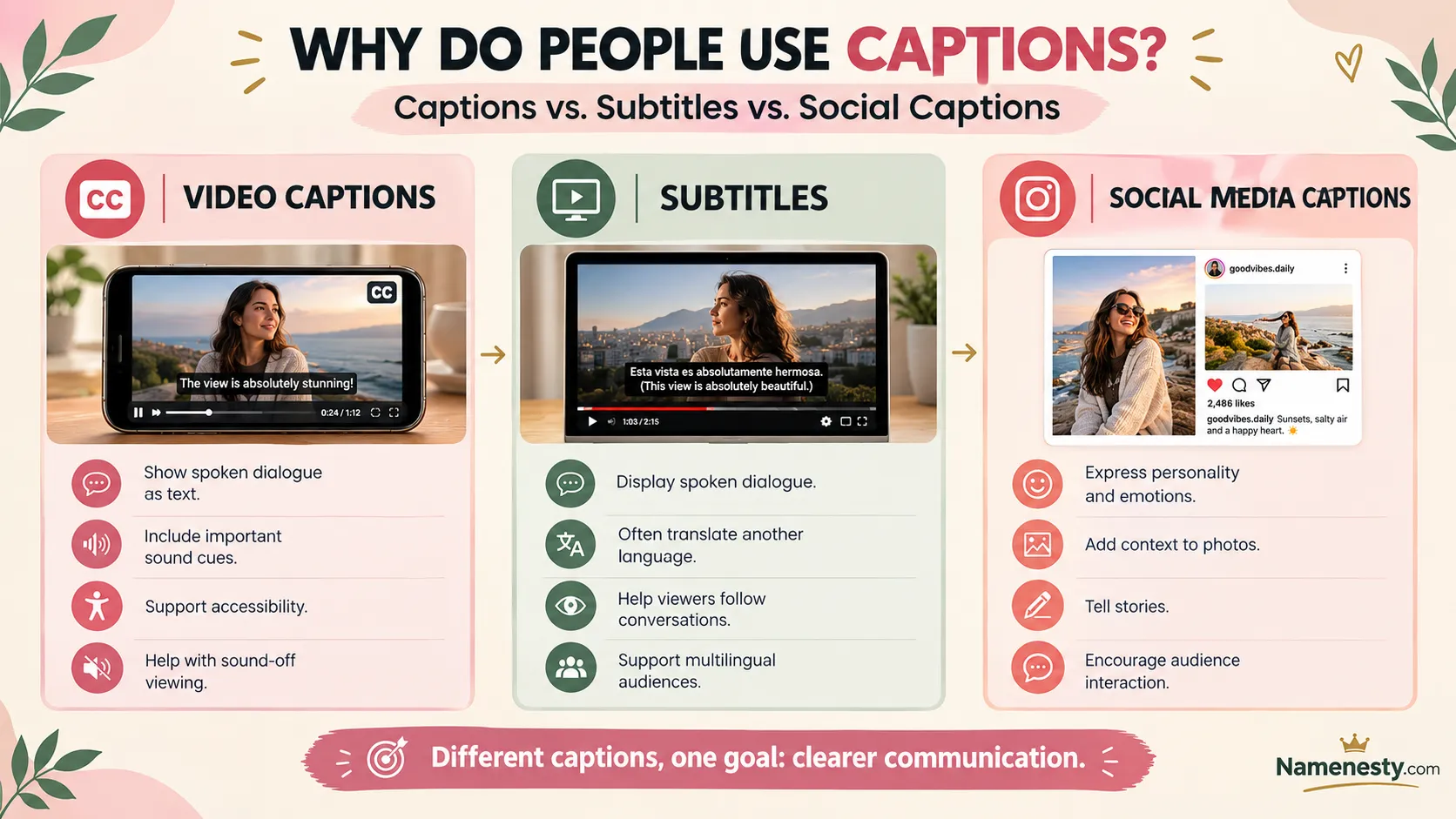
- Video captions: Timed text showing speech and meaningful sounds in a video.
- Social media post captions: Written descriptions, quotes, stories, or messages accompanying a photo or video.
Both make content more useful, but they serve different purposes.
1. Why Do People Use Captions? 12 Important Reasons Explained
People use captions for accessibility, communication, convenience, creativity, and emotional connection. The purpose depends on whether someone is watching a video, publishing a post, or sharing a personal experience.
Here are 15 short social media captions that demonstrate how a few words can add meaning to everyday content.
Best for: Instagram, Threads, Facebook, and everyday posts · Style: Short and meaningful
- A little context makes every moment brighter.
- Some memories deserve more than a picture.
- Giving this moment the words it deserves.
- One photo, a hundred feelings.
- Because the story matters as much as the view.
- A few words, a whole mood.
- The feeling behind the frame.
- Not everything meaningful needs a long explanation.
- Adding a little heart to the highlight.
- Every picture has something left to say.
- The smallest details tell the biggest stories.
- Turning a passing moment into a lasting memory.
- When the picture speaks, the caption whispers.
- Sharing more than what the camera captured.
- Sometimes the words complete the picture.
Why these work: Short captions offer emotional context without overwhelming the image. They are especially suitable for photos where the visual should remain the main focus.
2. What Are Captions and Why Are They Important?
Captions help audiences understand information that might otherwise be missed. In videos, they represent spoken dialogue and meaningful sounds; in social media posts, they explain or enhance visual content.
For everyday posts, simple captions can turn ordinary experiences into relatable messages.
Best for: Daily photos, lifestyle posts, and WhatsApp · Style: Simple and relatable
- Today’s little chapter.
- Nothing fancy, just a good day.
- Keeping this one close.
- A moment worth remembering.
- The kind of day I needed.
- Small joys, big smiles.
- Just another beautiful piece of ordinary life.
- Happiness found in familiar places.
- A little sunshine for the timeline.
- This moment felt like home.
- Collecting memories, not perfect pictures.
- Life looks lovely from here.
- A peaceful pause in a busy world.
- Some days simply feel right.
- Here for the little things.
Why these work: They give an image meaning without requiring a lengthy story, making them useful for casual and personal updates.
3. Why Do People Watch Videos With Captions Turned On?
Many people watch videos with captions because they’re in noisy places, cannot play audio, or prefer reading along. Captions also help viewers catch unfamiliar words and understand speech more clearly.
For creators, the accompanying post caption can introduce the video and encourage viewers to watch.
Best for: TikTok, Reels, and YouTube Shorts · Style: Curious and attention-grabbing
- Wait until you see how this ends.
- The little detail everyone almost missed.
- This changed the way I see things.
- You might want to watch this twice.
- A quiet moment with a powerful message.
- The ending says more than the beginning.
- Something about this deserves your attention.
- The part nobody warned me about.
- Proof that small moments can surprise you.
- Watch closely; the magic is in the details.
- I didn’t expect this to mean so much.
- A story worth following until the last second.
- This is your sign to pay attention.
- One moment, an unexpected lesson.
- The message behind this might stay with you.
Why these work: They introduce curiosity and establish a reason to watch. They should only be used when the video genuinely delivers what the caption promises.
4. How Do Captions Help Deaf and Hard-of-Hearing Viewers?
Accurate video captions allow deaf and hard-of-hearing viewers to access dialogue and important audio information. Meaningful sounds, speaker identification, and synchronized text can all contribute to a more inclusive viewing experience.
The following examples are social post captions about inclusion and communication, not replacements for accessible timed video captions.
Best for: Awareness campaigns, educational posts, and community content · Style: Inclusive and thoughtful
- Every voice deserves a way to be understood.
- Inclusion begins with thoughtful choices.
- Make room for every way of experiencing the world.
- Accessibility belongs in the conversation.
- A better experience leaves fewer people out.
- Communication should open doors, not close them.
- Small changes can make content more welcoming.
- Understanding should never depend on volume.
- Different experiences, equal importance.
- Thoughtful content considers every viewer.
- Make the message accessible, not just visible.
- Good communication reaches beyond sound.
- Every audience member matters.
- Clear words create stronger connections.
- The best stories welcome everyone.
Why these work: They focus on respectful, inclusive communication. When paired with videos, creators should also provide accurate dialogue captions and meaningful sound cues.
5. Why Do People Prefer Captions Even When They Can Hear?
Captions are not exclusively for people with hearing loss. Hearing viewers may use them to follow fast dialogue, understand accents, watch in public, or avoid missing important information.
Similarly, people often enjoy social post captions because they reveal the personality and mood behind a photo.
Best for: Selfies, aesthetic photos, and personal branding · Style: Confident and expressive
- Quiet confidence looks good on me.
- A little mystery, a lot of personality.
- My energy needs no introduction.
- Soft expression, strong intentions.
- More than what meets the eye.
- Finding beauty in my own rhythm.
- A mood I can’t quite explain.
- Confidence without the extra noise.
- Let the details tell my story.
- Comfortable being exactly who I am.
- Not every thought needs an audience.
- A calm face with a curious mind.
- Growing into someone I’m proud to know.
- My favorite version is the real one.
- A little glow from the inside out.
Why these work: They add self-expression and emotional meaning to photos that might otherwise communicate only appearance.
6. How Do Captions Improve Video Understanding and Memory?
Captions can reinforce spoken information by presenting it in written form. Research reviewing caption use has found benefits for attention, comprehension, and memory, although results depend on the viewer and content.
For educational social posts, captions can also summarize a takeaway and make the message easier to revisit.
Best for: Study posts, tutorials, and educational Reels · Style: Inspirational and reflective
- Today’s lesson might become tomorrow’s breakthrough.
- Learning something new is always a good investment.
- Progress starts with one curious question.
- A little knowledge can change your direction.
- Keep the lesson, even when the moment passes.
- Growth happens one discovery at a time.
- Curious minds make ordinary days interesting.
- Save the lesson, not just the highlight.
- Every mistake has something useful to teach.
- Understanding begins when we start paying attention.
- Make space for ideas that challenge you.
- The best discoveries often begin with confusion.
- One new insight can unlock a fresh perspective.
- Learning doesn’t have to look perfect.
- Take what helps you grow and carry it forward.
Why these work: They connect information to motivation, making educational content feel approachable and personally relevant.
7. Why Are Captions Important for Instagram, TikTok, and Reels?
On Instagram, TikTok, and Reels, captions can serve two roles: timed text makes videos understandable without audio, while post captions add context, personality, and calls to action.
The most useful caption style depends on the content, audience, and platform rather than a single viral formula.
Best for: Instagram Reels, TikTok, and short-form lifestyle content · Style: Modern and playful
- Main character energy, ordinary Tuesday edition.
- Plot twist: the little moments won.
- This vibe deserved its own post.
- Currently romanticizing my daily routine.
- A tiny reset with a big mood shift.
- Consider this your daily dose of good energy.
- The camera roll made the decision for me.
- Living for the moments between plans.
- POV: you finally enjoy the present.
- Another episode of making life interesting.
- No dramatic storyline, just beautiful timing.
- Posting this before I overthink it.
- A little chaos, a little charm.
- My kind of unplanned happiness.
- If this is a phase, I’m enjoying it.
Why these work: They use conversational language and familiar social media storytelling formats without depending on exaggerated promises.
8. Do Captions Increase Video Engagement and Watch Time?
Captions can support engagement by making videos easier to follow, particularly when viewers cannot hear the audio. However, captions alone do not guarantee longer watch time, more likes, or better algorithmic distribution.
A good social post caption can also encourage meaningful interaction by inviting people to share an opinion or experience.
Best for: Facebook, Instagram, Threads, and community posts · Style: Conversational and interactive
- Which part of this would you remember most?
- Tell me your favorite detail from today.
- Would you choose the same adventure?
- What’s one small thing that made you smile?
- Describe this mood in three words.
- Which moment deserves a replay?
- Have you ever experienced something similar?
- What’s your favorite way to slow down?
- Would you save this memory or relive it?
- Tell me something good about your week.
- Which photo tells the better story?
- What would you name this little chapter?
- Is anyone else learning to enjoy the quiet?
- What’s a lesson you wish you’d learned sooner?
- Your turn: what does happiness look like today?
Why these work: Specific, relevant questions make it easier for readers to respond naturally. Engagement is more valuable when the conversation genuinely relates to the content.
9. How Do Captions Help With Language Learning and Communication?
Captions can help language learners connect spoken words with their written forms, follow unfamiliar vocabulary, and understand expressions in context.
Social post captions can support communication in a different way by expressing feelings that might be difficult to convey through images alone.
Best for: Emotional posts, friendship, and personal reflections · Style: Deep and meaningful
- Some feelings become clearer when written down.
- Words can hold what silence cannot.
- Not every emotion arrives with an explanation.
- A gentle reminder that feelings deserve space.
- The heart remembers what the mind forgets.
- Sometimes clarity begins with a simple sentence.
- A thousand thoughts behind one quiet smile.
- Finding the language for things I used to hide.
- The right words can make distance feel smaller.
- Every meaningful conversation starts somewhere.
- There is beauty in being understood.
- Some truths are easier to write than say.
- Learning to express myself without apologizing.
- A little honesty can change the whole conversation.
- The moments we explain become stories we share.
Why these work: They communicate vulnerability and emotional depth, making them appropriate for reflective content and personal storytelling.
10. Why Do Content Creators and Influencers Use Captions?
Creators use video captions to improve accessibility and help audiences follow content. They use post captions to communicate their voice, explain their message, and build relationships with followers.
For personal brands, consistent, authentic caption writing can make posts feel more recognizable.
Best for: Influencers, entrepreneurs, and creator accounts · Style: Authentic and professional
- Building something meaningful, one post at a time.
- Behind every polished moment is a real process.
- Creating with purpose, not just for attention.
- Sharing the journey, including the messy middle.
- My work is evolving, and so am I.
- A new idea deserves a chance to grow.
- Showing up with intention today.
- The creative process rarely follows a straight line.
- Real connection matters more than perfect presentation.
- A little behind-the-scenes honesty.
- Turning curiosity into something worth sharing.
- Small beginnings can lead to meaningful work.
- My story is still under construction.
- Creating things I’d genuinely want to discover.
- More substance, less unnecessary noise.
Why these work: They establish values, creative identity, and credibility without relying on exaggerated achievements.
11. How Do Captions Improve Video SEO and Discoverability?
Accurate captions and transcripts can provide textual information about video content. When made accessible to search systems, this text may help explain a video’s subject, terminology, and relevance.
Search visibility also depends on factors such as page quality, metadata, technical accessibility, and content usefulness. Captions are not a guaranteed ranking shortcut.
Best for: Business posts, product demonstrations, and educational marketing · Style: Clear and value-focused
- Here’s what makes this idea worth exploring.
- A closer look at the details that matter.
- Simple solutions begin with understanding the problem.
- Making complicated ideas easier to use.
- Here’s the process behind the finished result.
- A practical tip you can try today.
- Good design starts with a thoughtful question.
- The difference is often in the smallest details.
- Sharing what worked and what I’d change.
- A better way to approach an everyday challenge.
- Useful information deserves a clear explanation.
- Let’s explore the idea behind the outcome.
- One simple improvement can change your workflow.
- Here’s what I learned from testing this.
- Helping good ideas become practical results.
Why these work: They emphasize usefulness and context. For SEO, accompany them with descriptive titles, relevant page copy, and accurate video transcripts where appropriate.
12. What Is the Difference Between Captions, Subtitles, and On-Screen Text?
Captions, subtitles, and decorative on-screen text are not interchangeable. Captions represent dialogue and meaningful sounds, subtitles commonly provide dialogue or translation, and on-screen text may highlight a hook, label, or message.
On social media, creative overlay text often adds humor or personality, but it should not be treated as a complete accessibility solution.
Best for: Memes, funny Reels, and relatable videos · Style: Funny and playful
- My brain has seventeen tabs open again.
- Acting organized while my calendar disagrees.
- Mentally on vacation, physically answering emails.
- Today’s productivity is sponsored by snacks.
- I came, I saw, I forgot why I came.
- Plot twist: I was the problem.
- My plans and reality are no longer speaking.
- Professional overthinker, amateur decision-maker.
- The Wi-Fi is strong; my motivation isn’t.
- Currently accepting compliments and extra fries.
- Trying to be mysterious, accidentally oversharing.
- My weekend disappeared without saying goodbye.
- Powered by coffee and questionable confidence.
- I have a plan. It’s mostly improvisation.
- My to-do list just requested a vacation.
Why these work: Relatable humor gives viewers an immediate emotional connection. They can be used as post captions or creative overlays, alongside proper video captions when needed.
13. When Should You Use Open Captions vs. Closed Captions?
Open captions are permanently visible in a video, while closed captions can usually be switched on or off by viewers.
Open captions may suit short social videos where visible text is part of the presentation. Closed captions offer viewer control and are useful on platforms supporting selectable caption tracks.
For romantic videos, the following post captions can accompany either format.
Best for: Couples, anniversaries, romantic Reels, and love posts · Style: Cute and romantic
- Explore More: https://namenesty.com/what-are-5-good-quotes/
- My favorite moments have you in them.
- Love feels softer when you’re near.
- Two hearts, one beautifully ordinary adventure.
- You make the quiet moments unforgettable.
- My favorite hello is still yours.
- The best part of today was us.
- A thousand little reasons to choose you.
- Love looks lovely in the everyday details.
- Your smile is my favorite plot twist.
- Finding home in the simplest moments together.
- Every ordinary day feels special beside you.
- Our kind of magic doesn’t need an audience.
- Still choosing your hand in every season.
- A love story written in little gestures.
- You make the journey feel like the destination.
Why these work: They express affection through specific, everyday emotions rather than relying entirely on familiar romantic clichés.
14. How Do You Write Effective Captions for Social Media Videos?
An effective social media post caption should complement the content, communicate a clear idea, and suit the audience. A useful framework is Hook + Context or Value + Optional Call to Action.
For video accessibility, creators should separately ensure that spoken dialogue and meaningful sounds are accurately captioned.
Best for: Travel, lifestyle, adventure, and storytelling Reels · Style: Aesthetic and memorable
- Somewhere between the journey and the view, I found peace.
- The horizon had other plans for my heart.
- Taking the scenic route to a better mood.
- Every new place teaches me something unexpected.
- Chasing experiences that feel like fresh beginnings.
- The best souvenirs are the stories I bring home.
- A postcard moment I never want to forget.
- Letting unfamiliar streets lead to beautiful discoveries.
- Golden skies and a mind finally at ease.
- Some adventures begin with a spontaneous yes.
- Following the sunlight into another memory.
- A new view, a fresh perspective.
- Finding wonder beyond my usual routine.
- Every road has a story waiting to unfold.
- A little farther from routine, a little closer to joy.
Why these work: They add emotion and narrative context to travel content. Pair them with a specific location, experience, or personal detail to make the post more distinctive.
15. Frequently Asked Questions About Why People Use Captions
People often have follow-up questions about when captions are necessary, whether they improve engagement, and how to choose the right words for social posts.
Before answering those questions, here are 15 final caption ideas suited to confidence, motivation, and personal growth.
Best for: Motivational posts, selfies, Threads, and personal milestones · Style: Confident and inspirational
- My progress doesn’t need anyone’s permission.
- Becoming stronger without becoming louder.
- The next chapter deserves my full effort.
- Not chasing approval, building something real.
- A quiet comeback is still a comeback.
- My standards grew with my self-respect.
- Some victories happen where nobody is watching.
- Choosing growth over familiar excuses.
- Let the results speak when they’re ready.
- I can be proud and still be learning.
- Making peace with my own pace.
- Strong boundaries, softer mornings.
- Confidence built through keeping promises to myself.
- Every fresh start deserves a fair chance.
- A little braver than I was yesterday.
Why these work: They communicate self-respect, resilience, and personal development. They are particularly suitable for milestone posts and meaningful updates.
Caption Style Comparison: Which One Fits Your Post?
The right caption depends on your audience, content, and intended emotional response.
| Caption style | Best use case | Intended effect |
| Short | Selfies, casual photos | Quick understanding |
| Funny | Memes, everyday moments | Humor and relatability |
| Romantic | Couples, anniversaries | Affection and connection |
| Aesthetic | Travel, nature, lifestyle | Mood and atmosphere |
| Deep | Personal reflections | Emotional resonance |
| Inspirational | Milestones, goals | Encouragement |
| Interactive | Community posts | Meaningful responses |
| Educational | Tutorials, explainers | Learning and clarity |
| Business | Products, services | Trust and usefulness |
These are editorial recommendations, not guaranteed engagement rankings.
How to Choose the Best Caption for Your Post
Choosing the right caption is easier when you start with the purpose of your content instead of selecting random trending phrases.
Use this simple decision framework:
Find your ideal caption style
What’s your main goal?
Encourage conversation
Express a feeling
Make people smile
Share useful information
Build my personal brand
Where will you post?
Instagram or Reels
TikTok
Facebook or Threads
Snapchat, WhatsApp, or Pinterest
RECOMMENDED STYLE
Interactive caption
“What’s one small thing that made you smile today?”
Ask a relevant, specific question that invites a genuine response.
Instagram tip: Pair the caption with a strong visual and add context when the image needs explanation.
Copy caption
Platform-Specific Caption Recommendations
Different platforms encourage different viewing and posting behaviors. The following are practical starting points, not fixed algorithmic rules.
| Platform | Recommended post-caption approach | Video caption advice |
| Personality, storytelling, relatable hooks | Caption spoken dialogue in Reels | |
| TikTok | Direct hooks and relevant context | Check automatic captions for accuracy |
| Conversational stories and questions | Make shared videos understandable without audio | |
| Snapchat | Short, personal, immediate messages | Keep text readable and away from important visuals |
| Brief, meaningful status messages | Use clear text when sharing informative clips | |
| Descriptive, search-relevant language | Add captions to video Pins with meaningful audio | |
| Threads | Natural conversation and personal opinions | Provide context for attached videos |
| YouTube | Descriptive titles and supporting descriptions | Supply accurate, synchronized caption tracks |
Video Captions vs. Social Media Post Captions
This distinction is important because the question “Why do people use captions?” can refer to either format.
| Feature | Video captions | Social media post captions |
| Primary purpose | Represent audio information | Add context and expression |
| Typical location | Over or alongside video | Beneath or attached to a post |
| Accessibility function | Essential for access to audio content | Can provide context, but does not replace video captions |
| Examples | [applause], spoken dialogue | “Collecting memories, not perfect pictures.” |
| Timing required | Yes, for synchronized video captions | No |
| Main writing priority | Accuracy and readability | Relevance, personality, and clarity |
Important: Adding an inspirational quote to a Reel is not the same as captioning its dialogue. Accessible video captions should include the information necessary to understand meaningful audio.
- Explore More: https://namenesty.com/what-is-a-social-caption/
What Makes Captions Effective? A Practical Checklist
Caption quality review
0 of 8 complete
The caption matches the content and intended audience.
The opening communicates a clear idea.
The wording feels natural and authentic.
The caption adds context rather than repeating the obvious.
Any call to action is relevant and not misleading.
Video dialogue and important sounds are accurately represented.
Timed captions are synchronized and readable.
Spelling, punctuation, and names have been reviewed.
Reset checklist
People Also Ask:
People use video captions to understand speech, access audio information without hearing it, follow content in noisy or quiet environments, and improve comprehension. Captions are particularly important for deaf and hard-of-hearing viewers.
People use Instagram post captions to express feelings, tell stories, provide context, build personal brands, and invite engagement. For Instagram Reels, timed captions also make spoken content more accessible.
Some viewers prefer subtitles or captions because they help clarify fast dialogue, unfamiliar accents, names, and background conversations. Others use them to watch quietly or support language learning.
Yes, accurate captions are still important for accessibility. Clear audio does not make spoken information accessible to everyone, and viewers may be watching in environments where they cannot hear it.
Captions can support engagement by making content easier to understand and follow. Their effect varies by audience, platform, caption quality, and the content itself; increased engagement is not guaranteed
Key Takeaways: Why People Use Captions
- Accessibility: Video captions help people access speech and meaningful audio information.
- Convenience: They allow viewers to follow videos when sound is unavailable or difficult to hear.
- Comprehension: Captions can help viewers understand and remember information.
- Self-expression: Social post captions communicate personality, emotions, and experiences.
- Engagement: Relevant captions can encourage interaction and make content easier to follow.
- Marketing: Creators and brands use captions to communicate messages clearly and connect with audiences.
The most effective caption is not necessarily the longest, funniest, or most fashionable. It is the one that serves the content and the people experiencing it.
Conclusion
So, why do people use captions? Because words can make content more accessible, understandable, personal, and memorable.
For video viewers, captions remove communication barriers and provide flexibility. For Instagram users, TikTok creators, influencers, and everyday social media users, post captions help turn images and videos into stories that people can understand and connect with.
The 225 creative examples in this guide demonstrate how different caption styles can communicate humor, love, confidence, inspiration, education, and everyday experiences.
Choose captions that reflect your actual message, review video captions for accessibility, and prioritize meaningful communication over chasing trends.