
What Is a Social Caption? Meaning, Examples, and How to Write One (2026)
Ever wondered why some social media posts feel more meaningful than others? Often, the secret is in the caption. A social caption is the written text that accompanies a photo, video, Reel, or other social media post. It can tell a story, express an emotion, share useful information, or encourage people to join the conversation. But writing the right caption isn’t always easy. Should you keep it short, make it funny, or add a thoughtful message? In this guide, you’ll discover what a social caption means, explore 225 original examples, and learn how to choose words that fit your post.
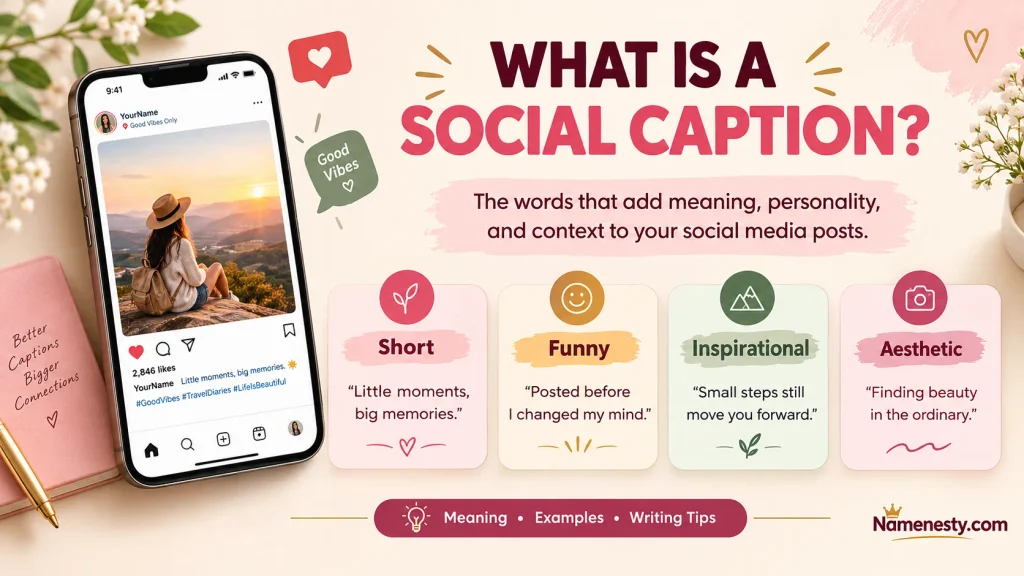
A social caption is the written text that accompanies a social media post. It can explain a photo, add context to a video, tell a story, express a feeling, share useful information, or encourage people to take action. Captions can be short one-liners, funny remarks, personal stories, educational tips, or promotional messages.
For example, a person sharing a sunset photo might write, “Some evenings remind you to slow down and simply be.” A small business might write, “Our new collection is here. Which design would you choose?”
Both are social captions, but each serves a different purpose. The best choice depends on the content, audience, platform, and message you want to communicate.
In this guide, you’ll discover what a social caption means, explore 225 original caption ideas across 15 categories, and learn how to choose and write captions for Instagram, TikTok, Facebook, Snapchat, Pinterest, Threads, Reels, personal posts, and business content.
1. What Is a Social Caption? Meaning and Definition
A social caption is the text published alongside a social media post. It may accompany a photograph, video, Reel, carousel, or other content format. Its purpose is to help the audience understand the post, connect with its message, or decide what to do next.
A social caption can be descriptive, entertaining, emotional, informative, persuasive, or conversational. It can also be a text-only post on platforms that support written updates.
Example: “A little progress every day still moves you forward.”
This caption communicates an idea without needing to describe a particular image. It could accompany a fitness update, study session, personal milestone, or motivational graphic.
15 simple social caption examples
Use these when you want to express a clear thought without writing a long paragraph.
- A little moment, a lasting memory.
- Today feels like a fresh page.
- Finding beauty in the ordinary.
- Small steps, meaningful progress.
- Here for the moments that matter.
- A quiet day with a happy heart.
- Making room for what feels right.
- Less rushing, more living.
- One photo, a thousand little feelings.
- Just sharing a piece of today.
- Ordinary hours, extraordinary memories.
- Keeping the good moments close.
- This is what today looked like.
- A simple moment worth remembering.
- Life lately, one frame at a time.
2. What Is the Purpose of a Social Media Caption?
A social caption helps explain why a post matters. The visual may attract attention, but the written message can provide background, personality, humor, useful information, or an invitation to interact.
Different posts have different goals. A personal photo may need a thoughtful sentence, while a product launch may need a benefit and a clear next step. An educational post may work best with a useful takeaway.
15 purpose-driven social caption examples
These examples show how captions can support different communication goals.
- Explain: Here’s the story behind the photo you’re seeing.
- Entertain: We came for one picture and left with fifty bloopers.
- Inspire: You do not need the perfect start to make progress.
- Connect: If you’ve felt this way too, you’re not alone.
- Educate: One small change can make your daily routine easier.
- Celebrate: A milestone worth pausing for.
- Promote: Your next favorite might be waiting in our new collection.
- Invite: Come along and see what happens next.
- Ask: What would you have done in this situation?
- Reflect: Looking back, the little things mattered most.
- Announce: Something new is taking shape, and we can’t wait to share it.
- Recommend: Save this idea for the next time you need inspiration.
- Thank: This moment means even more because of the people who shared it.
- Document: A quick snapshot of what we’ve been working on.
- Start a conversation: What is one thing you wish you had learned sooner?
3. What Does a Good Social Caption Include?
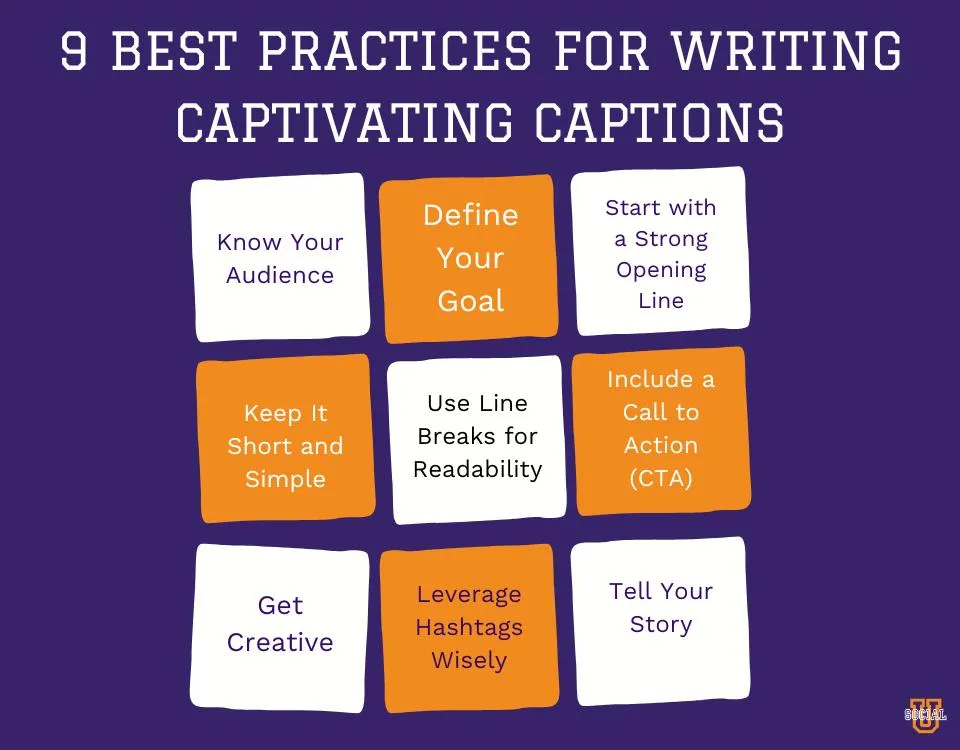
A useful caption does not need every possible element. Most effective captions focus on one clear message and add only the details that help communicate it.
Depending on the post, you might include:
- Hook: An opening line that gives people a reason to keep reading.
- Context: Details that explain the photo, video, or announcement.
- Value: A tip, story, observation, benefit, or emotional connection.
- Call to action: A relevant invitation to comment, save, share, visit, or learn more.
- Hashtags and mentions: Optional labels and account references where appropriate.
- Emojis: Optional visual cues that match the tone.
15 captions demonstrating different writing elements
- Hook: Nobody tells you how satisfying the small wins can feel.
- Context: A rainy afternoon, a warm drink, and nowhere else to be.
- Value: Three minutes of planning can make tomorrow feel much lighter.
- Question: What is one thing that instantly improves your mood?
- Save prompt: Keep this idea handy for your next creative project.
- Story: This started as a rough sketch and became our favorite design.
- Benefit: Made for busy mornings when you still want something special.
- Announcement: The wait is over—our latest project is finally here.
- Invitation: Join us as we turn this idea into something real.
- Community: We built this with your feedback in mind.
- Emotion: Some memories become part of you before you realize it.
- Humor: The plan was simple. The execution had other ideas.
- Recommendation: Send this to the friend who would appreciate it.
- Brand voice: Thoughtful details, useful design, and no unnecessary fuss.
- Clear action: Explore the collection through the link on our profile.
4. What Are the Different Types of Social Captions?
Social captions can be grouped by tone, length, purpose, and audience. Understanding these styles helps you choose words that match your content instead of using the same format for every post.
15 social caption styles to try
- Minimalist: Just this moment.
- Funny: Evidence that adulthood did not come with instructions.
- Cute: A little sunshine with a heartbeat.
- Romantic: Somehow, the ordinary feels special with you.
- Attitude: I know my direction, even when the road changes.
- Aesthetic: Soft light, slow mornings, quiet thoughts.
- Deep: Becoming yourself sometimes means outgrowing old versions.
- Emotional: Some goodbyes leave lessons where words used to be.
- Inspirational: Keep showing up for the future you imagine.
- Storytelling: It began with a plan, changed halfway through, and turned out better.
- Educational: The simplest solution is sometimes the one we overlook.
- Promotional: Thoughtfully made, ready for your everyday routine.
- Conversational: Be honest—which option would you pick?
- Celebratory: A new chapter deserves a little celebration.
- Reflective: Not every meaningful moment needs an audience.
5. What Are Some Examples of Social Captions?
The right example depends on what the post shows and what you want readers to feel or understand. A travel photograph may need a sense of discovery, while a friendship photo might call for warmth or humor.
The examples below are designed to be adapted. Change the wording to reflect the real people, place, event, or experience in your post.
15 versatile social caption examples
- A moment I would happily experience twice.
- Proof that the unplanned days can be the best ones.
- Collecting memories, not just photographs.
- A little reminder of what makes life beautiful.
- Today gave me a reason to smile.
- Here’s to doing more of what makes us feel alive.
- Not a perfect day, just a good one.
- This moment deserves a place in the memory box.
- Some days speak for themselves.
- A fresh perspective can change everything.
- Keeping the moments that feel like me.
- A small highlight from a very full day.
- The kind of day that makes you appreciate the present.
- More of this energy, please.
- If this is the beginning, I’m curious about what comes next.
6. How Do You Write an Effective Social Media Caption?
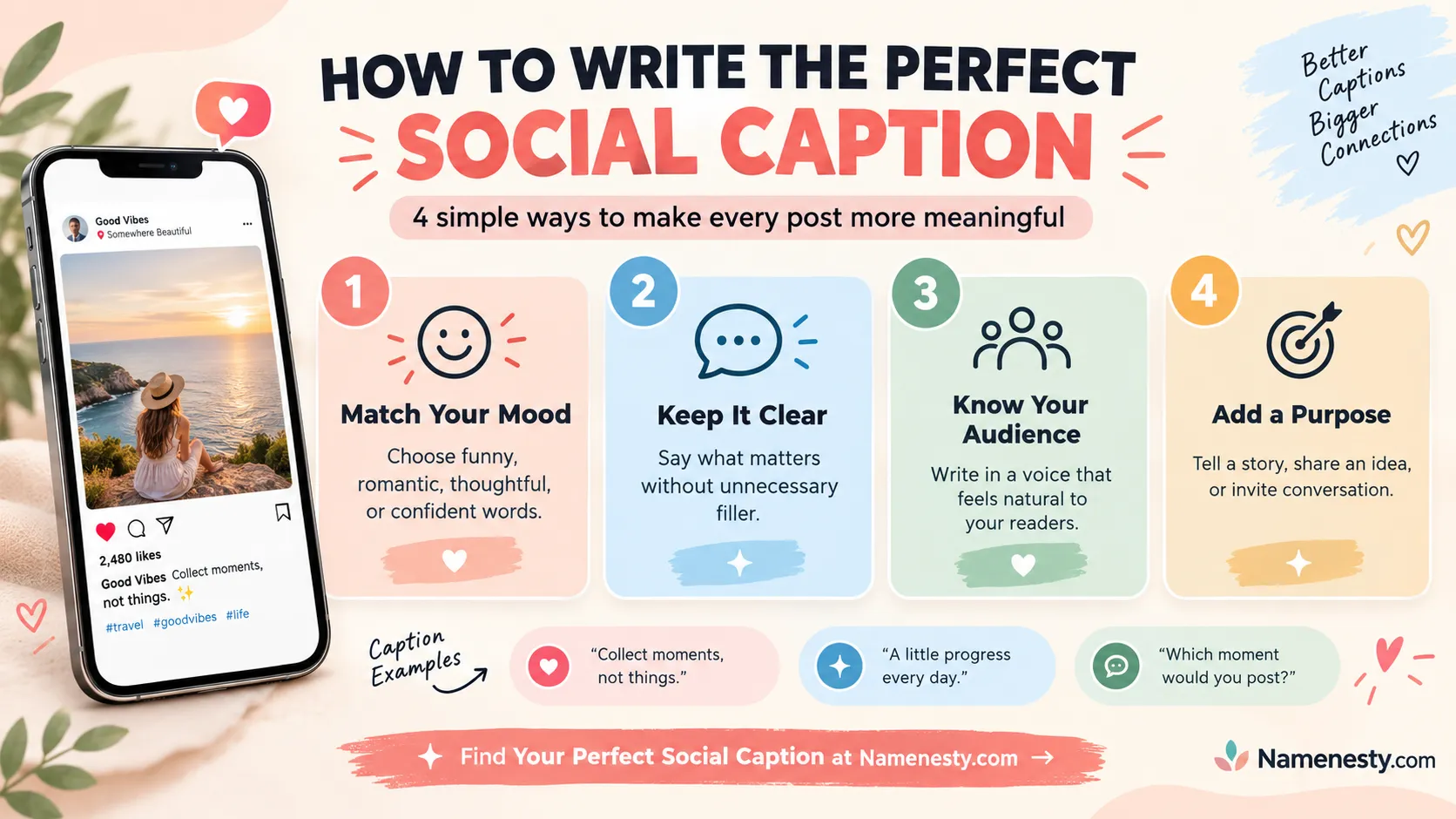
Writing a strong caption starts with knowing what the post is supposed to communicate. You do not need complicated language or a clever phrase every time. You need a message that feels relevant to the people who will read it.
Use this simple formula:
Hook + context or value + optional call to action
For example:
“Trying to make your mornings less stressful? Prepare one small thing the night before. What is your favorite morning shortcut?”
The opening identifies a relatable problem, the middle provides a useful idea, and the final question invites a response.
15 captions based on practical writing techniques
- Start with a question: What would your ideal weekend look like?
- Open with a lesson: The biggest improvement came from simplifying the process.
- Use a relatable observation: Somehow, the smallest errands take the whole afternoon.
- Tell a mini-story: We changed the original plan and found something better.
- Share a tip: Put the most important task where you can see it.
- Use contrast: Less planning for perfection, more room for discovery.
- Make a clear announcement: The new guide is ready to explore.
- Explain the benefit: Designed to make your everyday routine feel easier.
- Invite participation: Pick your favorite: the classic look or the bold one?
- Add context: This photo was taken just after the rain stopped.
- Share a personal insight: I learned that consistency matters more than a perfect day.
- Offer reassurance: You can start again without starting from zero.
- Make the action specific: Save this checklist for your next planning session.
- Keep it concise: One goal. One step. Start today.
- End with curiosity: The final result surprised even us.
7. What Makes a Social Caption Interesting and Engaging?
An engaging caption gives people something worth noticing, feeling, thinking about, or responding to. It may create curiosity, offer a practical benefit, express a recognizable emotion, or ask a question that people genuinely want to answer.
There is no caption formula that guarantees virality. Performance depends on the content, audience, platform, timing, and many other factors. Instead of chasing every trend, focus on making the message relevant and easy to understand.
15 engaging social caption examples
- The plot twist was realizing I needed a slower pace.
- One small decision changed the direction of the whole day.
- Tell me your favorite part without telling me your favorite part.
- This is your reminder to enjoy the progress you usually overlook.
- What would you add to this list?
- The behind-the-scenes version is always more interesting.
- A good idea becomes better when you make it your own.
- The detail you almost missed is my favorite part.
- Choose one: more adventure or more peaceful mornings?
- Sometimes the answer is to try a different approach.
- This looked simple until we tried it ourselves.
- Tag the person who would turn this into a whole adventure.
- An honest review: the experience was different from what I expected.
- Save the inspiration; make the result your own.
- What is your take? I would love to hear a different perspective.
8. What Is the Difference Between a Social Caption and a Video Caption?
The word caption can describe two different things.
A social caption is the written message accompanying a post. A video caption is on-screen text that represents spoken dialogue and, where relevant, meaningful sounds. Video captions help viewers follow audio content, including when they cannot hear it clearly.
For example, “A day behind the scenes at our studio” is a social caption. The words displayed on a video to represent someone saying “Welcome to our studio” are video captions.
These two forms of text can be used together.
15 examples that distinguish post captions from video captions
The first sentence in each example is suitable as social post copy; the second illustrates dialogue that could appear as video captions.
- Social: A quick look at our creative process. Video: “First, we prepare the materials.”
- Social: Come along for a morning walk. Video: “The park is especially quiet today.”
- Social: Here is how we organize our workspace. Video: “I keep the tools I use most within reach.”
- Social: Three ideas for a simpler routine. Video: “The first step is to write everything down.”
- Social: Our latest recipe experiment. Video: “Now add the flour and stir gently.”
- Social: A glimpse of the event setup. Video: “The guests will arrive in about an hour.”
- Social: Small details make a big difference. Video: “Notice how the light changes the color.”
- Social: Behind the scenes of a new project. Video: “We are testing the second version.”
- Social: A useful tip for new creators. Video: “Start by choosing one clear topic.”
- Social: Come see the finished room. Video: “We moved the desk closer to the window.”
- Social: A little travel diary from today. Video: “Our train leaves in ten minutes.”
- Social: How we pack an order with care. Video: “This final layer protects the product.”
- Social: A conversation worth sharing. Video: “The most important lesson was to listen.”
- Social: Learning something new, one step at a time. Video: “Let me show you the first movement.”
- Social: The final result is ready. Video: “Here is the finished design.”
9. What Is the Difference Between a Caption, Hashtag, and Alt Text?
A caption, hashtag, and alt text have different jobs. The caption communicates the message, a hashtag labels a topic or theme, and alt text describes visual content for people using assistive technology.
For example:
- Caption: “Our garden is finally full of spring flowers.”
- Hashtag: #SpringGarden
- Alt text: “Pink tulips and yellow daffodils growing in a garden beside a stone path.”
Use each element for its intended purpose. Alt text should describe the image accurately rather than become a second promotional caption. Hashtags should be relevant rather than added simply to fill space.
15 examples of captions, hashtags, and visual descriptions
Each caption below is paired with a possible relevant hashtag and descriptive alt text.
- Caption: A quiet morning in the garden. Hashtag: #GardenMorning. Alt text: A wooden chair beside green plants in morning sunlight.
- Caption: Our newest handmade ceramic pieces are ready. Hashtag: #HandmadeCeramics. Alt text: Three glazed ceramic cups arranged on a wooden table.
- Caption: Weekend adventures start here. Hashtag: #WeekendAdventure. Alt text: A backpack and walking shoes beside a forest trail.
- Caption: A little color for your everyday routine. Hashtag: #ColorfulStyle. Alt text: A blue scarf folded beside a mustard-yellow bag.
- Caption: Freshly baked and ready to share. Hashtag: #HomeBaking. Alt text: A loaf of bread cooling on a wire rack.
10. How Do Social Captions Work on Instagram and TikTok?
Instagram and TikTok both use captions to accompany content, but the best writing approach depends on the post format and the creator’s goal.
On Instagram, captions can add context to photos, carousels, and Reels. A personal story, a useful takeaway, or a question can complement the visual. On TikTok, a concise, relevant caption can frame a video, establish context, or support the creator’s message.
Do not assume shorter is always better or that a longer caption automatically creates more engagement. Test different approaches with your audience.
15 Instagram and TikTok caption examples
- A little photo diary from a day I want to remember.
- The story behind this moment is better than the picture.
- Three details that made this project come together.
- POV: You finally make time for the thing you love.
- Wait until you see how this turned out.
- The before-and-after still makes me smile.
- Things I wish I knew when I started creating.
- One small change, a noticeably different result.
- Behind the scenes, where the real story happens.
- A trend is more fun when you give it your own twist.
- Trying something new, even if the first attempt is awkward.
- Which version would you choose for your feed?
- A quick tutorial you can revisit whenever you need it.
- The little detail that changed the whole look.
- Follow the process, not just the final result.

11. How Should You Write Captions for Facebook, Snapchat, Pinterest, and Threads?
Different platforms support different styles of communication. Facebook may suit community conversations and updates. Snapchat often favors casual, immediate moments. Pinterest descriptions benefit from clear language that helps people understand an idea or find relevant inspiration. Threads often suits conversational observations and open-ended discussions.
Adapt the wording to the platform rather than copying the same caption everywhere without considering the audience.
15 captions for different social platforms
- Facebook: What is one local place you think everyone should visit?
- Facebook: We are celebrating a small milestone and thanking everyone who helped us reach it.
- Facebook: Which tip from this list would you try first?
- Snapchat: The unfiltered version of today.
- Snapchat: A little update before the day gets busy.
- Snapchat: This moment deserved a quick snap.
- Pinterest: Simple bedroom ideas for a calmer, more organized space.
- Pinterest: Save these color combinations for your next creative project.
- Pinterest: A practical checklist for planning a weekend getaway.
- Threads: What is a small habit that made a surprisingly big difference in your life?
- Threads: I think we underestimate how much a thoughtful message can mean.
- Threads: What is something you enjoy that never gets old?
- Cross-platform: New project, fresh perspective, and plenty to learn.
- Cross-platform: A little inspiration for whatever you are working on today.
- Cross-platform: Sharing the process because the journey matters, too.
12. Should You Use Short or Long Social Media Captions?
Short captions are useful when the visual communicates most of the message or when a quick, memorable line fits the tone. Long captions are useful when readers need a story, explanation, tutorial, reflection, or additional context.
Neither format is universally best. The right length is the length needed to communicate the message clearly.
| Caption format | Best suited to | Example |
| One-line | Simple photos and quick updates | A moment worth keeping. |
| Short | Selfies, casual posts, visual content | Good light, good company, no rush. |
| Medium | Tips, questions, announcements | Three things that helped me make this project easier. |
| Long-form | Stories, tutorials, thoughtful reflections | I started this project with a simple idea, but the process taught me much more than I expected. |
| Action-focused | Product launches and relevant promotions | Explore the new collection and find your favorite design. |
15 short and long caption examples
- A little more present.
- Today, at my own pace.
- Good things take practice.
- A frame full of sunshine.
- Keeping this memory close.
- The best part was the journey.
- I used to think progress had to look impressive. Now I know it can look like showing up on a difficult day and doing one small thing anyway.
- This project started with a question: could we make something simpler? After several drafts, we found a solution that feels more useful and more natural.
- I took this photo because the light was beautiful, but I kept it because of how peaceful that moment felt.
- One of the most helpful lessons I have learned is to ask for feedback before assuming something needs a complete redesign.
- Some seasons are about moving forward; others are about understanding where you are. Both can be valuable.
- We tried a different approach, learned from the first version, and adjusted the details until the result felt right.
- The goal was never perfection. It was to create something useful, thoughtful, and worth sharing.
- I am learning to celebrate the little milestones instead of waiting for one big moment to feel proud.
- Behind every finished project are questions, revisions, small victories, and people who make the work worthwhile.
13. How Do You Choose the Best Caption for Your Post?
Choose a caption by matching its purpose to the content and the audience. Before publishing, ask yourself three questions:
- What should someone understand or feel after seeing this post?
- What tone suits the moment: funny, warm, professional, thoughtful, or informative?
- What, if anything, should the reader do next?
A useful caption-selection framework is to choose the content type, then the emotional tone, then the desired action. A travel photo might call for curiosity; a business tutorial might need clarity; a personal achievement might need gratitude.
15 captions matched to different post situations
- Selfie: Feeling comfortable in my own little world.
- Couple photo: My favorite part of the day is sharing it with you.
- Friends: Different personalities, one unforgettable story.
- Travel: Took the scenic route and found a new favorite view.
- Beach: Salt in the air, nowhere to hurry.
- Achievement: A quiet goal became a moment worth celebrating.
- Business launch: Built with care, ready to meet its first customers.
- Educational carousel: Swipe through for the steps, then save the checklist.
- Product photo: Designed for the little things you use every day.
- Motivational post: Keep your promises to yourself, one step at a time.
- Family moment: The kind of ordinary day I hope to remember forever.
- Creative project: An idea became clearer with every draft.
- Fitness update: Showing up is part of the progress.
- Personal reflection: I am learning to choose what brings clarity, not just what looks impressive.
- Community post: What would make this guide more useful for you?
14. What Social Caption Mistakes Should You Avoid?
A caption can lose clarity when it tries to do too much. Common mistakes include vague openings, excessive hashtags, irrelevant emojis, forced slang, repetitive wording, and calls to action that do not fit the content.
Avoid promising viral results. A caption can improve communication, but no wording guarantees reach or engagement. Review your post as a whole: the visual, caption, audience, and purpose should work together.
15 caption rewrites that improve clarity
- Instead of: “Amazing day!!!” Try: A sunny afternoon and a much-needed change of pace.
- Instead of: “Buy now!!!” Try: Explore the new collection and see which design fits your style.
- Instead of: “Thoughts?” Try: Which of these two approaches would work better for your routine?
- Instead of: “Best thing ever.” Try: The small detail that made this experience memorable was the thoughtful service.
- Instead of: “New post, go look.” Try: I shared three practical ideas for planning your next project.
- Instead of: “Use all the hashtags.” Try: Choose a few relevant tags that accurately describe the post.
- Instead of: “This will change your life.” Try: This simple idea may help make your routine easier.
- Instead of: “Everyone needs this.” Try: If you are looking for a simpler option, this may be worth exploring.
- Instead of: “No words.” Try: Some moments are hard to explain, but easy to remember.
- Instead of: “Perfect in every way.” Try: Thoughtful details and a design that suits everyday use.
- Instead of: “Follow for more!!!” Try: Follow along if you enjoy practical tips and behind-the-scenes updates.
- Instead of: “We are the best.” Try: Here is what we focus on and how we approach each project.
- Instead of: “You won’t believe this.” Try: The unexpected lesson we learned while working on this project.
- Instead of: “Going viral soon.” Try: Sharing this idea in case it helps someone else.
- Instead of: “Like, comment, share, save, follow, and click.” Try: Save this checklist for the next time you need it.
15. People Also Ask About Social Captions
A social caption is the text written with a social media post. It gives context, shares a message, expresses personality, or invites people to interact.
For a sunset photo, you might write, “Some views make you forget to check the time.” For a business update, you could write, “Our latest collection is now available to explore.”
A caption helps people understand the post, adds meaning or personality, and can guide them toward an action such as commenting, saving, visiting a website, or learning more.
There is no single ideal length. Use a short caption for a straightforward visual and a longer one when you need to explain a story, share a lesson, or provide useful details.
A caption is the written message accompanying the post. A hashtag is a label beginning with the # symbol that associates content with a topic or theme.
No. A social caption is the post’s written copy. Video captions display spoken dialogue and, when appropriate, meaningful sounds as text on the video.
You can reuse the main idea, but adapting the opening, wording, and call to action for each platform may make the message more relevant to its audience.
Conclusion: Choose a Social Caption That Gives Your Post Meaning
A social caption is more than a line of text under a photo or video. It helps explain the content, express personality, communicate useful information, and create a connection with the audience.
The best caption is not necessarily the funniest, longest, or trendiest. It is the one that suits the post, sounds authentic, and helps the audience understand why the content matters.
Before publishing, remember these key takeaways:
- Match the message to the moment. Let the content and purpose guide your wording.
- Keep the language natural. Write the way your audience can comfortably understand.
- Choose length intentionally. Use only as many words as the message needs.
- Adapt to the platform. Rework the caption to fit the audience and format.
- Make the next step clear. Add a call to action only when it makes sense.
- Learn from your results. Review meaningful interactions and refine your approach.
Bookmark this guide for your next post, and explore more caption ideas on Namenesty.com to find wording that fits your style, audience, and message.











3 thoughts on “Social Captions Explained: Meaning, Types & Examples”