Introduction: The Art of the Apodo — Why Spanish Nicknames Hit Different
Imagine someone calling you Cielo (‘sky’) instead of your name, or your best friend earning the nickname Cotorra (‘parrot’) because they never stop talking. That is the world of Spanish Nicknames — called apodos (ah-POH-dohs) — where language becomes an act of love, humor, and cultural identity all at once.
Spanish is spoken across 21 countries, and every region has its own vibrant ecosystem of apodos. A name that signals deep affection in Argentina might raise eyebrows in Spain. A term of endearment in Cuba might be pure comedy in Mexico. That richness — layered with history, dialects, and personality — is exactly why this guide exists.
Whether you are learning Spanish, looking for a perfect nickname for your partner or child, or hunting for a username that sounds powerful and unique, this is the most complete, researched, and useful Spanish nickname guide you will find. 500+ apodos, full pronunciations, cultural context, and usage rules. Let’s go.
1. Cute Spanish Nicknames That’ll Make Anyone Smile (Apodos Adorables)
Cute apodos in Spanish lean hard on diminutive suffixes (-ito/-ita) and sweet imagery from nature, food, and celestial bodies. They work for babies, toddlers, children, and romantic partners — basically anyone you want to make feel wrapped in warmth.
| Nickname | Pronunciation | Meaning | Best For |
| Cielito | syeh-LEE-toh | Little sky / little heaven | Partners, babies |
| Pichoncito/a | pee-chohn-SEE-toh | Little pigeon (affectionate) | Partners, babies |
| Bomboncito/a | bohm-bohn-SEE-toh | Little sweet candy | Children, romantic partners |
| Bichito | bee-CHEE-toh | Little bug — tiny and adorable | Babies, toddlers |
| Terroncito | teh-rohn-SEE-toh | Tiny sugar lump | Extra-sweet babies |
| Pimpollo | peem-POH-yoh | Rosebud / little sprout (Spain) | Sweet young children |
| Muñeco/a | moo-NYEH-koh | Little doll/puppet | Pretty babies |
| Caballito | kah-bah-YEE-toh | Little horse | Energetic, bouncy toddlers |
| Lucecita | loo-seh-SEE-tah | Little light | Partners who brighten your day |
| Almita | ahl-MEE-tah | Little soul | Deeply romantic — a rare gem |
| Nene/Nena | NEH-neh / NEH-nah | Baby / little one | Babies and partners |
| Canelita | kah-neh-LEE-tah | Little cinnamon | Warm, sweet-natured people |
| Suspiro | soos-PEE-roh | Sigh — takes your breath away | Poetic romantic partners |
| Beso | BEH-soh | Kiss | Simply and unexpectedly sweet |
| Rinconcito | reen-kohn-SEE-toh | My little safe place | Intimate romantic partners |
💡 Naming Tip: In Venezuelan Spanish, double diminutives are common — chiquito becomes chiquitico, which becomes chiquitiquisimo. The more diminutive the stacking, the warmer and more affectionate the intent.
2. Funny Spanish Nicknames That Hit Like a Telenovela Plot Twist (Apodos Graciosos)
Spanish humor in nicknames is beautifully direct — physical traits, habits, and quirks are fair game between close friends. The more outrageous the apodo, the deeper the friendship it signals. These are not insults; they are badges of closeness.
| Nickname | Pronunciation | The Joke Behind It | Usage |
| Cabezón/a | kah-beh-SOHN | Big-headed — literally or personality-wise | Universal best friend |
| Cotorra | koh-TOH-rah | Parrot — talks non-stop, never shuts up | The chatty one |
| Dormilón/a | dohr-mee-LOHN | Sleepyhead — always napping | Your laziest friend |
| Patas de Palo | PAH-tahs deh PAH-loh | Wooden legs — terrible dancer | Dance floor disaster |
| Lengua Larga | LEHN-gwah LAHR-gah | Long tongue — cannot keep a secret | The gossip of the group |
| El Catástrofe | kah-TAHS-troh-feh | The Catastrophe — accident-prone | Spain / Argentina |
| Tragoncito/a | trah-gohn-SEE-toh | Little glutton — always eating | Food-obsessed friend |
| Chismoso/a | chees-MOH-soh | Gossip/rumor spreader | Universal |
| Cuatro Ojos | KWAH-troh OH-hohs | Four eyes — wears glasses | Affectionate nerd nickname |
| Soplón/a | soh-PLOHN | Snitch / tattletale | The one who tells Mom everything |
| Pelón/Pelona | peh-LOHN | Baldie — said with love | Mexico, Central America |
| Narizón/a | nah-ree-SOHN | Big nose — worn as a badge | Close friends only |
| Trompudo/a | trohm-POO-doh | Big-lipped / always pouting | Caribbean friends |
| Ciruelo | see-RWEH-loh | Plum tree — silly, clueless person (Spain) | Gently mocking friends |
| Cuñao | koo-NYAH-oh | The know-it-all brother-in-law (Spain viral) | That one friend who’s always right |
⚠️ Cultural Note: Physical nicknames like Gordo, Pelón, and Flaco signal deep affection within established friendships. Using them with strangers or new acquaintances can feel rude — read the relationship first.
3. Romantic Spanish Nicknames That Sound Like a Love Song (Apodos Románticos)
Romance is structurally embedded in Spanish. Metaphors for the cosmos, precious metals, and natural wonders are standard vocabulary for lovers. These are not clichés — they are cultural expressions of profound emotional investment.
| Nickname | Pronunciation | Meaning | Romantic Intensity |
| Mi Vida | mee BEE-dah | My life — you are my everything | ★★★★★ |
| Mi Alma | mee AHL-mah | My soul — deepest level of love | ★★★★★ |
| Mi Cielo | mee SYEH-loh | My sky / my heaven | ★★★★★ |
| Amor de mi vida | ah-MOHR deh mee BEE-dah | Love of my life | ★★★★★ |
| Media Naranja | MEH-dyah nah-RAHN-hah | My other half (lit. half orange) | ★★★★☆ |
| Luciérnaga | loo-SYEHR-nah-gah | Firefly — shines in your darkness | ★★★★★ (rare & poetic) |
| Alborada | ahl-boh-RAH-dah | Dawn — you are my new beginning | ★★★★★ (rare & poetic) |
| Espejito | es-peh-HEE-toh | Little mirror — reflects my best self | ★★★★☆ |
| Zarcillo | sahr-SEE-yoh | Grapevine tendril — wraps around my heart | ★★★★★ (rare) |
| Manantial | mah-nahn-TYAHL | Spring/water source — you sustain me | ★★★★★ (rare & poetic) |
| Centella | sehn-TEH-yah | Lightning spark — electric and passionate | ★★★★☆ |
| Tesoro | teh-SOH-roh | Treasure — you are precious to me | ★★★☆☆ |
| Corazoncito | koh-rah-sohn-SEE-toh | Tiny heart — more intimate than Corazón | ★★★★☆ |
| Mi pedacito | mee peh-dah-SEE-toh | My little piece of everything | ★★★★★ |
| Encanto | ehn-KAHN-toh | Enchantment / pure charm | ★★★★☆ |
💡 Why These Work: The most romantic Spanish nicknames are always metaphors — not descriptions. Calling someone your ‘firefly’ or ‘spring water source’ communicates emotion that no adjective can. That is the linguistic genius of Spanish romance.
4. Unique Spanish Nicknames for Boys That Pack Personality (Apodos para Chicos)
Male apodos in Spanish tend toward power, nature, and street credibility. They come from physical traits, sports achievement, animal symbolism, and personality quirks. Many are deeply regional — what sounds tough in one country sounds funny in another.
| Nickname | Pronunciation | Meaning | Vibe |
| Lobo | LOH-boh | Wolf — lone and instinct-driven | Strong / Mysterious |
| Tiburón | tee-boo-ROHN | Shark — fierce competitor | Sports / Intense |
| Halcón | ahl-KOHN | Falcon — precision and sharp vision | Athletic / Cool |
| Trueno | TRWEH-noh | Thunder — booming dominant presence | Powerful |
| El Mago | ehl MAH-goh | The Wizard — creatively brilliant | Clever / Artistic |
| Rayo | RAH-yoh | Lightning bolt — fastest in the group | Sports / Energetic |
| Pulga | POOL-gah | Flea — tiny but devastatingly quick | Soccerstar’s nickname |
| Torbellino | tohr-beh-YEE-noh | Whirlwind — impossible to keep up with | Chaotic energy |
| El Bicho | ehl BEE-choh | The Bug — unpredictable wildcard (Spain) | Spain / Soccer |
| Machete | mah-CHEH-teh | Hard-working go-getter (Caribbean) | Hustler |
| Gavilán | gah-bee-LAHN | Sparrowhawk — stealthy and quick | Athletic |
| Campeón | kahm-peh-OHN | Champion — winner’s mentality | Achievement |
| Fuego | FWEH-goh | Fire — passionate and intense | Personality |
| El Profe | ehl PROH-feh | The Professor — the smartest one | Intellectual |
| Zorro | SOH-rroh | Fox — cunning, clever, always ahead | Strategy / Cool |
5. Unique Spanish Nicknames for Girls Full of Beauty & Fire (Apodos para Chicas)
Female apodos in Spanish are a masterclass in poetic imagery. Flowers, birds, celestial objects, and precious gems dominate — but the best ones carry double meanings that make them feel personal and poetic rather than generic or predictable.
| Nickname | Pronunciation | Meaning | Personality Fit |
| Mariposa | mah-ree-POH-sah | Butterfly — free-spirited & beautiful | Independent dreamer |
| Lucero | loo-SEH-roh | Morning star / brightest light | The one who shines |
| Luciérnaga | loo-SYEHR-nah-gah | Firefly — magical in the dark | Quietly extraordinary |
| Gaviota | gah-BYOH-tah | Seagull — free and wandering soul | Adventurous spirit |
| Golondrina | goh-lohn-DREE-nah | Swallow bird — graceful flier | Elegant & graceful |
| Canela | kah-NEH-lah | Cinnamon — warm and aromatic | Warm-natured people |
| Amapola | ah-mah-POH-lah | Poppy flower — vibrant and bold | Colorful personality |
| Chispa | CHEES-pah | Spark — witty, sharp, electric | Sharp-tongued brilliance |
| Brujita | broo-HEE-tah | Little witch — charmingly mischievous | Playful troublemaker |
| Colibrí | koh-lee-BREE | Hummingbird — tiny but mighty force | Energetic achievers |
| Alondra | ah-LOHN-drah | Lark — a cheerful natural songbird | Music lovers |
| Lunática | loo-NAH-tee-kah | Moon-girl — dreamy, bold, cosmic | Artistic souls |
| Perla | PEHR-lah | Pearl — rare, precious, found in depth | Hidden gem personalities |
| Maravilla | mah-rah-BEE-yah | Wonder/marvel — astonishing presence | Genuinely impressive people |
| Nubecita | noo-beh-SEE-tah | Little cloud — soft and dreamy | Soft-spoken dreamers |
6. Spanish Nicknames for Friends That Only Real Ones Understand (Apodos para Amigos)
Friendship apodos are the most creative and culturally specific. They embrace teasing, inside jokes, and shared history. The more ridiculous and irreverent the apodo, the deeper the bond it represents.
| Nickname | Country/Region | What It Really Means | Usage Vibe |
| Tronco | Spain | Trunk / old buddy | Said to close male friends only |
| Cuate | Mexico | Twin / best friend (from Nahuatl ‘coatl’) | The deepest friendship term |
| Pana | Venezuela/Colombia | Like ‘bro’ — Gen Z slang | Casual, warm, millennial/Gen Z |
| Causa | Peru | Buddy/ally — your ’cause’ | Male friendship, informal |
| Parcero/a | Colombia | Partner / close friend | The defining Colombian friend term |
| Llave | Colombia (Bogotá) | Key — ‘you unlock my world’ | Bogotá urban slang |
| Asere | Cuba | Buddy — Cuba’s most iconic term | Uniquely Cuban |
| Acho/Chacho | Puerto Rico/Dom. Rep. | Short for ‘muchacho’ — dude | Caribbean universal |
| Yunta | Argentina | Inseparable pair/yoke | For two friends always together |
| Bicho | Puerto Rico/Spain | Bug/creature — affectionate | Teasing but loving |
| Mano/a | Caribbean | Short for hermano/a — sibling-like | Super casual Caribbean |
| Socio/a | Universal | Business partner / buddy | Slightly formal friendship |
| Compa | Mexico/Central Am. | Short for compañero — companion | Casual and warm |
| Elemento | Spain | Element / wild unpredictable card | The chaotic friend |
| Pata | Peru/Ecuador | Foot / close friend (unusual etymology) | Uniquely Andean |
💡 Quick Test: If you can use the nickname in front of other people and everyone laughs WITH the person — it’s a real apodo. If everyone goes quiet, you misjudged the relationship. Context is everything.
7. Spanish Family Nicknames That Go Way Beyond Mamá & Papá (Apodos Familiares)
Family is the gravitational center of Hispanic culture, and nicknames reflect that intensity. These go far deeper than the standard terms — they carry generational warmth, regional identity, and a humor that only exists between people who have shared a lifetime.
| Family Member | Nickname | Pronunciation | Meaning & Cultural Note |
| Mom | Jefecita | heh-feh-SEE-tah | Little boss — Mexico; playfully respectful authority |
| Mom | Viejita | byeh-HEE-tah | Little old one — deeply affectionate, not insulting |
| Dad | El Jefe | ehl HEH-feh | The Boss — humorous acknowledgment of authority |
| Dad | Viejo | BYEH-hoh | Old man — used lovingly by children and partners |
| Grandma | Yaya | YAH-yah | Spain, Caribbean — very warm and intimate |
| Grandma | Nana | NAH-nah | Mexico, Argentina — widely used |
| Grandpa | Tata | TAH-tah | Andean countries (Peru, Bolivia, Ecuador) — beloved |
| Grandpa | Güelo | GWEH-loh | Colloquial shortening of Abuelo (Mexico) |
| Sibling | Manito/a | mah-NEE-toh | Little brother/sister — implies deep closeness |
| Sibling | Carnal/a | kahr-NAHL | Blood — Mexico; ‘as close as flesh and blood’ |
| Baby sibling | Escuintle | ehs-KWEEN-tleh | Little rascal — from Nahuatl ‘itzcuintli’; Mexico |
| Cousin | Primito/a | pree-MEE-toh | Little cousin — affectionate diminutive |
| Uncle | Tío buena onda | TYOH BWEH-nah OHN-dah | Good-vibes uncle — the cool one |
| Partner (any) | Mi media naranja | mee MEH-dyah nah-RAHN-hah | My other half — soulmate expression |
| Child (any) | Pimpollo | peem-POH-yoh | Rosebud / little sprout (Spain) — adored child |
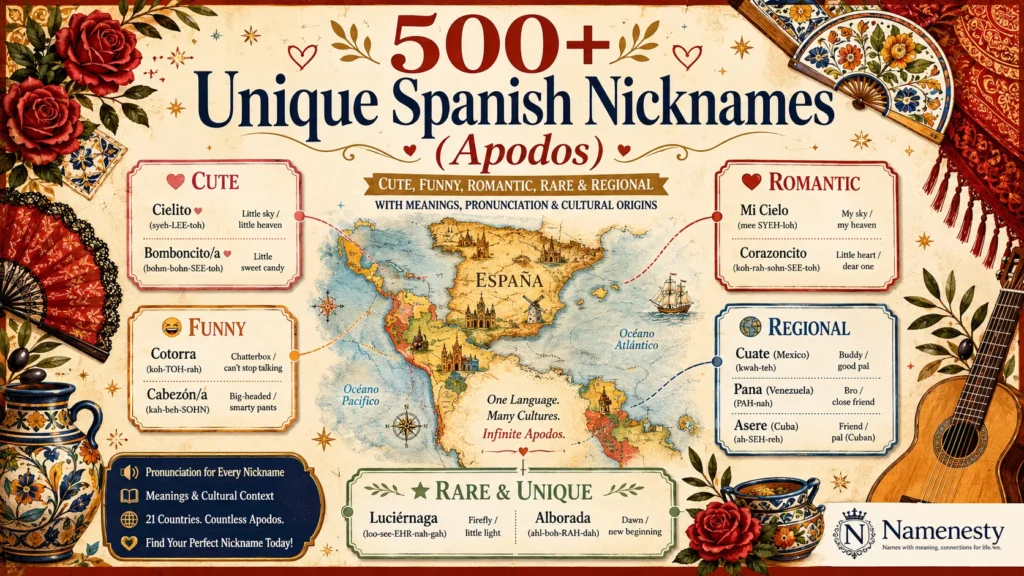
8. Nature-Inspired Spanish Nicknames That Sound Like Poetry (Apodos de la Naturaleza)
The natural world flows through Spanish like a river through a canyon — constant, shaping, and beautiful. These nature-based apodos are among the most poetic and memorable in the entire language, because they attach cosmic or organic meaning to a human being.
| Category | Nickname | Meaning | For Personality Type |
| Celestial | Estrellita | Little star — always shining | Naturally talented people |
| Celestial | Cometa | Comet — rare, fast, unforgettable | Free spirits who come and go |
| Celestial | Aurora | Dawn — represents hope and new beginnings | Optimistic, hopeful partners |
| Water | Manantial | Spring water source — sustains everything | Nurturing, dependable people |
| Water | Cascada | Waterfall — powerful and dramatic presence | Intense, passionate personalities |
| Water | Rocío | Morning dew — pure, fresh, quietly beautiful | Gentle, quiet souls |
| Water | Oleaje | Ocean waves — turbulent but mesmerizing | Passionate, emotional partners |
| Flowers | Amapola | Poppy — vibrant, bold, impossible to miss | Bold, colorful personalities |
| Flowers | Clavelito | Little carnation — sweet and classic | Traditional, loving people |
| Animals | Luciérnaga | Firefly — magical, shines in darkness | Creative, quietly extraordinary |
| Animals | Colibrí | Hummingbird — tiny but works non-stop | High-energy achievers |
| Animals | Golondrina | Swallow — graceful, always returning home | Loyal wanderers |
| Weather | Centella | Lightning spark — electric and quick | Witty, fast-thinking people |
| Weather | Brisa | Breeze — calming, always present, never harsh | Calming, steady partners |
| Weather | Tormenta | Storm — intense, dramatic, unforgettable | Intense, passionate souls |
9. Food-Inspired Spanish Nicknames That Are Deliciously Unique (Apodos Gastronómicos)
Food is not just fuel in Hispanic culture — it is love, identity, and memory. So naturally, some of the most affectionate Spanish nicknames are food-based. They are playful, warm, impossible not to smile at, and often deeply regional.
| Nickname | Food Reference | Meaning as Apodo | Country |
| Bombón | Chocolate bonbon | Sweet, irresistible, and a little indulgent | Universal |
| Canela | Cinnamon | Warm, aromatic, spicy personality | Universal |
| Azúcar | Sugar | Pure sweetness — iconic Cuban expression | Cuba / Caribbean |
| Terrón | Sugar lump | Extra sweet — used for very sweet people | Universal |
| Flan | Flan custard | Soft, sweet, jiggly — for adorably chubby babies | Mexico |
| Chicharrón | Fried pork rind | Lovably chubby and crispy-fun personality | Mexico |
| Churro | Churro | Sweet, warm, slightly twisted personality | Spain |
| Mazapán | Marzipan | Sweet and a little nutty — said with affection | Mexico |
| Palomita | Popcorn | Small, light, always popping up everywhere | Central America |
| Melón | Melon | Sweet and large-headed (affectionate) — Spanish humor | Spain |
| Frijolito | Little bean | Tiny, nourishing, essential — for babies | Mexico |
| Coco | Coconut | Hard exterior, totally sweet inside | Caribbean |
| Piña | Pineapple | Sweet but spiky — for complicated personalities | Caribbean |
| Empanada | Empanada | Stuffed full of surprises — complex person | Argentina |
| Tamal | Tamale | Tightly wrapped, takes time to unwrap — for shy people | Mexico |
10. Cool Spanish Nicknames for Gaming, Discord & Social Media (Apodos para Gamers)
Spanish nicknames make elite gaming usernames and social media handles for one powerful reason — they sound fierce, mysterious, or hilarious to English speakers while carrying real cultural depth for Spanish speakers. Double meaning = double memorability.
| Nickname | Meaning | Why It Wins as a Username | Style |
| ElLobo | The Wolf | Lone-warrior identity, universally recognized | Strong / Mysterious |
| LaVibora | The Viper | Snake energy — deadly, precise, silent | Villain / Tactical |
| CentellaNegra | Black Spark | Dark + electric = rare aesthetic combo | Dark / Electric |
| NieblaGris | Grey Mist | Mysterious support-player energy | Stealth / Mystery |
| TiburónAzul | Blue Shark | Aggressive with cool coloring — memorable | Intense / Cool |
| SombraReal | Royal Shadow | Shadow + royalty = elite identity | Prestige / Dark |
| CóndorNegro | Black Condor | Majestic rare bird — soaring over everyone | Epic / Rare |
| FuegoVerde | Green Fire | Unusual color combo — instantly memorable | Unique / Striking |
| RayoRojo | Red Lightning | Fast + fire energy — action-hero feel | Speed / Power |
| LoboSolitario | Lone Wolf | Classic solo-queue identity made Spanish | Solo / Intense |
| Remolino | Whirlwind | Chaotic fast playstyle encapsulated in one word | Chaotic / Fast |
| ElZorro | The Fox | Cunning strategy, legendary name, cultural depth | Strategy / Clever |
| Trueno_X | Thunder | Powerful, atmospheric, works in any game genre | Power / Universal |
| LaGuerra | The War | Intimidating — you ARE the conflict | Intense / Threatening |
| HalcónSilente | Silent Falcon | Precision + silence = sniper energy | Tactical / Prestige |
💡 Username Tip: Combine a Spanish animal name + a color or element for an instantly unique, cross-cultural handle. Examples: LoboCeniza (Ash Wolf), CobraNegra (Black Cobra), TigreDorado (Golden Tiger). These rarely exist in username databases because most people don’t think in Spanish.
11. Spanish Nicknames by Country: The Hyper-Local Apodos Competitors Miss
This is where most online lists collapse. They cover Spain and Mexico and stop. But the real treasure lives in the hyper-local, culturally embedded apodos that native speakers use daily but rarely appear in learner resources.
| Country / Region | Nickname | Meaning | Cultural Note |
| 🇲🇽 Mexico | Güero/a | Blondie / fair-skinned | Not offensive — common physical descriptor |
| 🇲🇽 Mexico | Cuate | Twin / best friend | From Nahuatl ‘coatl’ — deeply Mexican |
| 🇲🇽 Mexico | Escuintle | Little rascal / kid | From Nahuatl ‘itzcuintli’ (hairless dog) |
| 🇦🇷 Argentina | Boludo/a | Dude (lit. ‘big balls’) | Affectionate between close friends ONLY |
| 🇦🇷 Argentina | Che | Hey / you — the Argentine call | Ernesto ‘Che’ Guevara was named for this |
| 🇦🇷 Argentina | Pibe/Piba | Kid / young person | Lunfardo slang — Italian immigrant influence |
| 🇨🇴 Colombia | Parcero/a | Partner / close friend | The defining Colombian friendship term |
| 🇨🇴 Colombia | Llave | Key — ‘you unlock my world’ | Bogotá urban slang |
| 🇪🇸 Spain | Tío/Tía | Dude/girl (NOT uncle/aunt here) | Most common Spanish friend term |
| 🇪🇸 Spain | Chaval/Chavala | Kid / young person | Spain’s equivalent of ‘kiddo’ |
| 🇨🇺 Cuba | Asere | Buddy / friend | Cuba’s most iconic friend term |
| 🇨🇺 Cuba | Maquina | Machine — impressively skilled person | Highest form of Cuban praise |
| 🇵🇷 Puerto Rico | Acho/Chacho | Short for ‘muchacho’ — dude | Universal Caribbean |
| 🇨🇱 Chile | Huevón/a | Dude (like Boludo in Argentina) | Chile’s most common friend term |
| 🇨🇱 Chile | Cuchuflí | Rolled wafer — a quirky unique person | Uniquely Chilean — rarely seen elsewhere |
12. Rare Spanish Nicknames Almost No One Knows (Apodos Raros & Olvidados)
These are the apodos that separate this guide from every list you’ve seen before. Drawn from regional dialects, Lunfardo slang, indigenous language roots, literary tradition, and historical usage, these rare gems are authentic, distinctive, and rarely appear in learner resources.
| Nickname | Pronunciation | Origin | Full Story & Meaning |
| Macanudo | mah-kah-NOO-doh | Argentina/Uruguay | Great/excellent — from Italian ‘macchinoso’; the highest Río de la Plata compliment |
| Cuñao | koo-NYAH-oh | Spain (viral) | Brother-in-law — evolved into ‘the guy who always has an opinion about everything’ |
| Pachuco | pah-CHOO-koh | Mexico/Costa Rica | Flashy dresser / streetwise figure — from 1930s-40s Mexican-American subculture |
| Cacique | kah-SEE-keh | Latin America | Chief / boss — from the indigenous Taíno word, for the one who runs the group |
| Guagua | GWAH-gwah | Caribbean/Chile | Baby in Caribbean; bus in Chile — same word, wildly different meanings |
| Monigote | moh-nee-GOH-teh | Spain/Latin Am. | Rag doll / puppet — for someone easily manipulated or amusingly silly |
| Petardo | peh-TAHR-doh | Spain | Firecracker — exhausting, dramatic, high-maintenance person |
| Pajolero | pah-hoh-LEH-roh | Spain | Pesky / annoying one — mild insult used with unmistakable affection |
| Chiringo | chee-REEN-goh | Colombia | Small, chaotic, disorganized thing — for the friend whose life is always a mess |
| Lépero/a | LEH-peh-roh | Mexico | Vulgar / rough-edged — historical term for street people; now playfully affectionate |
| Chupamedias | choo-pah-MEH-dyahs | Argentina | Sock-sucker — the ultimate Argentine insult for a yes-man / suck-up |
| Tocho | TOH-choh | Spain | Thick-headed / brick — for a stocky or gloriously dense friend |
| Triquiñuela | tree-kee-NYEH-lah | Spain | Little schemer / trickster — cunning but lovable, always finding a workaround |
| Vaguito/a | bah-GEE-toh | Venezuela | Little drifter / wanderer — affectionate name for the laziest person you know |
| Porrón | poh-ROHN | Spain | Wine jug — for the most laid-back, unhurried, chilled-out friend in any group |
13. Spanish Nicknames for Babies & Kids That Parents Actually Use (Apodos Infantiles)
Baby nicknames in Spanish are a full genre unto themselves — layered with diminutive stacking, food imagery, and animal metaphors that describe perfectly the small, sweet, chaotic reality of a young child. These are the real names parents use at home.
| Nickname | Pronunciation | Meaning | For What Kind of Baby/Kid |
| Pimpollo | peem-POH-yoh | Rosebud / little sprout | Sweet, angelic babies (Spain) |
| Terroncito | teh-rohn-SEE-toh | Tiny sugar lump | The extra-sweet, affectionate baby |
| Chicharrón | chee-chah-ROHN | Fried pork rind | Chubby, round, deliciously cute babies |
| Escuintle | ehs-KWEEN-tleh | Little rascal (Nahuatl) | The mischievous, always-in-trouble one |
| Bichito | bee-CHEE-toh | Tiny little bug | Curious, crawling babies |
| Caballito | kah-bah-YEE-toh | Little horse | Bouncy, energetic toddlers |
| Muñeco/a | moo-NYEH-koh | Little doll | Unusually beautiful or angelic babies |
| Pulgarcito | pool-gahr-SEE-toh | Little Thumbelino | Very small babies — from the fairy tale |
| Renacuajo | reh-nah-KWAH-hoh | Tadpole | Tiny, wiggly, always-moving babies |
| Frijolito | free-hoh-LEE-toh | Little bean | Newborns — tiny, curled, precious |
| Monito/a | moh-NEE-toh | Little monkey | Climbers, explorers, bathroom-counter kids |
| Sapito | sah-PEE-toh | Little toad | Wide-eyed, funny-faced adorable babies |
| Palomita | pah-loh-MEE-tah | Littledove/popcorn | Gentle, sweet, light babies |
| Nene/Nena | NEH-neh / NEH-nah | Baby / little one | Universal — works at any baby age |
| Chirulí | chee-roo-LEE | Cute little thing (Venezuela) | Rare — uniquely Venezuelan endearment |
14. How to Create Your Own Spanish Nickname: The Diminutive System Explained
This is the section that makes this guide irreplaceable. Every other list gives you nicknames. This section teaches you how to CREATE unlimited original nicknames using the Spanish diminutive suffix system — a grammatical tool native speakers use instinctively.
| Suffix | Rule — When to Use | Base Word | Nickname Result | Meaning |
| -ito / -ita | Word ends in a vowel | Gato (cat) | Gatito | Little cat — affectionate |
| -ito / -ita | Most -o / -a endings | Amor (love) | Amorcito | Little love |
| -cito / -cita | Word ends in -e | Noche (night) | Nochecita | Little night — cozy |
| -cito / -cita | Word ends in -ón | Corazón (heart) | Corazoncito | Tiny heart |
| -escrito / -ecita | Monosyllabic words | Flor (flower) | Florecita | Little flower |
| -illo / -illa | Neutral/affectionate (Spain) | Beso (kiss) | Besillo | Little kiss |
| -zuelo / -zuela | Slightly ironic diminutive | Rey (king) | Reyezuelo | Petty little ruler |
| Double diminutive | Venezuela / Caribbean | Chiquito | Chiquitico | Even tinier — hypercute |
CREATION FORMULA: Take any Spanish word you love → apply the right suffix → you have an original apodo that no list anywhere will have, because YOU made it. Example: Luna + -ita = Lunita (little moon). Brisa + nothing needed (already short) = Brisa. Mariposa + -ita = impossible (too many syllables already), so just use Mariposa.
Country Variation: In Mexico, -ito is king. In Spain, -illo is common. In Venezuela and the Caribbean, double and triple diminutives are stacked for maximum affection. Knowing where your person is from lets you match the suffix to their cultural comfort.
15. Spanish Nickname Etiquette: Cultural Rules Every Non-Native Must Know
The most perfectly chosen apodo in the world can still land wrong if you misread the relationship or cultural context. These rules — drawn from real usage patterns across Spanish-speaking countries — will make sure you always get it right.
| Rule | What It Means in Practice | Real Example |
| Physical nicknames signal closeness, not cruelty | Gordo, Pelón, Flaco — these are signs of deep affection between established friends, not bullying | Calling your best friend ‘Gordito’ signals you are close enough to be that honest |
| Same nickname ≠ same meaning across borders | Guagua = baby in Cuba, but bus in Chile. Bicho = cute in Puerto Rico, vulgar in parts of Spain | Always ask what country a person is from before using regional slang |
| Diminutives increase affection, not condescension | -ito/-ita expresses warmth and smallness simultaneously — the more suffixes, the more love | Amorcito is warmer than Amor; Corazoncito is more intimate than Corazón |
| Wait for the person to use it first | Let native speakers apply physical or slang apodos to themselves before you adopt them | If a Colombian friend calls themselves Gordo, you can gently mirror it later |
| Gender matters (most of the time) | Most apodos have -o (male) and -a (female) forms — always match the person’s gender identity | Gordito (boy) / Gordita (girl) / Gordi (gender-neutral) |
| Strong regional slang requires earned trust | Boludo (Argentina), Huevón (Chile), Güey (Mexico) — these are only acceptable from established friends | Strangers using these terms will almost always offend |
| Tone carries more weight than the word itself | The same word can be a compliment or an insult based purely on tone of voice and context | Idiota said with a laugh between friends ≠ idiota said coldly to an acquaintance |
People Also Ask: Your Spanish Nickname Questions Answered
The primary Spanish word for nickname is apodo (Ah-POH-Doh), plural apodos. The alternative term sobrenombre (soh-breh-NOHM-breh) means ‘additional name.’ In some Southern Cone countries, alias is also used. The diminutive apodito is sometimes used affectionately.
Popular Spanish nicknames include Mi Amor, Cariño, Corazón, Nene/Nena, Cielo, Tesoro, Bombón, Gordo/a, and Flaco/a. These are widely used across Spanish-speaking countries.
Unique Spanish nicknames include Luciérnaga (firefly), Canelita (little cinnamon), Alborada (dawn), and Mariposa (butterfly). These are poetic, meaningful, and less common than traditional pet names.
Usually not among close friends or family. Nicknames like Gordo or Flaco are often used affectionately, but from strangers, they may sound rude depending on the situation and culture.
Funny Spanish nicknames include Cotorra (chatterbox), Dormilón/a (sleepyhead), Lengua Larga (can’t keep secrets), and El Catástrofe (accident-prone person). They are often playful and based on personality traits.
Spanish diminutives use endings like -ito/-ita or -cito/-cita to make nicknames sound more affectionate. For example, Sol becomes Solecito. Some regions use double diminutives, like chiquitico, for extra warmth.
Apodo is the everyday Spanish word for a nickname. Sobrenombre is more formal and refers to an additional name someone is commonly known by. In casual conversation, most people use apodo.
Yes! You can create a Spanish nickname by using a favorite word and adding a diminutive like -ito/-ita or -cito/-cita. For example, Luna becomes Lunita and Corazón becomes Corazoncito. This makes the nickname sound more personal and affectionate.
Quick Comparison: Spanish Nickname Styles at a Glance
| Style | Best Examples | Best For | Occasion |
| Cute / Sweet | Cielito, Terroncito, Almita | Partners, babies, children | Everyday affection |
| Funny / Teasing | Cotorra, Dormilón, Cuñao | Close friends with history | Casual/private settings |
| Romantic / Poetic | Luciérnaga, Alborada, Zarcillo | Romantic partners | Intimate moments |
| Regional / Local | Cuate, Pana, Asere, Tronco | Friends from specific countries | Cultural connection |
| Nature-Based | Mariposa, Lucero, Centella | Anyone with a strong personality trait | Poetic / creative |
| Food-Based | Bombón, Canela, Chicharrón | Partners, babies | Playful affection |
| Gaming / Online | ElLobo, CentellaNegra, HalcónSilente | Online identities | Gaming, Discord, Social media |
| Rare / Unusual | Macanudo, Porrón, Triquiñuela | People who appreciate depth | Special, memorable moments |
Conclusion: Finding Your Perfect Apodo
Spanish nicknames are not just words. They are cultural artifacts — tiny, living expressions of how people relate to each other with love, humor, history, and fierce loyalty. From the celestial poetry of Luciérnaga to the street-smart punch of Asere, every region’s apodos are a window into its soul.
The 500+ unique Spanish nicknames in this guide give you everything you need — whether you are deepening a relationship, learning Spanish authentically, creating a memorable online identity, or simply looking for the perfect name that no one else will have.
Key Takeaways from This Guide:
1 The Spanish diminutive system (-ito/-ita) lets you create unlimited original nicknames from any Spanish word.
2 Physical nicknames (Gordo, Flaco, Pelón) signal deep affection — but only within established, close relationships.
3 Regional apodos are the most authentic and distinctive — learn which country your person is from.
4 The rarest nicknames (Luciérnaga, Alborada, Zarcillo) are rarely used, which makes them unforgettable.
5 Tone and context always outweigh the word itself in Spanish nickname culture.
Next Steps for Namenesty.com Readers:
1 Explore: Spanish Boy Names — deep dive into formal given names and their apodo variations
2 Explore: Spanish Girl Names — beautiful formal names and their nickname forms
3 Explore: Funny Nicknames — the best irreverent nicknames across all languages
4 Explore: Gaming Username Ideas — cool handles that stand out in any lobby
5 Explore: Terms of Endearment — romantic expressions from 10 languages compared