Introduction
What if a single suffix could transform the word “bear” into “my cuddly teddy bear” — and carry a lifetime of affection in just two syllables?
That’s exactly what Russian does. Unlike English, where “honey” and “babe” cover most romantic ground, Russian offers hundreds of distinct, emotionally layered nicknames — each one telling you something specific about the relationship, the mood, and the speaker’s heart.
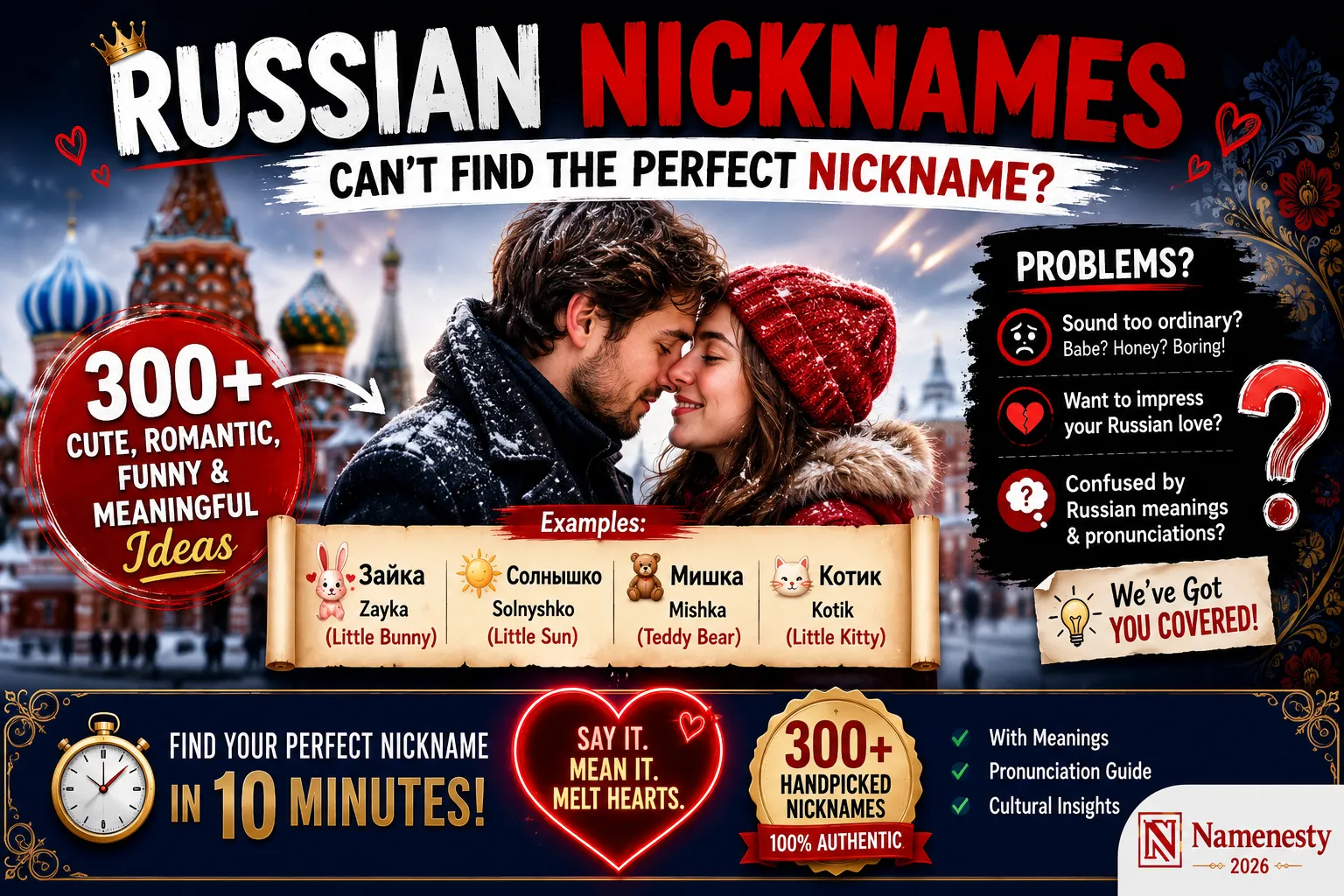
This guide covers 300+ Russian Nicknames across every relationship type — romantic partners, friends, children, spouses, grandparents, and more. Every entry includes Cyrillic spelling, romanization, phonetic pronunciation, meaning, and a usage tip. Whether you’re dating a Russian partner, learning the language, writing authentic fiction, or simply curious, this is the only guide you’ll need.
Why Russians Use So Many Nicknames (The Cultural Secret)
Before diving into the lists, understanding why Russians love nicknames unlocks the whole system.
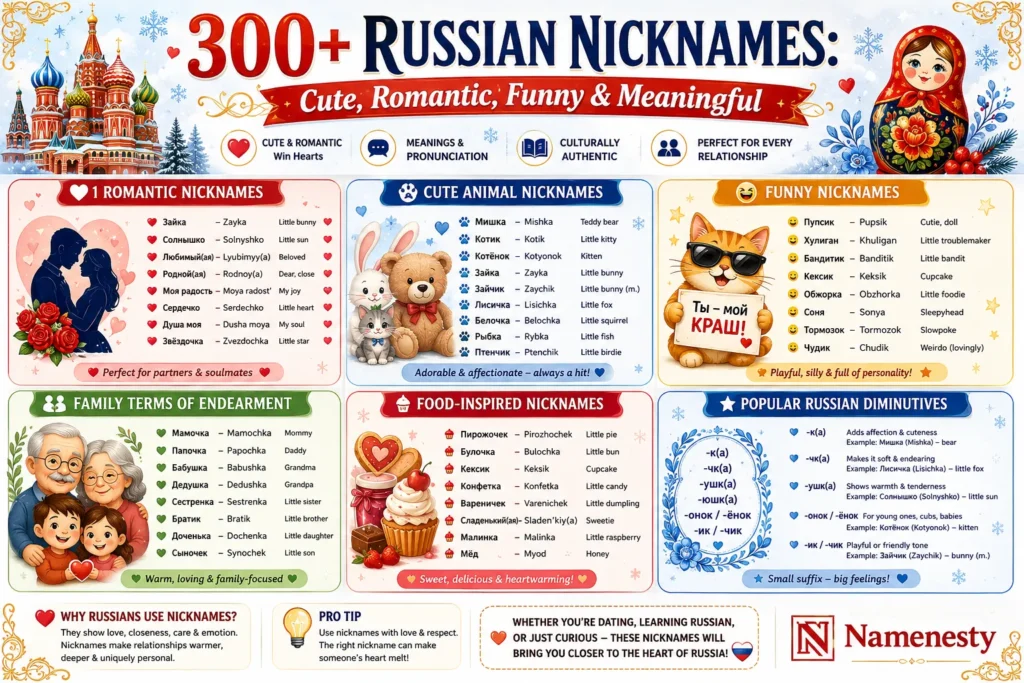
Russian is a grammatically gendered language with an extraordinary system of diminutive suffixes. These suffixes don’t just shrink words — they encode emotion. Adding -ка, -чка, -ушка, -юшка, or -онок to almost any word signals warmth, tenderness, intimacy, or playful teasing.
Example: Three levels of “bear”
| Russian | Romanization | Meaning | Emotional Register |
| Медведь | Medved’ | Bear | Neutral, formal |
| Медвежонок | Medvezhonok | Bear cub | Sweet, affectionate |
| Мишка | Mishka | Teddy bear | Warm, cuddly, beloved |
Unlike English nicknames, Russians compare their loved ones to animals, celestial objects, food, and fairy tale characters — bunnies, little suns, kittens, tiny pies, and golden ones. This reflects a deeply embedded cultural warmth in spoken Russian.
Key grammar rule: Russian adjective-based nicknames change endings based on gender:
- Feminine: Зайка (Zayka) — for a woman
- Masculine: Зайчик (Zaychik) — for a man
You’ll see gender pairs throughout every section below.
1. Cute Russian Nicknames (Animal-Inspired)
Russia’s most beloved nickname tradition compares loved ones to small, adorable animals. These work across romantic, family, and friendship contexts — universally warm and never offensive.
| Cyrillic | Romanization | Phonetic | Meaning | Best Used For |
| Зайка | Zayka | ZAY-kah | Little bunny | Girlfriend/boyfriend — #1 most popular |
| Зайчик | Zaychik | ZAY-cheek | Little bunny (m.) | Boyfriend or male partner |
| Мишка | Mishka | MEESH-kah | Teddy bear | Anyone cuddly and warm |
| Котик | Kotik | KOH-teek | Little kitty cat | Romantic partners |
| Котёнок | Kotyonok | Kah-TYON-ok | Kitten | Sweet, gentle person |
| Киска | Kiska | KEES-kah | Kitty (f.) | Girlfriend, close female friend |
| Лисичка | Lisichka | Lee-SEECH-kah | Little fox | Clever, witty person |
| Рыбка | Rybka | REEB-kah | Little fish | Girlfriend, beloved |
| Птенчик | Ptenchik | PTYEN-cheek | Little birdie | Delicate, sweet person |
| Собачка | Sobachka | Sah-BACH-kah | Little puppy | Playful, loyal person |
| Медвежонок | Medvezhonok | Med-veh-ZHOH-nok | Bear cub | Big, cuddly husband or boyfriend |
| Мышка | Myshka | MEESH-kah | Little mouse | Shy or quiet person |
| Рыжик | Ryzhik | REE-zheek | Little red one | Person with red or light hair |
| Воробышек | Vorobyshek | Vah-ROH-bysh-ek | Little sparrow | Small, lively, spirited person |
| Ёжик | Yozhik | YOH-zheek | Little hedgehog | Prickly on the outside, soft inside |
Cultural note: Animal nicknames are used at all ages in Russia. Calling your grandmother “Зайчик” is not strange — it’s deeply warm.
2. Romantic Russian Nicknames for Girlfriends
These are the nicknames Russian men and women use most for their girlfriends — deeply affectionate, widely recognized, and culturally natural to use.
| Cyrillic | Romanization | Phonetic | Meaning | Notes |
| Малышка | Malyshka | Mah-LEESH-kah | Baby girl / Little one | Most common boyfriend-to-girlfriend term |
| Солнышко | Solnyshko | SOHL-nysh-koh | Little sun | Universally beloved — you can’t go wrong |
| Красотка | Krasotka | Krah-SOHT-kah | Beautiful girl | Use with sincerity — can feel cliché if overused |
| Ангел | Angel | AHN-gel | Angel | Classic, timeless romantic term |
| Принцесса | Printsessa | Preen-TSES-sah | Princess | Playful and loving |
| Любимая | Lyubimaya | Lyoo-BEE-mah-yah | Beloved / My darling (f.) | The deepest, most sincere term |
| Милая | Milaya | MEE-lah-yah | Sweetheart / Dear (f.) | Warm, everyday affection |
| Дорогая | Dorogaya | Dah-rah-GAH-yah | Darling / Dear (f.) | Slightly formal, always sincere |
| Родная | Rodnaya | Rahd-NAH-yah | My own / My dear one (f.) | Deeper than “dear” — implies belonging |
| Крошка | Kroshka | KROHSH-kah | Little crumb / Baby | Playful — used exactly like “babe” in English |
| Лапочка | Lapochka | LAH-poch-kah | Little paw / Sweetheart | Very popular; implies tenderness and care |
| Душечка | Dushechka | DOO-shech-kah | Little Soul / Dearie | Old-fashioned but deeply sweet |
| Кисонька | Kisonka | KEE-son-kah | Little kitty | Soft, endearing, intimate |
| Звёздочка | Zvyozdochka | Zvyoz-DOCH-kah | Little star | Poetic and romantic |
| Ягодка | Yagodka | YAH-god-kah | Little berry | Sweet, playful, fruity |
Tip: In text messages, Russians often shorten these: Зайка → Зай, Котик → Кот, Малышка → Малыш. Short forms signal closeness.
3. Romantic Russian Nicknames for Boyfriends
Russian has specific masculine forms for nearly every term of endearment. Here are the most authentic nicknames Russian women use for their boyfriends.
| Cyrillic | Romanization | Phonetic | Meaning | Notes |
| Малыш | Malysh | Mah-LEESH | Baby / Little one (m.) | Male equivalent of Малышка |
| Любимый | Lyubimyy | Lyoo-BEE-mee | Beloved / Darling (m.) | The most romantically intense term |
| Милый | Milyy | MEE-lee | Sweetheart / Dear (m.) | Warm everyday affection |
| Дорогой | Dorogoy | Dah-rah-GOY | Darling / Dear (m.) | Sincere, classic |
| Родной | Rodnoy | Rahd-NOY | My own / My dear (m.) | “My own person” — deep emotional bond |
| Зайчик | Zaychik | ZAY-cheek | Little bunny (m.) | Playful, very popular with Russian women |
| Лучик | Luchik | LOO-cheek | Sunbeam / Ray of light | “You light up my life” |
| Котик | Kotik | KOH-teek | Little kitty | Used for boyfriends too — warm and playful |
| Лев | Lev | Lyev | Lion | For a strong, bold, confident partner |
| Герой | Geroy | Geh-ROY | Hero | Admiring, slightly teasing |
| Богатырь | Bogatyr’ | Bah-gah-TEER | Epic warrior / Strong man | Very masculine — from Slavic folklore |
| Красавчик | Krasavchik | Krah-SAHV-cheek | Handsome guy | Flirty and affirming |
| Дружочек | Druzhochek | Droo-ZHOH-chek | Little friend / Buddy | Affectionate, slightly playful |
| Сахарок | Sakharok | Sah-khah-ROK | Little sugar | Sweet and playful |
| Солнышко | Solnyshko | SOHL-nysh-koh | Little sun | Gender-neutral — works equally well for men |
4. Classic Russian Terms of Endearment (Gender Pairs)
Russian adjective-based endearments always change their endings based on the recipient’s gender. Use this table to always get the right form.
| Masculine (for him) | Feminine (for her) | Meaning |
| Любимый (Lyubimyy) | Любимая (Lyubimaya) | Beloved / My darling |
| Милый (Milyy) | Милая (Milaya) | Sweetheart / Honey |
| Дорогой (Dorogoy) | Дорогая (Dorogaya) | Dear / Darling |
| Родной (Rodnoy) | Родная (Rodnaya) | My dear one / My own |
| Золотой (Zolotoy) | Золотая (Zolotaya) | Golden one / My gold |
| Маленький (Malen’kiy) | Маленькая (Malen’kaya) | Little one |
| Красивый (Krasivyy) | Красивая (Krasivaya) | Beautiful one |
| Сладкий (Sladkiy) | Сладкая (Sladkaya) | Sweet one / Sweetie |
| Хороший (Khoroshiy) | Хорошая (Khoroshaya) | Good one / My good one |
| Умный (Umnyy) | Умная (Umnaya) | Clever one / My smart one |
| Нежный (Nezhnyy) | Нежная (Nezhnaya) | Gentle one / Tender one |
| Верный (Vernyy) | Верная (Vernaya) | Faithful one / Loyal one |
| Добрый (Dobryy) | Добрая (Dobraya) | Kind one / My kind one |
| Любой (Lyuboy) | Любая (Lyubaya) | My beloved (casual) |
| Смелый (Smelyy) | Смелая (Smelaya) | Brave one / My brave one |
Grammar tip: Add мой (moy) before a masculine adjective or моя (moya) before a feminine one to say “my.” Example: Моя любимая = “My beloved” (to a woman).
5. Cute Russian Nicknames for Friends
Russian friendship has its own warm, distinct nickname culture — separate from romance and far more playful.
| Cyrillic | Romanization | Phonetic | Meaning | Usage |
| Дружище | Druzhishche | Droo-ZHEESH-cheh | Buddy / Old pal | Best male friends; deeply warm |
| Дружок | Druzhok | Droo-ZHOK | Little friend | Warm and casual, any gender |
| Подруга | Podruga | Pahd-ROO-gah | Female friend | Standard close girl-to-girl term |
| Товарищ | Tovarishch | Tah-VAH-reeshch | Comrade | Classic Soviet term — now used ironically and playfully |
| Братан | Bratan | Brah-TAHN | Bro | Gen Z / millennial slang |
| Братишка | Bratishka | Brah-TEESH-kah | Little bro | Warm, affectionate male friendship |
| Сестрёнка | Sestryonka | Ses-TRYON-kah | Little sis | Girl-to-girl affection |
| Дорогуша | Dorogusha | Dah-rah-GOO-shah | Dearie | Warm, slightly old-fashioned, unisex |
| Голубчик | Golubchik | Gah-LOOB-cheek | Little dove (m.) | Gentle, caring, classic |
| Голубушка | Golubushka | Gah-LOOB-oosh-kah | Little dove (f.) | Gentle and caring for women |
| Подельник | Podelnik | Pah-DEL-neek | Partner in crime | Playful, used for mischievous close friends |
| Кума | Kuma | KOO-mah | Bestie / Godmother | Close female friend; traditional |
| Корешок | Koreshok | Kah-ryeh-SHOK | Old root / Close buddy | Informal slang for a lifelong friend |
| Приятель | Priyatel’ | Pree-YAH-tel’ | Pal / Good friend | Casual male friend — less intense than друг |
| Закадычный друг | Zakadychnyy drug | Zah-kah-DEECH-nyy droog | Bosom friend | Deep literary phrase for a best friend |
6. Russian Nicknames for Husband and Wife
Long-term couples in Russia develop highly specific affectionate vocabularies. These are the most common spousal nicknames — intimate, sincere, and often deeply poetic.
| Cyrillic | Romanization | Phonetic | Meaning | Context |
| Муженёк | Muzhenyok | Moo-zhe-NYOK | Dear little husband | Wife to husband — extremely warm |
| Женушка | Zhenusbka | ZHEH-noosh-kah | Dear little wife | Husband to wife |
| Моя жизнь | Moya zhizn’ | Mah-YAH ZHEEZ’n | My life | Deep marital devotion |
| Моё сердце | Moyo serdtse | Mah-YO SYERD-tseh | My heart | Very sincere and tender |
| Душа моя | Dusha moya | Doo-SHAH mah-YAH | My soul | Old Russian — among the most touching |
| Свет мой | Svet moy | Svyet MOY | My light | Poetic, used by wives for husbands |
| Лапушка | Lapushka | LAH-poosh-kah | Darling / Sweetheart | Popular for spouses of all ages |
| Любовь моя | Lyubov’ moya | Lyoo-BOFF’ mah-YAH | My love | Classic, always sincere |
| Счастье моё | Schast’ye moyo | SHCHAST’-yeh mah-YO | My happiness | Heartfelt and intimate |
| Ненаглядный / ая | Nenaglyadnyy/aya | Neh-nah-GLYAD-nyy | Can’t take my eyes off you | A beloved old Russian romantic tradition |
| Верная моя | Vernaya moya | VYER-nah-yah mah-YAH | My faithful one (f.) | Deep trust and loyalty |
| Надёжный мой | Nadyozhnyy moy | Nah-DYOZH-nyy moy | My reliable one (m.) | Admiration and security |
| Родненький | Rodnen’kiy | Rahd-NYEN-keey | My dearest (m.) | Even more affectionate than Родной |
| Голубка моя | Golubka moya | Gah-LOOB-kah mah-YAH | My dove | Poetic, old-fashioned |
| Половинка | Polovinka | Pah-lah-VEEN-kah | My other half | The equivalent of “my better half” in Russian |
7. Russian Nicknames for Children and Babies
Russian parents are remarkably creative with nicknames for their children — and these terms of endearment often follow a person their entire life.
| Cyrillic | Romanization | Phonetic | Meaning | Notes |
| Малыш | Malysh | Mah-LEESH | Baby / Little one (m.) | Universal for baby boys |
| Малышка | Malyshka | Mah-LEESH-kah | Baby girl | Universal for baby girls |
| Пупсик | Pupsik | POOP-seek | Baby doll / Pumpkin | Very common for toddlers |
| Крошка | Kroshka | KROHSH-kah | Little crumb | Perfect for tiny newborns |
| Зайчонок | Zaychonok | Zay-CHOH-nok | Tiny baby bunny | For small children |
| Солнышко | Solnyshko | SOHL-nysh-koh | Little sun | Parents to children of any age |
| Дочка | Dochka | DOHCH-kah | Daughter / My girl | Parent to daughter |
| Сынок | Synok | See-NOK | My son / Sonny | Parent to son |
| Ангелочек | Angelochek | Ahn-geh-LOH-chek | Little angel | For sweet, gentle children |
| Любимчик | Lyubimchik | Lyoo-BEEM-cheek | Little favorite / Darling | Favorite child — used playfully |
| Кнопочка | Knopochka | KNOH-poch-kah | Little button | For tiny, petite children |
| Цыплёнок | Tsyplyonok | Tsyp-LYON-ok | Little chick | Adorable for babies |
| Пончик | Ponchik | POHN-cheek | Little doughnut | Chubby, round, adorable baby |
| Светик | Svetik | SVYEH-teek | Little light | Warm, affectionate toward children |
| Топтыжка | Toptyzhka | Top-TYSH-kah | Little stomper | Playful, for a toddler learning to walk |
8. Russian Nicknames for Parents and Grandparents
Russian family vocabulary is rich with warmth and respect. These terms signal love across generations — and many are famous worldwide.
| Cyrillic | Romanization | Phonetic | Meaning | Who Uses It |
| Мамочка | Mamochka | MAH-moch-kah | Dear mommy | Children to mother — most affectionate form |
| Мамуля | Mamulya | Mah-MOO-lyah | Mummy / Mom | Warm, slightly playful |
| Мамулечка | Mamule chka | Mah-MOO-lech-kah | Dearest mommy | Extra-affectionate form |
| Папочка | Papochka | PAH-poch-kah | Dear daddy | Children to father |
| Папуля | Papulya | Pah-POO-lyah | Daddy (playful) | Warm and loving |
| Батя | Batya | BAH-tyah | Dad (informal, masculine) | Sons to fathers; casual, strong |
| Бабуля | Babulya | Bah-BOO-lyah | Granny | Warm, grandchildren to grandma |
| Бабуленька | Babulen’ka | Bah-BOO-len-kah | Dearest little grandma | Extra affectionate form |
| Дедуля | Dedulya | Deh-DOO-lyah | Grandpa (affectionate) | Grandchildren to grandfather |
| Дедушка | Dedushka | DEH-doosh-kah | Grandpa (standard) | Universal Russian term |
| Бабушка | Babushka | BAH-boosh-kah | Grandma (standard) | Famous worldwide; deeply warm |
| Матушка | Matushka | MAH-toosh-kah | Mother (old, poetic) | Literary; also “Mother Russia” |
| Батюшка | Batyushka | BAH-tyoosh-kah | Father (old, poetic) | Literary, religious, or dramatic contexts |
| Дедок | Dedok | Deh-DOK | Old grandpa (playful) | Grandchildren teasing affectionately |
| Бабок | Babok | BAH-bok | Granny (playful) | Affectionate teasing from grandkids |
9. Funny and Playful Russian Nicknames
Russians have an exceptional sense of humor in their nickname culture. These playful terms are common between very close friends and partners who love teasing each other.
| Cyrillic | Romanization | Phonetic | Meaning | Why It’s Funny |
| Капуста | Kapusta | Kah-POOS-tah | Cabbage | Calling someone “my cabbage” is absurdly endearing |
| Колобок | Kolobok | Kah-lah-BOK | Bread bun (fairy tale) | Round, cheerful fairy tale hero — implies roundness |
| Слон | Slon | Slohn | Elephant | Lovingly calling someone clumsy |
| Комар | Komar | Kah-MAHR | Mosquito | Someone always buzzing in your ear |
| Кефирчик | Kefirchik | Keh-FEER-cheek | Little kefir | Silly fermented milk reference — pure food humor |
| Бублик | Bublik | BOO-bleek | Bagel | Funny, round, warm — also means “zero” in slang |
| Грибок | Gribok | Gree-BOK | Little mushroom | Teasing someone short or who pops up unexpectedly |
| Мышонок | Myshonok | Mee-SHOH-nok | Little mouse | Funny and endearing at once |
| Облачко | Oblachko | OB-lach-koh | Little cloud | For a dreamy person always lost in thought |
| Пузик | Puzik | POO-zeek | Little tummy | Used for chubby babies and partners alike |
| Сонька | Son’ka | SOHN-kah | Sleepyhead | The person who can never wake up |
| Пиявка | Piyavka | Pee-YAV-kah | Little leech | Affectionate for someone who clings constantly |
| Таракан | Tarakan | Tah-rah-KAHN | Little cockroach | Extremely endearing when said with love |
| Хомяк | Khomyak | Khah-MYAK | Hamster | For someone who hoards snacks or stuffs their cheeks |
| Растяпа | Rastyapa | Rahs-TYAH-pah | Little clumsy one | Someone who always trips or drops things |
10. Food-Inspired Russian Nicknames
Russia’s deep love of food extends directly into its affectionate vocabulary. Food nicknames are warm, funny, and surprisingly widespread in everyday Russian speech.
| Cyrillic | Romanization | Phonetic | Meaning | Usage |
| Пирожок | Pirozhok | Pee-roh-ZHOK | Little pie | Sweet and filling — just like the person you love |
| Пирожочек | Pirozhochek | Pee-roh-ZHOH-chek | Tiny little pie | Even more affectionate diminutive |
| Булочка | Bulochka | BOO-loch-kah | Sweet bun / Muffin | Warm, soft, adorable |
| Плюшка | Plyushka | PLYOOSH-kah | Sweet pastry bun | Soft and sweet — easygoing person |
| Сахарок | Sakharok | Sah-khah-ROK | Little sugar | Sweet and energetic personality |
| Вишенка | Vishenka | VEE-shen-kah | Little cherry | Sweet with a hint of cheekiness |
| Конфетка | Konfetka | Kahn-FYET-kah | Little candy | Sweet |
| Шоколадка | Shokoladka | Shah-kah-LAHD-kah | My chocolate | Rich, sweet, irresistible personality |
| Яблочко | Yablochko | YAH-bloch-koh | Little apple | Fresh, wholesome, classic |
| Медок | Medok | Meh-DOK | Little honey | Very sweet person |
| Карамелька | Karamelka | Kah-rah-MYEL-kah | Little caramel | Sweet and golden |
| Ватрушка | Vatrushka | Vah-TROOSH-kah | Cheese pastry | Soft, warm, slightly old-fashioned |
| Изюмка | Izyumka | Ee-ZYOOM-kah | Little raisin | A small but sweet surprise |
| Пончик | Ponchik | POHN-cheek | Little doughnut | Round, sweet, irresistible |
| Кисель | Kisel’ | Kee-SYEL’ | Fruit jelly pudding | Wobbly, soft, endearing |
11. Russian Nicknames from Popular Given Names (Diminutives)
One of the most unique features of Russian is that every formal given name has multiple warmly shortened forms. Here are the most common — knowing these is essential for anyone interacting with Russian speakers.
| Formal Name | Common Diminutives | Notes |
| Александр / Александра | Саша (Sasha), Санечка (Sanechka), Саня (Sanya), Шура (Shura) | Саша is gender-neutral |
| Дмитрий | Дима (Dima), Димочка (Dimochka), Димон (Dimon) | Димон is informal/slang |
| Михаил | Миша (Misha), Мишенька (Mishen’ka), Мишутка (Mishutka) | Мишутка is especially sweet |
| Екатерина | Катя (Katya), Катенька (Katen’ka), Катюша (Katyusha) | Катюша is also a famous wartime song |
| Наталья | Наташа (Natasha), Наташенька (Natashen’ka), Наташка (Natashka) | Наташка is casual/playful |
| Владимир | Вова (Vova), Вовочка (Vovochka), Володя (Volodya) | Вовочка is often teasing |
| Анастасия | Настя (Nastya), Настенька (Nasten’ka), Ася (Asya) | Three distinct warm forms |
| Татьяна | Таня (Tanya), Танечка (Tanechka), Таюша (Tayusha) | Танечка is very affectionate |
| Николай | Коля (Kolya), Коленька (Kolen’ka), Колюня (Kolyunya) | Коленька is the most loving |
| Иван | Ваня (Vanya), Ванечка (Vanechka), Ванюша (Vanyusha) | Ванюша is old-fashioned warm |
| Сергей | Серёжа (Seryozha), Серёженька (Seryozhen’ka) | Серёженька is deeply affectionate |
| Юлия | Юля (Yulya), Юленька (Yulen’ka), Юлечка (Yulechka) | Three levels of affection |
| Елена | Лена (Lena), Леночка (Lenochka), Аленушка (Alyonushka) | Аленушка is poetic, fairy-tale |
| Павел | Паша (Pasha), Пашенька (Pashen’ka) | Пашенька is very warm |
| Андрей | Андрюша (Andryusha), Андрюшенька (Andryushen’ka) | Andryusha is universally warm |
12. Poetic and Literary Russian Nicknames
Russia’s extraordinary literary tradition — Pushkin, Tolstoy, Dostoevsky — has contributed deeply emotional phrases that survive in everyday modern speech.
| Cyrillic | Romanization | Phonetic | Meaning |
| Душа моя | Dusha moya | Doo-SHAH mah-YAH | My soul |
| Свет очей моих | Svet ochey moikh | Svyet ah-CHEY mah-EEKH | Light of my eyes |
| Жизнь моя | Zhizn’ moya | ZHEEZ’n mah-YAH | My life |
| Сердце моё | Serdtse moyo | SYERD-tseh mah-YO | My heart |
| Радость моя | Radost’ moya | RAH-dost’ mah-YAH | My joy |
| Счастье моё | Schast’ye moyo | SHCHAST’-yeh mah-YO | My happiness |
| Ненаглядный мой | Nenaglyadnyy moy | Neh-nah-GLYAD-nyy moy | Can’t take my eyes off you (m.) |
| Ненаглядная моя | Nenaglyadnaya moya | Neh-nah-GLYAD-nah-yah | Can’t take my eyes off you (f.) |
| Голубка моя | Golubka moya | Gah-LOOB-kah mah-YAH | My dove |
| Лебёдушка | Lebyodushka | Lyeh-BYOD-oosh-kah | Little swan |
| Звезда моя | Zvezda moya | Zvez-DAH mah-YAH | My star |
| Свет мой | Svet moy | Svyet MOY | My light |
| Утренняя звезда | Utrennyaya zvezda | OO-tren-nyah-yah zvez-DAH | My morning star |
| Цвет мой | Tsvet moy | Tsvyet MOY | My flower / My bloom |
| Отрада моя | Otrada moya | Ah-TRAH-dah mah-YAH | My comfort / My delight |
13. Modern and Trendy Russian Nicknames (Gen Z Style)
Contemporary Russian youth culture has produced a new wave of minimalist, international-feeling nicknames — shorter, cooler, and social-media ready.
| Cyrillic | Romanization | Meaning | Style |
| Леха | Lekha | Cool spin on Alexei | Masculine, street-smart |
| Ника | Nika | Short for Veronika | Unisex, stylish |
| Кира | Kira | Standalone modern name | Strong, feminine |
| Максик | Maksik | Cute diminutive of Maxim | Playful |
| Тимо | Timo | Modern take on Timofei | Minimalist, European |
| Рина | Rina | Short for Irina or Ekaterina | Soft, artistic |
| Лио | Lio | Short for Leonid | Cool, minimal |
| Дани | Dani | Trendy form of Daniil | International |
| Соня | Sonya | From Sofiya — now a standalone | Classic-modern |
| Ася | Asya | From Anastasiya | Friendly, warm |
| Вики | Viki | From Viktoriya | International appeal |
| Ро | Ro | Minimal short for Roman | Gen Z cool |
| Элли | Elli | Modern twist on Elena | Aesthetic |
| Арти | Arti | From Artyom | Energetic, boyish |
| Сева | Seva | From Vsevolod | Rare but rising |
14. Seasonal and Nature-Inspired Russian Nicknames
Russia’s dramatic landscape — vast snowy winters, golden springs, birch forests — inspires a whole category of affectionate names drawn from the natural world.
| Cyrillic | Romanization | Meaning | Imagery |
| Снежинка | Snezhinка | Snowflake | Delicate, pure, unique |
| Снегурочка | Snegurochka | Snow Maiden | Fairytale princess of winter |
| Весна | Vesna | Spring | New life, warmth, freshness |
| Ромашка | Romashka | Daisy | Simple, cheerful, honest love |
| Незабудка | Nezabudka | Forget-me-not | “Please don’t forget me” |
| Капелька | Kapelka | Little raindrop | Gentle, refreshing, life-giving |
| Росинка | Rosinka | Little dewdrop | Morning freshness, quiet beauty |
| Берёзка | Beryozka | Little birch tree | Iconic Russian symbol of grace and resilience |
| Ветерок | Veterok | Little breeze | Free-spirited, light, carefree |
| Лунный свет | Lunnyy svet | Moonlight | Romantic, mysterious, silver |
| Рябинка | Ryabinka | Little rowan berry | Bright red, beautiful, slightly bittersweet |
| Ивушка | Ivushka | Little willow | Graceful, flowing, feminine |
| Василёк | Vasilyok | Little cornflower (blue) | Wild, pure, naturally beautiful |
| Зорька | Zor’ka | Little dawn | Morning light; fresh start |
| Метелица | Metelitsa | Little blizzard | Wild, passionate, unstoppable |
15. Flirty Russian Nicknames for a Crush
Using one of these names on someone you’re interested in signals confidence, cultural awareness, and genuine attraction. Use them sincerely — Russians can always tell.
| Cyrillic | Romanization | Meaning | Vibe |
| Красотка | Krasotka | Beautiful girl | Direct, confident, classic |
| Красавчик | Krasavchik | Handsome guy | Flirty, affirming |
| Принцесса | Printsessa | Princess | Charming, slightly playful |
| Принц | Prints | Prince | For a man you genuinely admire |
| Волшебница | Volshebnitsa | Enchantress | Deeply flattering — use with feeling |
| Богиня | Boginya | Goddess | Bold, intense flirtation |
| Сокровище | Sokrovishche | My treasure | Sincere and powerful |
| Умница | Umnitsa | Smart one / Clever one | For someone whose mind you admire |
| Загадка | Zagadka | Mystery / Enigma | Intriguing, draws them in |
| Мечта | Mechta | My dream | You are everything I hoped for |
| Искушение | Iskusheniye | Temptation | Intense, very flirty |
| Судьба моя | Sud’ba moya | My destiny | Bold and deeply romantic |
| Соблазн | Soblazn | My temptation | Confident, direct |
| Чудо | Chudo | My miracle | Sincere, overwhelmed admiration |
| Невероятная / ый | Neveroyatnaya/yy | Incredible one | You are simply unbelievable |
How to Choose the Right Russian Nickname: A Decision Framework
Step 1: Identify the relationship type.
- Romantic partner → Sections 2, 3, 4, 6
- Close friend → Section 5
- Child or baby → Section 7
- Parent or grandparent → Section 8
- Crush or new flirtation → Section 15
Step 2: Assess the emotional register you want.
| You Want | Best Options |
| Warm and sincere | Любимая/ый, Душа моя, Солнышко |
| Playful and cute | Зайка, Котик, Мишка, Крошка |
| Funny and teasing | Колобок, Капуста, Хомяк, Пузик |
| Poetic and literary | Душа моя, Жизнь моя, Ненаглядный |
| Bold and flirty | Богиня, Мечта, Судьба моя |
| Modern and casual | Зай, Кот, Миш (shortened text forms) |
3: Match gender correctly.
- Adjective nicknames require the right ending: -ый/-ой (masculine) vs. -ая (feminine)
- Noun nicknames (Зайка, Мишка) are often used for any gender, but masculine forms exist (Зайчик, Медвежонок)
4: Consider the context.
- In public / around others → Classic: Любимый/ая, Дорогой/ая
- Privately / intimately → Animal names, Малышка, Зайка, Солнышко
- In text messages → Shortened forms: Зай, Миш, Кот, Лапа
- In a letter or serious moment → Literary: Душа моя, Жизнь моя
People Also Ask
Зайка (Zayka), meaning “little bunny,” is consistently the most popular Russian nickname for romantic partners. It’s playful, warm, and works for any gender. Солнышко (“little sun”) and Котик (“little kitty”) are close runners-up.
Мишка (Mishka) means “teddy bear” in Russian — a softened, affectionate form of Медведь (bear). It’s used for warm, huggable people and is one of the most recognized Russian nicknames outside Russia.
“My love” translates as Любовь моя (Lyubov’ moya). More commonly, Russians say Любимый (Lyubimyy) to a man or Любимая (Lyubimaya) to a woman — meaning “my beloved.”
Russian parents most commonly use Малыш (baby boy), Малышка (baby girl), Солнышко (little sun), Пупсик (baby doll), and the diminutive form of the child’s given name — e.g., Катенька for Ekaterina.
Russian grammar allows virtually any noun to be transformed with suffixes like -ка, -чка, -ушка, and -онок. These don’t just mean “small” — they encode affection and closeness, making Russian one of the world’s most emotionally expressive languages for nicknames.
Зайчик (Zaychik) means “little bunny” in the masculine form. It’s the male version of Зайка (Zayka) and is one of the most widely used romantic nicknames for boyfriends in Russia.
Солнышко (Solnyshko) means “little sun” — derived from Солнце (sun) with the diminutive suffix -ышко. It’s used for someone who brightens your life and is one of Russia’s most universally loved terms of endearment.
Conclusion and Key Takeaways
Russian nicknames are one of the most emotionally expressive systems in any language. The secret is the diminutive suffix — a tiny grammatical tool that encodes warmth, tenderness, humor, and love all at once.
Key takeaways:
- The most popular Russian nickname overall is Зайка (Zayka) — little bunny.
- Russian nicknames have gender forms — always match the ending to the recipient.
- Animal nicknames (bunny, bear, kitty, fox) are universally beloved across all ages and relationships.
- Food nicknames (little pie, sweet bun, candy) are more common than most Westerners expect.
- For text messages, shorten: Зайка → Зай, Котик → Кот, Мишка → Миш.
- Literary phrases like Душа моя (my soul) and Жизнь моя (my life) are used in real daily speech — not just books.
Bookmark this guide and come back whenever you need the perfect word. And if you’re learning Russian, start with Зайка and Солнышко — they’ll take you far.