From Heroes to Villains: Names That Defined Cinema
A good nickname does more work than a real name ever could. Three words — “the Man with No Name,” “Cool Hand Luke,” “Hannibal the Cannibal” — and you already know the character before you’ve seen a single frame. That’s the power classic film figured out decades before branding agencies caught up to it.
Most lists built around classic movie character nicknames mix up two very different things: a character’s actual name, and a nickname someone else gave them in the story. That mix-up matters if you’re here for real trivia — and it matters even more if you’re hunting for classic movie character nickname ideas to use yourself, since copying a character’s real name isn’t really borrowing a nickname at all.
This guide keeps the two separate: a sourced, era-by-era list of genuine in-story nicknames, followed by original ideas — clearly labeled as such — for anyone naming a pet, a username, or a character of their own.
What Actually Counts as a Movie Character Nickname
Most “nickname” lists online are just character names with an adjective bolted on — “Iron Man (for someone powerful).” That’s not a nickname. That’s the character’s actual title, recycled.
A genuine classic movie character nickname comes from one of four places:
1 Given by another character, usually for how they look, act, or what they did — Tony Camonte becomes “Scarface” because of the scar; Ellis Redding becomes “Red” because he’s Red.
2 A trade name or alias standing in for a real name — “Doc” Holliday (he was a dentist), “the Man with No Name” (he’s never named at all).
3 A shortened or affectionate version of a real name — Lucas Jackson becomes “Cool Hand Luke,” Jeffrey Lebowski becomes “the Dude.”
4 A code name assigned for a job — the color-coded crew in Reservoir Dogs, the call signs in Top Gun.
Keeping this distinction means the “real” section below is trivia you can actually trust, and the “ideas” section is honestly labeled as original — not movie facts dressed up as more than they are.
Classic Movie Character Nicknames by Era
Golden Age & Studio Era (1930s–1950s)
1 Scarface — Tony Camonte, Scarface (1932). The name comes straight from the knife scar on his cheek, and other gangsters in the film use it, not just the title card.
2 Mr. Chips — Goodbye, Mr. Chips (1939). His real name is Mr. Chipping; generations of students shorten it to “Chips,” and the nickname outlives the man.
3 The Tramp — Charlie Chaplin’s recurring silent-era figure across The Kid and City Lights. Rarely named on screen, “the Tramp” is what audiences and the press called him instead.
4 The Ringo Kid — Stagecoach (1939). “Kid” was the standard Western nickname suffix for a young outlaw, attached here to John Wayne’s breakout role.
Westerns, Noir & New Hollywood (1950s–1970s)
5 Doc Holliday — recurring across decades of Westerns. John Henry Holliday trained as a dentist, hence “Doc,” long before film picked the nickname up.
6 The Man with No Name — Clint Eastwood’s character across the Dollars Trilogy (1964–1966) is never given a name on screen; the nickname exists purely to fill the gap the film leaves open.
7 Blondie — The Good, the Bad and the Ugly (1966). Tuco gives Eastwood’s character this nickname, and it lands harder because it doesn’t match his hard-edged persona.
8 Fast Eddie Felson and Minnesota Fats — The Hustler (1961). Pool-hall nicknames built on speed and geography are used constantly by other characters in the film.
9 Cool Hand Luke — Cool Hand Luke (1967). Lucas Jackson earns it from his unshakable composure at the poker table.
10 Scout, Dill, and Boo — To Kill a Mockingbird (1962). Jean Louise Finch is “Scout,” Charles Baker Harris is “Dill,” and reclusive Arthur Radley is “Boo” — all nicknames the neighborhood kids use, not legal names.
Action & Adventure Icons (1970s–1980s)
1 Dirty Harry Callahan — Dirty Harry (1971). The department always hands him its dirtiest, toughest cases — hence the name.
2 Hawkeye, Trapper John, and Radar — MASH (1970). Benjamin Franklin Pierce is “Hawkeye,” John McIntyre is “Trapper John,” and Walter O’Reilly is “Radar” for anticipating orders before they’re given.
3 Swan — The Warriors (1979). The gang leader’s nickname was used by his crew throughout.
4 Indiana Jones — Raiders of the Lost Ark (1981). His real name is Henry Jones Jr.; “Indiana” turns out to be the name of the family dog, revealed in The Last Crusade.
5 Mad Max Rockatansky — Mad Max (1979). A road-cop nickname that’s outlasted his actual surname in pop culture.
6 Snake Plissken — Escape from New York (1981). S.D. Plissken is known almost exclusively by his nickname for the rest of the franchise.
6 Maverick, Goose, and Iceman — Top Gun (1986). Military call signs assigned to fighter pilots — a nickname convention built directly into the job.
Cult Classics & 90s Icons (1980s–1990s)
1 Bluto — Animal House (1978). John “Bluto” Blutarsky’s nickname is baked into the character’s full name in the credits.
2 Chunk, Data, Mouth, and Sloth — The Goonies (1985). A friend group defined by nicknames tied to personality — Chunk for his size, Data for his gadgets, Mouth for talking too much.
3 The Dude — The Big Lebowski (1998). Jeffrey Lebowski insists on it; every other character uses it instead of his real name.
4 Mr. Pink, Mr. White, Mr. Blue, Mr. Orange, Mr. Brown — Reservoir Dogs (1992). Assigned color-code aliases so the crew never learns each other’s real names.
5 Red — The Shawshank Redemption (1994). Ellis Boyd Redding is “Red” to every character in the film.
6 The Wolf — Pulp Fiction (1994). Winston Wolfe is introduced by reputation before he’s introduced by name.
7 Hannibal the Cannibal — The Silence of the Lambs (1991). The tabloid nickname for Hannibal Lecter, used in-story by the press covering his case.
8 Keyser Söze — The Usual Suspects (1995). An alias so effective it functions as a legend rather than a name.
9 McLovin — Superbad (2007). A fake ID alias that becomes the character’s nickname for the rest of the film.
Classic Movie Character Nicknames by Vibe
The same real nicknames above, organized by tone instead of decade — useful if you want a feel rather than a film era.
| Vibe | Nickname | Film |
| Funny / Quirky | Bluto | Animal House (1978) |
| Funny / Quirky | Mouth | The Goonies (1985) |
| Funny / Quirky | McLovin | Superbad (2007) |
| Cool / Iconic | The Dude | The Big Lebowski (1998) |
| Cool / Iconic | Maverick | Top Gun (1986) |
| Cool / Iconic | Indiana | Raiders of the Lost Ark (1981) |
| Badass / Villain | Scarface | Scarface (1932) |
| Badass / Villain | Hannibal the Cannibal | The Silence of the Lambs (1991) |
| Badass / Villain | Snake | Escape from New York (1981) |
| Mysterious / Enigmatic | The Man with No Name | The Dollars Trilogy (1964–66) |
| Mysterious / Enigmatic | Keyser Söze | The Usual Suspects (1995) |
| Mysterious / Enigmatic | Mr. Pink | Reservoir Dogs (1992) |
| Retro / Old Hollywood | The Tramp | Chaplin films (1910s–30s) |
| Retro / Old Hollywood | Mr. Chips | Goodbye, Mr. Chips (1939) |
| Retro / Old Hollywood | The Ringo Kid | Stagecoach (1939) |
How to Invent a Classic-Movie-Style Nickname
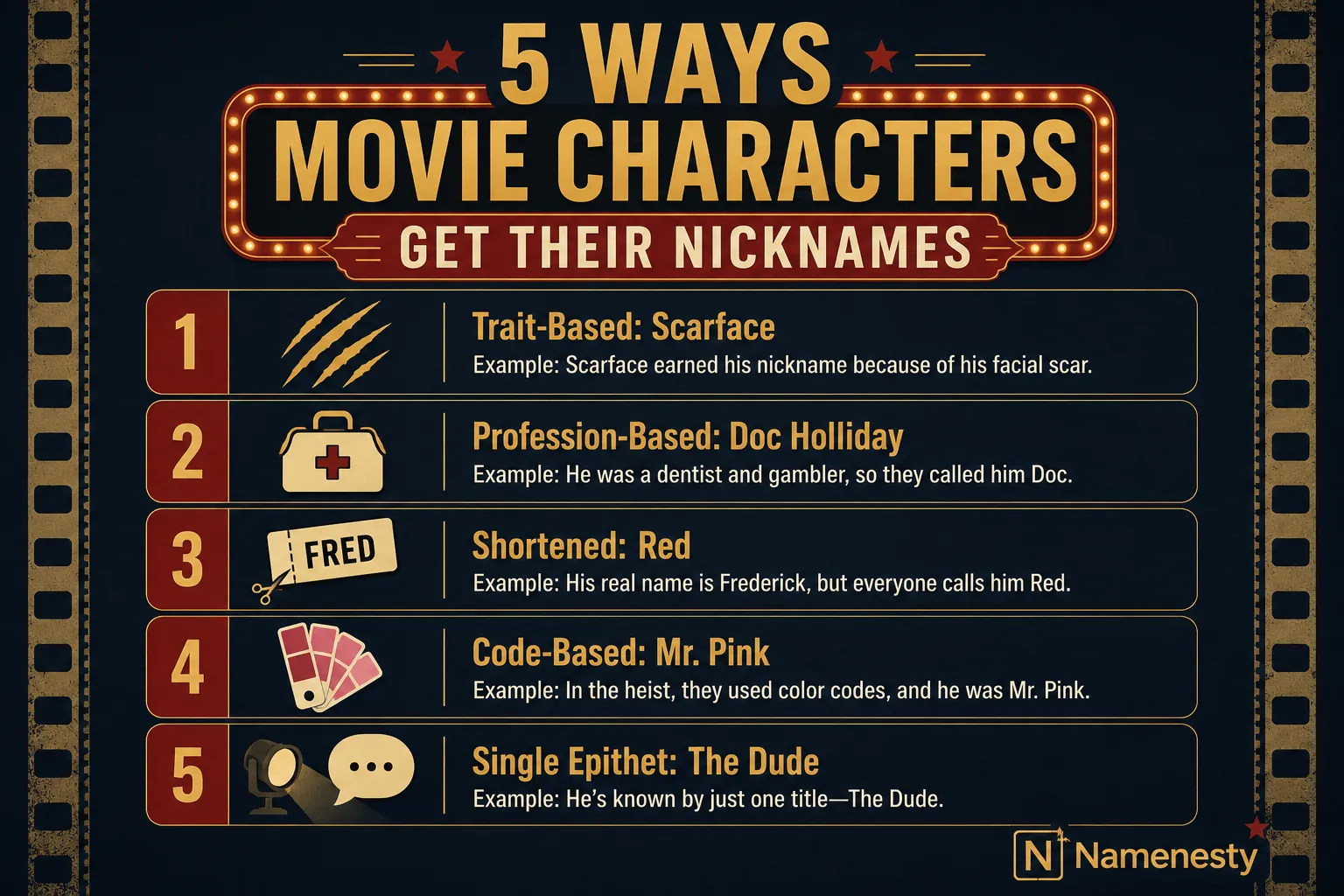
If you’re not here for trivia — you’re naming a username, a tabletop character, or a pet — this is the actual pattern screenwriters have leaned on for ninety years. Every real nickname above falls into one of five buckets:
1. Trait-based — built from one defining feature or habit. Scarface, Cool Hand Luke. Find the one trait people always notice and build the name around it.
2. Profession or role-based — the job becomes the name. Doc Holliday, Maverick. Works well for a callsign, gamer tag, or work nickname.
3. Shortened or affectionate — clip a real name down. Red from Redding, Trapper John from McIntyre. The simplest method, and often the most natural-sounding.
4. Code or color-based — a category instead of a name. Mr. Pink, Mr. Orange. Great for group nicknames — a team, a crew, a friend group.
5. The single epithet — drop the real name almost entirely. The Dude, The Wolf, the Man with No Name. Best when the nickname implies a whole personality in two or three words.
Pick the trait or role people already associate with you, then run it through whichever pattern fits. “The ___” works for almost anyone; a job-based tag works if your role is distinctive; a clipped name works if you want something that sounds lived-in rather than invented.
Nickname Ideas Inspired by Classic Film Style
These are original suggestions inspired by classic movie naming conventions — not nicknames pulled from real films. Use them for a username, a character, or a persona; don’t repeat them as movie trivia, because none of these were used in an actual film.
Cool / Iconic
- The Last Reel
- Duskrunner
- Greyframe
- Lonecoast
- The Quiet Engine
- Amberlight
- Stillpoint
- The Backlot King
- Slatewood
- Hallowind
Edgy / Badass
- Razorline
- Coldwire
- Blacktide
- Hollowpoint
- Ironclad
- The Undertow
- Nightfence
- Gravelvoice
- Brokenclock
- Stonecut
Villain-Style
- The Quiet Threat
- Doctor Hollow
- The Pale Verdict
- Crowsfoot
- The Velvet Knife
- Madame Obscura
- The Long Con
- Mister Static
- The Hollow Crown
- Lady Cinder
Mysterious / Enigmatic
- Ghostlight
- Shadowplay
- The Quiet One
- Halfshadow
- The Unlisted
- The Understudy
- Backlot Ghost
- The Silent Reel
- Whisper Reel
- The Vanishing Act
Funny / Quirky
- Two-Left-Feet
- The Mumbler
- Lucky Stiff
- Plan B
- Popcorn King
- Background Barry
- Cue-Card Carl
- The Understudy’s Understudy
- Matinee Mishap
- Extra Number Nine
Fantasy / Mythical
- Hollowmoon
- The Last Watch
- Stormcaller
- Driftwood King
- The Ember Vow
- Northstar Reverie
- The Quiet Flame
- Moonglass
- The Forgotten Verse
- Wayfarer
Retro / Old Hollywood
- The Marquee
- Reel Two
- Silver Screen
- The Encore
- Matinee
- Technicolor Joe
- The Velvet Curtain
- Backlot Kid
- Newsreel Nora
- The Premiere
Rare & Unique
- Indigo Static
- The Off-Script
- Halflight
- The Side Plot
- Quietframe
- The Outtake
- Driftcode
- The Second Take
- Glassframe
- The Unwritten
Aesthetic / Stylish
- Velvet Noir
- Goldframe
- The Soft Static
- Duskframe
- Champagne Reel
- The Pale Gold
- Satin Static
- The Quiet Glow
- Moonframe
- The Linen Hour
Gaming & Username-Friendly
- ReelRunner
- NightframeX
- GhostCue
- StaticDrift
- BacklotOne
- QuietTake07
- FrameBreaker
- SilverReelX
- DriftcodeZero
- TheUnscripted
How to Choose the Right One
Start with what the nickname needs to do, not how it sounds. A username needs to be typed often, so short and easy beats clever. A character name needs to survive being said out loud in tense scenes, so test it in a sentence, not just on a page. A pet’s nickname just needs to be fun to call across a yard — so say it outside before you commit.
Then check it against the five patterns above. If a name doesn’t clearly fit trait-based, role-based, shortened, code-based, or single-epithet, it’s probably trying to do too much at once — and the strongest classic nicknames almost always do exactly one job well.
Mistakes to Avoid When Naming a Character
1 Confusing a name with a nickname. If nobody in the story (or your head-canon) ever calls them anything else, it’s not a nickname — it’s just their name.
2 Stacking too many traits into one name. “The Dude” works because it’s one idea. A name trying to signal tough, funny, and mysterious usually lands as none of them.
3 Picking something that doesn’t survive being shouted. Test it in an urgent sentence — “Get [name] out of there!” Names that are too long or too soft often fall apart under pressure.
4 Borrowing a real character’s exact nickname. It reads as a reference, not an identity — fine for a tribute, not great if you want the name to be yours.
5 Ignoring how it sounds next to a real name. A nickname usually has to coexist with someone’s actual name in dialogue (“Get up, Red”), so test the pairing, not just the nickname alone.
Best Situations to Use These Nicknames
1 Usernames and gamer tags — the single-epithet and code-based patterns work especially well here; short, distinct, easy to type.
2 Original characters (fiction, tabletop, screenwriting) — trait-based and profession-based nicknames give a character instant texture without a paragraph of backstory.
3 Pets — affectionate, shortened-name style nicknames translate best; anything you’ll happily yell across a park.
4 Friend groups and crews — the Reservoir Dogs code-name approach (one category, several variations) works well for assigning a whole group a nickname system at once.
5 Personal branding or a stage name — retro/old Hollywood and aesthetic-style ideas above lean toward this use case specifically.
Questions People Actually Ask
Not in the traditional sense. Those are the character’s own operating name or codename within their universe — used by themselves and everyone else as their actual identity, rather than something assigned by another character to stand in for a “real” name.
Clint Eastwood’s role across the Dollars Trilogy. The film never gives him a name, which is exactly why “the Man with No Name” became the nickname fans use to refer to him.
Both genres lean on outsiders and aliases — drifters, outlaws, criminals working under assumed identities — so a nickname does real narrative work instead of just being a nice-to-have. That’s part of why Reservoir Dogs, The Usual Suspects, and a string of Westerns show up so often on this list.
You can, but it’ll read as a direct reference rather than something that’s yours. If you want a name with the same flavor without quoting a film outright, the idea sections above are built for exactly that.
The shortened-name pattern, by a wide margin — clip your own first or last name the way “Redding” became “Red.” It sounds the most natural because it’s the method real people actually use, not just movie characters.
A Quick Word Before You Go
Nicknames in classic film almost always do one job: tell you who someone is before the story has time to explain it. The real list above shows how that’s actually been done on screen for ninety years; the Idea sections give you the same tools to do it yourself. Bookmark this if you’re naming something later — and if you came here from a search, the fastest way back is the table of contents at the top.