What Does Caption Mean? Definition, Types, Examples & 225 Ideas
Ever wondered what a caption really means when you see one beneath an Instagram photo, TikTok video, or online image? A caption is more than just a few words. It can explain a picture, express emotions, tell a story, or make videos easier to understand. But not all captions serve the same purpose. Some make people laugh, others inspire conversations, and video captions can improve accessibility. In this guide, you’ll discover exactly what captions mean, explore different types, and find 225 creative examples to inspire your next post. Ready to turn ordinary words into meaningful captions? Let’s explore!
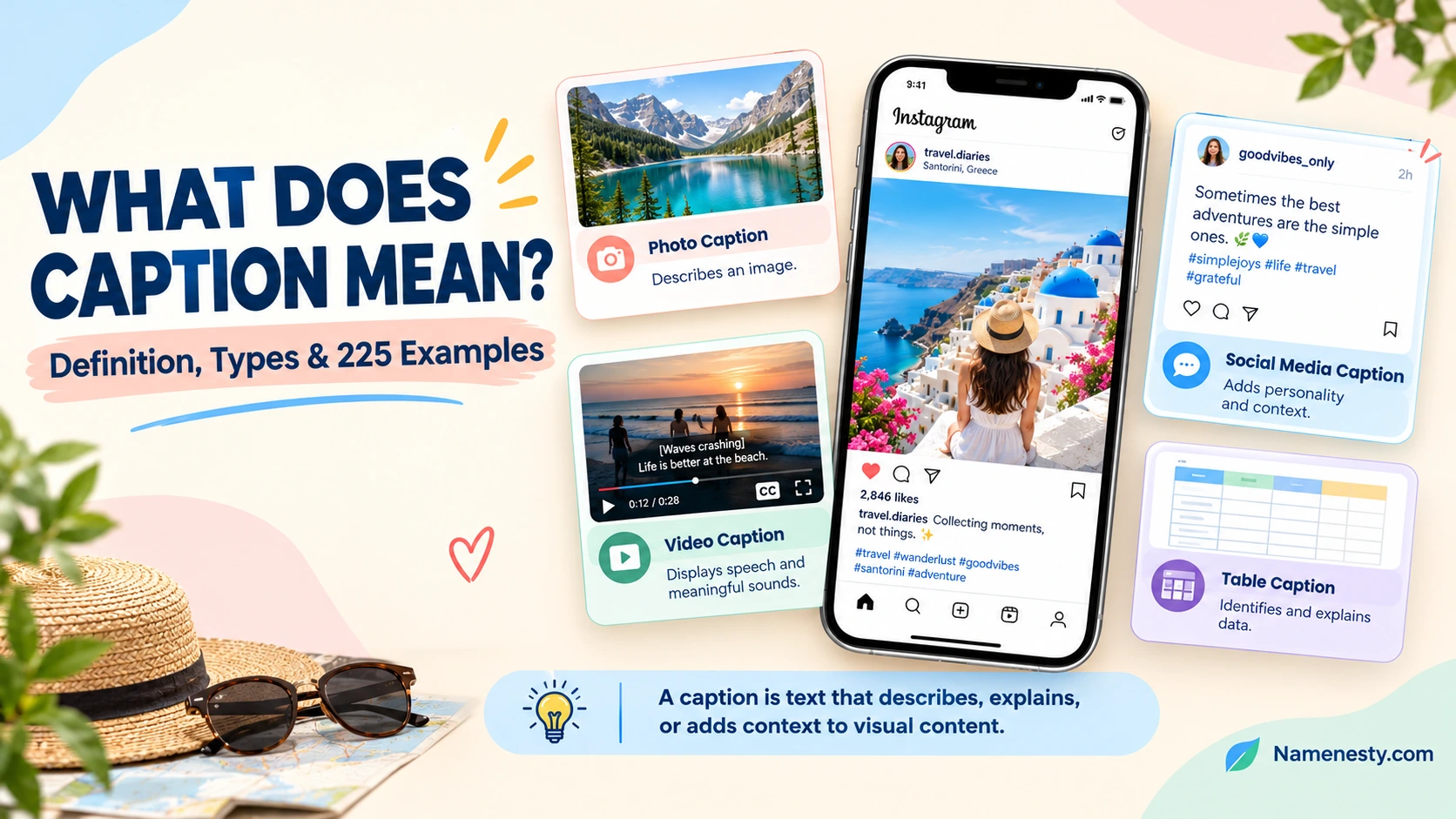
A caption is a short piece of text that describes, explains, or adds meaning to a photo, video, illustration, table, or social media post. On platforms such as Instagram, TikTok, and Facebook, a caption can also express personality, tell a story, share emotions, or encourage people to interact with your content.
But what does caption mean in different situations? Is an Instagram caption the same as a video caption? How do you write one that sounds natural rather than forced?
This guide explains caption meanings in simple language, compares different caption types, and provides 225 original caption examples for everyday moments, selfies, friendships, relationships, travel, personal branding, and social media.
1. What Does Caption Mean? Simple Definition and Examples
A caption is text attached to visual content to provide information, identification, explanation, or additional meaning. Depending on the context, it might be a factual description, a creative sentence, or a written representation of speech and important sounds.
For example, the caption below a newspaper photograph might identify a location, while the caption on an Instagram selfie might express the person’s mood.
| Context | Example | Purpose |
| Photo | “A rainbow appears above the mountains.” | Describe the image |
| “Collecting moments, not things. ✨” | Express personality | |
| Video | “[rain falling] It’s getting colder.” | Communicate audio information |
| Table | “Table 1: Monthly website visits” | Identify data |
| Business post | “Meet the newest addition to our collection.” | Introduce a product |
The meaning changes slightly by context, but the central idea stays consistent: a caption adds useful meaning to something the audience sees.
2. What Is a Caption? Meaning in Simple Words
In everyday language, a caption is the writing that goes with a picture, video, or another visual element. It helps people understand what they are looking at or what the creator wants to communicate.
Imagine a picture of two friends laughing. Without a caption, viewers see a happy moment. With the caption “Ten years of friendship, and we’re still laughing at the same jokes,” they understand the relationship behind the image.
A caption can be informative, emotional, humorous, descriptive, or persuasive.
What makes a caption effective?
A good caption normally has a clear purpose. It may explain what happened, reveal something the image cannot communicate alone, express a feeling, or invite the audience to respond.
The best caption is not necessarily the longest or the funniest. It is the one that fits the visual, the audience, and the intended message.
3. What Does Caption Mean on Instagram and Social Media?
On social media, a caption is the text published alongside a photo, video, carousel, or other post. It gives creators space to express themselves beyond the visual content.
For example, a sunset photograph could have a simple caption such as “Golden hour feels different here,” while a business post might include product details and a helpful invitation to learn more.
Social captions can include emojis, hashtags, mentions, storytelling, questions, and calls to action. None of those elements is mandatory.
Caption meaning across platforms
| Platform | Common caption purpose | Helpful approach |
| Personality, storytelling, visual context | Match the mood of the image | |
| TikTok | Video context, humor, curiosity | Make the message immediately clear |
| Stories, updates, conversation | Use natural, conversational language | |
| Snapchat | Immediate reactions and personal moments | Keep the text brief |
| Threads | Thoughts and discussion | Start with a relatable observation |
| Explain and contextualize visual ideas | Use specific, descriptive language | |
| YouTube | Video description or timed accessibility text | Distinguish descriptions from actual video captions |
| Professional insights and updates | Lead with a meaningful takeaway |
A social media caption is not the same as timed accessibility captions, even though both use the word caption.
4. What Does Caption Mean in a Photo or Picture?
A photo caption is text that accompanies an image and explains what it shows or why it matters. In journalism, it often identifies people, places, events, and dates. In personal posts, it may express a memory, feeling, or opinion.
For example:
Descriptive photo caption: “A family watches the sunset from a hillside overlooking the city.”
Emotional photo caption: “Some evenings feel like memories before they’re even over.”
Informational photo caption: “Volunteers prepare meals for residents affected by the storm.”
A useful distinction is that a visible photo caption serves readers, while image alt text primarily describes meaningful visual information for people using assistive technology and can also serve as fallback text.
For factual images, accuracy matters more than clever wording. For creative social posts, personal expression may matter more than detailed identification.
- Explore More: https://namenesty.com/what-are-good-captions/
5. What Does Caption Mean in a Video?
In video, captions commonly refer to synchronized text that represents spoken words and important audio information. They help viewers follow content when they cannot hear it clearly or cannot access the audio.
For example, a video caption might display:
[birds chirping] Good morning, everyone!
Illustration of synchronized video captions showing speech and a meaningful sound.
Well-produced accessibility captions may include dialogue, speaker identification, music, laughter, and relevant sound effects.
A separate written description below a video is often called a social media caption or video description. It is not necessarily synchronized with the video.
6. What Are the Different Types of Captions?
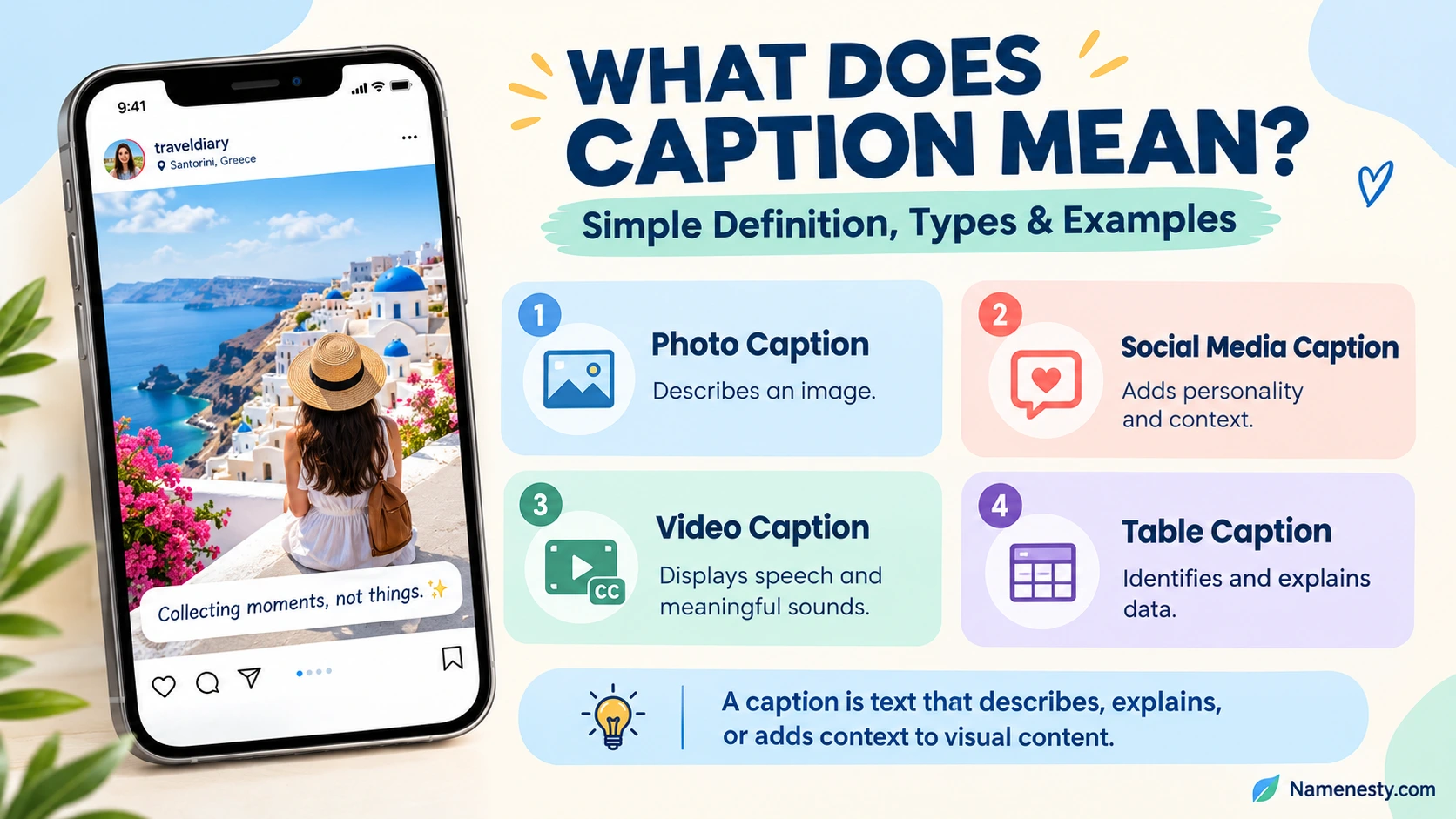
Captions serve different purposes depending on the content and audience. Understanding these types makes it easier to choose the right writing style.
| Caption type | Meaning | Best use |
| Photo caption | Text describing or contextualizing an image | News, blogs, galleries |
| Social media caption | Text accompanying a social post | Instagram, TikTok, Facebook |
| Video caption | Synchronized speech and audio information | Educational and entertainment videos |
| Closed caption | Caption track viewers can switch on or off | Streaming and online video |
| Open caption | Caption text permanently visible in the video | Videos with burned-in text |
| Figure caption | Text identifying or explaining a visual figure | Reports and research |
| Table caption | Text identifying or explaining tabular data | Documents and articles |
| Legal caption | Formal heading identifying a legal case | Court documents |
The purpose determines how a caption should be written. A research figure caption needs precision, while a personal Instagram caption can use emotion, humor, and creative language.
7. Caption vs. Subtitle: What Is the Difference?
Captions and subtitles both display text with video, but their traditional purposes differ.
Captions are designed to communicate speech and meaningful non-speech sounds. Subtitles commonly display spoken dialogue, often translating it into another language.
| Feature | Captions | Subtitles |
| Spoken dialogue | Yes | Yes |
| Important sound effects | Generally included | Not always included |
| Speaker identification | Included when needed | Varies |
| Translation | Possible | Common |
| Accessibility focus | Often designed for deaf and hard-of-hearing viewers | Depends on subtitle type |
| Example | “[door slams] Who’s there?” | “Who’s there?” |
The terminology can overlap in real-world streaming services. Subtitles for deaf and hard-of-hearing audiences may include the same accessibility information as captions.
For a deeper explanation, see the W3C Web Accessibility Initiative’s guidance on captions.
8. What Is the Difference Between Open and Closed Captions?
Open captions are permanently visible in the video image. Closed captions can be turned on or off when the player and caption track support that functionality.
Welcome to our story!
Open captions
Always visible because the text is embedded in the video.
Welcome to our story!
Closed captions
Can be enabled or disabled through supported player controls.
Open captions can be useful when a creator wants text to remain visible regardless of playback settings. Closed captions provide viewers with more control over their viewing experience.
Neither should be confused with a social media post caption, which is usually separate from the video’s timed audio text.
9. What Does Captioned Mean? Definition and Examples
Captioned is the past tense and past participle of the verb caption. It means that explanatory or descriptive text has been added to an image, video, or other content.
For example, “She captioned her photo with a funny joke” means she added a humorous written message to the picture.
Other examples include:
- “The documentary was captioned for accessibility.”
- “He captioned the photograph with the location and date.”
- “The creator captioned her post with a question.”
- “The chart was captioned to explain the figures.”
The related word captioning describes the process of creating or adding captions. In video production, captioning may involve transcribing dialogue, identifying relevant sounds, synchronizing text, and checking accuracy.
10. How to Write a Good Caption for Any Post
A good caption begins with understanding the purpose of your content. Before writing, ask yourself what the audience should know, feel, or do after seeing the post.
A simple caption-writing formula
Hook
Context
Emotion
Optional CTA
Example: “One unexpected turn, the prettiest mountain view, and a memory I’ll keep forever. ⛰️ What’s your favorite road-trip discovery?”
Start with a meaningful idea. Add context the visual cannot communicate alone. Match the language to your audience, then include a question or call to action only if it naturally supports the post.
Compare these two examples:
Basic: “Nice day.”
More expressive: “A slow afternoon, fresh coffee, and absolutely nowhere I need to be.”
The second caption creates a clearer scene and feeling. However, the shorter version might be better when the photograph already tells a strong story.
The key is relevance rather than length.
11. 15 Short Caption Examples for Photos and Social Media
Short captions communicate a mood or idea in just a few words. They are especially useful for selfies, Instagram Stories, Snapchat updates, profile pictures, and minimalist posts where the image already carries most of the message.
BEST FOR: Instagram, Snapchat, Threads, selfies and everyday moments
225 caption ideas · 15 styles
Select a style to browse and copy examples.
Copy all 15
Short captions
01
A little more alive today.
02
Somewhere between here and happy.
03
Just enough magic. ✨
04
This moment gets to stay.
05
Keeping the good parts close.
06
Soft days, strong memories.
07
A pause worth taking.
08
Currently choosing joy.
09
The little things won.
10
Life, in lovely fragments.
11
Nothing extra, just me.
12
A good kind of ordinary.
13
Today looks promising.
14
Here for this feeling.
15
One moment, all mine.
Why these short captions work
Short captions are most effective when they reinforce a strong visual instead of repeating everything already visible. A reflective caption can deepen an emotional post, while a playful one can give an ordinary selfie a distinct personality.
They are not automatically more engaging than longer captions. The ideal length depends on whether the audience needs information, entertainment, storytelling, or a reason to respond.
12. 15 Creative Instagram Caption Examples for Every Mood
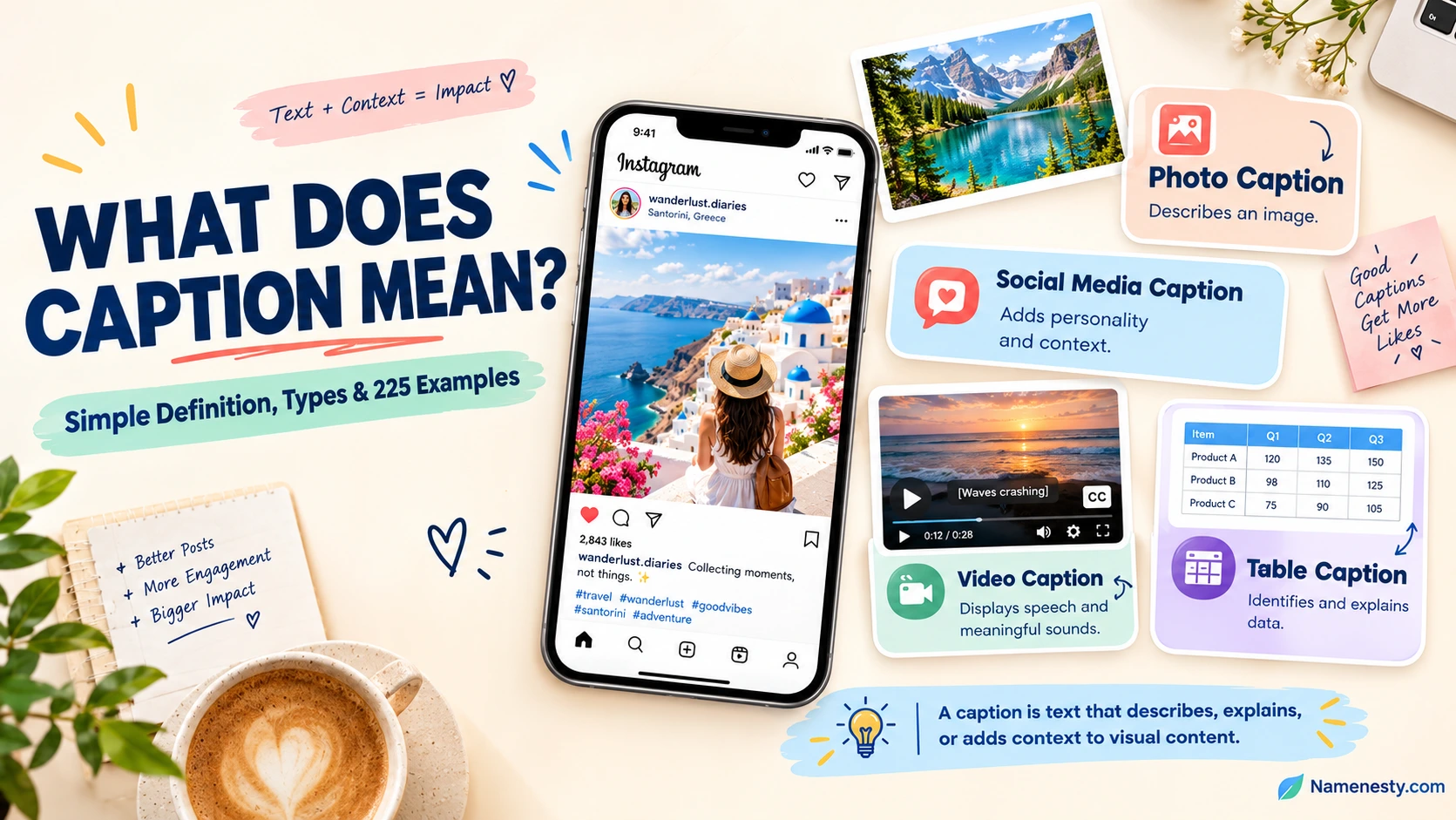
Instagram captions give photos more personality and help followers understand the moment behind an image. The strongest choices are often specific, natural, and connected to something meaningful in the photograph.
The following examples work particularly well for photo dumps, lifestyle posts, travel snapshots, casual Reels, and personal updates.
BEST FOR: Instagram feeds, carousels, photo dumps, Reels, and lifestyle creators
1. Plot twist: the ordinary day became my favorite memory.
2. If this photo had a soundtrack, it would be sunshine.
3. I came for the view and stayed for the feeling.
4. Some chapters deserve a little extra sparkle.
5. Proof that spontaneous plans have excellent taste.
6. Not everything beautiful needs a filter.
7. This is what my camera roll has been waiting for.
8. Somewhere in this picture is my new favorite story.
9. The lighting understood the assignment.
10. Today’s mood has officially entered its golden era.
11. No grand occasion, just a genuinely good day.
12. Caught between a perfect angle and a better memory.
13. My weekend deserves its own highlight reel.
14. A little chaos, a lot of character.
15. The kind of scene you wish you could bottle.
How to choose an Instagram caption
Instagram caption quality depends on relevance, clarity, and authenticity. Buffer’s guidance also emphasizes matching the caption to the visual and the creator’s voice.
Buffer
+1
13. How to Choose the Right Caption for Your Photo or Video
The right caption depends on the mood, audience, platform, and purpose of the post. A caption that works beautifully for a sunset selfie might feel inappropriate beneath an educational video or professional announcement.
Instead of searching endlessly for the most popular phrase, begin with the emotion or message you want to communicate.
Interactive caption selection guide
MoodFunny
PlatformInstagram
Main goal
Express personality
Share a memory
Start a conversation
Teach something
Promote a product
SUGGESTED CAPTION
Currently accepting compliments and snack recommendations.
A starting point for your Instagram post. Personalize it with a specific detail from your content.
Copy caption
Caption style comparison
| Caption style | Emotional impact | Suitable content |
| Short | Simple, immediate | Selfies, minimalist photos |
| Funny | Playful, relatable | Bloopers, casual updates |
| Romantic | Warm, affectionate | Couples, anniversaries |
| Aesthetic | Atmospheric, artistic | Photography, lifestyle |
| Inspirational | Hopeful, encouraging | Achievements, progress |
| Deep | Thoughtful, introspective | Reflections, personal stories |
| Savage | Assertive, humorous | Attitude posts |
| Informational | Clear, useful | Tutorials, business updates |
Which captions increase engagement?
There is no universal caption style that guarantees more likes, comments, or shares. However, a caption can support engagement when it gives the audience something relevant to think about or respond to.
A question may encourage discussion when followers genuinely care about the answer. A personal story may inspire meaningful comments. An educational caption may encourage saves because readers want to return to the information.
Avoid asking for engagement without offering value. The best caption creates a reason for interaction rather than merely demanding it.
Which captions are trending in 2026?
Current-feeling caption approaches include conversational micro-stories, casual humor, reflective one-liners, photo-dump diary text, and captions that acknowledge imperfect everyday moments.
These are creative approaches rather than verified rankings of the most-used captions in 2026. Trends change quickly, and relevance to the actual post is more important than copying a fashionable phrase.
14. Why Are Captions Important for Accessibility and Engagement?
Captions matter because they make content easier to understand, provide context, and help audiences connect with the information or emotion behind a visual.
However, the benefits depend on which type of caption is being discussed. Video accessibility captions serve a different primary purpose from social media post captions.
Accessibility and inclusion
Video captions provide essential information for viewers who are deaf or hard of hearing. They can also help people watching videos in noisy places, quiet environments, or situations where sound is unavailable.
According to the World Wide Web Consortium (W3C), accessible captions should communicate meaningful speech and non-speech audio information and remain synchronized with the video.
W3C
+1
For example, a properly captioned educational video might include both the instructor’s explanation and a sound cue that is necessary to understand the lesson.
Automatic captions can be helpful, but creators should review them for mistakes, especially when discussing names, numbers, technical concepts, or safety-related information.
Social media engagement
Social media captions can encourage interaction by adding context, personality, or a reason to participate.
A caption such as “Beautiful beach” describes a scene. A more specific caption like “We woke up before sunrise to find this empty stretch of coastline” gives the audience a story.
The second version may create more opportunities for meaningful conversation because it shares something the photograph alone cannot communicate.
Personal branding
For creators, entrepreneurs, and professionals, captions also help establish a recognizable communication style.
A photographer might write thoughtfully about light and composition. A fitness creator might explain the lesson behind a training session. A business owner might share the process behind a new product.
- Explore More: https://namenesty.com/sponge-bath
Consistent, authentic language can help followers understand what a creator or brand stands for.
Caption benefits by purpose
| Benefit | Caption approach | Intended result |
| Accessibility | Accurate synchronized video captions | Help viewers access audio information |
| Clarity | Descriptive image captions | Explain what the visual represents |
| Connection | Personal storytelling | Build audience familiarity |
| Conversation | Relevant questions | Invite meaningful responses |
| Education | Useful explanations | Help readers understand or remember |
| Brand identity | Consistent tone and messaging | Establish a recognizable voice |
| Discoverability | Clear, relevant descriptions | Help communicate the subject of a post |
Captions can support these outcomes, but performance depends on the content, audience, platform, and presentation. No particular caption format guarantees reach or engagement.
15. People Also Ask About Caption Meaning
A caption is a short text that explains, describes, or adds meaning to a picture, video, or other visual content. On social media, it is usually the text accompanying a post.:
An example is “A peaceful morning beside the ocean.” This caption describes the feeling and setting of a beach photograph. Another example is “New beginnings, familiar smiles,” which suits a personal milestone post.:
An Instagram caption is the text accompanying a photo, Reel, or carousel. It can contain a story, joke, description, emojis, hashtags, mentions, or a call to action:.
A caption is text accompanying content, while a quote is a statement attributed to a person or source. A quote can be used as a caption, but not every caption is a quote.
Yes. A caption can be a single word such as “Finally,” “Unstoppable,” or “Home.” One-word captions are particularly suitable when the visual already communicates most of the message.
In texting or messaging, caption usually refers to text attached to a shared photo, video, or status update. Its meaning depends on the application and how the image or video is presented.
On TikTok, a caption commonly means the written description accompanying a video. TikTok videos can also contain synchronized captions that display spoken words and meaningful audio information.
Conclusion: What Does Caption Mean and How Should You Use One?
A caption is more than a few words attached to a photograph. It can explain a visual, preserve a memory, communicate emotion, introduce a product, or make video content more accessible.
The most important thing is to understand its purpose.
This guide has covered the definition of a caption, different caption types, the distinction between captions and subtitles, practical writing advice, and 225 creative examples for different moods and platforms.
Key takeaway: The best caption is not necessarily the cleverest or longest. It is the one that adds the most appropriate meaning to the content.
Bookmark this guide whenever you need a quick definition, writing inspiration, or help choosing the right caption for your next post.










2 thoughts on “What Does Caption Mean? 225 Examples & Easy Guide”