
What Does Carnal Mean? Definition, Bible Meaning, and Examples
Have you ever come across the word in a Bible verse, book, relationship discussion, or social media post and wondered what it really means? You’re not alone. The word can refer to physical desires, sensual or sexual attraction, or worldly concerns, depending on the context. But does it always have a sexual meaning, and what does it mean in the Bible? In this guide, you’ll discover the definition in simple English, learn how to pronounce it, explore real sentence examples, and understand related phrases such as carnal desire, mind, and carnal knowledge. Let’s make the meaning clear.
Have you encountered the word in a Bible verse, book, conversation, or online post and wondered what it actually means? Although the word can sound complicated, its basic meaning is straightforward once you understand the context.
Carnal means relating to the physical body and its desires, especially sensual or sexual desires. In religious writing, it can also describe worldly or fleshly attitudes in contrast with spiritual values.
The word is a formal English adjective, and its exact meaning depends on how it is used. This guide explains the definition, pronunciation, biblical meaning, common phrases, examples, and related words in simple English.
- Explore More: https://namenesty.com/arouse-synonym/
What Does Carnal Mean in Simple English?
In simple English, it means connected with the body, physical pleasure, or bodily desires. It often refers to sexual attraction, but it can also describe a focus on material or worldly concerns rather than spiritual matters.
For example:
- Carnal desire: A strong physical or sexual desire.
- Carnal pleasure: Pleasure associated with bodily or sensual experiences.
- Carnal thinking: Thinking focused on worldly or fleshly concerns, particularly in religious contexts.
The word is more formal than everyday words such as physical or sexual. Its tone may sound literary, serious, or morally critical, depending on the sentence.
For a straightforward definition, remember that it refers to the flesh or physical nature of a person. It does not automatically mean something immoral or sexual in every context.
What Is the Definition of Carnal?
According to the Cambridge Dictionary, carnal is an adjective relating to the physical feelings and desires of the body. It is generally considered a formal word.
The term has several related meanings:
- Bodily: Relating to the physical body.
- Sensual: Connected with physical sensations or pleasure.
- Sexual: Relating to sexual attraction or desire.
- Worldly: Focused on earthly concerns rather than spiritual matters, especially in religious contexts.
The meanings overlap, but they are not identical. A sentence about attraction may refer to sexual desire, while a sentence about a carnal mind may concern a person’s attitudes or priorities.
Example: “The story explores the conflict between spiritual devotion and desire.”
Here, desire refers to physical or sensual desire, while spiritual devotion refers to a religious or spiritual commitment.
How Do You Pronounce Carnal?
The word carnal has two syllables and is pronounced with the stress on the first syllable.
- American English: KAR-nuhl — /ˈkɑːr.nəl/
- British English: KAH-nuhl — /ˈkɑː.nəl/
You can remember the pronunciation as CAR-nal.
The pronunciation differs slightly between American and British English, particularly in the first vowel and the treatment of the letter r. The Cambridge Dictionary entry provides pronunciation guidance for both varieties.
What Does Carnal Mean in the Bible?
In biblical writing, carnal generally means relating to the flesh or human nature, sometimes in contrast with the Spirit of God. Depending on the passage, it may describe ordinary physical or earthly things, human weakness, spiritual immaturity, or behavior driven by selfish desires.
The word does not always refer to sexual activity in the Bible.
For example, the Bible Gateway Encyclopedia of the Bible explains that biblical usage can refer both to physical or earthly things and to attitudes characterized by the flesh rather than spiritual values.
Common biblical expressions include:
- Carnal mind: A mindset described as fleshly or opposed to spiritual priorities.
- Carnal behavior: Conduct characterized by worldly or fleshly attitudes in a religious context.
- Carnal things: Physical or material things, depending on the passage.
- Carnal Christians: A phrase used in some Christian teaching for believers whose behavior reflects spiritual immaturity or worldly priorities.
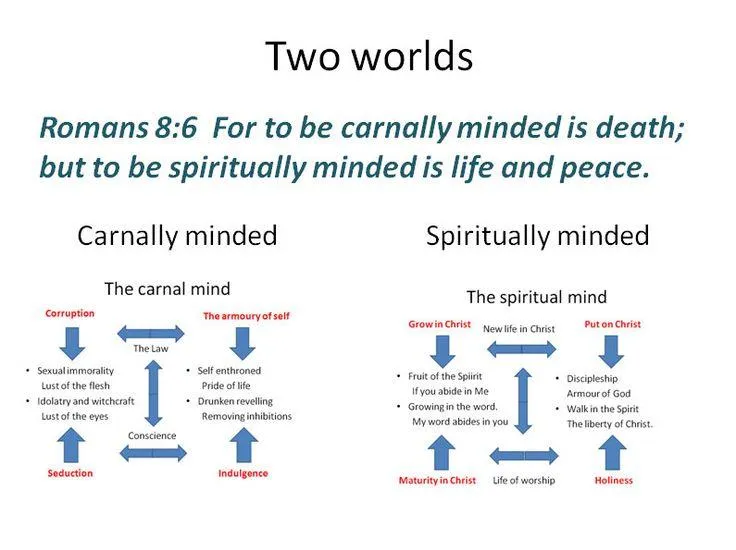
For instance, 1 Corinthians 3 discusses divisions and jealousy among believers and uses the language of fleshly or worldly behavior. Romans 8 contrasts the mindset of the flesh with the mindset of the Spirit.
These passages should be understood in their broader biblical context rather than interpreted as statements about sexual desire alone.
What Does Carnal Mean Spiritually?
Spiritually, carnal often describes a way of thinking or behaving that prioritizes immediate physical desires, selfish ambitions, or worldly concerns over spiritual principles.
In Christian teaching, the term may be used to contrast two orientations:
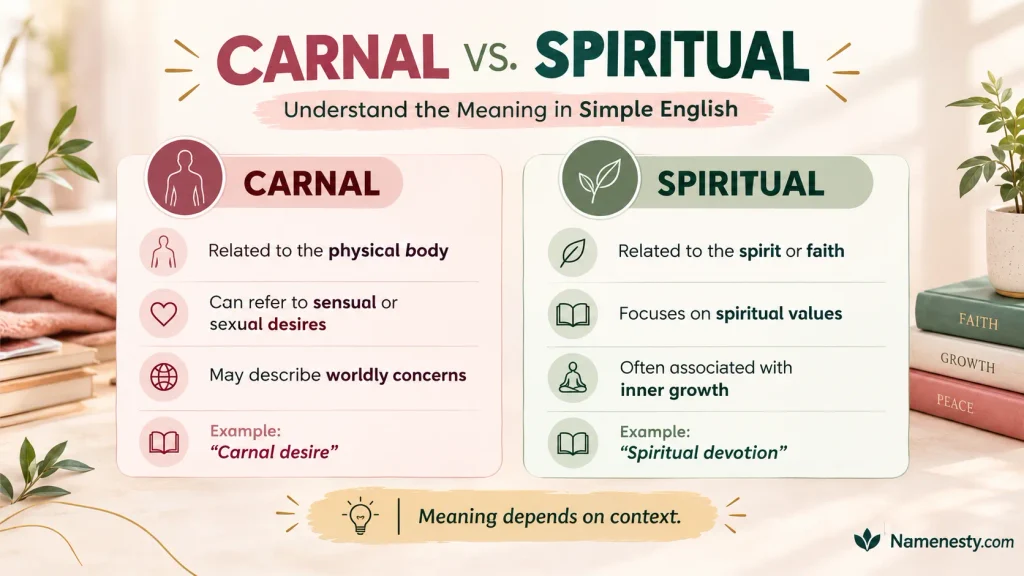
- Carnal: Focused on fleshly impulses or worldly priorities.
- Spiritual: Focused on faith, spiritual growth, and living according to spiritual values.
For example, a religious teacher might describe someone as “carnally minded” when discussing jealousy, selfishness, or a persistent focus on personal desires at the expense of spiritual growth.
This is a religious interpretation of the word, not its only definition. In ordinary English, carnal can simply refer to physical or sensual matters without making a theological judgment.

What Does Carnal Desire Mean?
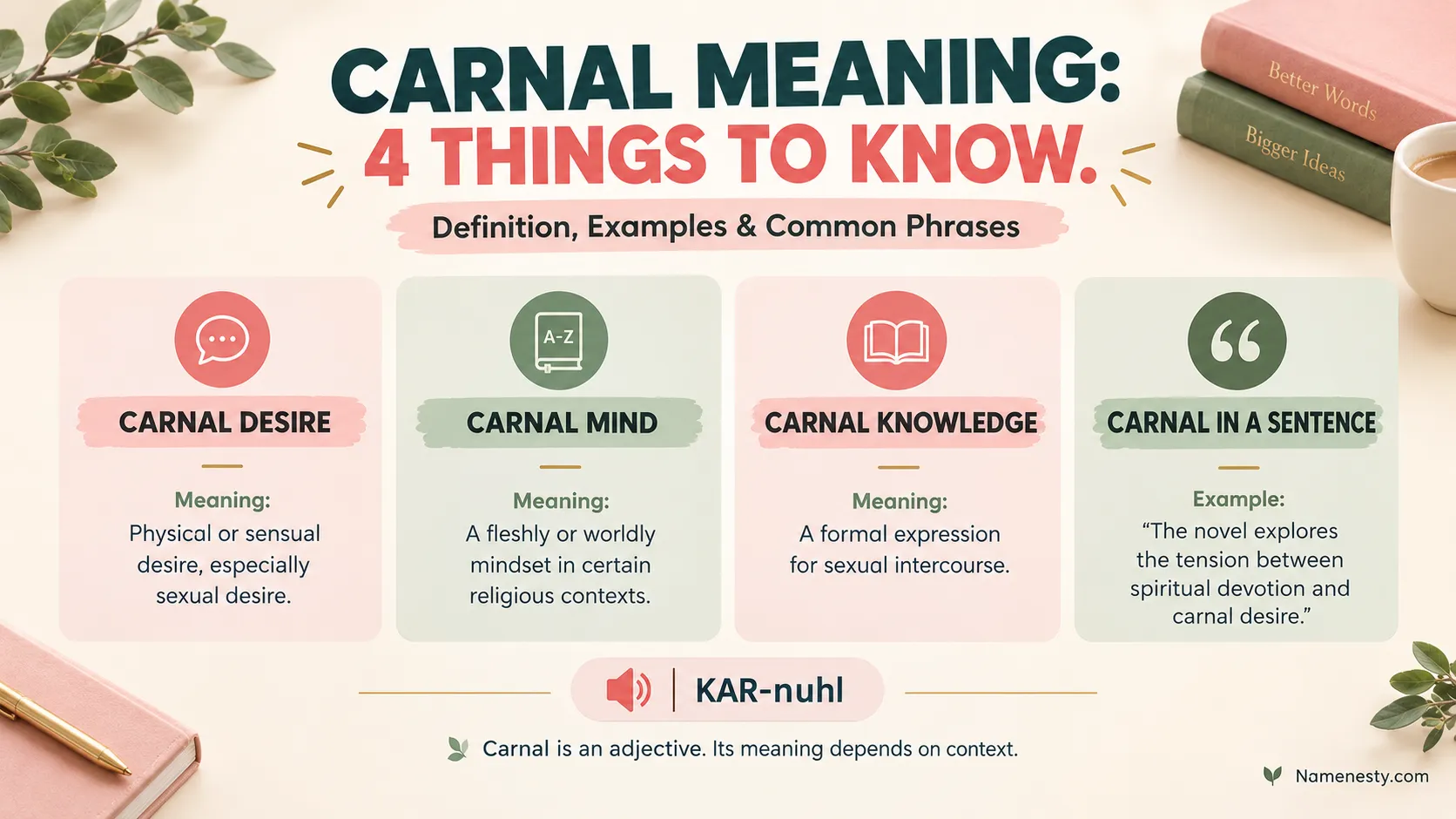
Carnal desire means a physical or sensual desire, especially a sexual desire.
The phrase commonly appears in literature, religious discussions, and descriptions of attraction. Its tone depends on the writer’s purpose.
Examples:
- “The novel explores the tension between love and carnal desire.”
- “The character struggles to balance physical attraction with personal values.”
- “The sermon warns against allowing carnal desires to control one’s decisions.”
In the first two examples, the expression describes physical attraction or desire. In the third, it carries a moral or religious meaning.
Carnal desire is not necessarily the same as love. Physical attraction can be one aspect of a relationship, while love may also involve emotional connection, trust, respect, and commitment.
What Does Carnal Knowledge Mean?
Carnal knowledge is a formal expression meaning sexual intercourse. It is most commonly encountered in older legal documents, historical writing, and religious or literary texts.
For example:
“The historical document used the expression carnal knowledge to refer to sexual intercourse.”
The phrase sounds formal and old-fashioned in contemporary conversation. Modern writers generally use more direct language when there is no reason to retain the historical expression.
It is also important to distinguish this phrase from the broader meaning of carnal. The word alone can refer to bodily, sensual, or worldly matters, whereas carnal knowledge has a more specific meaning.
What Does a Carnal Mind Mean?
A carnal mind is a mindset focused on fleshly or worldly concerns rather than spiritual priorities, particularly in Christian writing.
The expression is associated with passages such as Romans 8, where the mindset of the flesh is contrasted with the mindset of the Spirit.
Depending on the context, it may describe attitudes such as selfishness, envy, excessive attachment to material things, or resistance to spiritual guidance.
Example:
“The teacher explained that a carnal mind, in this passage, refers to an outlook centered on the flesh rather than the Spirit.”
The phrase does not simply mean having physical needs or experiencing ordinary human feelings. Its religious meaning concerns the orientation of a person’s thoughts and actions.
What Is a Carnal Person?
A carnal person is someone described as being strongly guided by physical appetites, sensual desires, or worldly concerns.
In religious contexts, the phrase may refer to someone whose behavior reflects spiritual immaturity or an emphasis on personal desires over spiritual principles.
In literature, it can describe a character who places considerable importance on bodily pleasure or sexual attraction.
For example:
“The author portrays him as a carnal character who values immediate pleasure above long-term commitments.”
This is a description of a person’s behavior or character, not a clinical or scientific classification. The meaning should be determined from the surrounding text.
What Does Carnal Mean in a Relationship?
In a relationship, carnal usually refers to the physical or sexual side of attraction between people.
For example:
- Carnal attraction: Physical or sexual attraction to another person.
- Carnal desire: A desire for physical or sexual intimacy.
- Carnal passion: Intense physical or sensual passion.
Consider this sentence: “Their connection began with carnal attraction but developed into a deeper emotional bond.”
The sentence distinguishes physical attraction from emotional closeness.
The word does not, by itself, establish whether a relationship is loving, healthy, committed, or meaningful. It describes a particular aspect of attraction rather than the entire relationship.
When reading the word in a message or social media post, pay attention to the surrounding words. A romantic or literary context may emphasize passion, while a religious context may emphasize the contrast between physical desires and spiritual values.
Is Carnal the Same as Sexual or Sensual?
No. Carnal, sexual, and sensual are related, but they do not have the same meanings.
| Word | Meaning | Example |
| Carnal | Relating to the body, physical desires, or worldly concerns | Carnal desires |
| Sexual | Directly relating to sex or sexuality | Sexual attraction |
| Sensual | Relating to the senses and physical pleasure | A sensual experience |
| Spiritual | Relating to the spirit, faith, or spiritual life | Spiritual growth |
| Worldly | Focused on material or earthly concerns | Worldly ambitions |
The Cambridge Dictionary thesaurus lists related terms such as sexual, sensual, erotic, and fleshly.
The important distinction is that carnal has a broader range than sexual. It can refer to bodily or worldly matters without necessarily referring to sexual activity.
What Are Examples of Carnal in a Sentence?
The following original examples show how the word can be used naturally in different contexts.
- “The novel examines the relationship between spiritual devotion and carnal desire.”
- “The character is tempted by carnal pleasures.”
- “Their initial connection was based largely on carnal attraction.”
- “The author contrasts worldly ambition with spiritual fulfillment.”
- “The phrase carnal knowledge appears in the historical legal document.”
- “The discussion explores the difference between physical attraction and emotional intimacy.”
- “The preacher warned the congregation against a carnal mindset.”
- “The poem describes the conflict between the body and the spirit.”
- “The story explores how physical desire can influence human decisions.”
- “The writer uses carnal imagery to describe the character’s intense passion.”
Notice how the meaning changes with the context. Some sentences refer to physical attraction, while others involve religious ideas or literary descriptions.
What Are the Synonyms and Antonyms of Carnal?
The best synonym depends on which meaning of carnal is intended.
Synonyms
- Physical: Bodily, corporeal, fleshly.
- Sensual: Sensual, sensuous, passionate.
- Sexual: Erotic, lustful, sexual.
- Worldly: Earthly, material, temporal, non-spiritual.
These words are not interchangeable in every sentence. For example, corporeal emphasizes the body, whereas worldly emphasizes earthly or material concerns.
Antonyms
Possible antonyms include:
- Spiritual
- Pure
- Chaste
- Sacred
- Holy
The right antonym depends on context. Spiritual is a useful contrast when carnal means worldly or fleshly. Chaste may be suitable when the word refers specifically to sexual desire or conduct.
Is Carnal a Bad Word? Understanding Its Context
No. Carnal is not inherently a swear word or vulgar expression. It is a formal English adjective.
However, the word can carry a negative or judgmental tone, especially in religious writing where it may describe behavior considered selfish, sinful, or opposed to spiritual values.
In literature, it may be used neutrally to describe physical passion or sensual attraction. In a legal or historical phrase such as carnal knowledge, it has a specific formal meaning.
- Explore More: https://namenesty.com/definition-of-seduced/
For example:
- Neutral literary use: “The novel explores carnal attraction.”
- Religious use: “The sermon discusses carnal attitudes.”
- Historical or legal use: “The document refers to carnal knowledge.”
Understanding the context helps you avoid assuming that every use of the word is offensive, sexual, or morally critical.
What Is the Origin of the Word Carnal?
The English word carnal comes from the Latin carnalis, meaning “of the flesh,” from caro or carn-, meaning “flesh.”
This origin explains the word’s central association with the physical body. Over time, its usage developed to include bodily appetites, sensuality, sexual desire, and worldly concerns.
The connection with flesh also helps explain its religious use as a contrast to spiritual life.
People Also Ask About the Meaning of Carnal
Carnal means related to the physical body and its desires, Especially Sensual or sexual desires. In religious writing, it can also mean worldly or fleshly rather than spiritual.
In the Bible, carnal generally refers to the flesh or earthly nature. Depending on the passage, it may describe physical things, human weakness, worldly behavior, or attitudes contrasted with the Spirit.:
Carnal desire means physical or sensual desire, especially sexual desire. Its tone depends on whether it is used in everyday, literary, or religious writing.:
Carnal knowledge is a formal term for sexual intercourse. It is commonly found in historical, legal, and religious texts.
A carnal mind is a mindset described in Christian contexts as being focused on fleshly or worldly concerns rather than spiritual priorities.
A carnal person is someone described as being strongly guided by physical appetites, sensual desires, or worldly concerns. In religious contexts, it may suggest spiritual immaturity.
Conclusion: What Does Carnal Mean?
Carnal means relating to the flesh, physical desires, sensual pleasure, or worldly concerns. Its meaning depends on context: it can describe physical attraction in everyday English or refer to fleshly and worldly attitudes in biblical writing.
Remember these key distinctions:
- Carnal desire: Physical or sexual desire.
- Carnal knowledge: A formal expression for sexual intercourse.
- Carnal mind: A fleshly or worldly mindset in religious contexts.
- Carnal versus spiritual: A contrast between bodily or worldly concerns and spiritual priorities.











3 thoughts on “What Does Carnal Mean? Definition & Bible Meaning”