When Evil Gets a Name — The Ultimate Roster of Movie Antagonists
Some characters live forever in one word. Vader. Lecter. Joker. One name — and your whole nervous system responds. That’s the power of a perfectly crafted movie villain name.
Whether you’re a screenwriter searching for the name that will define your antagonist, a film lover building the ultimate ranked list, or a student analyzing what makes cinema’s greatest bad guys so unforgettable, this is the most complete guide to villain names for movies ever assembled.
We’ve analyzed 70+ years of cinema, broken down 200+ antagonist names by genre, psychology, archetype, and era, and included the hottest new villain names from 2024 and 2026. By the end of this article, you’ll understand not just who the greatest movie villains are — but why their names work.
The villain makes the hero. And the name makes the villain. Let’s dig in.
The 15 Most Iconic Villain Names in Movie History (All-Time Legends)
These are the names that permanently changed cinema. Each one earns its spot not just because of a great performance, but because the name itself does irreplaceable work — before a single line of dialogue is spoken.
| # | Villain Name | Film | What the Name Does |
| 1 | Darth Vader | Star Wars (1977) | “Dark Father” in Dutch — gains devastating new meaning in The Empire Strikes Back |
| 2 | Hannibal Lecter | The Silence of the Lambs (1991) | Ordinary first name + alien surname = clinical predator energy |
| 3 | The Joker | The Dark Knight (2008) | Deceptively playful name for an agent of absolute chaos |
| 4 | Keyser Söze | The Usual Suspects (1995) | Turkish for “to drown in words” — a villain who controls every narrative |
| 5 | Voldemort | Harry Potter series | French-derived “flight from death” — so feared his name can’t be spoken |
| 6 | Anton Chigurh | No Country for Old Men (2007) | Completely unplaceable — no cultural anchor = pure dread |
| 7 | Norman Bates | Psycho (1960) | Devastatingly ordinary — the horror is in the normalcy |
| 8 | Nurse Ratched | One Flew Over the Cuckoo’s Nest (1975) | Clinical, mechanical — sounds like the click of a trap closing |
Table 2
| # | Villain Name | Film | What the Name Does |
| 9 | Hans Gruber | Die Hard (1988) | A common European name elevated into a byword for stylish villainy |
| 10 | Sauron | The Lord of the Rings | Ancient, sibilant, impossible to say without a chill |
| 11 | Thanos | Avengers: Infinity War (2018) | Greek root for death; two hard syllables that feel like a verdict |
| 12 | Pennywise | It (1990/2017) | Absurdly cheerful name for something purely evil — the contrast is the horror |
| 13 | Magneto | X-Men series | Power encoded in the name itself — magnetic, forceful, repelling |
| 14 | Loki | Thor / Avengers | Norse trickster god — carries 1,000 years of mythological menace |
| 15 | Emperor Palpatine | Star Wars: Return of the Jedi | “Palpatine” sounds palatial and creepy — a name born to rule darkness |
Why these names last: Each one is 2–3 syllables, phonetically distinctive, and carries a layer of meaning beyond the obvious. They don’t sound evil. They are evil — and that’s the difference.
Horror Movie Villain Names That Still Give You Nightmares
Horror has produced the richest vein of villain naming in all of cinema. The best horror villain names walk a knife’s edge between the mundane and the monstrous — and that tension is where the fear lives.
| # | Villain Name | Film | Fear Factor |
| 1 | Michael Myers | Halloween (1978) | Terrifyingly ordinary — could be your neighbor |
| 2 | Jason Voorhees | Friday the 13th (1980) | Biblical first name turned slasher icon |
| 3 | Freddy Krueger | A Nightmare on Elm Street (1984) | Childlike “Freddy” vs brutal “Krueger” — a name of two halves |
| 4 | Leatherface | The Texas Chain Saw Massacre (1974) | Descriptive nickname; no humanity left in it |
| 5 | Pennywise the Dancing Clown | It (1990/2017) | Cheerful name, apocalyptic threat |
| 6 | Pinhead | Hellraiser (1987) | Brutally blunt — earned in the most disturbing way |
| 7 | Candyman | Candyman (1992) | Sweet name for something summoned in mirrors |
| 8 | Art the Clown | Terrifier series | Deliberately bland — “Art” as the punchline to a very dark joke |
| 9 | Ghostface | Scream (1996) | Masked identity; the name hides everyone and no one |
| 10 | Samara Morgan | The Ring (2002) | Soft, feminine name that hides pure malevolence |
| 11 | Annie Wilkes | Misery (1990) | Sounds like your aunt — behaves like a nightmare |
| 12 | Count Orlok | Nosferatu (1922/2024) | Sparse, aristocratic, ancient — pre-dates memory |
| 13 | Aunt Gladys Lilly | Weapons (2025) | Instant 2025 icon — grandmotherly name masking absolute evil |
| 14 | Pazuzu | The Exorcist (1973) | Real Mesopotamian demon name — the research makes it worse |
| 15 | The Major | The Long Walk (2025) | No real name at all — the absence of identity IS the horror |
Horror naming truth: The genre’s best villain names either sound like someone you already know (Michael, Annie, Norman) or belong to something so alien it has no human category (Pazuzu, Pennywise). Both paths lead to fear — just through opposite doors.
Sci-Fi & Space Opera Villain Names That Feel Like the Future
Science fiction villain names carry a unique burden — they must feel foreign enough to signal “other world” while remaining pronounceable and memorable. The greatest sci-fi antagonist names nail this balance.
| # | Villain Name | Film | Why It Works in Sci-Fi |
| 1 | Darth Vader | Star Wars (1977) | Germanic/Dutch roots make it feel both alien and ancient |
| 2 | Emperor Palpatine | Return of the Jedi (1983) | Political title + invented surname = totalitarian dread |
| 3 | Grand Moff Tarkin | Star Wars (1977) | Military title + hard consonants = cold bureaucratic evil |
| 4 | Thanos | Avengers: Infinity War (2018) | Greek “Thanatos” (death) stripped to its brutal minimum |
| 5 | General Zod | Superman II (1980) | One syllable, military title — punchy and militaristic |
| 6 | HAL 9000 | 2001: A Space Odyssey (1968) | Mundane acronym as the most unsettling villain name ever |
| 7 | Agent Smith | The Matrix (1999) | Corporate ordinariness as existential threat |
| 8 | Roy Batty | Blade Runner (1982) | Deceptively simple — “batty” suggesting instability, humanity’s edge |
| 9 | Feyd-Rautha Harkonnen | Dune: Part Two (2024) | Hyphenated aristocratic naming = inherited dynastic evil |
| 10 | Baron Vladimir Harkonnen | Dune (2021) | Title + Slavic surname = oppressive colonial power |
| 11 | Varang | Avatar: Fire and Ash (2025) | Organic, elemental — belongs to Pandora’s world |
| 12 | Colonel Miles Quaritch | Avatar (2009) | Military rank + hard Q sound = unyielding aggression |
| 13 | Skynet | The Terminator (1984) | Corporate-tech name for humanity’s extinction — banally terrifying |
| 14 | Starkiller | Star Wars (concept) | What it says on the tin — cosmic, unsparing |
| 15 | Ronan the Accuser | Guardians of the Galaxy (2014) | Title as name — “Accuser” defines his entire worldview |
Sci-fi naming rule: The best space villain names either feel like they’ve been translated from something ancient and alien (Harkonnen, Palpatine) or are devastatingly mundane (HAL 9000, Agent Smith) — because sometimes the banality of evil is the point.
Fantasy Movie Villain Names Drawn from Myth and Darkness
Fantasy gives writers the widest naming canvas in cinema. The best fantasy villain names draw from real mythology, constructed languages, and ancient etymology — giving them a depth that feels earned rather than invented.
| # | Villain Name | Film | Mythic/Etymological Root |
| 1 | Sauron | Lord of the Rings | Quenya for “the abhorred” — Tolkien’s crafted language lends real weight |
| 2 | Saruman the White | Lord of the Rings | Old English “saru-man” = man of cunning |
| 3 | Voldemort | Harry Potter series | French “vol de mort” = flight from / theft of death |
| 4 | Morgoth | The Silmarillion | Tolkien’s first Dark Lord — “Black Enemy of the World” |
| 5 | Maleficent | Sleeping Beauty / Maleficent | Latin “maleficentia” = evil-doing, harmful |
| 6 | Hades | Hercules (1997) | Actual Greek god of the underworld — 3,000 years of fear behind the name |
| 7 | Commodus | Gladiator (2000) | Historical Roman emperor — real person, real atrocities |
| 8 | Xerxes | 300 (2006) | Old Persian “Xšayārša” = ruler over heroes |
| 9 | The Darkness | Legend (1985) | Mythic abstraction — when evil is so vast it needs no other name |
| 10 | Frollo | The Hunchback of Notre Dame (1996) | Cold, closed syllables — dismissive and cruel by sound |
| 11 | The Evil Queen | Snow White | Archetypal title — the original template all fantasy queens descend from |
| 12 | Malebolge | Various | Dante’s eighth circle of Hell — borrowed by fantasy for ultimate evil |
| 13 | Gollum | Lord of the Rings | Onomatopoeic of the gulping, swallowing sound the character makes |
| 14 | Jadis the White Witch | The Chronicles of Narnia | “Jadis” from Arabic/Persian: witch, sorceress |
| 15 | The Horned King | The Black Cauldron (1985) | Celtic mythic figure — a name that belongs to nightmares |
Disney & Animation Villain Names That Defined Childhood Fear
Disney villain names are a masterclass in accessible menace. They work for children on the level of sound — Cruella hisses and stabs — while carrying meanings adults discover later. Every name on this list is doing double duty.
| # | Villain Name | Film | Hidden Meaning |
| 1 | Cruella de Vil | 101 Dalmatians | Audibly says “cruel devil” — one of the least subtle villain names ever, brilliantly |
| 2 | Maleficent | Sleeping Beauty | From Latin: “evil-doing” — kids feel it before they know it |
| 3 | Scar | The Lion King (1994) | Named for the wound on his face — a name that marks him as damaged and dangerous |
| 4 | Jafar | Aladdin (1992) | Hissing sibilance; dark vowels; feels foreign and threatening |
| 5 | Ursula | The Little Mermaid (1989) | Latin for “little bear” — deceptively soft name for ocean-scale evil |
| 6 | Hades | Hercules (1997) | Real Greek death god; kids learn mythology through fear |
| 7 | Gaston | Beauty and the Beast | Pompous French name — perfectly self-satisfied |
| 8 | Frollo | The Hunchback of Notre Dame | Cold, clipped syllables; repressed and cruel by sound |
| 9 | Yzma | The Emperor’s New Groove (2000) | Sharp, eccentric, odd — like the character herself |
| 10 | Syndrome | The Incredibles (2004) | Tech-fandom villain whose name blurs into “syndrome” — a psychological condition |
| 11 | Mother Gothel | Tangled (2010) | “Gothel” echoes “godmother” — a poisoned caretaker name |
| 12 | Doctor Facilier | The Princess and the Frog (2009) | Elegant, shadow-smooth — “facilier” from French: one who facilitates (dark deals) |
| 13 | Bellwether | Zootopia (2016) | Literally “the sheep that leads the flock” — bait-and-switch villain naming perfection |
| 14 | King Candy / Turbo | Wreck-It Ralph (2012) | Sweet name concealing a poisoned identity — the sweetness IS the lie |
| 15 | The Coachman | Pinocchio (1940) | No name at all — just a job title. The anonymity makes him worse. |
Female Villain Names in Movies — The Most Iconic Women of Evil
For decades, female villains were sidelined or reduced to “jealous queen” archetypes. That era is over. Cinema’s most nuanced, most terrifying, most complex villain names increasingly belong to women — and these names deserve their own spotlight.
| # | Villain Name | Film | What Makes Her Unforgettable |
| 1 | Nurse Ratched | One Flew Over the Cuckoo’s Nest (1975) | Institutional evil in a uniform — “Ratched” like a ratchet tightening |
| 2 | Amy Dunne | Gone Girl (2014) | Devastatingly ordinary name for the most calculating villain in modern thriller |
| 3 | Annie Wilkes | Misery (1990) | Fan obsession weaponized — sounds like your aunt, acts like your captor |
| 4 | Maleficent | Sleeping Beauty / Maleficent | The name literally means evil-doing — theatrical, mythic, inevitable |
| 5 | Cruella de Vil | 101 Dalmatians | Fashion villain whose name is her thesis statement |
| 6 | Dolores Umbridge | Harry Potter series | “Dolores” = pain (Latin); “Umbridge” echoes “umbrage” — taking offense as power |
| 7 | Eleanor Iselin | The Manchurian Candidate (1962) | Cold political manipulation — ordinary name hiding extraordinary ruthlessness |
| 8 | Ursula | The Little Mermaid | Operatically villainous; the Latin softness is a trap |
Table 2
| # | Villain Name | Film | What Makes Her Unforgettable |
| 9 | Margaret White | Carrie (1976) | Religious fundamentalism encoded in a plain, maternal name |
| 10 | Asami Yamazaki | Audition (1999) | A quiet Japanese name concealing the film’s devastating reveal |
| 11 | Red / Adelaide Wilson | Us (2019) | Dual name for dual identity — the naming structure is the horror |
| 12 | Aunt Gladys Lilly | Weapons (2025) | Instant 2025 icon — grandmotherly warmth as the ultimate villain mask |
| 13 | Varang | Avatar: Fire and Ash (2025) | First true Na’vi villain — ancient, elemental, commanding |
| 14 | Madame Morrible | Wicked (2024) | “Morrible” audibly contains “horrible” — naming that winks without hiding |
| 15 | O-Ren Ishii | Kill Bill (2003) | Precise, controlled name for cinema’s most controlled assassin |
The shift happening now: Female villain names are moving away from overtly “evil” sounds and toward deceptive ordinariness. Gladys. Amy. Eleanor. Annie. The most frightening female villains in 2024–2025 cinema have names that sound like safety — and that’s the point.
Classic Villain Names from Hollywood’s Golden Age (Pre-1980)
Before CGI, before franchises — Hollywood’s classic era built villainy from character alone. These names come from a time when a single film could define an actor for life, and a name had to carry the entire weight of a career’s worth of menace.
| # | Villain Name | Film | Era |
| 1 | Harry Lime | The Third Man (1949) | Cold War noir — “Lime” promises zest; delivers poison |
| 2 | Norman Bates | Psycho (1960) | Hitchcock’s masterstroke — a name of perfect innocence |
| 3 | Alex DeLarge | A Clockwork Orange (1971) | “Alex” = friendly; “DeLarge” = pretension; together = designer violence |
| 4 | Iago | Othello (various adaptations) | One of literature’s most studied villain names — shapeless, unrooted |
| 5 | Mrs. Danvers | Rebecca (1940) | Formal address as a weapon — the “Mrs.” makes her more dangerous |
| 6 | Sam Bowden’s antagonist Max Cady | Cape Fear (1962/1991) | “Cady” sounds almost like “caddie” — servile turned threatening |
| 7 | The Wicked Witch of the West | The Wizard of Oz (1939) | No proper name — replaced entirely by her title and direction |
| 8 | Humbert Humbert | Lolita (1962) | Nabokov’s doubled name — the vanity and self-mythology of a monster |
| 9 | Colonel Walter E. Kurtz | Apocalypse Now (1979) | Military rank stripped of its meaning by the jungle’s madness |
| 10 | Frank Booth | Blue Velvet (1986) | Aggressively ordinary name for David Lynch’s most disturbing creation |
| 11 | Jack Torrance | The Shining (1980) | “Torrance” feels institutional, trapped — like a corridor with no exit |
| 12 | Travis Bickle | Taxi Driver (1976) | An incel before the word existed — the name sounds like a small caliber bullet |
| 13 | The Shark (Bruce) | Jaws (1975) | Given a human name by the cre, the humanizing makes it worse |
| 14 | Nurse Ratched | One Flew Over the Cuckoo’s Nest (1975) | Clinical machinery given a human name |
| 15 | Clarence Boddicker | RoboCop (1987) | Savagely satiric name — almost corporate, almost normal, totally vicious |
Marvel Villain Names — Every MCU Antagonist Worth Remembering
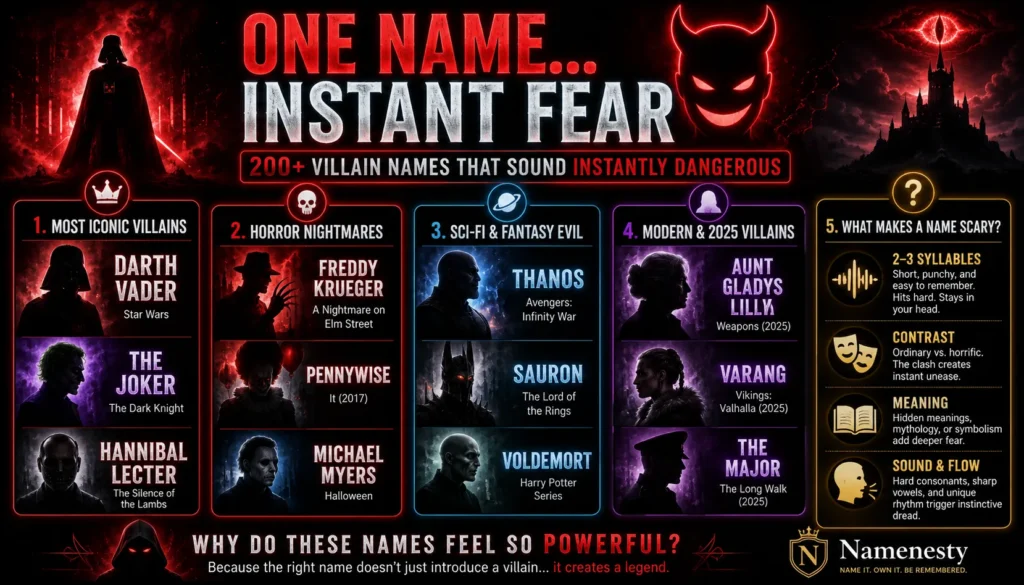
One name… and you already feel the fear 😈
Discover 200+ villain names that sound powerful, scary, and unforgettable — plus the hidden psychology behind what makes them so iconic.
Marvel has produced some of cinema’s most commercially successful — and creatively interesting — villain names. The best MCU antagonist names draw from decades of comic book tradition while adding cinematic weight.
| # | Villain Name | Film | Naming Craft |
| 1 | Thanos | Infinity War / Endgame | Greek “Thanatos” (death personified) — myth made muscular |
| 2 | Loki | Thor / Avengers series | Real Norse mythology — 1,000 years of trickster weight |
| 3 | Magneto | X-Men series | Power named in the name — magnetic, repelling, polarizing |
| 4 | Killmonger (Erik Stevens) | Black Panther (2018) | Real name vs. title — the alias tells you what he became |
| 5 | Bane | The Dark Knight Rises (2012) | Old English “bana” = killer, slayer — ancient, unambiguous |
| 6 | Doctor Doom | Marvel Films | Title + noun = the most on-the-nose villain name that somehow still works |
| 7 | Ultron | Avengers: Age of Ultron | Sounds technological, ultrasonic — beyond human comprehension |
| 8 | Ronan the Accuser | Guardians of the Galaxy | Title = worldview. He doesn’t have a job — he IS an accusation |
| 9 | The Vulture (Adrian Toomes) | Spider-Man: Homecoming | Working-class man with a scavenger’s name — class politics encoded |
| 10 | Red Skull (Johann Schmidt) | Captain America | Nazi bureaucrat hiding behind a mythic horror name |
| 11 | Hela | Thor: Ragnarok (2017) | Norse “Hel” = goddess of death — directly mythological |
| 12 | Baron Mordo | Doctor Strange | Title + Latinate surname = academic villainy with ancient roots |
| 13 | Ego the Living Planet | Guardians Vol. 2 | Named for the Freudian concept — the most literalized villain name in Marvel |
| 14 | Alexander Pierce | The Winter Soldier | Deliberately ordinary — HYDRA’s greatest weapon was looking like Washington |
| 15 | Kang the Conqueror | Ant-Man and the Wasp: Quantumania | Title describes destiny — “conqueror” is not a role; it’s an identity |
DC & Batman Villain Names That Redefined Cinematic Evil
DC’s villain roster has given cinema some of its most psychologically complex antagonist names. From the Joker’s deliberate anonymity to Lex Luthor’s century of iterations, DC villain names carry enormous cultural weight.
| # | Villain Name | Film | Why DC Naming Works |
| 1 | The Joker | Multiple films (1966–2024) | No real name — pure archetype, pure chaos, pure performance |
| 2 | Lex Luthor | Superman series (1978–2025) | “Luthor” from “Luther” = light — the ultimate irony for humanity’s enemy |
| 3 | Bane | The Dark Knight Rises (2012) | Old English “bana” = killer; also: a thing that causes harm |
| 4 | Two-Face / Harvey Dent | The Dark Knight (2008) | The beauty of the name: Dent is whole; Two-Face is broken |
| 5 | Ra’s al Ghul | Batman Begins (2005) | Arabic: “Head of the Demon” — real Arabic lending genuine gravity |
| 6 | Scarecrow (Jonathan Crane) | Batman Begins | Alias more real than the real name — fear given an identity |
| 7 | Deathstroke (Slade Wilson) | Various | Military precision + brutal finality — a soldier who became a weapon |
| 8 | Penguin (Oswald Cobblepot) | Multiple films | Ridiculous name the character has spent his life escaping — the rage drives him |
| 9 | Riddler (Edward Nashton) | The Batman (2022) | Riddler in 2022 given a mundane surname — anonymity as origin story |
| 10 | General Zod | Superman II / Man of Steel | Military title + hard stop — a name that commands and dismisses simultaneously |
| 11 | Steppenwolf | Justice League (2017) | German Romantic literature meets cosmic evil — Hesse repurposed |
| 12 | Darkseid | DC films | “Dark” + “side” — as direct as Darth Vader but cosmic in scale |
| 13 | Black Manta | Aquaman (2018) | Ocean creature + darkness — elemental and personal at once |
| 14 | Talia al Ghul | The Dark Knight Rises | Arabic feminized “head of the demon” — the name hides her lineage in plain sight |
| 15 | Lex Luthor (Nicholas Hoult) | Superman (2025) | Century-old name modernized — proof a great villain name never truly dates |
Action & Thriller Villain Names With Serious Cinematic Swagger
Action and thriller cinema produces villain names with a different quality than horror or fantasy — they need to feel like a real person could have this name, while still carrying unmistakable menace. These are the names you whisper before the movie even starts.
| # | Villain Name | Film | The “Swagger” Factor |
| 1 | Hans Gruber | Die Hard (1988) | European elegance weaponized — Alan Rickman made this name immortal |
| 2 | Hans Landa | Inglourious Basterds (2009) | Nazi charm in a cosmopolitan name — the most unsettling Christoph Waltz role |
| 3 | Raoul Silva | Skyfall (2012) | Romance language roots; suave surface hiding brutal damage |
| 4 | Ivan Drago | Rocky IV (1985) | “Drago” = dragon in several Slavic languages — the Cold War in two syllables |
| 5 | Colonel Kurtz | Apocalypse Now (1979) | Military title stripped of authority — “Kurtz” rhymes with “hurts” |
| 6 | Anton Chigurh | No Country for Old Men (2007) | Unplaceable etymology — no cultural framework, no mercy |
| 7 | Patrick Bateman | American Psycho (2000) | WASP banker name for Wall Street’s worst impulses |
| 8 | Hannibal Lecter | The Silence of the Lambs | “Lecter” from “lector” = reader, lecturer — the most educated monster in cinema |
| 9 | Dementus | Furiosa: A Mad Max Saga (2024) | Latin “demens” = out of one’s mind — poetry in a post-apocalyptic name |
| 10 | Colonel Steven J. Lockjaw | One Battle After Another (2025) | “Lockjaw” = ideological rigidity + physical paralysis; brilliantly charged |
| 11 | Castor Troy | Face/Off (1997) | Mythological twins repurposed — Castor and Pollux as brothers in crime |
| 12 | Lord Humungus | Mad Max 2 (1981) | Self-given title; the grandiosity of the name is the point |
| 13 | Clarence Boddicker | RoboCop (1987) | Almost a middle-manager name — the banality masks the savagery |
| 14 | Amon Goeth | Schindler’s List (1993) | Historical figure — the real name carrying the weight of documented atrocity |
| 15 | Cooper (the villain) | Trap (2024) | No surname needed — Shyamalan’s most disarming villain name by design |
Villain Names from 2024 Movies — The Best New Antagonists
2024 was a landmark year for cinematic villainy. From dystopian sci-fi to folk horror to prestige drama, new villain names entered the cultural lexicon — some of which will still be discussed in 50 years.
| # | Villain Name | Film | What Makes It 2024 |
| 1 | Feyd-Rautha Harkonnen | Dune: Part Two | Hyphenated aristocratic cruelty — the year’s defining antagonist name |
| 2 | Count Orlok | Nosferatu (2024 remake) | 100-year-old name given terrifying new life by Bill Skarsgård |
| 3 | Dementus | Furiosa: A Mad Max Saga | Latin derangement meets post-apocalyptic poetry |
| 4 | Cooper | Trap | Radical ordinariness — the thriller villain whose name is the trick |
| 5 | Lou Langston Sr. | Love Lies Bleeding | Doubled initials; domestic evil with Southern Gothic weight |
| 6 | Cardinal Tedesco | Conclave | Religious title as villain name — institutional power personified |
| 7 | Art the Clown | Terrifier 3 | Deliberately banal; the joke name that stopped being funny |
| 8 | Paddy | Speak No Evil | Irish informality masking European horror |
| 9 | Mr. Melancholy | I Saw the TV Glow | Psychological abstraction given a name — metaphor as antagonist |
| 10 | Megatron | Transformers One | Humanized origin in 2024 — villain name given tragic biography |
| 11 | Madame Morrible | Wicked (2024) | “Morrible” sounds like “horrible” — musical theater villain naming at its best |
| 12 | Feyd / Harkonnen | Dune: Part Two | Family name as inherited evil — the dynasty IS the villain |
| 13 | Longlegs | Longlegs (2024) | Nicolas Cage’s serial killer named for his body — disturbingly literal |
| 14 | Anxiety | Inside Out 2 (2024) | Abstract emotion as antagonist — animated villainy at its most sophisticated |
| 15 | Raoul Silva (echo) | N/A | 2024 saw numerous callbacks proving classic villain names never expire |
Villain Names from 2025 Movies — The Freshest Antagonists in Cinema
2025 delivered what critics are calling one of the greatest years for movie villainy in a generation. These names are fresh, culturally charged, and already entering the permanent vocabulary of cinema evil.
| # | Villain Name | Film | Why It’s Already Iconic |
| 1 | Aunt Gladys Lilly | Weapons | Instant icon — the year’s most terrifying name is the most domestic one |
| 2 | Varang | Avatar: Fire and Ash | First true Na’vi villain; ancient, organic, commanding |
| 3 | The Major | The Long Walk | Name withheld as a power move — Mark Hamill’s best villain role |
| 4 | Colonel Steven J. Lockjaw | One Battle After Another | Most politically charged villain name of 2025 |
| 5 | Lex Luthor | Superman (2025) | Classic name; boldest new interpretation in the character’s history |
| 6 | Reze (Bomb Devil) | Chainsaw Man: The Movie | Deceptively soft name for anime’s most explosive villain |
| 7 | Lockjaw | One Battle After Another | Sean Penn’s finest villain work — name as locked ideology |
| 8 | The Evil Queen | Snow White (2025) | Classic name; Gal Gadot’s widely-discussed interpretation |
| 9 | Cane | The Naked Gun (2025) | Villain in comedy — the name works straight and satirically |
| 10 | Quartich (returning) | Avatar: Fire and Ash | Villain so good he had to come back — name now mythologized |
| 11 | Gladys Lilly (Aunt Gladys) | Weapons | First name basis — you’re afraid of someone you might call “Aunt” |
| 12 | Baron | Various 2025 releases | Aristocratic titles trending in 2025, villain naming |
| 13 | Reze | Chainsaw Man | Short, soft, deceptive — 2025’s best anime villain name |
| 14 | The Bomb Devil | Chainsaw Man | Title reveals power; name Reze conceals it — brilliant duality |
| 15 | Varang of the Mangkwan | Avatar: Fire and Ash | Full name with tribal title — the most complete villain introduction of 2025 |
Scary Villain Names That Work Across Every Genre
Some villain names transcend genre entirely. Whether they appear in horror, drama, thriller, or sci-fi, these names carry a universal dread that needs no context. Just the name, whispered, is enough.
| # | Villain Name | Film | Universal Fear Factor |
| 1 | Hannibal Lecter | Silence of the Lambs | Polite name for a monster who offers dinner before eating you |
| 2 | Anton Chigurh | No Country for Old Men | Completely unplaceable — pure, context-free dread |
| 3 | The Joker | DC Universe | Chaos named as a card game — you can never predict what it means |
| 4 | Voldemort | Harry Potter | So scary, the wizarding world won’t say it |
| 5 | Sauron | Lord of the Rings | One eye. One name. The whole darkness of history in two syllables. |
| 6 | Pennywise | It | Comedy name + clown costume + pure evil = maximum psychological horror |
| 7 | Nurse Ratched | Cuckoo’s Nest | Institutional evil — the name sounds like a mechanism, not a person |
| 8 | Patrick Bateman | American Psycho | WASP normality at its most terrifying |
| 9 | Keyser Söze | The Usual Suspects | A name built to be spoken in fear by other criminals |
| 10 | The Pale Man | Pan’s Labyrinth | No real name — the description IS the dread |
| 11 | Bagul | Sinister (2012) | Ancient Sumerian demon name — real mythology, real chills |
| 12 | Aunt Gladys Lilly | Weapons (2025) | 2025’s scariest name is the warmest one |
| 13 | The Major | The Long Walk (2025) | Title without a name — the absence of identity is the threat |
| 14 | Samara Morgan | The Ring | Japanese “Sadako” translated soft — Americanized horror |
| 15 | Buffalo Bill (Jame Gumb) | Silence of the Lambs | Aliis has built on the absence of identity — the name is the costume |
Cool Villain Names for Movies with Undeniable Cinematic Swagger
Sometimes a villain’s name just has it — an ineffable coolness that makes them the most interesting person in every scene. These are the antagonists audiences secretly root for.
| # | Villain Name | Film | The Cool Factor |
| 1 | Hans Gruber | Die Hard | The villain who made audiences mourn at the end |
| 2 | Keyser Söze | The Usual Suspects | The name that makes the myth — whispered by criminals worldwide |
| 3 | Magneto | X-Men series | Moral complexity + unanswerable power = anti-villain coolness |
| 4 | Loki | Thor / Avengers | God Mischief, the MCU’s most beloved antagonist by audience polling |
| 5 | Killmonger | Black Panther | Alias earned through pain — the alias is more honest than his real name |
| 6 | Raoul Silva | Skyfall | Spanish/Portuguese roots; sounds like a man who summers on islands |
| 7 | Castor Troy | Face/Off | Mythological twins — the name carries a different myth than the character |
| 8 | Dementus | Furiosa | Latin-rooted, post-apocalyptic swagger — Chris Hemsworth’s career highlight |
| 9 | Hans Landa | Inglourious Basterds | Lethal intelligence in a cultured name |
| 10 | Feyd-Rautha | Dune: Part Two | Aristocratic hyphenation as danger — built for privilege and violence equally |
| 11 | Syndrome | The Incredibles | Fanboy rage channeled through a name that sounds like a medical condition |
| 12 | Roy Batty | Blade Runner | Replicant named for combat — “Batty” sounds off, which is the point |
| 13 | Agent Smith | The Matrix | Corporate anonymity turned icon of authoritarian cool |
| 14 | Colonel Lockjaw | One Battle After Another (2025) | Politically charged, brilliantly named, unforgettable |
| 15 | Varang | Avatar: Fire and Ash (2025) | The Na’vi villain whose name already echoes like myth |
Unique & Rare Villain Names in Cinema You Haven’t Thought About Enough
Beyond the obvious icons, cinema is full of villain names that are uniquely crafted, deeply interesting, and rarely discussed. These names deserve more attention.
| # | Villain Name | Film | Why It Deserves More Study |
| 1 | Clarence Boddicker | RoboCop (1987) | Almost a corporate middle-manager — the most satirically named villain in action cinema |
| 2 | Harry Lime | The Third Man (1949) | “Lime” promises zest; delivers poison; one of cinema’s great ironic names |
| 3 | Frank Booth | Blue Velvet (1986) | Dennis Hopper’s creation — aggressively normal name for Lynch’s most disturbing character |
| 4 | Mrs. Danvers | Rebecca (1940) | The formal “Mrs.” is the weapon — it claims respectability while performing devotion as menace |
| 5 | Yzma | Emperor’s New Groove (2000) | Sharp, bizarre, one-of-a-kind — impossible to confuse with any other villain |
| 6 | Dieter Von Cunth | MacGruber (2010) | The most deliberate double-entendre villain name in cinema history |
| 7 | Bagul | Sinister (2012) | Real ancient Sumerian demon name — the research makes it genuinely worse |
| 8 | Paimon | Hereditary (2018) | Real demonological entity — “Paimon” from medieval grimoires |
| 9 | Mr. Melancholy | I Saw the TV Glow (2024) | Abstract psychological state as villain identity — pure thematic naming |
| 10 | Ego the Living Planet | Guardians Vol. 2 | Named after a Freudian concept — the most on-the-nose Marvel villain name that actually works |
| 11 | The Thin Man | Charlie’s Angels (2000) | Physical description as name — he’s defined by absence and elongation |
| 12 | Bellwether | Zootopia (2016) | The sheep that leads the flock — political allegory hiding in a children’s film |
| 13 | Alameda Slim | Home on the Range (2004) | Western villain name with musicality and physicality baked in |
| 14 | Ronan the Accuser | Guardians of the Galaxy | His title is his entire worldview — accusation as identity |
| 15 | The Coachman | Pinocchio (1940) | No name, just function — the oldest Disney villain with no identity except what he does to children |
How to Create Your Own Villain Name for a Movie (Writer’s Framework)
If you’re developing an original screenplay or novel, these 5 steps will guide you to a villain name that earns its place in cinema history.
Step 1 — Define the Nature of the Evil
The name must grow from the character’s core threat. Ask:
- Intellectual/manipulative evil → lean toward ordinary names or elegant surnames
- Primal/physical evil → use hard consonants and muscular syllables
- Institutional evil → consider titles, initials, ranks
- Cosmic/abstract evil → consider constructed words or mythological roots
Step 2 — Choose Your Spectrum: Ordinary or Extraordinary
| If your villain… | Go toward… | Examples |
| Hides in plain sight | Ordinary names | Amy, Norman, Annie, Cooper |
| Represents a force beyond humanity | Alien names | Sauron, Thanos, Chigurh |
| Commands through power | Titled names | General Zod, Emperor Palpatine |
| Seduces before striking | Elegant names | Hannibal, Silva, Landa |
Step 3 — Play with Sound Deliberately
Test these phonetic patterns:
- Aggression: K, X, Z, hard G, hard C (Killmonger, Xerxes, Zod)
- Menace: Long dark vowels — Oo, Oh, Aw (Sauron, Doom, Voldemort)
- Slithering dread: S and Sh sounds (Saruman, Silva, Söze)
- Power: Title prefixes — Lord, Doctor, General, Emperor, Baron, Darth
Step 4 — Dig for Hidden Meaning
Great villain names carry etymology that enriches the character:
- Latin roots: mal- (evil), mortem (death), nox (night)
- Greek roots: thanatos (death), kakos (bad), phobo- (fear)
- Mythology: Hades, Loki, Morrigan, Kali, Anubis
- Foreign language irony: a name meaning “peacekeeper” for a warlord
Step 5 — Run the 5-Point Test
Before committing to the name, ask:
- Can you say it in under 2 seconds?
- Does it feel threatening when whispered?
- Will it survive repeated dialogue use without tipping into parody?
- Does it tell us something about the character without explaining everything?
- Is it completely distinct from every existing villain name in your genre?
If yes to all five, you have your villain’s name.
People Also Ask — Villain Names for Movies
Darth Vader is the consensus answer across cultural critics, film historians, and audience polling. The name works on every level — it sounds dangerous, carries hidden meaning (“dark father” in Dutch/German), belongs to one of cinema’s greatest performances, and is recognized globally across generations. Hannibal Lecter and The Joker are equally strong answers, depending on the criteria.
The most memorable villain names share four qualities: (1) distinctive phonetics with hard consonants or alien sounds, (2) brevity — typically 2–3 syllables, (3) a sense of hidden meaning or depth, and (4) absolute uniqueness — there is no other character in your mental catalog sharing the name. The best villain names also survive repeated use in dialogue without tipping into parody.
Cinema’s greatest female villain names include Nurse Ratched (institutional evil), Amy Dunne (Gone Girl — devastating ordinariness), Maleficent (theatrical mythic power), Dolores Umbridge (pain encoded in Latin + umbrage), and Cruella de Vil (the name literally says “cruel devil”). From 2025, Aunt Gladys Lilly and Varang have already joined this list.
The dominant new villain names of 2026 are Aunt Gladys Lilly (Weapons), Varang (Avatar: Fire and Ash), Colonel Steven J. Lockjaw (One Battle After Another), and The Major (The Long Walk). The trend is toward domestic and deceptive names — grandmotherly warmth, bureaucratic titles — rather than overtly “evil” sounds.
Use strong sounds, keep it memorable, and match it to your character. A great villain name should feel unsettling, fit the villain’s personality, and sound believable every time it’s spoken.
Conclusion: The Villain’s Name Is Where the Story Begins
A great villain name is the first act of storytelling — the moment a writer declares what kind of darkness this character will bring, how they’ll move through the world, and what they’ll feel like in a room.
The names that last — from Darth Vader to Hannibal Lecter, from Voldemort to Keyser Söze, from Nurse Ratched to the brand-new Aunt Gladys Lilly — share a common quality. They are doing invisible, structural work. We tell you something before the first line of dialogue. They linger after the credits.
Whether you’re building your first screenplay villain or compiling the definitive ranking of cinema’s greatest antagonists, the lesson is the same:
The Villain makes the hero. The name makes the villain.
Key Takeaways
The best villain names are 2–3 syllables, phonetically distinctive, and carry hidden meaning
Ordinary names (Norman, Amy, Annie) can be scarier than invented “evil-sounding” names
Genre shapes naming: horror = mundane or alien; sci-fi = title + constructed word; fantasy = mythological root
2026’s biggest villain names trend toward deceptive domestic warmth (Aunt Gladys) over overt menace
When creating original villain names: start with the nature of the evil, then work backward to the sound