
How to Make Love Last: 12 Real Ways to Keep a Relationship Strong (2026 Guide)
Most couples don’t fall out of love in one Dramatic moment — they drift, quietly, one skipped conversation at a time. The relationships that last aren’t the ones that never struggle; they’re the ones where both people keep choosing to show up, even on the boring, tired, ordinary days. If you’ve ever wondered what actually separates couples who stay close for decades from those who slowly grow apart, the answer isn’t mystery or luck. It’s a handful of specific, learnable habits — and this guide breaks down exactly what they are, starting now.
Falling in love is easy. Staying in love — through busy weeks, bad days, and the slow drift of routine — takes intention. This guide skips the vague “communicate more” advice and gets into specific, practical habits that actually keep a relationship strong over time.
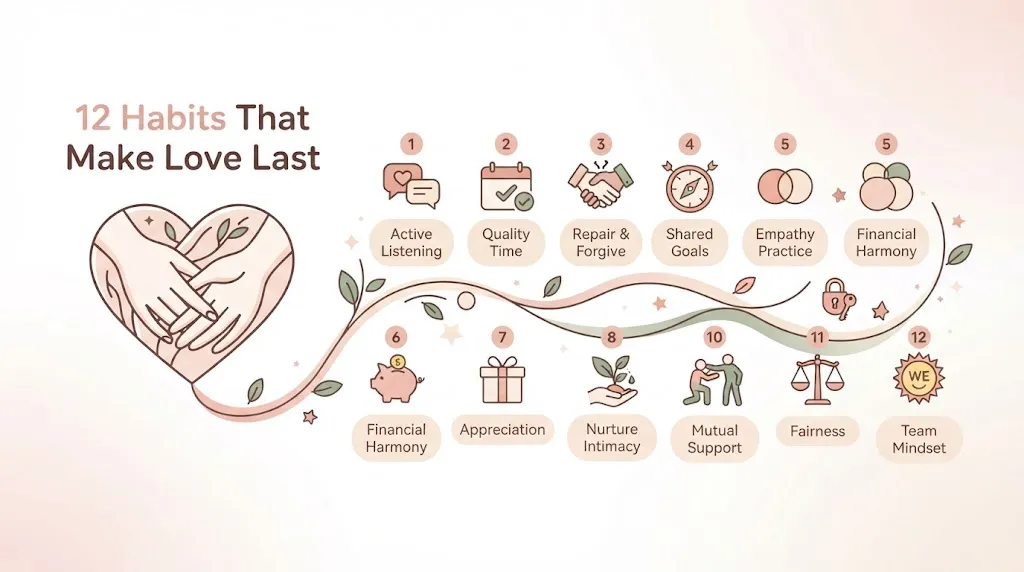
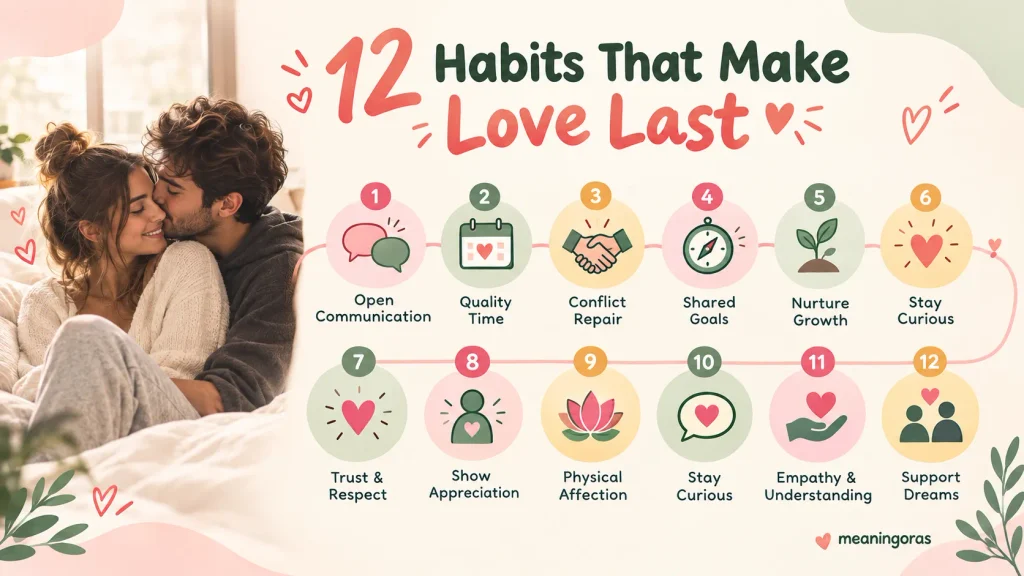
Below are 12 categories of advice, each with a quick note on why it works, so you can figure out what your relationship actually needs right now instead of guessing.
1. Keep Choosing Each Other, Daily
Love isn’t a single decision made once — it’s a decision remade every day, often in small ways nobody notices from the outside.
- Say what you appreciate about your partner out loud, not just in your head.
- Make time for them even on days you’re exhausted.
- Choose patience in small friction moments, not just big ones.
Why it works: Small, repeated choices build more trust over time than grand gestures ever do.
2. Communicate Before Things Pile Up
Most relationship resentment doesn’t start as a big fight — it starts as a small thing that never got said.
- Bring up what’s bothering you within days, not months.
- Use “I feel” statements instead of accusations.
- Ask questions before assuming you know the answer.
Why it works: Unspoken frustration compounds; addressed frustration usually resolves.
3. Protect Time Together From Everything Else
Busy schedules are the quiet killer of connection — not conflict.
- Put a weekly check-in or date on the calendar, non-negotiable.
- Put phones away during meals or conversations.
- Protect at least one ritual that’s just the two of you.
Why it works: Time together has to be defended, or it gets replaced by everything else.
4. Keep Learning Who They’re Becoming
People change. The relationships that last are the ones where both people keep getting to know the current version of each other.
- Ask questions you don’t already know the answer to.
- Notice new interests, stresses, or goals as they show up.
- Don’t assume this year’s version is the same as five years ago.
Why it works: Relationships stagnate when partners stop updating their picture of each other.
5. Handle Conflict Without Trying to “Win”
The goal of an argument isn’t victory — it’s understanding.
- Focus on the issue, not on scoring points.
- Take breaks if a conversation gets too heated to be productive.
- Repair quickly after a disagreement instead of letting it linger.
Why it works: Couples who fight fair stay together; couples who fight to win usually don’t.
6. Show Up in the Hard Moments
Anyone can be a good partner when things are easy. What builds real trust is showing up during stress, illness, grief, or failure.
- Be present during their hard days, not just your convenient ones.
- Offer support without needing to fix everything.
- Remember that consistency matters more than grand gestures.
Why it works: People remember who stayed, not who said the right thing once.
7. Keep Physical and Emotional Affection Alive
Affection fades when it’s assumed rather than practiced.
- Small physical touch — a hand, a hug — matters more than people think.
- Say what you feel, not just what you do.
- Don’t let affection become something only shown during good moods.
Why it works: Consistent affection reinforces safety and closeness in a relationship.
8. Build Shared Goals, Not Just Shared Time
Spending time together is different from building a life together.
- Talk about where you’re both headed, not just what’s next this week.
- Revisit goals together as life circumstances change.
- Celebrate progress on shared plans, however small.
Why it works: Couples with shared direction tend to weather change better than those without one.
9. Give Each Other Room to Be Individuals
Closeness doesn’t mean merging into one person.
- Support hobbies and friendships outside the relationship.
- Respect the need for alone time without taking it personally.
- Stay curious about their world, not just your shared one.
Why it works: Relationships with too little individual space often burn out faster.
10. Say Thank You for the Ordinary Things
Gratitude keeps love from becoming invisible.
- Acknowledge the small, Unglamorous things they do.
- Don’t wait for a special occasion to say something kind.
- Notice effort, not just outcomes.
Why it works: Feeling appreciated is one of the strongest predictors of relationship satisfaction.
11. Repair Quickly After Mistakes
No relationship is mistake-free. What matters is how quickly and sincerely repair happens.
- Apologize without immediately defending yourself.
- Focus on making things right, not just being forgiven.
- Let the relationship move forward instead of relitigating old issues.
Why it works: Fast, genuine repair prevents small mistakes from becoming long-term damage.
12. Keep Some Mystery and Playfulness
Comfort is good — but a little spontaneity keeps things from going flat.
- Try new things together occasionally, even small ones.
- Flirt like you’re still getting to know each other.
- Don’t let routine fully replace surprise.
Why it works: Novelty keeps the relationship feeling alive, not just stable.
How Love Changes Through the Stages of a Relationship
Long-lasting love doesn’t look the same at year one as it does at year twenty. Couples who understand this tend to adjust their expectations and habits accordingly, instead of measuring a fifteen-year relationship against the intensity of month three.
Stage One: The Early Spark (0–2 Years)
In the beginning, connection often feels effortless. Novelty does a lot of the work — new experiences, new information about each other, and the natural excitement of a developing relationship keep things feeling vivid without much conscious effort. This is a real and valuable stage, but it’s also the stage most likely to give people an unrealistic baseline for what love should always feel like.
What matters most here is honesty. Early on, it’s tempting to present an idealized version of yourself. Couples who build a lasting foundation tend to let their real personalities, habits, and needs show up early, rather than saving the “real” version for later. Disagreements during this stage are actually useful information — they reveal how two people handle friction before deeper commitment is on the table.
Stage Two: Settling In (2–7 Years)
This is usually when the initial intensity levels off and the relationship becomes more routine — which can feel like a loss if it’s not understood as normal. Life logistics start taking up more space: shared finances, possibly moving in together, career pressures, sometimes children. The relationship shifts from “getting to know you” to “building something together.”
This stage is where many relationships quietly start to drift, not because love has disappeared, but because attention has moved elsewhere. Couples who stay strong through this period are usually the ones who treat the relationship itself as a project worth maintaining — not assuming it will simply take care of itself because it once felt effortless.
Stage Three: The Long Middle (7–20 Years)
By this point, couples know each other deeply — sometimes so deeply that familiarity starts to feel like the opposite of romance. This is the stage where boredom, if it’s going to show up, tends to show up. It’s also the stage where resentment, if left unaddressed for years, tends to surface all at once rather than gradually.
The relationships that stay vibrant here usually share one trait: they keep treating each other as people who are still changing, not as a fixed character they memorized years ago. Curiosity has to be reintroduced deliberately, because it no longer arrives automatically the way it did early on.
Stage Four: The Long-Term Partnership (20+ Years)
Couples who make it here often describe their relationship less in terms of passion and more in terms of partnership, trust, and shared history. That’s not a downgrade — it’s a different, often deeper, kind of closeness. The risk at this stage is complacency: assuming the relationship is “done” and no longer needs active care simply because it has survived this long.
The strongest long-term couples still make small efforts — a compliment, a check-in, a new shared activity — even after decades. Longevity is a result of ongoing maintenance, not a finish line that removes the need for it.
Recognizing the Warning Signs Before They Become Problems
Most relationships don’t fail overnight. They tend to drift gradually, and the early warning signs are often small enough to explain away individually — which is exactly why they’re worth naming clearly.
Conversations have become purely logistical. When most exchanges are about scheduling, chores, or errands, and rarely about feelings, ideas, or each other’s inner life, emotional connection is quietly shrinking even if nothing dramatic has happened.
Contempt has replaced frustration. Frustration is normal in any relationship. Contempt — eye-rolling, mocking, or treating a partner’s flaws as evidence of their character rather than a specific moment — is a much stronger predictor of long-term trouble, because it signals disrespect rather than simple disagreement.
One or both partners stop bringing up problems. It might look like peace, but silence isn’t the same as resolution. When issues stop being raised at all, it’s often because someone has decided it’s not worth the effort anymore — which is a much bigger warning sign than active conflict.
Time together has quietly disappeared. Busy seasons happen to everyone. The concern is when “we’re just busy right now” becomes a permanent explanation rather than a temporary one, and neither partner is actively trying to change it.
Comparisons to other people or other relationships increase. Occasional comparison is normal. A pattern of comparing a partner unfavorably to others, or fantasizing regularly about a different life, often reflects unmet needs that haven’t been voiced directly.
Physical and emotional affection has become rare and effortful. A dry spell isn’t automatically a red flag. A long-term pattern where affection feels obligatory rather than natural, and neither partner seems to miss it, usually is.
None of these signs mean a relationship is doomed. They’re signals, not verdicts — and relationships that notice these patterns early and address them directly are often able to course-correct well before anything becomes irreversible.
Understanding Love Languages and Why They Matter
One of the most common reasons couples feel disconnected isn’t a lack of love — it’s a mismatch in how that love is expressed and received. The concept of “love languages,” popularized by therapist Gary Chapman, groups the ways people give and receive affection into five broad categories: words of affirmation, quality time, acts of service, physical touch, and gifts.
The friction usually shows up like this: one partner expresses love primarily through acts of service — cooking dinner, handling errands, fixing things around the house — while the other partner’s primary language is words of affirmation. The first partner may feel like they’re constantly showing love and getting little acknowledgment. The second may feel like they’re rarely told they’re loved, even though love is clearly being demonstrated in other ways. Neither person is wrong; they’re simply speaking different languages and expecting the other to translate automatically.
A few practical ways to use this idea without treating it as a rigid formula:
- Notice what makes you feel most loved, and say so directly instead of assuming your partner will guess.
- Pay attention to what your partner does for you unprompted — it often reveals their natural language, even if they’ve never labeled it.
- Try expressing affection in your partner’s language occasionally, even if it doesn’t come naturally to you. It’s a learnable habit, not a fixed trait.
- Avoid using “that’s not my love language” as a reason to dismiss a partner’s need. The goal is mutual translation, not a scorecard.
Love languages aren’t a scientifically airtight framework, and real relationships are more complicated than five categories. But as a starting vocabulary for a conversation that couples often struggle to have — how do you actually feel loved? — it remains genuinely useful.
Common Mistakes That Quietly Kill Long-Term Love
Most relationships don’t end because of one catastrophic event. They erode gradually, through patterns that feel minor in any single instance but compound significantly over years.
Keeping score. Tracking who did more chores, who apologized last, or who initiated affection more recently turns a partnership into a competition. Even when the tracking is silent, it tends to surface as resentment during unrelated arguments.
Assuming the relationship doesn’t need active effort. It’s common to put enormous effort into the early stages of a relationship and then gradually stop, treating stability as proof that effort is no longer required. In reality, stability is often the result of ongoing effort, not a replacement for it.
Avoiding difficult conversations to “keep the peace.” Short-term peace bought by avoiding hard topics usually costs more later, when unspoken frustrations accumulate and resurface all at once, often in a much less constructive way.
Prioritizing being right over being understood. In many arguments, the actual goal quietly shifts from resolving an issue to winning it. Couples who catch themselves doing this and deliberately shift back toward understanding tend to recover from conflict much faster.
Letting outside relationships take priority without discussion. Friendships, family obligations, and work commitments are all healthy in moderation, but when they consistently take priority over the relationship without any conversation about it, the partner on the other end often experiences it as a form of neglect.
Neglecting physical health and self-care. It’s not just about attraction — chronic stress, poor sleep, and neglected physical health measurably affect patience, mood regulation, and emotional availability, all of which show up in how partners treat each other.
Withholding appreciation because “they already know.” Assuming a partner already knows they’re loved and appreciated is one of the most common — and most avoidable — sources of slow emotional distance in long relationships.
Rebuilding Connection After a Rough Patch
Every long relationship goes through periods of disconnection — after a stressful year, a major life change, a health crisis, or simply a long stretch where two people drifted without noticing. Rebuilding isn’t about recreating the exact feeling of the early relationship; it’s about deliberately re-establishing the habits that created closeness in the first place.
Start smaller than feels necessary.
Couples in a rough patch often try to fix everything at once with a single big conversation or gesture. It’s usually more effective to rebuild through small, consistent actions — a daily check-in, a weekly walk, a returned habit of saying goodnight properly — rather than one dramatic reset.
Name the disconnection without assigning blame. Simply acknowledging “we’ve drifted a bit” out loud, without turning it into an argument about whose fault it is, often does more to open the door to reconnection than any specific fix.
Revisit what used to work. Most couples had rituals, inside jokes, or routines earlier in the relationship that quietly disappeared over time — not because they stopped working, but because life got busier. Reviving even one of these can rebuild momentum faster than starting something entirely new.
Get curious again, on purpose. After years together, it’s easy to assume you already know everything important about your partner. Deliberately asking questions you don’t already know the answer to — about their current stresses, hopes, or changing interests — often reopens a level of intimacy that faded through assumption rather than active neglect.
Consider outside support if the rough patch is prolonged. A rough patch that lasts a few weeks is different from one that’s lasted years. Couples therapy isn’t a sign of failure — it’s a tool that helps identify patterns that are difficult to see from inside the relationship. Many. Many couples who use it describe it as one of the more effective investments they made in the relationship.
Explore More https://namenesty.com/fall-in-love-captions/
Be patient with the pace of reconnection. Trust and closeness that eroded over months or years rarely rebuild in a single conversation. Expecting a quick fix often leads to disappointment and a sense that “nothing’s working,” when in reality the process is simply gradual by nature.
People Also Ask
Consistency. Relationships last less because of grand romantic gestures and more because both people keep showing up, day after day, in small reliable ways.
By treating the relationship as something to actively maintain — through communication, shared goals, affection, and repair — rather than something that runs on autopilot once it’s established.
Yes. Many couples go through periods of drift and Reconnect once they intentionally rebuild time, communication, and affection.:
No. How a couple handles conflict matters far more than whether conflict happens at all.
Yes. Early relationship intensity is driven partly by novelty, which naturally settles over time. Long-term love tends to feel steadier and more trust-based rather than less real — though it does require more intentional effort to keep feeling alive.
Love languages describe the different ways people express and prefer to receive affection — words, time, acts of service, touch, or gifts. They’re not a rigid science, but they’re a useful starting point for couples who feel loved differently than they’re currently being shown love.:
A temporary rough patch usually has an identifiable cause — stress, a life transition, exhaustion — and both partners still want to reconnect. A bigger problem is more likely when the disconnection has lasted a long time, one or both partners have stopped trying, or contempt has replaced ordinary frustration.:
No. Many couples use therapy proactively, as a space to build communication skills or work through a rough patch before it becomes a larger issue, not only as a last resort.
Key Takeaways
- Love lasts through daily choices, not one big Decision.
- Small, consistent habits outperform occasional grand gestures.
- Protect time, communicate early, and repair quickly after conflict.
- Growth and individuality within a relationship strengthen it, not weaken it.











2 thoughts on “How to Make Love Last: 12 Habits That Actually Work”