ID Meaning in Text: What Does “ID” Mean in Chat?
Ever received a message containing “ID,” “id,” or “ID?” and wondered what it meant? You’re not alone. The meaning can change depending on the conversation. In most everyday contexts, ID means identification or an identifier, such as an ID card, username, or account number. However, lowercase “id” may be informal typing for “I’d,” meaning “I would” or “I had.” On social media, “ID?” can also be a request to identify a song, outfit, or product. In this guide, you’ll discover the key differences, real texting examples, and simple ways to understand the intended meaning without guessing.
Have you received a text containing “id,” “ID,” or “ID?” and wondered what the sender meant? The answer depends on the words around it and the conversation’s context.
In texting, “ID” commonly means identification or an identifier, such as a username, account number, or identification document. Lowercase “id” may also be informal typing for “I’d,” meaning “I would” or “I had,” particularly when the sentence makes that interpretation clear. Standard English dictionaries distinguish the contraction “I’d” from “ID,” the abbreviation for identification.
English meaning – Cambridge Dictionary+1
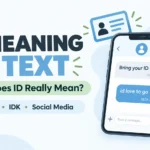
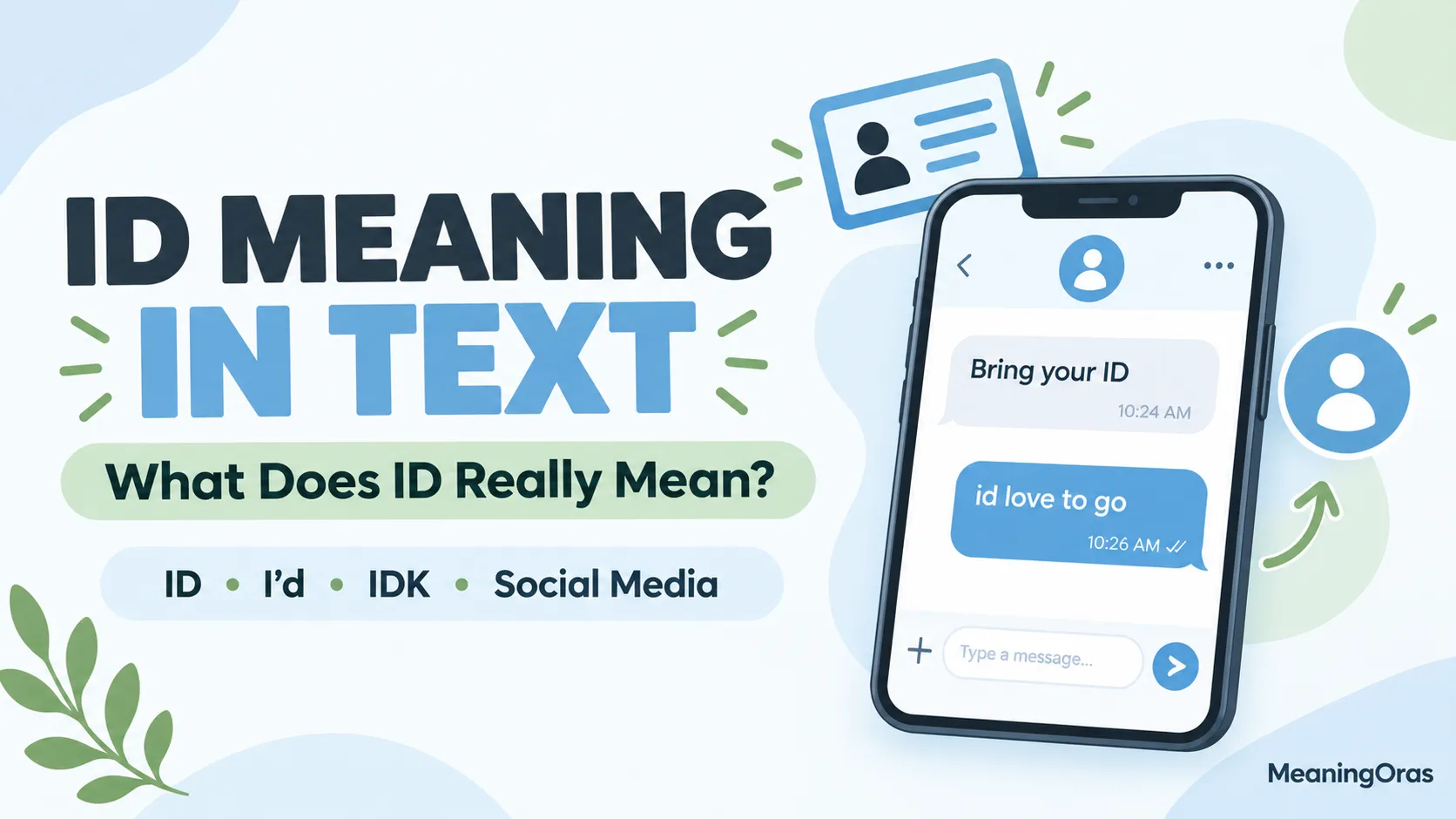
For example, “Bring your ID” probably refers to an identification document, while “id love to go” may mean “I’d love to go.” On social media, someone might also write “ID?” when asking others to identify an item, song, outfit, or person.
The important thing is not to assume that every version has the same meaning. Capitalization, sentence structure, and the platform can help you work out what the sender intended.
In this guide, you’ll discover the main meanings of ID in text messages, how people use it in online conversations, real-world examples, and how to reply when you’re unsure.
What Does ID Mean in Text?
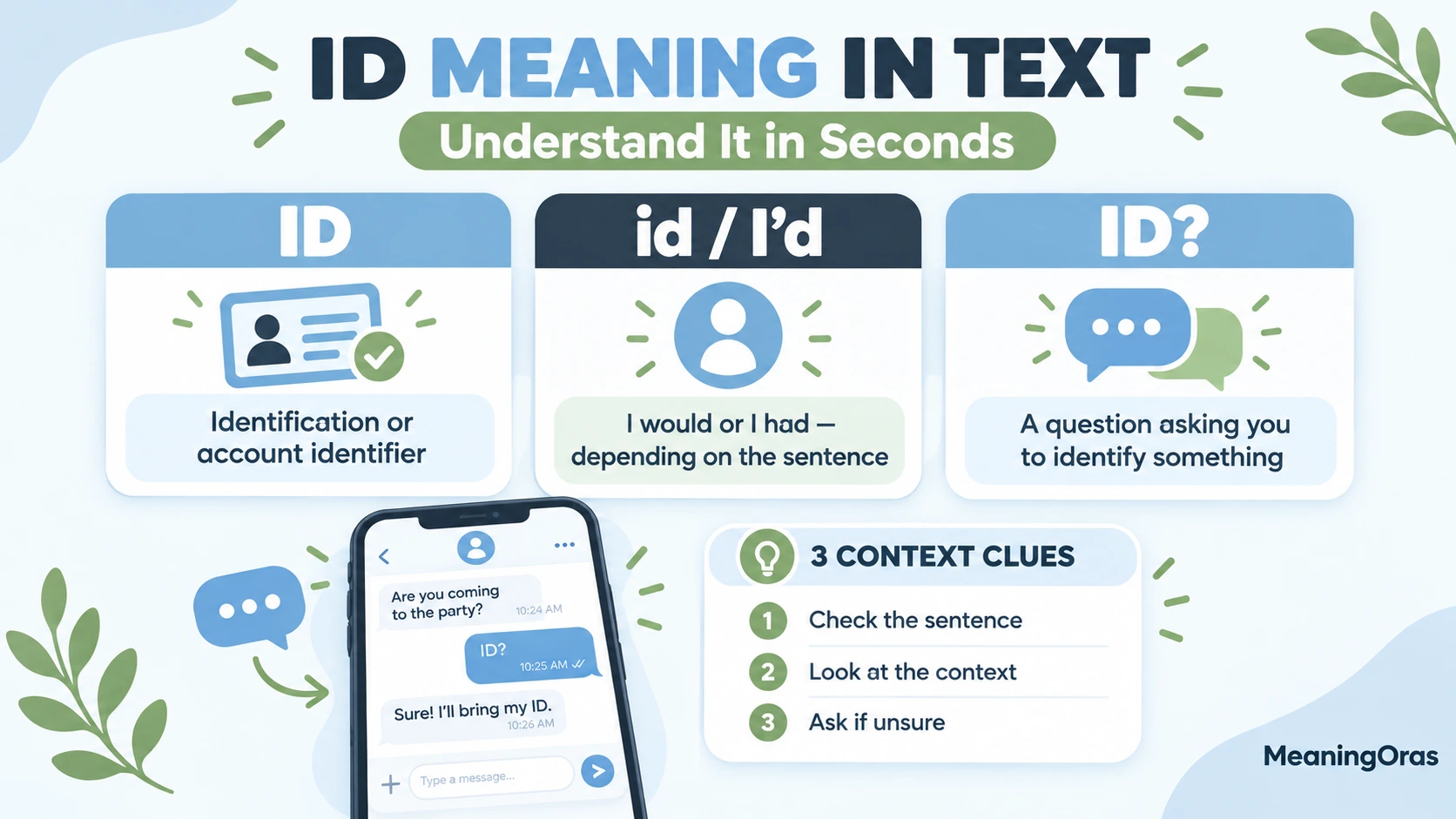
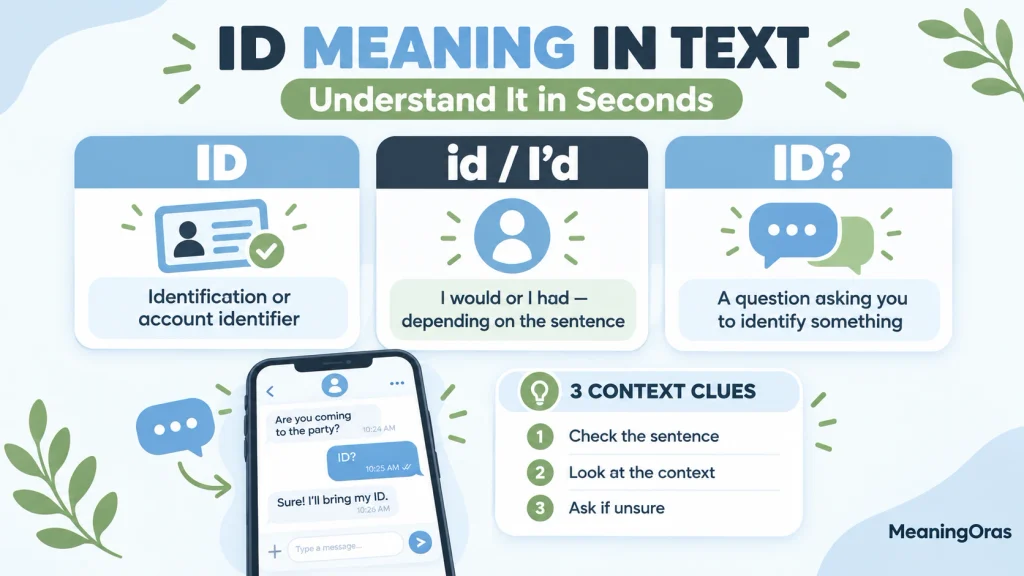
ID usually means “identification” or “identifier” in text messages. In informal writing, lowercase “id” can sometimes stand for “I’d,” the contraction of “I would” or “I had.” The correct interpretation depends on the sentence.
Here are the most useful distinctions:
- ID = identification: “Please bring your ID.”
- ID = an identifier: “Send me your account ID.”
- id = informal I’d: “id love to see that movie.”
- ID? = identify this: “These shoes look great. ID?”
The last example is a contextual use, not a universal definition. The sender is likely asking someone to identify the item.
- Explore More: https://namenesty.com/regularly-captions/
Quick Meaning Summary
| Expression | Likely meaning | Example |
| ID | Identification | “Show your ID at the entrance.” |
| Account ID | Account identifier | “What’s your account ID?” |
| User ID | Username or unique user identifier | “Enter your user ID.” |
| id | Informal spelling of “I’d,” if the sentence fits | “I’d rather stay home.” |
| ID? | A request to identify something | “ID on this jacket?” |
| IDK | I don’t know | “IDK what happened.” |
| IDC | I don’t care | “IDC which movie we watch.” |
Quick tip: If “I would” or “I had” fits naturally in the sentence, the sender may have intended “I’d.” If the message concerns a document, account, username, or verification, ID probably refers to identification or an identifier.
What Does ID Stand For?
The abbreviation ID most commonly stands for identification. It can refer to a document that proves who you are or to information that distinguishes one person, account, object, or record from another.
English meaning – Cambridge Dictionary+1
The exact meaning changes with the situation.
1. Identification
An ID may be an identity card, driver’s license, student card, employee badge, or another document used to confirm someone’s identity.
Example:
Alex: “Do I need to bring anything?”
Sam: “Just your ID and ticket.”
Here, ID means an identification document.
2. Identity or account identifier
In technology and online communication, an ID can be a unique name, number, or code associated with a person, device, account, or record.
Example:
“Send me your player ID so I can add you.”
The sender wants the identifier used to find the correct gaming account.
3. Informal “I’d”
In casual messages, some people omit the apostrophe in “I’d” and type “id.” This is informal and potentially ambiguous, so readers should interpret it in context.
Example:
“id love to visit someday.”
The intended meaning is likely “I’d love to visit someday,” or “I would love to visit someday.”
For clear writing, especially in professional messages, use the standard spelling “I’d.”
How to Tell What ID Means in a Text Message
When you encounter ID in a message, follow these simple steps.
Step 1: Read the whole sentence.
Does the message discuss an identification document, an account, or an action someone would take?
Step 2: Check capitalization.
Uppercase “ID” commonly refers to identification or an identifier. Lowercase “id” may be casual typing, but capitalization alone does not prove the meaning.
Step 3: Test the likely interpretation.
If replacing “id” with “I’d” makes the sentence grammatical and sensible, that may be what the sender intended.
Step 4: Ask if it is still unclear.
A quick question such as “Do you mean your username or your ID card?” prevents misunderstandings.
Examples of context in action
| Text message | Likely interpretation |
| “Bring your ID tomorrow.” | Identification document |
| “What’s your ID on Discord?” | Username or account identifier |
| “id like to try that.” | “I’d like to try that.” |
| “Can someone ID these shoes?” | Identify the shoes |
| “Enter your ID number.” | A required identification number |
What Does ID Mean on Social Media?
On social platforms, ID may refer to an account identifier, a request to identify something, or the ordinary abbreviation for identification. The intended meaning depends on what people are discussing.
ID meaning on Instagram
On Instagram, ID may refer to an account identifier or username, especially when someone wants to find a profile. In comments, “ID?” can also be a request to identify an outfit, product, song, or other item.
Examples:
- “What’s your IG ID?” — The sender wants your Instagram handle or account details.
- “ID for these sunglasses?” — The sender wants to know the brand or model.
- “id love this color on my nails.” — The writer may mean “I’d love this color on my nails.”
The phrase “IG handle” or “Instagram username” is often clearer when referring specifically to a profile.
ID meaning on Snapchat
On Snapchat, ID may refer to a username, account identifier, or identification document, depending on the conversation.
Examples:
- “Send me your Snapchat ID.” — The sender wants information to find your account.
- “What’s the ID for this song?” — The sender wants the song identified.
- “Bring your ID.” — The sender likely means an identification document.
Snapchat usernames, display names, and other account identifiers are not necessarily interchangeable, so use the specific term when accuracy matters.
ID meaning on TikTok
On TikTok, “ID?” may appear in comments when someone wants to identify a song, product, outfit, creator, or another item shown in a video.
Examples:
- “Song ID?” — What is the song’s name?
- “Outfit ID please!” — Where can I find the clothing, or what brand is it?
- “id wear that.” — The writer may mean “I’d wear that.”
The meaning comes from the surrounding content; “ID?” is not a universal TikTok abbreviation with only one definition.
ID meaning on Facebook
On Facebook, ID may refer to a profile identifier, account information, identification document, or a request to identify something in a post.
Example:
“Can you send me your Facebook profile ID?”
The sender likely wants information that helps locate a particular profile. If they need your public profile link, ask whether that is what they mean.
ID meaning on Reddit
On Reddit, users may write “ID?” to ask for the identity of something in a photo, video, discussion, or recommendation.
Example:
“Anyone know the ID of this plant?”
The user wants to know which plant it is. In a different discussion, ID could mean an account or another kind of identifier.
ID meaning on Discord
On Discord, ID often refers to a user, server, channel, or message identifier. These can be different from the username or display name visible in a conversation.
Example:
“Can you share the message ID?”
The sender wants the identifier for a specific message, not necessarily the sender’s username.
ID meaning on X (Twitter)
On X, ID may refer to an account identifier or a request to identify an item mentioned in a post.
Example:
“Does anyone know the ID of these sneakers?”
The user is asking for the sneaker’s identity, brand, or model.
Social media takeaway: When you see “ID” in a comment, first determine whether the sender wants an account identifier or wants someone to identify an item. Do not assume the same meaning applies to every platform.
What Does ID Mean From a Girl or a Guy?
ID does not have a special meaning based on the sender’s gender. If a girl or guy sends “ID,” the interpretation depends on the words, conversation, and situation.
For example:
- “id love to see you” may mean “I’d love to see you.”
- “What’s your ID?” may be asking for an account identifier.
- “ID on that jacket?” may be asking where the jacket came from.
- “Please bring your ID” likely refers to identification.
Does ID mean someone likes you?
Not by itself. The abbreviation is not a reliable sign of attraction, flirting, or romantic interest.
If someone writes “id love to hang out,” the full message may communicate enthusiasm. However, it is the sentence and the relationship between the people—not the letters “id”—that provide the useful clues.
If you’re unsure about someone’s tone, consider the entire conversation rather than trying to interpret a single abbreviation.
- Explore More: https://namenesty.com/another-word-for-understand/
Is ID Rude in Texting?
No. ID is not inherently rude or offensive. It is a common abbreviation, and its tone depends on how it is used.
Compare these examples:
- “Can you send me your ID?” — A straightforward request.
- “id love to come!” — An informal expression of interest, if “id” means “I’d.”
- “ID?” — A short request that may seem abrupt without context.
- “Please provide your identification.” — A more formal request.
Short messages can sometimes feel blunt, but that does not mean the sender intended to be rude.
If you are writing a sensitive or professional message, spell out what you need. For example, “Could you please share your account username?” is clearer than “Send ID.”
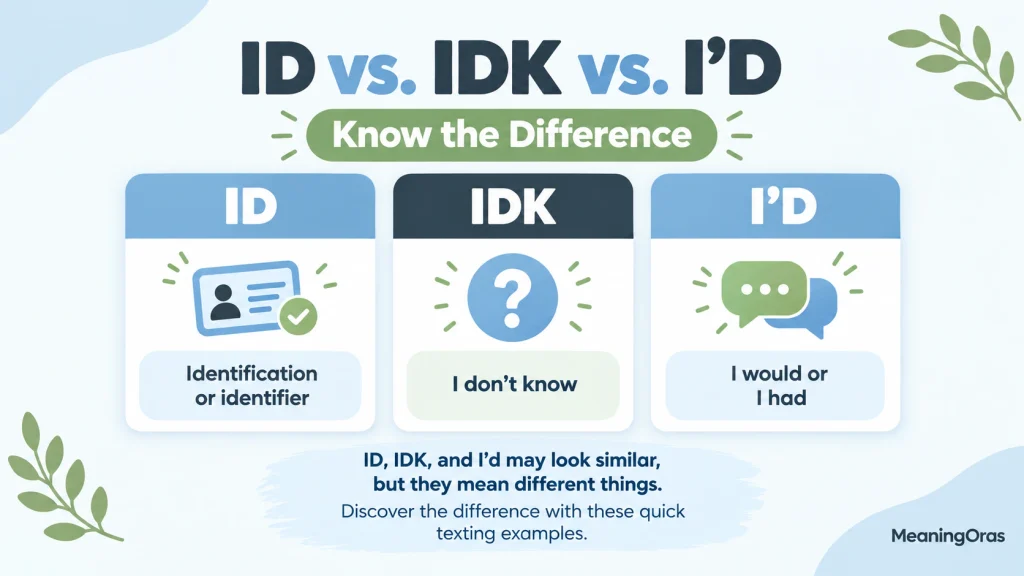
ID vs. I’d vs. IDK vs. IDC
These expressions may look similar, but their meanings are different.
| Term | Meaning | Example |
| ID | Identification or an identifier | “What’s your user ID?” |
| I’d | I would or I had | “I’d love to join.” |
| id | May be informal typing for “I’d” in context | “id go with you.” |
| IDK | I don’t know | “IDK the answer.” |
| IDC | I don’t care | “IDC which one we choose.” |
| IDEK | I don’t even know | “IDEK what happened.” |
| IDR | Often used informally for “I don’t remember” | “IDR where I put it.” |
The contraction “I’d” has two standard meanings: “I would” and “I had.”
English meaning – Cambridge Dictionary+1
By contrast, IDK is a separate texting abbreviation for “I don’t know.”
Do not treat these abbreviations as interchangeable. A single extra letter can change the meaning completely.
Real Text Conversation Examples
The following examples show how the meaning changes with context.
Example 1: ID means identification
Alex: “Are we allowed into the venue without anything?”
Jamie: “Bring your ID just in case.”
Meaning: Jamie is referring to an identification document.
Example 2: ID means an account identifier
Alex: “How can I add you to the game?”
Jamie: “I’ll send you my player ID.”
Meaning: Jamie will share an identifier used to find the gaming account.
Example 3: id means “I’d”
Alex: “Would you visit London if you had the chance?”
Jamie: “id go in a heartbeat.”
Meaning: Jamie probably means “I’d go in a heartbeat.”
Example 4: ID? asks for identification of an item
Alex: “Look at these sneakers I found.”
Jamie: “ID?”
Meaning: Jamie is likely asking for the sneaker brand, model, or product name.
Example 5: The meaning is unclear
Alex: “Can you send me your ID?”
Jamie: “Which one do you need—my username or my identification document?”
Meaning: Jamie asks for clarification instead of guessing.
How Should You Reply When Someone Says ID?
The best response depends on what the sender is asking for.
| If they mean… | Possible reply |
| An identification document | “Do you need a photo ID or another document?” |
| A username or account identifier | “Sure, I’ll send you my username.” |
| A song or product identification | “I’ll check the name and send it to you.” |
| “I’d” in a casual sentence | Respond to the full statement normally. |
| Something unclear | “What do you mean by ID here?” |
Privacy tip: If someone asks you to send an ID document, make sure the request is legitimate and that you understand why the document is needed. Avoid sharing sensitive identification details with unknown people or unverified accounts.
Common Misunderstandings About ID
1. Assuming every “id” means “I’d”
This interpretation may fit a sentence such as ” I’dlove to go,” but it will not fit every message. Read the complete sentence before deciding.
2. Assuming ID always means an identity card
In technology and online gaming, ID may refer to a user, device, account, or message identifier. The relevant platform determines which identifier is meant.
3. Confusing ID with IDK
ID and IDK are different. ID commonly means identification or an identifier; IDK means “I don’t know.”
4. Assuming “ID?” always asks for a product
It may be a request to identify a song, outfit, person, plant, or another object. It could also refer to an account identifier in the right context.
5. Assuming the abbreviation reveals someone’s feelings
ID alone does not prove that someone is interested, annoyed, dismissive, or flirting. Interpret the full message and the surrounding conversation.
Origin and History of ID
The abbreviation ID developed from the word “identification.” Today, dictionaries recognize ID as a shortened form used for identity documents and other identifying information.
English meaning – Cambridge Dictionary+1
As digital communication expanded, the term became common in contexts involving usernames, account numbers, and unique identifiers. The same two letters can therefore appear in everyday conversations, gaming, technology, school, work, and official verification processes.
- Explore More: https://namenesty.com/ditto-meaning-in-text/
The separate expression “I’d” is a contraction of “I would” or “I had.”
English meaning – Cambridge Dictionary+1
When someone omits the apostrophe and types “id,” readers may infer the intended contraction from the sentence, but the spelling is informal and ambiguous.
There is no single origin story for every online use of “ID?” as a request to identify an item. Its interpretation follows ordinary shorthand and the context of the discussion.
When Should You Use ID in a Message?
Use ID when the meaning is clear to the recipient.
Appropriate casual uses
- Asking for an account or player ID.
- Referring to an identification document.
- Asking someone to identify an item in a social media post.
- Using informal typing with friends when the intended meaning is obvious.
When clarity matters
- Use “I’d” instead of “id.”
- Write “account username” instead of a vague “ID” when you mean a profile name.
- Write “photo identification” when requesting a document.
- Explain whether you need a user ID, account number, or message ID in a technical conversation.
These small changes make communication easier to understand and reduce unnecessary back-and-forth.
Related Terms and Similar Meanings
If you are learning internet abbreviations, these related terms may help:
- IDK: I don’t know.
- IDC: I don’t care.
- IDEK: I don’t even know.
- IDR: Often means I don’t remember in casual texting.
- I’d: I would, or I had.
- Username: The name used to identify an account on a platform.
- User ID: A unique identifier associated with a user.
- Identification: Information or documentation used to establish who someone is.
- Handle: A public-facing username on a social platform.
Remember that informal abbreviations can vary by community. When the meaning is uncertain, asking for clarification is more reliable than assuming.
People Also Ask: ID Meaning in Text
ID usually means identification or an identifier, such as an account ID. Lowercase “id” can sometimes be informal typing for “I’d,” meaning “I would” or “I had,” depending on the sentence.
It has no special gender-based meaning. A girl may use ID to refer to identification, an account identifier, or an item she wants identified. Context determines the intended meaning.
On Snapchat, ID may refer to an account identifier or username, an identification document, or a request to identify something. Read the surrounding message to determine which meaning fits.
“ID?” may be a request to identify a song, outfit, product, or another item in a video. It is a contextual shorthand rather than a universal TikTok-specific definition.
Not usually as a standard abbreviation. “I’d” is the correct contraction of “I would” or “I had.” In casual texting, someone may omit the apostrophe and type “id,” but the meaning depends on context.
Conclusion
The meaning of ID in text depends on context. Most commonly, ID refers to identification or an identifier, such as an account ID or user ID. In casual writing, lowercase “id” may be intended as “I’d,” meaning “I would” or “I had,” while “ID?” can be a request to identify an item.
To interpret it correctly, look at the surrounding words, the platform, and what the sender is discussing. When a message remains ambiguous, ask a quick clarifying question instead of guessing.
For more straightforward explanations of internet slang, abbreviations, and digital communication, explore the related meaning guides on MeaningOras.