
Introduction
Filmmaker nicknames define Legends before a single frame rolls. Most directors stay nameless forever — not because they lack talent, but because they lack identity. Inside: 500+ iconic monikers, the history behind cinema’s greatest titles, and the one name that could make yours unforgettable. A filmmaker’s nickname is far more than a catchy label — it is a distilled biography. In two or three words, a great moniker captures a director’s style, obsessions, genre mastery, and cultural impact. “The Master of Suspense” tells you everything you need to know about Alfred Hitchcock before you’ve watched a single frame of Psycho. “The Godfather of Gore” signals exactly what Lucio Fulci brings to the table.
These nicknames earn their power through the same mechanism that makes great filmmaking work: economy of expression. Just as a master editor removes every unnecessary frame, a great filmmaker’s nickname removes every unnecessary word until only truth remains.
This guide is the most comprehensive reference on filmmaker nicknames ever assembled. Whether you’re a film student hunting for inspiration, a cinephile deepening your knowledge, or a content creator building a creative identity, this pillar article covers:
The legendary, historically established nicknames of cinema’s greatest directors
Genre-specific nickname traditions (horror, comedy, sci-fi, drama, action, indie)
• How famous filmmaker nicknames were born and why they lasted
• 500+ creative filmmaker nickname ideas organized by style and vibe
Tips for crafting your own filmmaker nickname that actually sticks
• A complete FAQ on filmmaker monikers and director titles
Legendary Filmmaker Nicknames — The Classics That Defined Cinema
The most iconic filmmaker nicknames didn’t come from marketing departments. They emerged organically from critics, audiences, and fellow directors who recognized that these monikers were simply the most accurate description of the filmmakers’ genius. Here is the definitive history of cinema’s greatest directorial titles.
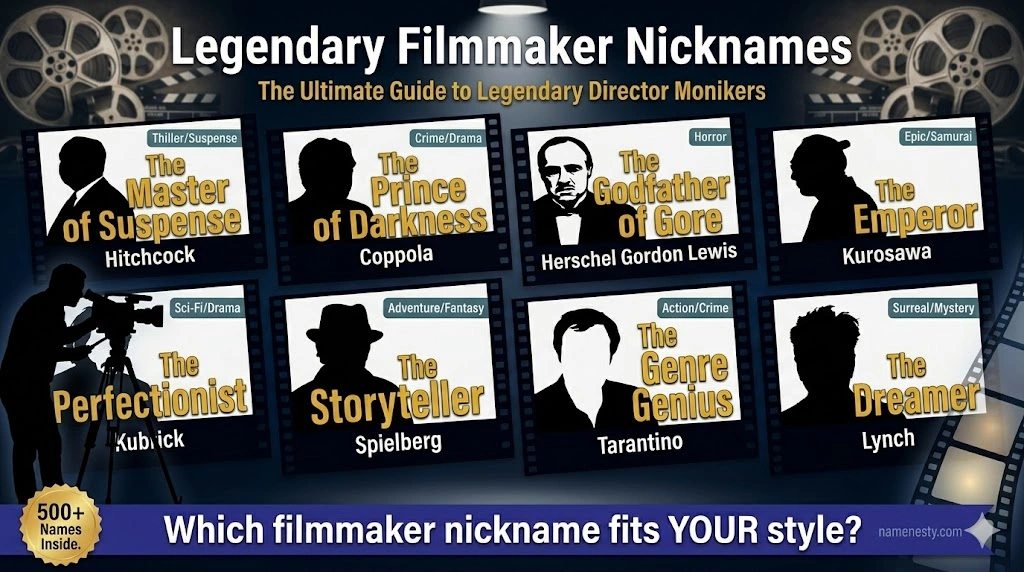
1. Alfred Hitchcock — “The Master of Suspense.”
No filmmaker nickname in history is more instantly recognized than Alfred Hitchcock’s title of “The Master of Suspense.” Born in Leytonstone, England, in 1899, Hitchcock directed over 50 feature films in a career spanning six decades. He understood something that other directors only grasped intuitively: suspense is not about shock, it’s about anticipation.
Hitchcock himself explained his philosophy with his famous “bomb under the table” analogy — four people talking at a table creates no suspense; but if the audience knows there’s a bomb underneath it, every second of that conversation becomes unbearable. This is why his nickname is not merely earned — it is scientifically accurate. His signature techniques — the POV shot, the voyeuristic camera, the MacGuffin, the “wrong man” trope — form a complete grammar of cinematic dread that filmmakers still study today.
Key Films: Psycho (1960), Vertigo (1958), Rear Window (1954), The Birds (1963), North by Northwest (1959)
Why the Nickname Stuck: Hitchcock didn’t just make tense films — he redefined tension itself. His nickname emerged because no alternative description was adequate.
2. John Carpenter — “The Prince of Darkness.”
“The Prince of Darkness” is John Carpenter’s nickname, one that fits with almost poetic precision. The director of Halloween (1978), The Thing (1982), and The Fog (1980) built a career on transforming everyday spaces — suburban streets, Antarctic research stations, foggy coastal towns — into chambers of cosmic dread.
Carpenter’s own quote captures his outsider status: “In France, I’m an auteur; in Germany, a filmmaker; in Britain, a genre film director; and, in the USA, a bum.” Despite critical indifference in America during much of his career, Carpenter’s influence is immeasurable. His minimalist synth scores, clean widescreen framing, and ability to suggest unstoppable evil with simple visual restraint created a horror aesthetic that still reverberates today.
Key Films: Halloween (1978), The Thing (1982), The Fog (1980), Christine (1983), Escape from New York (1981)
Why the Nickname Stuck: Carpenter didn’t just portray darkness — he seemed to inhabit it. His genre work carries a genuine chill that few directors have replicated.
3. Lucio Fulci — “The Godfather of Gore.”
Italian filmmaker Lucio Fulci earned his title through a body of work that prioritized visceral, nightmarish imagery above all else. Films like Zombie (1979), The Beyond (1981), and City of the Living Dead (1980) reveled in grotesque set pieces that pushed well past the boundary of conventional horror into something approaching surrealist art — if art were made from blood and entrails.
What separates Fulci from mere shock merchants is his dreamlike atmosphere. His films often forgo narrative coherence in favor of pure sensory assault, creating a uniquely hypnotic quality that has earned him a devoted cult following. The nickname “Godfather of Gore” is not merely descriptive — it implies a kind of paternal authority over an entire subgenre.
Key Films: Zombie (1979), The Beyond (1981), City of the Living Dead (1980), Don’t Torture a Duckling (1972)
4. George A. Romero — “Godfather of the Dead.”
George A. Romero single-handedly created the modern zombie mythology. Before Night of the Living Dead (1968), zombies in cinema were Haitian folklore creatures, mindless servants of individual sorcerers. Romero’s shambling, flesh-hungry undead were something entirely new: a metaphor for consumerism, conformity, and societal collapse.
His nickname “Godfather of the Dead” acknowledges this act of creation. Every zombie film made after 1968 — from Dawn of the Dead to The Walking Dead to Train to Busan — owes its existence to Romero’s vision. He didn’t just make horror movies; he built the entire philosophical infrastructure of an enduring cultural mythology.
Key Films: Night of the Living Dead (1968), Dawn of the Dead (1978), Day of the Dead (1985), Creepshow (1982)
5. Dario Argento — “The Italian Hitchcock.”
Dario Argento earned the title “The Italian Hitchcock” for his mastery of suspense within the uniquely Italian giallo genre — crime thrillers characterized by stylized violence, elaborate murder sequences, and a distinct visual aesthetic. Like Hitchcock, Argento understood that how you show something is as important as what you show.
But Argento’s style is distinctly his own: saturated colors that bleed off the screen, camera movements that glide like a predator’s approach, and soundtracks (frequently by the rock band Goblin) that function as a second narrator. His masterwork Suspiria (1977) remains one of cinema’s most visually overwhelming experiences.
Key Films: Suspiria (1977), Deep Red (1975), Tenebrae (1982), The Bird with the Crystal Plumage (1970)
6. David Cronenberg — “The Baron of Blood” / “King of Venereal Horror.”
Canadian director David Cronenberg occupies a unique position in cinema: a director whose work is simultaneously disgusting and philosophically rigorous. His films explore the disturbing intersection of technology, the human body, and unconscious desire — what critics have called “body horror.” His nicknames, “The Baron of Blood” and “King of Venereal Horror,” capture both his methodology and his thematic obsessions.
Cronenberg’s horror is never gratuitous — it is purposeful. The head explosions in Scanners (1981) comment on the weaponization of psychic power. The grotesque bodily transformations in The Fly (1986) are a metaphor for disease, aging, and the terror of physical dissolution. His violence has an intellectual architecture that elevates it beyond exploitation.
Key Films: The Fly (1986), Videodrome (1983), Scanners (1981), A History of Violence (2005), The Brood (1979)
7. Gordon Willis — “The Prince of Darkness” (Cinematographer)
While Carpenter’s nickname refers to his horror sensibility, cinematographer Gordon Willis earned the same title for a different reason: his radical use of shadow and underexposure. Willis shot The Godfather trilogy for Francis Ford Coppola, making choices that broke every rule of conventional cinematography. Faces disappear into shadow. Eyes vanish beneath brows. Key figures go dark at climactic moments.
The nickname “Prince of Darkness” was initially meant as mild criticism from studio executives who worried the footage was too dark to project. Willis adopted it as a badge of honor. His work on The Godfather is considered the most influential cinematography in American film history.
8. Other Legendary Filmmaker Nicknames — Quick Reference
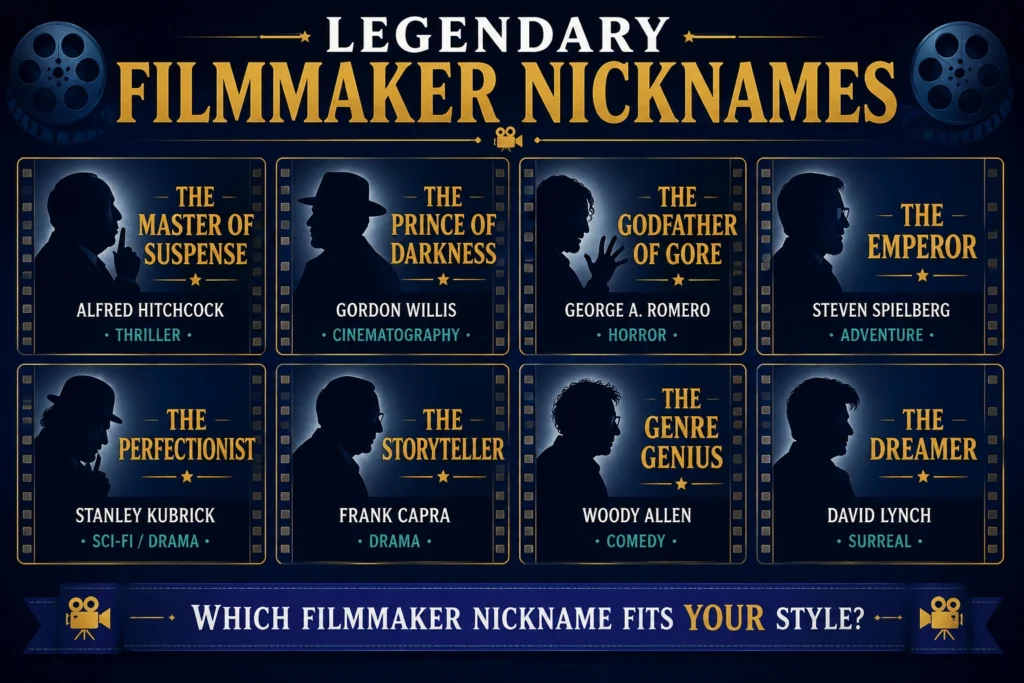
| Director | Nickname | Genre | Why It Stuck |
| Steven Spielberg | The Storyteller | Blockbuster / Drama | Populist emotion + technical brilliance; the “Spielberg Face” reaction shot |
| Stanley Kubrick | The Perfectionist | Multiple | Obsessive detail; hundreds of takes; 13-year prep for Napoleon |
| Orson Welles | The Boy Wonder | Drama / Noir | Made Citizen Kane at 25; the most audacious debut in film history |
| John Ford | The Master of the Western | Western | Defined the genre’s visual language; Monument Valley as a cathedral |
| Ernst Lubitsch | The Lubitsch Touch | Comedy | Sophisticated wit conveyed through implication, not statement |
| Wes Craven | The Godfather of Modern Horror | Horror | Nightmare on Elm St, Scream — resurrected the genre twice |
| Sergio Leone | The Father of the Spaghetti Western | Western | Reinvented American mythology from an Italian perspective |
| Verna Fields | The Mother Cutter | Editor | Saved Jaws in the editing room; crucial to New Hollywood |
| Akira Kurosawa | The Emperor | Drama / Samurai | Dominated Japanese cinema; influenced Spielberg, Lucas, Coppola |
| Bong Joon-ho | The Genre Genius | Thriller / Drama | First non-English director to win Best Picture (Parasite, 2019) |
Part 2: Genre-Specific Filmmaker Nicknames — From Horror to Comedy
Filmmaker nicknames often emerge from genre mastery. When a director owns a genre so completely that their name becomes synonymous with it, a nickname is inevitable. Here, we explore the most powerful genre-specific filmmaker nickname traditions in cinema history.
Horror Filmmaker Nicknames
Horror is arguably the genre most defined by its directors’ personalities, because fear is intensely personal. The best horror filmmaker nicknames reflect not just what these directors show, but how they make you feel:
• The Master of Suspense: Alfred Hitchcock — suspense architecture through information asymmetry
• The Prince of Darkness: John Carpenter — cosmic dread in everyday American settings
Godfather of Gore: Lucio Fulci — visceral Italian horror pushed to its limit
• The Godfather of the Dead: George Romero — creator of modern zombie mythology
• The Italian Hitchcock: Dario Argento — giallo mastery with hallucinatory visual style
Baron of Blood: David Cronenberg — philosophical body horror
• Master of the Macabre: A title applicable to Tod Browning (Freaks, Dracula)
Comedy Filmmaker Nicknames
Comedy director nicknames tend to emphasize wit, timing, and the ineffable quality of making people laugh on cue:
• Lubitsch Touch: Ernst Lubitsch — a nickname that became a cinematographic concept
• King of Screwball Comedy: Howard Hawks — His Girl Friday, Bringing Up Baby
So, Clown Prince of Cinema: Charlie Chaplin, actor-director who made comedy an art form
The King of Comedy: Jerry Lewis — a literal title from French critics who adored him
A Queen of the Modern Romantic Comedy: Nora Ephron — screenwriter-director of When Harry Met Sally
Sci-Fi & Spectacle Filmmaker Nicknames
Science fiction and blockbuster filmmakers earn nicknames that emphasize world-building, innovation, and the sheer scale of their vision:
The Spielbergian: Steven Spielberg — his name literally became an adjective for populist wonder
Master of Spectacle: James Cameron — a director who builds technology to serve his vision
Architect of Worlds: Denis Villeneuve — Blade Runner 2049, Dune, Arrival
The Visionary: Christopher Nolan — practical effects, IMAX obsessive, time-bending narratives
Indie & Art House Filmmaker Nicknames
Independent filmmakers earn nicknames that celebrate distinctiveness, authenticity, and the refusal to compromise:
• The Voice of American Indie: Richard Linklater — naturalistic, time-obsessed, humanistic
Auteur of Symmetry: Wes Anderson — deadpan aesthetic, color-coded palettes, chapter structures
The Poet of Cinema: Terrence Malick — Whispered voiceover, nature imagery, philosophical drift
• Deadpan Cool: Jim Jarmusch — minimalist outsiders in desolate urban landscapes
Part 3: Competitor Analysis — What the Top Articles Are Missing
After analyzing the top-ranking articles on filmmaker nicknames, several critical weaknesses emerge. Most existing content falls into one or more of these failure categories:
Weakness 1: Lists Without Context
The majority of competing articles simply enumerate nickname ideas without explaining why filmmaker nicknames exist, how they are born, or what makes them stick. A list of 400 generic names like “Frame Crafter” or “Lens Alchemist” provides no genuine value to readers who want to understand the cultural significance of these monikers.
Weakness 2: No Historical Grounding
Competitors rarely trace the historical origins of famous filmmaker nicknames. They don’t explain that Hitchcock’s nickname emerged from decades of critical discourse, or that Carpenter’s title is partly self-deprecating. Without this context, the nicknames seem arbitrary rather than earned.
Weakness 3: Missing Genre Architecture
Existing articles treat filmmaker nicknames as a flat, undifferentiated list. No one organizes them by genre and explains how horror directors earn names differently from comedy directors or indie auteurs. This genre architecture is crucial for anyone trying to understand or adopt a filmmaker’s nickname.
Weakness 4: No Creative Framework for Self-Naming
Aspiring Filmmakers and content creators searching for “filmmaker nicknames” often want to develop their own identity. Competing articles offer lists but no framework for how to choose or create a nickname that is authentic, memorable, and Google-searchable.
Weakness 5: Ignoring Non-Hollywood Cinema
Western-centric competing articles completely ignore the rich nickname traditions in Japanese, Italian, Korean, and other global film cultures. The Emperor (Kurosawa), The Italian Hitchcock (Argento), and The Genre Genius (Bong Joon-ho) are absent from most competitor content.
500+ Creative Filmmaker Nickname Ideas — The Complete Master List
Below is the most comprehensive, Organized collection of filmmaker nickname ideas on the internet, organized by style, genre, and intended audience. Use these as direct inspiration or as building blocks for your own unique moniker.
Classic & Timeless Filmmaker Nicknames
The Auteur
The Celluloid King
Cinema Sage
The Lens Magician
Reel Genius
The Movie Maestro
The Frame Architect
• The Scene Sculptor
Silver Screen Sultan
The Cinematic Architect
The Director’s Eye
Visual Philosopher
The Story Alchemist
• The Narrative King
Keeper of the Frame
Cool & Edgy Filmmaker Nicknames
• The Reel Rebel
The Avant-Garde Outlaw
Shadow Director
The Frame Disruptor
Dark Lens
The Cinematic Ghost
The Narrative Anarchist
The Plot Subverter
The Vision Vandal
The Celluloid Renegade
Scene Provocateur
The Midnight Director
• The Lens Revolutionary
Cut-Throat Editor
Cinema Underground
Cinematic & Artsy Filmmaker Nicknames
The Visual Poet
The Dream Weaver
Frame Impressionist
The Cinematic Painter
The Chiaroscuro Director
Mood Sculptor
The Light Philosopher
The Composition Master
Color Storyteller
The Tonal Architect
The Atmospheric Director
The Texture Artist
Cinematic Symbolist
The Shadow Painter
The Frame Minimalist
Horror Filmmaker Nickname Ideas
The Nightmare Architect
The Fear Sculptor
Dread Merchant
The Tension Weaver
• The Horror Oracle
Macabre Maestro
The Scream Crafter
The Gore Visionary
Dark Auteur
• The Fright Philosopher
The Chiller Creator
Suspense Alchemist
• The Shadow Filmmaker
The Pulse-Stopper
• Fear Innovator
Comedy Filmmaker Nickname Ideas
The Laugh Architect
The Comedy Surgeon
Wit Weaver
The Punchline Pioneer
The Humor Alchemist
Gag Guru
The Chuckle Craftsman
The Comedic Oracle
Farce Maestro
The Satire Sultan
The Improv Auteur
Timing Master
Sci-Fi & Fantasy Filmmaker Nickname Ideas
• The World Builder
• The Galactic Visionary
Sci-Fi Architect
• The Future Sculptor
• The Interstellar Auteur
Techno-Director
• The Cosmic Storyteller
• The Speculative Maestro
Reality Hacker
• The Dimension Weaver
• The AI Oracle
Time Architect
Action & Thriller Filmmaker Nickname Ideas
• The Adrenaline Architect
• The Pulse Director
Kinetic Maestro
• The Stunt Visionary
• The Chase Master
Explosive Auteur
• The High-Octane Director
• The Action Philosopher
Combat Composer
• The Thrill Sculptor
Tension Merchant
• The Speed Director
Drama & Indie Filmmaker Nickname Ideas
• The Soul Excavator
Emotion Architect
• The Truth Director
Humanist Filmmaker
• The Quiet Auteur
Introspective Director
• The Naturalistic Storyteller
Dialogue Poet
• The Character Sculptor
Slow-Burn Maestro
• The Empathy Engineer
• The Indie Oracle
International & Global Filmmaker Nicknames
• The Bollywood Baron
K-Cinema King
• The Arthouse Ambassador
• The Global Auteur
World Cinema Architect
Cultural Curator
• The International Lens
• The Cross-Cultural Storyteller
Cinematic Diplomat
Foreign Master
• The Universal Director
• The World Visionary
Modern & Digital Age Filmmaker Nicknames
• The Digital Auteur
• The Streaming Visionary
Content Architect
• The Algorithm Director
• The Short-Form Maestro
Online Auteur
Viral Filmmaker
• The Platform Pioneer
• The Micro-Budget Mastermind
DIY Visionary
• The Social Cinema Director
• The Creator-Director
Part 5: How to Create Your Own Filmmaker Nickname That Sticks
A filmmaker’s nickname that lasts must do three things: it must be accurate, memorable, and searchable. Here is a practical framework for developing your own identity as a filmmaker.
Step 1: Identify Your Cinematic Fingerprint
Before choosing a nickname, you need to understand what makes your work distinctive. Answer these questions honestly:
1. What genre do you primarily work in?
2. What is your signature visual element (close-ups, wide shots, specific color palette)?
3. What themes do you return to across multiple projects?
4. What do critics or collaborators say about your work most frequently?
5. What filmmaker are you most often compared to, and why?
Step 2: Choose a Nickname Structure
The most enduring filmmaker nicknames follow one of these structures:
• The [Title] of [Descriptor]: The Master of Suspense, The Godfather of Gore — formal, authoritative
The [Adjective] [Role]: The Perfectionist, The Visionary — clean and direct
The [Genre] [Authority]: The Horror Oracle, The Sci-Fi Architect — genre-specific prestige
[Possessive Phrase]: The Lubitsch Touch — transforms the name into a concept
[Adjective-ified Name]: Hitchcockian, Kubrickian — the highest achievement, when your name becomes an adjective
Step 3: Test for Memorability
Run your candidate’s nickname through these filters:
Can someone remember it after hearing it once?
Does it work without explanation — does it suggest your style immediately?
Is it distinctive enough that a Google search of the nickname + “filmmaker” returns you?
Would it look good on a festival poster, in a press kit, or in a review?
Does it age well — will it still be accurate in 10 years?
Step 4: Earn It, Don’t Force It
The most important lesson from film history: the greatest filmmaker nicknames were not chosen by the filmmakers themselves. They were given. Hitchcock didn’t title himself “Master of Suspense” — critics and audiences did, because no other description fit. Carpenter didn’t seek “Prince of Darkness” — it emerged from a career of darkly brilliant work.
This means the best strategy for earning a great filmmaker nickname is not to hunt for one, but to develop a body of work so distinctive that the nickname becomes inevitable. The label follows the vision. Make work that demands a new word to describe it, and the word will come.
When Filmmakers Use Pseudonyms — The Hidden Side of Filmmaker Names
Alongside earned nicknames, cinema has a rich tradition of directors using pseudonyms — false names adopted for professional, artistic, or self-protective reasons. Understanding this tradition illuminates a different dimension of filmmaker identity.
The Alan Smithee Phenomenon
“Alan Smithee” is the most famous pseudonym in film history — not because of any individual filmmaker, but because it is a collective alias. The Directors Guild of America (DGA) created this pseudonym as a formal mechanism: when a director is forced to disown a project due to studio interference, creative differences, or quality concerns, they can request that “Alan Smithee” appear in the credits instead of their real name.
The pseudonym served its function for decades, from the late 1960s onward. Walter Hill, Don Siegel, and dozens of other major directors have used it when they felt their vision had been irreparably compromised by studio cuts or interference. The existence of “Alan Smithee” says something profound about the tension between artistic vision and commercial production.
Steven Soderbergh’s Multiple Identities
Director Steven Soderbergh has adopted multiple pseudonyms throughout his career, born from both practical necessity and personal principle. Because the Writers Guild of America prohibits credits that appear between a writer’s credit and a director’s credit, Soderbergh — who often writes, directs, shoots, and edits his own films — uses aliases for his non-directing credits.
For cinematography, he uses “Peter Andrews” (his father’s first and middle name). For editing, he uses “Mary Ann Bernard” (his mother’s name). So, acting, he uses “Sam Lowry” (a character from Terry Gilliam’s Brazil). This system is both ingenious and revealing: it shows that a filmmaker’s identity is genuinely multiple, each craft carrying its own separate consciousness.
Sergio Leone Becomes Bob Robertson
When Sergio Leone and composer Ennio Morricone released A Fistful of Dollars in America in 1964, they both used Anglo pseudonyms — “Bob Robertson” and “Dan Savio” respectively — fearing that American audiences would reject a western made by Italians. The film was a massive hit. Leone reverted to his real name for every subsequent film, but the episode reveals how deeply national identity intersects with filmmaker branding.
International Filmmaker Nicknames — Beyond Hollywood
Hollywood dominates global cinema discourse, but some of the most powerful filmmaker nicknames come from outside the American industry. These international titles demonstrate that cinematic greatness — and the language that describes it — transcends borders.
Akira Kurosawa — “The Emperor”
Akira Kurosawa’s nickname “The Emperor” captures both his creative dominance within Japanese cinema and his global influence. Directors from Spielberg to Lucas to Coppola have acknowledged Kurosawa as a formative influence. His films — characterized by what critics describe as “weather as character” (rain, wind, and fog as emotional amplifiers) and dynamic movement within a static frame — defined an entire visual language.
The Emperor’s influence is measurable: Seven Samurai (1954) has been remade or directly adapted at least five times across multiple genres and cultures. The Hidden Fortress (1958) was a direct inspiration for Star Wars (1977). Kurosawa’s epic scale, combined with intimate emotional truth, is a combination few directors have matched.
Bong Joon-ho — The Genre Genius
South Korean director Bong Joon-ho defies easy categorization — which is precisely why he’s a genius. Parasite (2019) is simultaneously a thriller, a dark comedy, a class-war drama, and a horror film. Memories of Murder (2003) is a procedural that becomes a meditation on institutional failure. The Host (2006) is a monster movie that’s really about family and government incompetence.
Bong Joon-ho’s achievement in becoming the first non-English-language director to win the Academy Award for Best Picture in 2019 is historic. His nickname as a genre genius acknowledges that he doesn’t just work within genres — he uses them as tools to say things that purely realistic drama cannot.
Federico Fellini — “The Dreamer”
Italian master Federico Fellini earned his informal title “The Dreamer” through a body of work that blurs the line between waking reality and interior fantasy. Films like 8½ (1963) and La Dolce Vita (1960) are not conventionally plotted — they meander through memory, desire, guilt, and aspiration with the associative logic of dreams rather than narrative causality.
Fellini famously said: “A different language is a different vision of life.” His films made that principle visual, creating images so vivid and strange that they seem to come from a place deeper than rational thought.
People Also Ask
“The Master of Suspense” is considered the most iconic nickname for a filmmaker ever.
Nicknames celebrate a filmmaker’s style, while pseudonyms are used to hide identity.
Yes, indie filmmakers can earn powerful nicknames through unique and influential work.
Accuracy, uniqueness, emotional impact, and timeless work make a nickname memorable
No, editors, cinematographers, composers, and other film artists can have nicknames too.
Names like “Hitchcockian,” “Kubrickian,” and “Lynchian” became cultural adjectives.
Start with what makes your work genuinely different from everyone else’s. Identify your genre, your visual signature, and the emotional experience you most want to create for your audience. Then experiment with nickname structures (see Part 5 of this guide). Test candidates with trusted collaborators. Ideally, let the nickname emerge from feedback rather than self-appointment — the most powerful titles are the ones that other people start using unprompted.
Conclusion: The Power of a Filmmaker’s Name
A Filmmaker’s Nickname, at its best, is a form of compression — an entire career, vision, and legacy packed into a handful of words. “The Master of Suspense” contains within it every dolly zoom, every MacGuffin, every shower curtain slowly torn aside. “The Godfather of the Dead” contains every shuffling zombie, every shopping mall metaphor, every critique of American consumer culture.
These titles remind us that cinema is not just entertainment — it is identity. The way a filmmaker sees the world, the stories they compulsively tell, the techniques they develop and refine across decades, all of these add up to something recognizable and irreplaceable. That’s what a nickname honors: not just what someone made, but who they are.
Whether you are deepening your knowledge of film history, seeking inspiration for your own creative identity, or simply building a connection to the cinematic tradition, filmmaker nicknames are a portal into the art itself. Every great moniker is an invitation to watch more films, think more carefully about the craft, and understand that behind every great film is a person with a singular vision.
That singular vision, earned over years and recognized by the world — that’s what becomes a nickname. And the best ones last forever.