Charming Terms of Endearment Straight From China
Names carry weight in any language, but Chinese nicknames do something most English ones don’t — they tell you exactly how close two people are. A 小 (xiǎo, “little”) in front of a name says “we’re friendly.” A doubled-up word like 宝宝 says “you’re precious to me.” A teasing insult like 傻瓜 (“silly fool”) said between best friends actually means the opposite of what it sounds like.
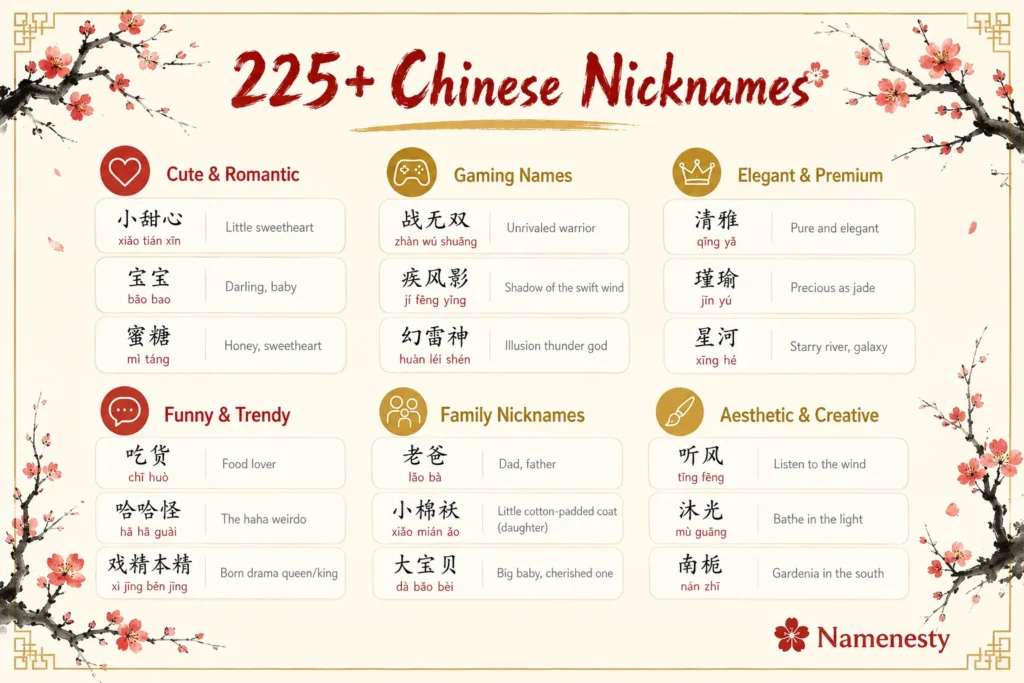
Whether you’re picking a sweet Nickname for your Boyfriend or girlfriend, looking for something for a new baby, hunting for a gamer tag that doesn’t sound like everyone else’s, or just curious how this whole system works, this guide pulls together 225+ Chinese nicknames across 15 categories — every one with pinyin and a plain-English meaning so you’re never just copying characters you don’t understand.
A quick note before you dive in: In Chinese, the relationship decides whether a nickname is sweet or rude. Keep that in mind as you browse, and we’ll cover the etiquette in detail further down.
Chinese Nickname Styles at a Glance
| Style | Typical Tone | Best For | Example |
| Cute | Soft, affectionate | Couples, kids | 团子 (Tuán zi) |
| Unique | Poetic, distinctive | Anyone wanting a name that stands out | 听雪 (Tīng xuě) |
| Stylish | Refined, trendy | Social media handles, aesthetic profiles | 墨白 (Mò bái) |
| Funny | Teasing, lighthearted | Close friends | 沙雕 (Shā diāo) |
| Aesthetic | Dreamy, visual | Usernames, journals, art accounts | 浮光 (Fú guāng) |
| Cool | Bold, powerful | Guys, gamers | 战神 (Zhàn shén) |
| Rare | Literary, uncommon | People who want something nobody else has | 璟 (Jǐng) |
| Modern | Internet-native, ironic | Gen Z self-description | 摆烂 (Bǎi làn) |
| Trendy | Viral, slang-driven | Social posts, comments | 绝绝子 (Jué jué zi) |
| Creative | Imagery-based | Writers, artists | 星河 (Xīng hé) |
| Elegant | Classical, formal-romantic | Period-drama fans, couples | 公子 (Gōng zǐ) |
| Short | Quick, casual | Everyday use among friends | 小七 (Xiǎo Qī) |
| Family | Warm, kinship-based | Parents, grandparents, kids | 心肝宝贝 (Xīn gān bǎo bèi) |
| Gaming | Competitive, dramatic | Esports and game profiles | 大神 (Dà shén) |
| Premium | Lofty, status-driven | Luxury branding, playful flattery | 至尊 (Zhì zūn) |
1. Cute Chinese Nicknames
Cute nicknames in Chinese lean on softness — doubled syllables, food words, and anything that sounds small and round. These work for couples, children, or anyone you want to call “precious” without sounding stiff.
| Nickname | Pinyin | Meaning |
| 宝贝 | Bǎo bèi | Treasure / baby |
| 甜心 | Tián xīn | Sweetheart |
| 萌萌 | Méng méng | Adorable one |
| 小可爱 | Xiǎo kě’ài | Little cutie |
| 心心 | Xīn xīn | Little heart |
| 软软 | Ruǎn ruǎn | Soft, cuddly one |
| 糖糖 | Táng táng | Sugar / sweetie |
| 团子 | Tuán zi | Dumpling (round and cute) |
| 桃桃 | Táo táo | Little peach |
| 奶糖 | Nǎi táng | Milk candy |
| 软糖 | Ruǎn táng | Gummy candy |
| 棉花糖 | Mián huā táng | Marshmallow |
| 蜜糖 | Mì táng | Honey |
| 小绵羊 | Xiǎo mián yáng | Little lamb |
| 布丁 | Bù dīng | Pudding |
2. Unique Chinese Nicknames
These borrow from classical poetry — short images (snow, rivers, geese) rather than direct descriptions. They read as distinctive precisely because they don’t translate into a single English word.
| Nickname | Pinyin | Meaning |
| 孤鸿 | Gū hóng | Lone wild goose |
| 临渊 | Lín yuān | By the abyss |
| 寄秋 | Jì qiū | Autumn’s letter |
| 听雪 | Tīng xuě | Listening to snow |
| 知南 | Zhī nán | Knowing the south |
| 浅墨 | Qiǎn mò | Light ink |
| 半夏 | Bàn xià | Midsummer |
| 沐辰 | Mù chén | Bathed in dawn |
| 凌川 | Líng chuān | Soaring river |
| 子归 | Zǐ guī | Return of the child |
| 千寻 | Qiān xún | A thousand searches |
| 远山 | Yuǎn shān | Distant mountain |
| 槎影 | Chá yǐng | A raft’s shadow |
| 顾南 | Gù nán | Looking south |
| 倦游 | Juàn yóu | Weary of wandering |
3. Stylish Chinese Nicknames
Stylish names favor crisp, modern-sounding character pairs — often the kind you’d see on a fashion blogger’s profile or a sleek username.
| Nickname | Pinyin | Meaning |
| 墨白 | Mò bái | Ink white |
| 清辞 | Qīng cí | Clear words |
| 锦黎 | Jǐn lí | Brocade dawn |
| 凌薇 | Líng wēi | Soaring violet |
| 慕辞 | Mù cí | Admiring words |
| 知夏 | Zhī xià | Knowing summer |
| 南絮 | Nán xù | Southern catkin |
| 凛风 | Lǐn fēng | Crisp wind |
| 北笙 | Běi shēng | Northern reed-pipe |
| 浅秋 | Qiǎn qiū | Light autumn |
| 江南 | Jiāng nán | South of the river |
| 墨染 | Mò rǎn | Ink-dyed |
| 清越 | Qīng yuè | Clear and resonant |
| 慕白 | Mù bái | Admiring white |
| 苏黎 | Sū lí | Awakening dawn |
4. Funny Chinese Nicknames
In Chinese, mocking someone gently is often a sign of trust, not disrespect. These only land well with people who already know you’re joking.
| Nickname | Pinyin | Meaning |
| 二货 | Èr huò | Goofball |
| 逗比 | Dòu bī | Funny clown |
| 沙雕 | Shā diāo | Goofy, ridiculous one |
| 戏精 | Xì jīng | Drama queen |
| 吃货 | Chī huò | Foodie / glutton |
| 懒虫 | Lǎn chóng | Lazy bug |
| 话痨 | Huà láo | Chatterbox |
| 路痴 | Lù chī | Direction idiot |
| 手残党 | Shǒu cán dǎng | The clumsy-hands gang |
| 大猪蹄子 | Dà zhū tí zi | “Big pig hooves” (a fickle flirt) |
| 杠精 | Gàng jīng | The contrarian |
| 锦鲤 | Jǐn lǐ | Lucky koi (always wins) |
| 柠檬精 | Níng méng jīng | Lemon spirit (jealous one) |
| 小迷糊 | Xiǎo mí hú | Little scatterbrain |
| 团宠 | Tuán chǒng | The group’s spoiled favorite |
5. Aesthetic Chinese Nicknames
Aesthetic nicknames read like a single frame from a film — quiet, visual, slightly melancholic. Popular for art accounts, journals, and moodboard-style social profiles.
| Nickname | Pinyin | Meaning |
| 月白 | Yuè bái | Moon white |
| 云汐 | Yún xī | Cloud tide |
| 顾影 | Gù yǐng | Watching one’s own reflection |
| 浅笑 | Qiǎn xiào | Faint smile |
| 雾起 | Wù qǐ | Rising mist |
| 清欢 | Qīng huān | Quiet joy |
| 暮雪 | Mù xuě | Dusk snow |
| 念安 | Niàn ān | Wishing for peace |
| 落霖 | Luò lín | Falling rain |
| 听风 | Tīng fēng | Listening to wind |
| 浮光 | Fú guāng | Floating light |
| 余温 | Yú wēn | Remaining warmth |
| 入画 | Rù huà | Entering a painting |
| 晚星 | Wǎn xīng | Evening star |
| 拾光 | Shí guāng | Gathering light |
6. Cool Chinese Nicknames for Guys
Bold, single- or double-character names built for impact — common in gaming circles and among friend groups that like a bit of theater.
| Nickname | Pinyin | Meaning |
| 战神 | Zhàn shén | War god |
| 影帝 | Yǐng dì | Movie king (top performer) |
| 狂刀 | Kuáng dāo | Mad blade |
| 烈风 | Liè fēng | Fierce wind |
| 黑豹 | Hēi bào | Black panther |
| 寒锋 | Hán fēng | Cold edge |
| 暗夜 | Àn yè | Dark night |
| 铁血 | Tiě xuè | Iron blood |
| 狼王 | Láng wáng | Wolf king |
| 影狼 | Yǐng láng | Shadow wolf |
| 烬 | Jìn | Ember / ash |
| 苍穹 | Cāng qióng | Vast sky |
| 孤狼 | Gū láng | Lone wolf |
| 锋哥 | Fēng gē | “Edge” bro |
| 王者 | Wáng zhě | Champion / king |
7. Rare Chinese Nicknames
These lean on uncommon, literary characters — many borrowed from classical jade and gemstone vocabulary — that you won’t see in everyday conversation.
| Nickname | Pinyin | Meaning |
| 玥 | Yuè | A mythical moon-pearl |
| 翊 | Yì | To assist, to shelter |
| 珩 | Héng | A jade pendant ornament |
| 黛 | Dài | Dark green-black pigment |
| 珂 | Kē | A jade-like ornament |
| 璟 | Jǐng | The brilliance of jade |
| 旻 | Mín | Autumn sky |
| 珞 | Luò | A jade-like stone |
| 昭言 | Zhāo yán | Bright words |
| 漪 | Yī | Ripple |
| 黎央 | Lí yāng | Dawn’s center |
| 苓 | Líng | A delicate medicinal herb |
| 莞 | Wǎn | A gentle smile |
| 砚秋 | Yàn qiū | Inkstone autumn |
| 阑珊 | Lán shān | Fading, dim light |
8. Modern Chinese Nicknames
Born from contemporary Chinese self-talk and social media culture — ironic, self-aware, and very relatable to anyone active online.
| Nickname | Pinyin | Meaning |
| 小确幸 | Xiǎo què xìng | A small, certain happiness |
| 干饭人 | Gàn fàn rén | “Let’s eat” energy / foodie |
| 摆烂 | Bǎi làn | Letting things “rot” (giving up on purpose) |
| 卷王 | Juǎn wáng | Hustle champion |
| 佛系 | Fó xì | “Buddha-style,” unbothered |
| 躺平 | Tǎng píng | “Lying flat,” anti-hustle |
| 显眼包 | Xiǎn yǎn bāo | The attention-grabber |
| 表情包本人 | Biǎoqíng bāo běnrén | A walking meme |
| 自来熟 | Zì lái shú | Instantly friendly with anyone |
| 行走的CPU | Xíngzǒu de CPU | “Walking CPU” — a human encyclopedia |
| 学霸 | Xué bà | Study tyrant / top student |
| 社恐 | Shè kǒng | Socially anxious one |
| 社牛 | Shè niú | Socially fearless one |
| 凡尔赛 | Fán’ěrsài | A humble-bragger (“Versailles” style) |
| 斜杠青年 | Xié gàng qīngnián | “Slash” youth — multiple careers at once |
9. Trendy Chinese Nicknames (Internet & Gen Z)
These spread through Douyin, Weibo, and gaming comment sections before going mainstream. Great for captions and casual chat, less so for formal use.
| Nickname | Pinyin | Meaning |
| 宝子 | Bǎo zi | Dear friend (gender-neutral) |
| YYDS | — | “Greatest of all time” |
| 老铁 | Lǎo tiě | Solid bro |
| 大佬 | Dà lǎo | Big boss / expert |
| 666 | Liù liù liù | Smooth, impressive |
| 夺笋啊 | Duó sǔn a | Playful “how rude” pun |
| city不city | City bù city | “Is it city / is it cool?” |
| 绝绝子 | Jué jué zi | Absolutely amazing |
| 我emo了 | Wǒ emo le | “I’m feeling down” |
| 上头 | Shàng tóu | Hooked, obsessed |
| 笑不活了 | Xiào bù huó le | “Laughed to death” |
| 真香 | Zhēn xiāng | “Smells so good” (ironic flip-flop) |
| 干巴爹 | Gān bā diē | “Keep going,” a playful loanword |
| 是个狼人 | Shì gè lángrén | “Total wolf” — sneaky and clever |
| 集美 | Jí měi | Playful version of “girls” |
10. Creative Chinese Nicknames
Built from nature imagery and abstract ideas, these work especially well for usernames, pen names, or fictional characters.
| Nickname | Pinyin | Meaning |
| 星河 | Xīng hé | Galaxy / river of stars |
| 墨韵 | Mò yùn | Ink’s rhythm |
| 风铃 | Fēng líng | Wind chime |
| 雨眠 | Yǔ mián | Rain sleep |
| 月隐 | Yuè yǐn | Hidden moon |
| 光阴 | Guāng yīn | Time, light and shadow |
| 流光 | Liú guāng | Flowing light |
| 浮云 | Fú yún | Floating cloud |
| 暮光 | Mù guāng | Twilight |
| 时雨 | Shí yǔ | Timely rain |
| 沉星 | Chén xīng | Sinking star |
| 落日 | Luò rì | Sunset |
| 海音 | Hǎi yīn | Sound of the sea |
| 风之子 | Fēng zhī zǐ | Child of the wind |
| 染秋 | Rǎn qiū | Dyed autumn |
11. Elegant Chinese Nicknames (Classical Style)
Pulled from historical drama vocabulary, these carry a formal, romantic register — half playful, half genuinely flattering.
| Nickname | Pinyin | Meaning |
| 公子 | Gōng zǐ | Young noble gentleman |
| 姑娘 | Gū niang | Young lady |
| 娘子 | Niáng zi | Wife (classical) |
| 相公 | Xiàng gōng | Husband (classical) |
| 仙子 | Xiān zǐ | Immortal fairy maiden |
| 才子 | Cái zǐ | Talented scholar |
| 佳人 | Jiā rén | A beautiful person |
| 君子 | Jūn zǐ | A person of virtue |
| 倾城 | Qīng chéng | Beauty that “topples cities” |
| 玉人 | Yù rén | Jade person (elegant beauty) |
| 雅士 | Yǎ shì | A refined scholar |
| 闺秀 | Guī xiù | A gentlewoman of good family |
| 公主 | Gōng zhǔ | Princess |
| 皇兄 | Huáng xiōng | “Royal brother” (playful) |
| 王妃 | Wáng fēi | Princess consort |
12. Short Chinese Nicknames
Quick, easy-to-say names built on the classic 小 (little) and 阿 (ah) prefixes — the everyday workhorses of Chinese nickname culture.
| Nickname | Pinyin | Meaning |
| 阿明 | Ā Míng | “Ah-Ming” |
| 小布 | Xiǎo Bù | “Little Bu” |
| 阿伟 | Ā Wěi | “Ah-Wei” |
| 小雨 | Xiǎo Yǔ | “Little Rain” |
| 老K | Lǎo K | “Old K” |
| 阿May | Ā May | “Ah-May” |
| 小七 | Xiǎo Qī | “Little Seven” |
| 阿杰 | Ā Jié | “Ah-Jie” |
| 小白 | Xiǎo Bái | “Little White” |
| 阿丽 | Ā Lì | “Ah-Li” |
| 小桃 | Xiǎo Táo | “Little Peach” |
| 阿土 | Ā Tǔ | “Ah-Tu” |
| 小贝 | Xiǎo Bèi | “Little Bei” |
| 阿牛 | Ā Niú | “Ah-Niu” |
| 小米 | Xiǎo Mǐ | “Little Millet” |
13. Chinese Nicknames for Family & Loved Ones
Kinship terms double as nicknames in Chinese far more than in English — calling someone “older brother” or “little ancestor” is normal even outside the biological family.
| Nickname | Pinyin | Meaning |
| 爸比 | Bà bi | Daddy |
| 妈咪 | Mā mī | Mommy |
| 哥哥 | Gēge | Older brother |
| 姐姐 | Jiějiě | Older sister |
| 弟弟 | Dìdi | Younger brother |
| 妹妹 | Mèimei | Younger sister |
| 爷爷 | Yéyé | Grandpa (paternal side) |
| 奶奶 | Nǎinai | Grandma (paternal side) |
| 外公 | Wàigōng | Grandpa (maternal side) |
| 外婆 | Wàipó | Grandma (maternal side) |
| 乖乖 | Guāi guāi | Good, obedient one |
| 心肝宝贝 | Xīn gān bǎo bèi | “Heart-and-liver treasure” |
| 小祖宗 | Xiǎo zǔ zōng | “Little ancestor” (a spoiled favorite) |
| 老伴 | Lǎo bàn | Lifelong companion |
| 一家之主 | Yī jiā zhī zhǔ | “Head of the household” (joking title) |
14. Chinese Nicknames for Gaming & Usernames
Gaming culture has built its own vocabulary of dramatic, larger-than-life handles — pick one that matches the energy you actually want to bring to a match.
| Nickname | Pinyin | Meaning |
| 大神 | Dà shén | Great god/expert player |
| 萌新 | Méng xīn | Cute newbie |
| 王者归来 | Wáng zhě guī lái | “The king returns” |
| 一刀传说 | Yī dāo chuán shuō | “One-blade legend” |
| 暗影杀手 | Àn yǐng shā shǒu | Shadow assassin |
| 孤狼战神 | Gū láng zhàn shén | Lone-wolf war god |
| 萌新上线 | Méng xīn shàng xiàn | “Newbie has logged on” |
| 战术大师 | Zhàn shù dà shī | Tactics master |
| 暴走萝莉 | Bào zǒu luó li | A rampaging, high-energy gamer girl |
| 电竞女神 | Diàn jìng nǚ shén | Esports goddess |
| 躺赢哥 | Tǎng yíng gē | “Win without trying” bro |
| 苍狼 | Cāng láng | Grey wolf |
| 影杀 | Yǐng shā | Shadow kill |
| 锁血侠 | Suǒ xuè xiá | The unkillable “HP-lock” hero |
| 一血王 | Yī xuè wáng | First-blood king |
15. Premium Chinese Nicknames
Borrowed from imperial and high-status vocabulary, these names are meant to flatter — useful for playful titles between couples or for a luxury-leaning brand persona.
| Nickname | Pinyin | Meaning |
| 帝王 | Dì wáng | Emperor/monarch |
| 御 | Yù | Imperial, exclusive |
| 尊上 | Zūn shàng | The esteemed one above |
| 贵公子 | Guì gōng zǐ | A noble young master |
| 千金 | Qiān jīn | “Thousand gold” — a treasured daughter |
| 名媛 | Míng yuán | A socialite lady |
| 总裁 | Zǒng cái | CEO / president |
| 御姐 | Yù jiě | The elegant elder-sister archetype |
| 殿下 | Diàn xià | “Your Highness” |
| 贵妃 | Guì fēi | Imperial consort |
| 财神 | Cái shén | The god of wealth |
| 锦衣公子 | Jǐn yī gōng zǐ | A brocade-robed young master |
| 御用 | Yù yòng | “Royally appointed,” exclusively favored |
| 至尊 | Zhì zūn | The supreme one |
| 顶流 | Dǐng liú | A top-tier celebrity |
How to Choose the Perfect Chinese Nickname
Start with the relationship, not the dictionary. A name that sounds sweet for a partner can sound bizarre or rude when applied to a coworker, so decide first who this nickname is for and how close you actually are.
Then pick a register: gentle and doubled (宝宝-style) for tenderness, prefixed with 小 or 阿 for everyday friendliness, or drawn from the classical/elegant list if you want something more dramatic. Say it out loud — Chinese nicknames are spoken constantly, so awkward pronunciation matters more than how a name looks written down.
Finally, check the meaning character by character if you’re building your own. A combination that looks pretty can occasionally carry an odd or unintended connotation once you know what each character means individually.
Tips to Create Your Own Unique Chinese Nickname
The fastest method is the prefix formula: take the last character of someone’s given name and add 小 (casual), 老 (close, long-term), or 阿 (common in Taiwan and southern China). 李明 becomes 小明 among friends or 阿明 in a southern, casual context.
Reduplication is the second trick — doubling any single pleasant character (笑笑, 甜甜, 团团) instantly makes it warmer and more affectionate, which is why so many baby and couple nicknames use this pattern.
For something more original, mix a nature or emotion word (云, 雪, 星, 念) with a soft verb or adjective (听, 浅, 暮, 拾) — that’s the formula behind most of the aesthetic and creative names above, and it’s flexible enough to build hundreds of new combinations.
Best Situations to Use These Names
Cute, family, and elegant-style nicknames suit private, affectionate settings — partners, parents, and children, or close relatives. Funny and trendy nicknames belong among friends who already share inside jokes, ideally after a relationship has had time to develop. Cool, gaming, and premium names work best as public-facing identities — profile names, usernames, or stream handles — where you’re choosing an image rather than describing a real bond. Short and family nicknames are the safest everyday defaults when you’re unsure which category fits.
Common Mistakes to Avoid While Choosing Names
Don’t apply a nickname meant for an intimate relationship — like 老公 (“husband”) or 心肝 (“heart and liver”) — to someone you’ve just met; it reads as overly forward rather than charming. Avoid the 小 prefix for anyone older or higher-ranking than you, since it subtly implies they’re junior to you, which can land as disrespectful in professional or family settings. Be careful with teasing names like 傻瓜 or 笨蛋: they only work as affection once a friendship is firmly established, never as an opener. And when building your own name from individual characters, always double-check the meaning rather than relying on how it sounds — a striking-looking combination can occasionally carry an unintended meaning once translated literally.
People Also Ask
Yes — terms like 老公 (lǎo gōng) and 老婆 (lǎo pó) are commonly used between dating couples in mainland China well before any wedding. It’s less about legal status and more about signaling “we’re serious about each other.”
小 (xiǎo) is used everywhere in mainland China and simply means “little,” usually for someone younger or close in age. 阿 (ā) carries the same warmth but is much more common in Taiwan and southern China, and it attaches directly to a name without implying age at all.
You can absolutely choose one yourself — the prefix-plus-name formula above is a safe, simple starting point. That said, a nickname gifted naturally by a Chinese friend tends to feel more personal, so it’s worth asking a friend what they’d instinctively call you if you want the more authentic route.
Not between people who are already close — in fact, they’re often a sign of deep comfort, since only a trusted friend gets away with teasing you. The same words from a stranger or new acquaintance would land very differently, so context is everything.
Gaming nicknames can be creative and dramatic. Choose a name that matches your playstyle and personality, since names like 大神 (“great expert”) sound confident, while 萌新 (“cute newbie”) feel playful and beginner-friendly.
Final Thoughts
Chinese nicknames are less a list of cute words and more a map of how close people are — every prefix, doubled syllable, and playful insult tells you something about a relationship that a plain name never could. With 225+ options across cute, funny, elegant, modern, and gaming styles, there’s a starting point here, whether you’re naming a partner, a pet project, or your next gaming profile.
Bookmark this page if you want to come back — and browse more in-depth name guides on Namenesty if you’re building out a fuller naming project beyond Chinese.