Introduction
In most cultures, a nickname is just a shorter version of a name. In Japan, it is something much deeper.
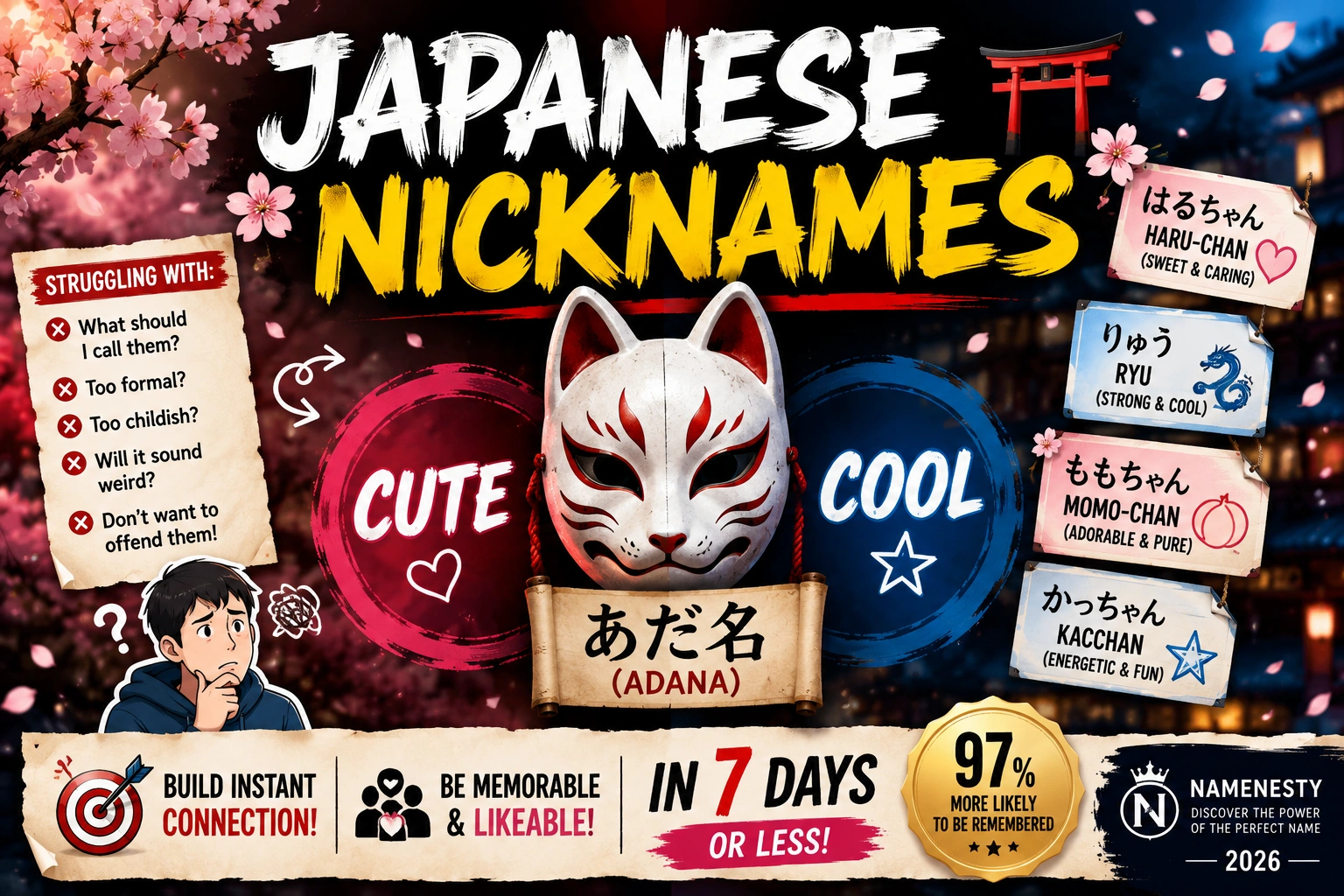
A Japanese Nickname — called あだ名 (adana) — reveals the nature of a relationship, the social hierarchy between two people, and often a hidden layer of cultural meaning that outsiders can easily miss. The way a Japanese person chooses to call someone by their nickname signals trust, warmth, years of friendship, or romantic affection more powerfully than words alone ever could.
This is not just about calling “Haruka” by “Haru-chan.” It is about understanding when that nickname is acceptable, why that specific suffix was chosen, and what it communicates to everyone in the room.
This guide is the most comprehensive resource available on Japanese nicknames in English. Whether you are a language learner, an anime fan, someone in a relationship with a Japanese person, or simply curious about one of the world’s most nuanced naming cultures, you will find everything you need right here.
1. Japanese Nickname Culture: What No One Tells You {#culture}
The “Nickname Permission” Concept
One of the most misunderstood aspects of Japanese nicknames is that you generally do not simply decide to give someone a nickname. In Japanese social dynamics, there is an unspoken process sometimes called nickname permission (ニックネーム許可) — a mutual, gradual shift from formal address to informal nickname that signals deepening trust.
Using someone’s nickname before that permission is granted — especially someone older, in a superior position, or someone you have just met — can come across as presumptuous, rude, or even offensive. This is why understanding the context of nickname use is as important as knowing the nicknames themselves.
Nicknames Through Life’s Stages
Japanese people experience nicknames very differently depending on their life stage:
Elementary and Middle School: This is the golden age of nicknames. Classmates freely invent creative, playful nicknames for each other. Being given a nickname is actually a sign of social acceptance — it means you belong to the group.
High School: Nicknames continue heavily, but start to become more identity-defining. Students known by a cool nickname often carry that identity into adulthood.
University: A mix of old high school nicknames and new ones formed in club activities (部活, bukatsu) or dormitory life.
Working Life (Shakaijin / 社会人): The workplace demands a near-complete return to formal address. Colleagues use last name + さん (san). Nicknames almost disappear in professional settings — except during after-hours gatherings called 飲み会 (nomikai), drinking parties where the social walls come down.
Close Adult Circles: Among lifelong friends, hobby groups, and intimate couples, nicknames survive indefinitely and become symbols of the relationship’s depth.
The Social Signal in Every Nickname
Every nickname choice broadcasts information:
- The relationship stage — how close the two people are
- The power dynamic — a senpai (senior) can nickname a kohai (junior) freely; the reverse requires more care
- The emotional tone — playful, affectionate, teasing, or deeply intimate
- The cultural fluency — using the right suffix shows you understand Japanese social norms
2. Honorifics vs. Nicknames: The Critical Difference {#honorifics}
This is a confusion that appears in virtually every other article on this topic, so let us settle it definitively.
Honorifics (敬称, keishō) are NOT Nicknames.
Japanese honorifics — san (さん), kun (くん), chan (ちゃん), sama (様), senpai (先輩) — are social markers, not nickname creators. They indicate the relationship or status between people. When you call someone “Tanaka-san,” you are not giving Tanaka a nickname. You are simply using a polite address.
| Term | Type | Purpose | Example |
| さん (-san) | Honorific | Respect/formality | Tanaka-san |
| 様 (-sama) | Honorific | High respect | Sensei-sama |
| くん (-kun) | Honorific | Casual male address | Kenji-kun |
| ちゃん (-chan) | Honorific (& nickname tool) | Affection/cuteness | Miko-chan |
| 先輩 (senpai) | Title | Senior in group | —used as a direct address |
How Honorifics Become Nickname Tools
Here is where it gets interesting: some honorifics double as nickname-building tools. When you shorten a name and add -chan or -kun, that shortened + suffix combination becomes a genuine nickname.
- “Haruka” shortened to “Haru” + -chan = Haru-chan ✅ (This is a nickname)
- Calling someone “Haruka-san” = ❌ (This is NOT a nickname, just a polite address)
The key distinction: a nickname modifies the actual name through shortening, sound play, or creative alteration. An honorific on a full name does not create a nickname — it just frames the relationship.
3. The Complete Japanese Nickname Suffix Guide {#suffixes}
Understanding suffixes is essential because the same base name with different suffixes creates completely different nicknames with very different emotional tones.
Core Suffixes
~ちゃん (-chan) | ちゃん
Tone: Cute, warm, affectionate
Best for: Girls, young children, female friends, pets, and very close male friends
Cultural note: Using -chan for an adult male outside of very close friendship can sound emasculating unless the relationship is established and mutual
Examples: Momo → Momo-chan, Saki → Sa-chan, Yuki → Yuki-chan
Special rule: When the name ends in -chi (ち) or -tsu (つ), a contraction occurs — “Katsu + chan” becomes “Katchan,” not “Katsu-chan.”
~くん (-kun) | 君
Tone: Casual, respectful, slightly boyish
Best for: Boys, male classmates, male colleagues in informal moments, some close female friends
Cultural note: In workplaces, female superiors sometimes address male subordinates with -kun, which can carry a slightly condescending nuance if the man is older
Examples: Takashi → Taka-kun, Kenji → Ken-kun, Ryosuke → Ryo-kun
~たん (-tan) | たん
Tone: Extra cute, baby-talk, intensely affectionate
Best for: Very young children, pets, anime characters, and in otaku or fandom culture
Origin: Arose from internet and anime fan communities in the early 2000s as an even sweeter variant of -chan
Examples: Risa → Risa-tan, Hina → Hina-tan
Caution: Using -tan with someone you are not extremely close to sounds overly infantilizing and can be unwelcome
~ちん (-chin) | ちん
Tone: Playful, intimate, slightly naughty-cute
Best for: Very close friends, younger siblings, childlike contexts
Cultural note: Limited to specific subcultures; not common in mainstream settings. Most common among teen girls and in idol fandoms
Examples: Nana → Nana-chin, Yuka → Yuka-chin
~りん (-rin) | りん
Tone: Soft, melodic, elegant-cute
Best for: Feminine names, young women, romantic contexts
Sound quality: The rin sound in Japanese is considered graceful and was popularized by names like “Rin” appearing frequently in anime
Examples: Mari → Mari-rin, Yuri → Yuri-rin, Hana → Hana-rin
~ぴ (-pi) | ぴ
Tone: Trendy, teen-pop, energetic
Best for: Teen girls, pop idol names, social media usernames
Examples: Yuki → Yuki-pi, Nana → Nana-pi
Cultural note: Very trendy in the 2010s and still used by younger generations
~っち (-cchi) | っち
Tone: Playful, pop-culture, buddy-like
Origin: Popularized by the Tamagotchi (たまごっち) brand
Best for: Casual male and female friend groups, fun and energetic contexts
Examples: Hiro → Hiroccchi, Tomo → Tomocchi
~さま (-sama) | 様
Tone: Dramatic, exaggerated reverence (usually ironic in nickname context)
When used as a nickname: Among very close friends as a joke, or in otaku/fandom culture to humorously elevate someone
Examples: In anime fan circles: “Lelouch-sama” (used genuinely as a term of deep admiration for a character)
4. How to Create an Authentic Japanese Nickname (Step-by-Step) {#howto}
Method 1: Name Shortening (短縮, tanshuku)
The most universal method. Reduce a name to its first one or two morae (Japanese sound units).
| Full Name | Shortened Base | Add Suffix | Final Nickname |
| Haruka | Haru | -chan | Haru-chan |
| Sakura | Saku | -chan | Saku-chan |
| Daiki | Dai | -kun | Dai-kun |
| Yoshiko | Yoshi | -chan | Yoshi-chan |
| Michiko | Michi | -chan | Michi-chan |
| Ryunosuke | Ryu | -kun | Ryu-kun |
The Contraction Rule: When a name base ends in -chi (ち) or -tsu (つ), the following -chan naturally contracts through a linguistic process called sokuon (促音) — a doubled consonant represented by the small っ (tsu):
- Katsu + chan → Kacchan (the “tsu” doubles the “c” sound)
- Uchi + chan → Ucchan
- Mitsu + chan → Micchan
This is not optional — native Japanese speakers will naturally produce these contractions, and using the uncontracted form sounds awkward.
Method 2: Surname + Given Name Fusion
One of the most distinctly Japanese nickname styles is the combination of part of the family name with part of the given name. Family names come first in Japanese order, so this fusion follows that structure.
Famous examples in Japanese popular culture:
- Kimura Takuya (木村拓哉) → Kimutaku (キムタク) — perhaps the most famous example, this SMAP idol’s fusion nickname became iconic
- Matsumoto Jun (松本潤) → Matsujun (まつじゅん)
- Kato Kenji (加藤賢二) → Kato-Ken
This method works best when the result sounds natural and smooth in Japanese phonology. It rarely works well with non-Japanese names without significant adaptation.
Method 3: Trait or Characteristic Nickname
Nicknames that arise from a person’s memorable quality, habit, or physical feature. These are completely organic and cannot really be invented — they emerge naturally in social groups.
Common nickname originates from traits:
- Hair color or style: Aka-chan (red-hair), Kuro-chan (dark-hair)
- A memorable moment: A student who once dramatically fell asleep in class might be nicknamed Nemurin (sleepyhead)
- Personality: Someone always eating might be called Tabecchi (from taberu, to eat)
- A skill: A great soccer player might earn Shootaa
Method 4: Animal or Nature Nickname
Giving someone an animal name based on their personality is a beloved tradition. These usually add -chan or -kun:
| Animal | Japanese | Nickname | Best For |
| Rabbit | Usagi | Usagi-chan | Energetic, quick, playful people |
| Bear | Kuma | Kuma-kun | Big, gentle, protective people |
| Cat | Neko | Neko-chan | Independent, elegant, mysterious people |
| Fox | Kitsune | Kitsune-chan | Clever, sly, charming people |
| Tiger | Tora | Tora-kun | Brave, strong, loyal people |
| Panda | Panda | Panda-chan | Round-faced, easygoing, lovable people |
| Wolf | Ookami | Ookami-kun | Independent, fierce, lone-wolf types |
| Deer | Shika | Shika-chan | Gentle, graceful, wide-eyed people |
Method 5: Repetition (Repeat Sound)
Doubling a syllable or short name creates an instantly cute nickname, especially for young children:
- Hana → Hana-hana
- Rin → Rin-rin (りんりん)
- Yuki → Yuki-yuki
- Momo → Momo-momo
5. Cute Japanese Nicknames for Girls (150+) {#girls}
Nature & Flowers
| Nickname | Kanji | Meaning | Personality Match |
| Sakura | 桜 | Cherry blossom | Beautiful, ephemeral, graceful |
| Hana | 花 | Flower | Warm, nurturing, radiant |
| Yuki | 雪 | Snow | Pure, calm, quiet |
| Hoshi | 星 | Star | Bright, dreamy, ambitious |
| Tsuki | 月 | Moon | Mysterious, gentle, reflective |
| Sora | 空 | Sky | Free-spirited, open-hearted |
| Umi | 海 | Sea | Deep, emotional, adventurous |
| Kiri | 霧 | Mist | Soft, elusive, artistic |
| Niji | 虹 | Rainbow | Colorful, joyful, optimistic |
| Haru | 春 | Spring | Cheerful, new beginnings, warm |
| Natsu | 夏 | Summer | Energetic, bold, fun-loving |
| Aki | 秋 | Autumn | Mature, elegant, thoughtful |
| Fuyu | 冬 | Winter | Reserved, strong, serene |
| Momiji | 紅葉 | Autumn leaves | Artistic, changing, beautiful |
| Bara | 薔薇 | Rose | Romantic, passionate, elegant |
| Himawari | 向日葵 | Sunflower | Happy, bright, loyal |
| Sumire | 菫 | Violet | Delicate, refined, sweet |
| Suzuran | 鈴蘭 | Lily of the valley | Pure, modest, charming |
| Shion | 紫苑 | Aster flower | Nostalgic, gentle, poetic |
| Ayame | 菖蒲 | Iris | Bold, elegant, distinctive |
Animals & Creatures
| Nickname | Kanji | Meaning | Personality Match |
| Usagi-chan | うさぎ | Rabbit | Playful, sweet, quick |
| Neko-chan | 猫 | Kitten | Independent, adorable |
| Kitsune | 狐 | Fox | Clever, charming, witty |
| Kotori | 小鳥 | Small bird | Delicate, cheerful, free |
| Cho | 蝶 | Butterfly | Graceful, transformative |
| Hotaru | 蛍 | Firefly | Magical, inspiring, unique |
| Shirouma | 白馬 | White horse | Noble, elegant, strong |
| Koharu | 小春 | Baby sparrow | Tiny, sweet, warmhearted |
| Taiyou | 太陽 | Sun | Energetic, warm, uplifting |
Sweet & Food-Inspired
| Nickname | Meaning | Tone |
| Mochi-chan | Rice cake | Soft, sweet, lovable |
| Ichigo-chan | Strawberry | Fresh, playful, cute |
| Maron | Chestnut (French loan) | Warm, cozy, sweet |
| Pudding-chan | Pudding | Soft, jiggly, adorable |
| Anko | Sweet red bean paste | Traditional, sweet, comforting |
| Kurimu | Cream | Smooth, gentle, sweet |
| Konpeitou | Star candy | Bright, small, sparkling |
| Ohagi | Sweet rice ball | Old-fashioned, tender |
Gem & Celestial Names
| Nickname | Kanji | Meaning |
| Kohaku | 琥珀 | Amber |
| Ruri | 瑠璃 | Lapis lazuli |
| Gin | 銀 | Silver |
| Kin | 金 | Gold |
| Tama | 珠 | Jewel/Gem |
| Kirakira | キラキラ | Sparkling |
| Hoshi-ko | 星子 | Little star |
| Akari | 明り | Glow / Light |
| Kagayaki | 輝き | Radiance |
Personality-Based Cute Nicknames for Girls
| Nickname | Meaning | Best For |
| Genki-chan | Energetic one | Sporty, lively girls |
| Waraii | Laughing one | Girls with infectious laughs |
| Yasashii-ko | Gentle one | Kind, soft-spoken girls |
| Fuwafuwa | Fluffy/Airy | Dreamy, soft-natured girls |
| Pikapika | Sparkling | Bright, cheerful girls |
| Niko-niko | Smiley | Girls who always smile |
| Honyaraka | Easy-going | Laid-back, relaxed girls |
| Oshaberi | Chatterbox | Talkative, social girls |
Suffix-Based Nickname Patterns for Girls’ Names
| Base Name | -chan | -tan | -rin | -pi |
| Yuki | Yuki-chan | Yuki-tan | Yuki-rin | Yuki-pi |
| Hana | Hana-chan | Hana-tan | Hana-rin | Hana-pi |
| Saki | Sa-chan | Sa-tan | Sa-rin | Saki-pi |
| Mio | Mio-chan | Mio-tan | Mio-rin | Mio-pi |
| Rina | Ri-chan | Ri-tan | Ri-rin | Rina-pi |
| Nana | Na-chan | Na-tan | Na-rin | Nana-pi |
| Kana | Ka-chan | Ka-tan | Ka-rin | Kana-pi |
| Aoi | Ao-chan | Ao-tan | Ao-rin | Aoi-pi |
6. Cool Japanese Nicknames for Boys (100+) {#boys}
Classic Cool (Masculine, Strong)
| Nickname | Kanji | Meaning | Vibe |
| Ryu | 龍 | Dragon | Powerful, fierce, cool |
| Kaze | 風 | Wind | Free-spirited, fast, cool |
| Rai | 雷 | Thunder | Bold, striking, dramatic |
| Geki | 激 | Intense | Passionate, driven |
| Ken | 剣 | Sword | Sharp, disciplined, classic |
| Tetsu | 鉄 | Iron | Tough, reliable, unbreakable |
| Kou | 光 | Light | Bright, positive, inspiring |
| Shou | 翔 | Soaring | Ambitious, free, fast |
| Hayate | 颯 | Swift wind | Quick, agile, cool |
| Taka | 鷹 | Hawk | Sharp, proud, observant |
| Rin | 凜 | Dignified | Calm, cool, controlled |
| Ban | 晩 | Evening | Mysterious, cool, brooding |
| Kiri | 霧 | Mist | Elusive, cool, calm |
| Gin | 銀 | Silver | Cool, sleek, elegant |
| Ao | 青 | Blue | Calm, steady, cool |
Animal-Based Nicknames for Boys
| Nickname | Kanji | Animal | Personality |
| Kuma-kun | 熊 | Bear | Big, protective, gentle giant |
| Tora-kun | 虎 | Tiger | Brave, loyal, fierce |
| Ookami | 狼 | Wolf | Independent, lone, fierce |
| Taka-kun | 鷹 | Hawk | Sharp, observant, proud |
| Saru | 猿 | Monkey | Clever, playful, mischievous |
| Uma-kun | 馬 | Horse | Strong, noble, fast |
| Koi | 鯉 | Carp | Persistent, ambitious (koi fish legend) |
| Tatsumaki | 竜巻 | Tornado | Wild, unpredictable energy |
Shortened Name Nicknames for Boys
| Full Name | Cool Nickname | Notes |
| Hiroshi | Hiro | Very common, timeless |
| Takuya | Taku | Classic |
| Ryosuke | Ryo | Smooth, popular |
| Yoshihiro | Yoshi | Friendly, playful |
| Kazuki | Kazu | Casual, easygoing |
| Daisuke | Dai | Strong, short |
| Naoki | Nao | Cool, simple |
| Shinobu | Shin | Classic, elegant |
| Kouhei | Kou | Bright, easy |
| Takehiro | Take | Masculine, direct |
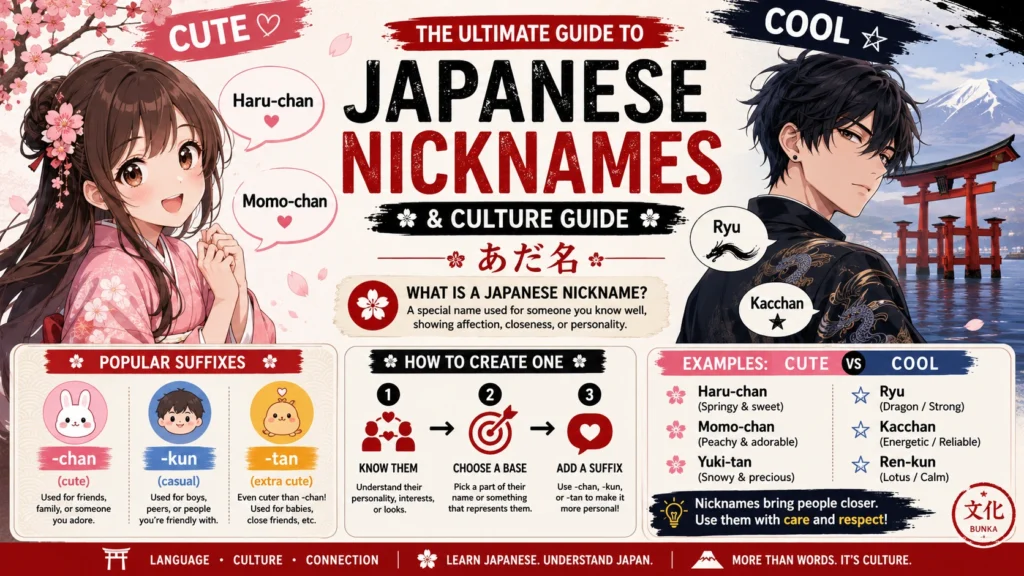
Discover meanings, cultural rules, and how to create your own cute or cool nickname 🇯🇵
Pop Culture / Gamer Style Names for Boys
| Nickname | Origin/Meaning | Style |
| Ace (Ēsu / エース) | Playing card ace | Leader, top-tier |
| Zero (Zero / ゼロ) | The number zero | Cool, detached, powerful |
| Rei | Zero/Spirit | Mysterious, cool |
| Kage | Shadow | Dark, cool, mysterious |
| Raito | Light (Raito = Death Note protagonist) | Intelligent, complex |
| Yuusha | Hero | Brave, classic RPG hero |
| Maou | Demon Lord | Edgy, powerful |
| Shinigami | Death God | Dark, anime-style |
7. Japanese Nicknames for Couples & Terms of Endearment (80+) {#couples}
The Unique Rules of Japanese Couple Nicknames
Japanese couples rarely use Western-style terms like “babe” or “honey” in their daily speech — at least not in Japanese. However, this has been changing rapidly since the 1990s, with borrowed English words and K-pop/Western media influence making affectionate language more normalized.
In traditional Japanese culture, even married couples often avoided using each other’s given names directly, instead using a role-based address: a wife might call her husband あなた (anata) — literally “you” — which carries the warmth of “dear” or “darling” in a marital context.
Essential Couple Nickname Vocabulary
| Nickname | Japanese | Romanization | Meaning | Tone |
| Dear / Darling | ダーリン | Daarin | Darling (from English) | Romantic, slightly retro |
| Honey | ハニー | Hanii | Honey (from English) | Sweet, modern |
| You (affectionate) | あなた | Anata | You / Dear | Traditional, warm |
| My love | 愛しい人 | Itoshii hito | Beloved one | Poetic, deep |
| Sweetheart | 心の人 | Kokoro no hito | Person of my heart | Poetic |
| Baby | ベイビー | Beibii | Baby (from English) | Modern, playful |
| My treasure | 宝物 | Takaramono | Treasure | Deeply affectionate |
| Lover | 恋人 | Koibito | Lover / Sweetheart | Romantic |
| Prince | 王子様 | Ouji-sama | Prince | Playful, affectionate |
| Princess | お姫様 | Ohimesama | Princess | Affectionate |
| Sunshine | 太陽 | Taiyou | My sun | Warm, uplifting |
| Star | 星 | Hoshi | Star | Dreamy, affectionate |
| Moon | 月 | Tsuki | Moon | Poetic, calm |
| Petal | 花びら | Hanabira | Flower petal | Delicate, romantic |
| Sparkling | キラキラ | Kirakira | Sparkle | Bright, joyful |
Cute Nicknames for Boyfriends
| Nickname | Japanese/Romaji | Meaning |
| Kakkoii-kun | かっこいい | Handsome/Cool one |
| Ikemen | イケメン | Hot guy (modern slang) |
| Ore-sama | 俺様 | Used playfully / ironically for cocky cool types |
| Taisetsu-kun | 大切 | Precious one |
| Amai-ko | 甘い子 | Sweet boy |
| Yasashii-kun | 優しい | Gentle one |
| Mamoru-kun | 守る | Protector |
| Hero | ヒーロー | My hero |
| Haato no Ou | ハートの王 | King of my heart |
Cute Nicknames for Girlfriends
| Nickname | Japanese/Romaji | Meaning |
| Akari-chan | 明り | My light |
| Hoshi no Ko | 星の子 | Child of the stars |
| Ichigo-chan | 苺 | Strawberry |
| Kokoro-chan | 心 | My heart |
| Himawari-chan | ひまわり | Sunflower |
| Kawaii Ko | かわいい子 | Cute one |
| Ohimesama | お姫様 | My princess |
| Yume-chan | 夢 | My dream |
| Ringo-chan | リンゴ | Apple |
| Koibito-chan | 恋人 | My sweetheart |
8. Japanese Nicknames for Best Friends (60+) {#friends}
The Friend Nickname in Japanese Culture
Friend nicknames in Japan tend to be creative, specific, and often born from a shared story. A nickname given by a best friend is called a 渾名 (adana) when it is an invented, unique nickname versus a modified version of the actual name.
The best nicknames between friends often reference:
- Something embarrassing that happened
- A favorite food or obsession
- A personality quirk
- A physical trait (handled warmly among friends)
- A catchphrase that the person always uses
Affectionate Friendship Nicknames
| Nickname | Japanese | Meaning |
| Nakayoshi | 仲良し | Bestie / Close friend |
| Zutto Tomodachi | ずっと友達 | Forever friend |
| Otomodachi | おともだち | My good friend |
| Muji | 無事 | All-good (as in “reliable, solid friend”) |
| Kirakira | キラキラ | Sparkling (for a dazzling friend) |
| Honwaka | ほんわか | Warm and fluffy (for a cozy, gentle friend) |
| Egao | 笑顔 | Smile (for a friend who always smiles) |
| Fuwafuwa | ふわふわ | Fluffy (for a soft-natured friend) |
| Tensai | 天才 | Genius (used playfully or sincerely) |
| Baka | バカ | Idiot (used only among VERY close friends!) |
Personality-Based Friend Nicknames
| Type of Friend | Suggested Nickname | Meaning |
| The energetic one | Genki-chan | Energetic one |
| The smart one | Tensai-kun | Genius |
| The foodie | Tabecchi / Kuicchi | From taberu (eat) |
| The sleepy one | Nemurin | Sleepyhead |
| The tall one | Takai-ko | Tall one |
| The tiny one | Chibi-chan | Tiny one |
| The dramatic one | Gekidou-kun | Intense/dramatic |
| The peacemaker | Yasuragi | Calm/peace |
| The chatterbox | Oshaberi-chan | Chatterbox |
| The mysterious one | Nazo-ko | Mysterious one |
9. Japanese Nicknames for Family Members (50+) {#family}
Parent Nicknames
| Relationship | Formal | Nickname/Casual | Childlike/Cute |
| Mother | お母さん (Okaa-san) | ママ (Mama) | まあちゃん (Maa-chan) |
| Father | お父さん (Otou-san) | パパ (Papa) | とーちゃん (Tou-chan) |
| Grandmother | お祖母さん (Obaasan) | おばあちゃん (Obaa-chan) | ばあば (Baaba) |
| Grandfather | お祖父さん (Ojiisan) | おじいちゃん (Ojii-chan) | じいじ (Jiiji) |
Sibling Nicknames
| Relationship | Standard | Nickname Version | Regional/Dialectal |
| Older brother | お兄さん (Onii-san) | おにいちゃん (Onii-chan) | にいに (Nii-nii) |
| Older sister | お姉さん (Onee-san) | おねえちゃん (Onee-chan) | ねえね (Nee-nee) |
| Younger sibling (M) | 弟 (Ototo) | おとうと (Otouto-chan) | Varies by region |
| Younger sibling (F) | 妹 (Imouto) | いもちゃん (Imo-chan) | Varies |
Regional note: In Okinawa and western Japan, sibling address terms differ significantly:
- In Okinawa, the older brother is often called アニキ (aniki) — carries tougher, more respectful connotations
- In Kansai: カアチャン (kaa-chan) for mother, トウチャン (tou-chan) for father are extremely common
Nicknames for Children (from parents)
| Nickname | Meaning | Context |
| うちの子 (Uchi no ko) | My child / Our kid | Endearing parent expression |
| ちびっこ (Chibikko) | Little one | Young children |
| ぼうや (Bouya) | Little boy | For young sons |
| お姫様 (Ohimesama) | Princess | For daughters |
| くまちゃん (Kuma-chan) | Little bear | Huggable, lovable child |
| まるまる (Marumaru) | Roundy (chubby cheeks) | Infants and toddlers |
| ぽんぽん (Ponpon) | Bouncy | Energetic children |
10. Nature-Inspired Japanese Nicknames with Kanji (70+) {#nature}
Nature holds a uniquely sacred place in Japanese culture, shaped by Shinto spirituality, haiku poetry, and the concept of mono no aware (物の哀れ) — the gentle sadness and beauty of impermanence. This deep respect for nature flows directly into naming culture.
Elements
| Nickname | Kanji | Reading | Meaning |
| Fire | 火 / 炎 | Hi / Honoo | Passionate, intense |
| Water | 水 | Mizu | Flowing, adaptable |
| Wind | 風 | Kaze | Free, changing |
| Earth | 土 | Tsuchi | Grounded, steady |
| Thunder | 雷 | Kaminari | Powerful, striking |
| Ice | 氷 | Koori | Cool, composed |
| Mist | 霧 | Kiri | Mysterious, soft |
| Frost | 霜 | Shimo | Cold beauty |
| Storm | 嵐 | Arashi | Passionate, dramatic |
| Dawn | 暁 | Akatsuki | New beginnings |
Seasons as Nicknames
| Season | Kanji | Romanization | Personality associations |
| Spring | 春 | Haru | Renewal, warmth, hope |
| Summer | 夏 | Natsu | Energy, boldness, freedom |
| Autumn | 秋 | Aki | Depth, elegance, nostalgia |
| Winter | 冬 | Fuyu | Strength, serenity, resilience |
| Cherry blossom season | 花見 | Hanami | Beauty, celebration, fleeting joy |
| Rainy season | 梅雨 | Tsuyu | Quiet, introspective |
Plants and Trees
| Nickname | Kanji | Meaning |
| Matsu | 松 | Pine — eternal, resilient |
| Take | 竹 | Bamboo — flexible, strong |
| Ume | 梅 | Plum blossom — elegant, early bloomer |
| Kuzu | 葛 | Kudzu — persistent |
| Sugi | 杉 | Cedar — tall, dignified |
| Hinoki | 檜 | Cypress — refined, aromatic |
| Kashi | 樫 | Oak — sturdy, dependable |
11. Anime & Pop Culture Japanese Nicknames (40+) {#anime}
Anime has been one of the most powerful forces shaping modern Japanese nickname culture — both within Japan and globally. Many contemporary Japanese suffixes, nickname styles, and terms of endearment gained mainstream traction through anime.
How Anime Influences Real Nickname Culture
Several suffix uses that seem informal today were popularized through iconic anime:
- -Tan originated in the internet/otaku culture and spread from there
- -dono (殿) — an archaic honorific — was revived in modern consciousness through historical anime like Rurouni Kenshin
- Nakama (仲間) — meaning “comrade” or “crewmate” — took on powerful emotional meaning through One Piece and is now used as a nickname in tight friend groups
- Senpai (先輩) — a school hierarchy term — became a Western internet meme and is now used self-referentially in Japan with irony
Iconic Nickname Patterns in Anime
| Anime | Character | Nickname | How It Formed |
| My Hero Academia | Katsuki Bakugo | Kacchan | Katsu + chan with contraction |
| Naruto | Naruto Uzumaki | Naru-chan / Naru-kun | Standard shortening |
| One Piece | Monkey D. Luffy | Luffy-kun | Informal -kun |
| Attack on Titan | Levi Ackerman | Heichou (Captain) | Title used as nickname |
| Sailor Moon | Usagi Tsukino | Usagi-chan | Name + chan |
| K-On! | Yui Hirasawa | Yui-chan / Yui-yui | Repetition style |
Gamer-Style Anime Nicknames for Friends
| Nickname | Meaning/Style |
| Yuusha | Hero (RPG protagonist energy) |
| Maou | Demon Lord (playful villain role) |
| Shiro | White (from No Game No Life) |
| Kuroneko | Black cat (character reference) |
| Kirito-kun | Referencing Sword Art Online‘s lone hero style |
| Zero-kun | Cool, detached (referencing Code Geass) |
12. Japanese Nicknames for Gamers (30+) {#gamers}
Gaming culture (ゲーム文化, gēmu bunka) has developed its own nickname ecosystem in Japan, particularly through online gaming communities, streaming platforms like Niconico (ニコニコ), and esports.
Common Gamer Nickname Styles in Japan
Shortened username + suffix:
Gamers often take their username, shorten it, and add -kun or -chan as an online handle. A user called “DarkHunter99” in a Japanese community might become “Daa-kun” in voice chat.
Role-based nicknames:
- タンク-くん (Tanku-kun) — the tank player
- ヒーラー-ちゃん (Hiiraa-chan) — the healer
- エース (Eesu) — the ace / top performer
Popular Gamer Nicknames:
| Nickname | Romaji | Meaning |
| 神 (Kami) | Kami | God (for insanely skilled players) |
| 廃人 (Haijin) | Haijin | Gaming addict (affectionately self-applied) |
| ガチ勢 (Gachizei) | Gachizei | Hardcore/serious player |
| 初心者 (Shoshinsha) | Shoshinsha | Newbie (not always a nickname, but used as one) |
| 猛者 (Mousha) | Mousha | Expert, veteran player |
| 無敵 (Muteki) | Muteki | Invincible |
| 影 (Kage) | Kage | Shadow (for stealthy/support players) |
| 疾風 (Hayate) | Hayate | Swift wind (for speed-focused players) |
13. How to Give a Western Name a Japanese Nickname {#western}
This is one of the most searched topics related to Japanese nicknames — and one of the least well-explained. Here is a proper step-by-step process.
Step 1: Convert Your Name to Katakana. The The
Japanese use the katakana writing system for foreign words and names. Every Western name has a standard katakana representation. Use that as your base.
| Western Name | Katakana | Romaji Reading |
| Michael | マイケル | Maikeru |
| Emily | エミリー | Emirii |
| David | デイビッド | Deibiddo |
| Sarah | サラ | Sara |
| James | ジェームズ | Jeemuzu |
| Jessica | ジェシカ | Jeshika |
| Chris | クリス | Kurisu |
| Sophie | ソフィー | Sofii |
Step 2: Identify the Natural Short Form
Cut to the first one or two morae:
| Full Katakana | Short Form | Romaji |
| マイケル (Maikeru) | マイ (Mai) | Mai |
| エミリー (Emirii) | エミ (Emi) | Emi |
| サラ (Sara) | サ (Sa) | Sa |
| クリス (Kurisu) | クリ (Kuri) | Kuri |
| ソフィー (Sofii) | ソフィ (Sofi) | Sofi |
Step 3: Add a Japanese Suffix
| Short Form | + -chan | + -kun | + -rin | + -tan |
| Mai | Mai-chan | — | Mai-rin | Mai-tan |
| Emi | Emi-chan | — | Emi-rin | Emi-tan |
| Kuri | Kuri-chan | Kuri-kun | Kuri-rin | — |
| Sa | Sa-chan | — | Sa-rin | — |
Common Mistakes to Avoid
Mistake 1: Keeping hard consonant endings
English names like “Brad” (ブラッド, Buraddo) should be trimmed to “Bura” before adding suffixes — “Brad-chan” sounds unnatural. “Bura-chan” works.
Mistake 2: Ignoring phonetic compatibility
Some shortened Western names do not flow naturally in Japanese. Test your nickname by saying it quickly five times. If it feels awkward, shorten further or try a different suffix.
Mistake 3: Using -sama seriously
Unless you are deliberately joking or roleplaying, using -sama on yourself or someone close to you sounds pretentious.
14. Regional Variations Across Japan {#regional}
Japan’s regional dialects (方言, hōgen) create fascinating variations in how nicknames are formed and used.
Kansai (Osaka, Kyoto, Kobe)
The Kansai dialect (関西弁, Kansai-ben) is famous for its warmth and expressiveness. Nicknames here tend to be:
- More direct and affectionate
- Use ~ちゃん even more freely than Tokyo Japanese
- May use ~はん (han) — a Kansai version of -san that sounds warmer
- Example: “Hanako-han” instead of “Hanako-san”
Okinawa (Ryukyuan Influence)
Okinawan naming culture retains influence from the Ryukyuan kingdom’s distinct language:
- Aniki (アニキ) for older brother carries more weight and respect than mainland usage
- Diminutive affixes may differ
- Community-based nicknames tied to village roles
Tohoku (Northern Honshu)
The Tohoku dialect (東北弁, Tohoku-ben) is often considered the most distinct and difficult to understand in Japan. Nicknames here may:
- Be shortened in slightly different ways
- Use local dialect words as nickname bases
- Have a warmer, rougher quality compared to the Tokyo standard
Tokyo Standard
Most of this guide follows Tokyo standard Japanese (標準語, hyōjungo), which is the baseline for formal education and media. Most Japanese nicknames you encounter in anime, pop music, and online content follow Tokyo standard patterns.
15. Social Rules: When You Can — and Cannot — Use a Nickname {#rules}
The Unspoken Permission System
As mentioned earlier, Japanese nicknames operate on a permission system. Here is how to navigate it without causing offense:
Safe to use immediately:
- With a child younger than you
- With a pet
- When someone explicitly tells you their nickname (“Call me Haru-chan!”)
- In very casual introductory contexts like international exchange programs
Wait for signals before using:
- With a classmate of the same age, after a few weeks of friendship
- With a colleague outside of work settings, after establishing rapport
- With a romantic partner, usually wait until both parties feel comfortable
Usually, never use without explicit permission:
- With someone older than you
- With a superior (teacher, boss, senior)
- With someone you have just met in a formal context
- With a person’s spouse, unless you are also close friends
The Age Factor
Age (年齢, nenrei) is perhaps the single most important factor:
- Japanese society operates on senpai/kohai (senior/junior) dynamics
- A younger person using a nickname for someone older without that person initiating it can feel deeply disrespectful
- However, an older person can freely nickname a younger one — this is simply the social hierarchy in action
The Workplace Exception (and Rule)
In Japanese workplaces:
- Formal address (last name + san) is almost always expected
- Even decade-long colleagues may still use formal address at work
- The nomikai (飲み会) — after-work drinking party — is often the space where nickname use begins naturally
- Once a nickname is established in social settings, it may migrate into the workplace IF both parties are comfortable
Quick Reference Tables
Top 20 Japanese Nickname Suffixes at a Glance
| Suffix | Japanese | Tone | Best For |
| -chan | ちゃん | Cute, warm | Girls, children, close friends |
| -kun | くん | Casual, respectful | Boys, male friends |
| -tan | たん | Baby-cute, intense | Very close, fans, kids |
| -rin | りん | Soft, melodic | Feminine names |
| -pi | ぴ | Trendy, pop | Teen girls |
| -cchi | っち | Playful, buddy | Friend groups |
| -chin | ちん | Intimate, childlike | Very close friends |
| -pyon | ぴょん | Bouncy, cute | Playful types |
| -nyan | にゃん | Cat-like, cute | Cat lovers, playful |
| -pon | ぽん | Soft, bouncy | Young children |
| -maru | まる | Round, classic | Boys historically, now general |
| -zo | ぞう | Rough-friendly | Old-fashioned male groups |
| -hee | ひー | Playful | Close male friends |
| -yan | やん | Kansai warmth | Western Japan usage |
| -han | はん | Kansai polite-warm | Western Japan usage |
| -sama | 様 | Ironic reverence | Fans, joking among close friends |
| -senpai | 先輩 | Admiration | Admired older figure |
| -ko | 子 | Traditional feminine | Classic female names |
| -hiko | 彦 | Traditional masculine | Classic male names |
| -nee/-nii | ねえ/にい | Sibling warmth | Older sibling address |
Most Common Nickname Meanings Quick Lookup
| Meaning | Japanese Nickname | Reading |
| Star | 星 | Hoshi |
| Moon | 月 | Tsuki |
| Sun | 太陽 | Taiyou |
| Cherry blossom | 桜 | Sakura |
| Snow | 雪 | Yuki |
| Spring | 春 | Haru |
| Dragon | 龍 | Ryu |
| Wind | 風 | Kaze |
| Shadow | 影 | Kage |
| Light | 光 | Hikari / Kou |
| Love | 愛 | Ai |
| Heart | 心 | Kokoro |
| Flower | 花 | Hana |
| Silver | 銀 | Gin |
| Gold | 金 | Kin |
| Tiger | 虎 | Tora |
| Cat | 猫 | Neko |
| Rabbit | うさぎ | Usagi |
| Fox | 狐 | Kitsune |
| 狼 | Ookami |
16. People Also Ask
A: Adana is the Japanese word specifically for a nickname — an informal name given to someone, usually reflecting personality, appearance, or a memorable quality. It is distinct from 名前 (namae, “name” in general) and from formal honorific address.
A: Yes, especially in casual or language-learning contexts. Japanese people generally appreciate foreigners who make the effort to understand and use naming customs correctly. The key is sensitivity — watch for cues about whether the other person is comfortable.
A: Yes. While chan is primarily associated with girls, it is used for young boys affectionately (especially by family members and between very close male friends in Japan. Many adult men have a childhood nickname ending in -chan that persists among their family.
A: あだ名 (adana) is the most specific term. You may also hear ニックネーム (nikku nēmu), a direct loan from the English word “nickname,” particularly among younger speakers and in international contexts.
A: ダーリン (Daarin) — borrowed directly from English — is the most common romantic nickname for a partner. Traditional Japanese equivalents include あなた (anata, literally “you”) used by wives addressing husbands, and 愛しい人 (itoshii hito, “beloved one”) for more poetic expression.
A: It depends heavily on context. Among young people in casual settings, spontaneously coined nicknames are often welcomed — they can signal that you see someone as a friend. But giving a nickname to someone older, in a formal setting, or to a near-stranger is risky and can come across as presumptuous or rude.
Conclusion: The Living Art of Japanese Nicknames
The same person can be Haru at home, Haru-chan to childhood friends, Haruka-san at the office, Haruka to newer acquaintances, and just “H” to their closest online gaming companion. Each of these names is real. Each reveals a different dimension of the relationship.
What sets an extraordinary Japanese nickname apart from an ordinary one is the story behind it — the inside joke, the shared memory, the observed personality quirk that no one else noticed. The best nicknames are discovered, not invented.
So whether you are creating a Japanese username, searching for the perfect term of endearment for someone you love, or simply trying to understand why your favorite anime character has three different names depending on who is speaking, now you have the full picture.
Japanese nicknames are not a static list to memorize — they are a living, evolving expression of human connection. Every nickname tells a story: how two people met, what makes someone special, what kind of relationship they share.