
How Do You Know If You Love Someone? 25+ Signs and Questions to Ask Yourself
Butterflies. Racing heart. Can’t stop thinking about them. If that’s your checklist for love, you might be measuring the wrong thing — those same signals show up in infatuation, anxiety, and even loneliness. Real love tends to look less dramatic and more consistent: it’s the calm you feel being fully yourself around someone, the safety of disagreeing without fear, the way your care for them holds steady on an ordinary Tuesday, not just during the exciting first weeks. If you’ve been asking yourself “is this actually love?” — here are 25 signs, and a few honest questions, to help you find out.
If you’re asking yourself how you know if you love someone, you’re probably not looking for butterflies-and-fireworks poetry — you’re looking for something more honest. Maybe the feeling snuck up on you. Maybe you’ve been together a while, and you’re second-guessing what’s real. Either way, the short answer is this: love usually shows up less as a single dramatic feeling and more as a pattern — consistent care, emotional safety, respect, and a willingness to know someone’s real, unfiltered self and stay anyway.
No single sign “proves” love. But taken together, the signs below — along with a few honest questions — can help you tell the difference between love, infatuation, lust, attachment, and simple loneliness, so you can trust what you’re feeling instead of guessing at it.
What Does It Feel Like to Love Someone?
Love doesn’t feel the same for everyone, and it doesn’t always feel the way movies suggest.
It’s more than intense excitement. New relationships often come with a rush — racing thoughts, nervous energy, constant texting. That’s real, but it’s also common in infatuation and even in anxiety. Excitement alone isn’t proof of love.
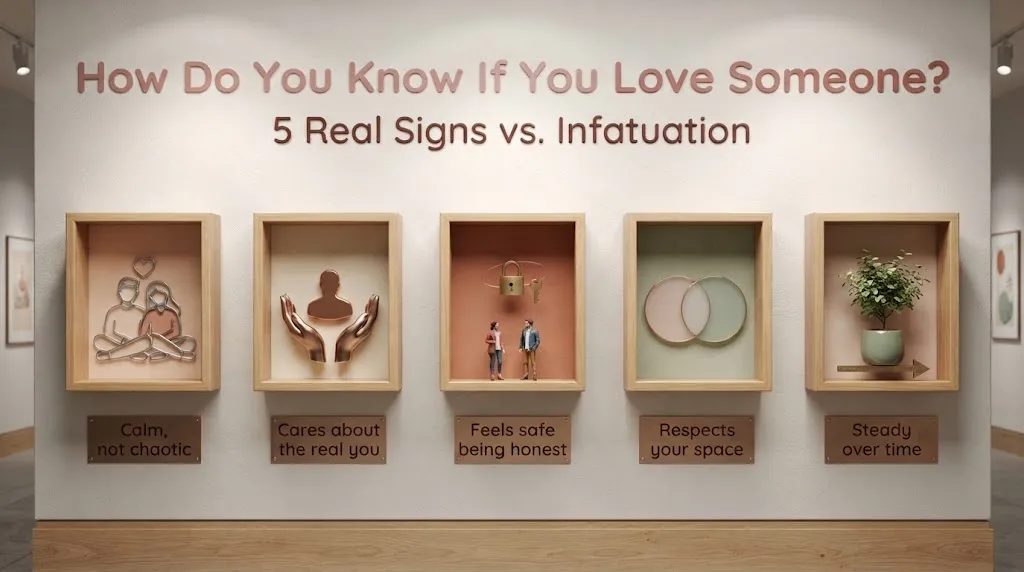
It can feel calm instead of chaotic. Long-term or mature love often feels steadier than the early spark: less obsessive, more like safety. If the “crazy about you” feeling has faded but you still deeply care about their well-being, that’s not necessarily a red flag — it may just be love settling into a different shape.
It looks different for different people. Some people express love through words, others through actions, presence, or quiet reliability. Comparing your experience to someone else’s highlight reel can create doubt where none is warranted.
It can exist without constant butterflies. If you’re waiting to feel nervous-excited every time you see them before you’ll believe it’s love, you may be holding out for infatuation, not love itself.
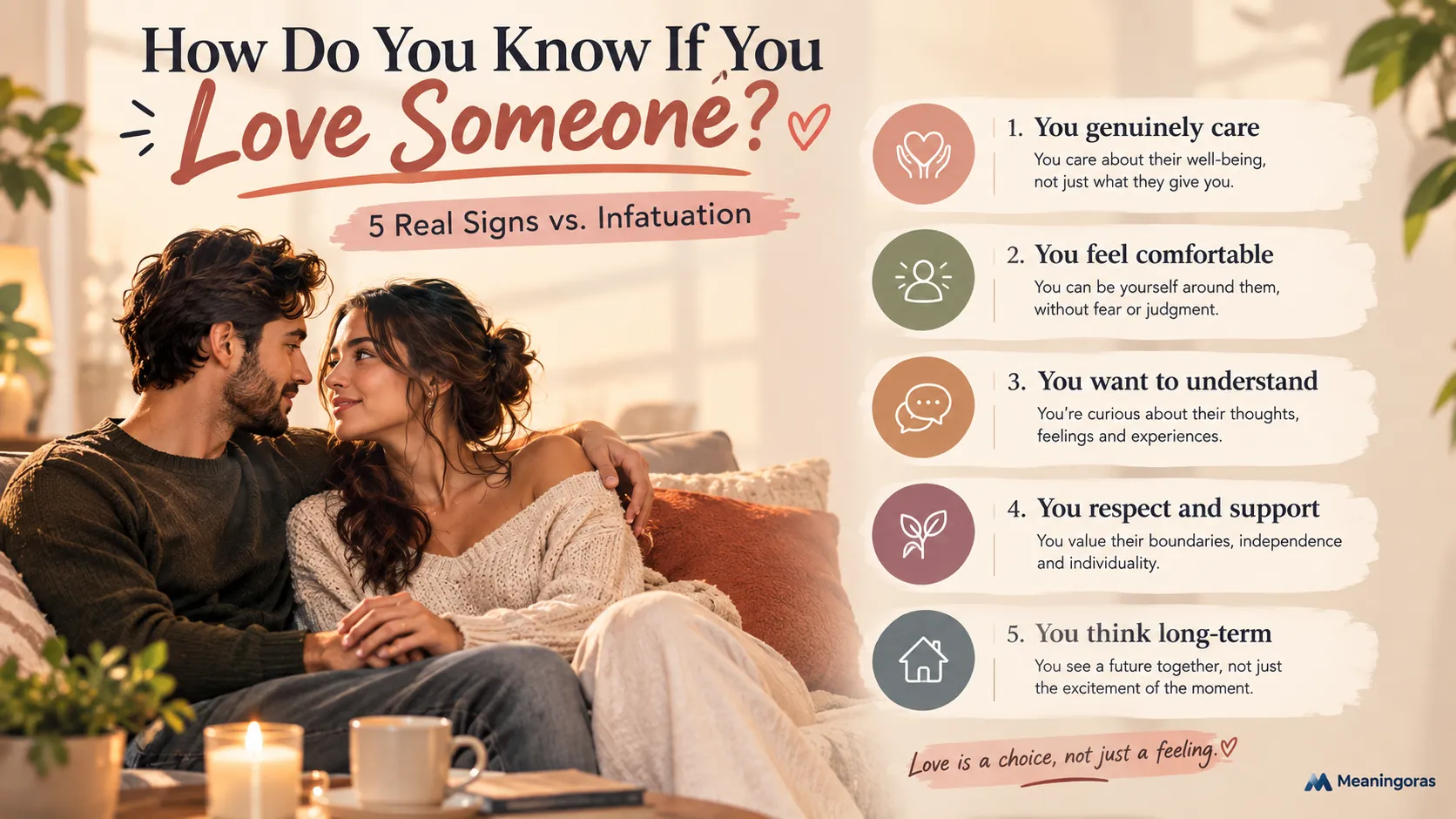
20 Signs You May Love Someone
These signs work best as a pattern, not a checklist you need to complete perfectly.
- You think about them regularly — not obsessively. They cross your mind throughout the day without disrupting your ability to function or focus.
- You want to know the real person, not just the idealized version. You’re curious about their history, fears, and ordinary daily life, not just their best qualities.
- You genuinely care about their well-being, even in moments that don’t benefit you directly.
- Their happiness matters to you, and you can feel glad for their wins without needing credit.
- You can be vulnerable with them — sharing insecurities, mistakes, or fears without expecting ridicule.
- You feel emotionally safe, meaning you can disagree, apologize, or be imperfect without fearing the relationship will end.
- You want to spend meaningful time together, not just fill time or avoid being alone.
- You miss them without losing yourself. Missing someone is normal; feeling like you can’t function without them is a different, more concerning pattern.
- You can accept their imperfections, having seen them tired, irritable, or at their worst, and still care.
- You respect their boundaries, including their need for space, other relationships, and autonomy.
- You support their individuality and goals, even ones that don’t include you.
- You can celebrate their success without resentment or competition.
- You’re willing to communicate honestly, even about uncomfortable topics.
- You try to repair conflict instead of only avoiding it or winning it.
- You can imagine a realistic future together — not a fantasy, but one That Accounts for real logistics and compromise.
- You want to be included in their important decisions, and want to include them in yours.
- You feel both affection and desire (if relevant to you), but neither one is required to “prove” the other.
- You’re comfortable being yourself around them, without performing a better version of you.
- You want the relationship to be healthy, not just intense. Drama and jealousy don’t feel like signs of passion to you — they feel like problems to solve.
- Your feelings hold up over time, including after an argument, a bad day, or a stretch where the novelty has worn off.
different from infatuation — save this for later. 💛
Love, Infatuation, Lust, or Attachment? A Comparison
These four states can overlap, which is exactly why confusion is so common. Here’s how they tend to differ.
| Feeling | What It Centers On | How It Tends to Feel | Common Pitfall |
| Love | The real person — flaws included | Steady, safe, grows with time and knowledge of them | Mistaking calm for “loss of feelings” |
| Infatuation | An idealized image of the person | Intense, obsessive, novelty-driven | Assuming intensity = depth |
| Lust | Physical or sexual attraction | Strong desire, can exist with or without emotional closeness | Assuming chemistry = compatibility |
| Attachment / Anxious Attachment | Fear of losing the connection | Preoccupation, checking behavior, relief when reassured | Mistaking anxiety for passion |
| Loneliness | Wanting connection in general | Strong pull toward anyone available and attentive | Mistaking relief from isolation for love for a specific person |
A few clarifying distinctions:
- Love vs. infatuation: Infatuation usually fades or shifts once the honeymoon phase ends. Love tends to become clearer — not weaker — once you’ve seen someone’s ordinary, unpolished self.
- Love vs. lust: Physical attraction can be part of love, but sexual chemistry on its own doesn’t establish trust, compatibility, or commitment.
- Love vs. limerence: Limerence is an involuntary, often obsessive preoccupation with someone, frequently paired with intrusive thoughts and anxiety about whether they feel the same. It can be intense enough to resemble love, but it centers on uncertainty and craving reassurance rather than mutual, grounded care.
- Love vs. loneliness: If the Strongest driver of the relationship is not wanting to be alone, it’s worth asking whether the feeling is really about this person — or about escaping isolation.
Healthy Love vs. Unhealthy Dependence
Some of the “signs” listed on other sites — constant thoughts, jealousy, prioritizing someone above everything else — can just as easily describe unhealthy patterns. It’s worth separating the two clearly.
Healthy interdependence looks like two people who support each other while keeping their own friendships, interests, and sense of identity intact.
Emotional dependence looks like relying on one person for most or all of your emotional regulation, to the point that your mood depends entirely on their attention.
Jealousy is not proof of love. Occasional jealousy is a normal human emotion, but frequent jealousy, possessiveness, or controlling behavior usually reflects insecurity or control needs — not depth of feeling.
Watch for love bombing — early, overwhelming affection, gifts, and declarations of love that arrive faster than genuine trust could reasonably build. It can feel flattering, but it’s sometimes used to fast-track intimacy before boundaries are established.
Watch for trauma bonding, a cycle where affection alternates with mistreatment or unpredictability, creating an intense attachment that is fear-driven rather than safety-driven. This is a different phenomenon from ordinary romantic intensity and often warrants professional support.
If you notice you’re losing touch with friends, family, hobbies, or your own opinions to preserve the relationship, that’s worth pausing on — regardless of how strong the feelings are.
Does Loving Someone Mean You’re Compatible?
Not necessarily — and this is one of the most overlooked questions in this whole topic. You can genuinely love someone and still be a poor long-term fit if you’re misaligned on:
- Core values and how you want to live day-to-day
- Communication and conflict style — do disagreements get resolved or avoided?
- Emotional availability — can they (and you) show up during hard moments?
- Life goals and commitment expectations, including marriage, children, or timeline
- Boundaries, respect, and consent, in both directions
- Financial habits, family expectations, and lifestyle preferences
Loving someone answers “how do I feel.” Compatibility answers “should we build a life together?” Both questions matter, and they don’t always have the same answer.
Physical and Psychological Signs (and Their Limits)
Many articles list butterflies, a racing heart, appetite changes, or trouble sleeping as signs of love. These can happen — but they’re not proof on their own.
- Butterflies and a faster heartbeat are common with new attraction, but they’re also physiological markers of general excitement or anxiety.
- Thinking about someone often is common early on, but constant, intrusive thinking that interferes with daily life is more associated with limerence or anxiety than secure love.
- Increased energy, appetite, or sleep changes can accompany the early “honeymoon phase,” but similar symptoms can also be caused by stress, medication, or a mental health condition unrelated to the relationship.
The takeaway: physical sensations are worth noticing, but they describe arousal or excitement in general — not love specifically. If a symptom is severe, persistent, or paired with major mood swings, it’s worth checking in with a doctor or therapist rather than assuming it’s purely romantic.
A “Do I Love Them?” Self-Reflection Checklist
No quiz can definitively Diagnose Love — but honest reflection can clarify what you’re actually feeling. Ask yourself:
your feelings
- Do I care about who they really are, or mainly about how being around them makes me feel?
- Can I picture their flaws clearly, not just their best moments?
About your behavior
- Do I feel safe disagreeing with them?
- Am I still connected to my friends, family, work, and hobbies — or has the relationship absorbed most of my time and identity?
About the relationship
- Do I respect their freedom and boundaries, and do they respect mine?
- Would I still care about their well-beingeven on a day they couldn’t give me much attention?
SO the future
- Are we compatible in ways that go beyond attraction?
- Do my feelings hold steady after a disagreement, a bad day, or a quiet week — or do they spike and crash?
If most of your answers point toward steadiness, respect, and genuine curiosity about the real person, that’s a strong indication of love. If your answers lean toward anxiety, control, or idealization, it may be infatuation, attachment fear, or something worth examining further — and that’s useful information either way.
different from infatuation — save this for later. 💛
What to Do If You Realize You Love Someone
- Give yourself time. Feelings that hold up over a few weeks are more trustworthy than a single intense moment.
- Check whether the relationship is healthy using the distinctions above before acting on the feeling.
- Talk honestly, without pressuring them. Share how you feel and give them room to respond at their own pace.
- Prepare for any response. They may feel the same, need time, or not feel the same — all are valid outcomes.
- Move at a pace you’re both comfortable with, especially around physical intimacy, exclusivity, and big commitments.
- Discuss expectations directly rather than assuming you’re on the same page.
What If They Don’t Love You Back?
- Accept their answer rather than trying to convince them otherwise; consent and genuine feeling can’t be persuaded into existing.
- Decide honestly whether friendship is realistic for you, without pretending you feel nothing if you do.
- Give yourself space to heal if staying close is too painful right now — that’s not a failure, it’s self-respect.
- Protect your self-worth. Unreciprocated feelings say something about timing and compatibility, not about your value.
Special Situations
- Falling in love with your best friend: These feelings are common and valid, but consider what you both risk losing, and choose a moment and setting where they can respond honestly.
- Long-distance relationships: Love can absolutely be real across distance, but pay closer attention to consistency and follow-through rather than the frequency of messages alone.
- Loving someone emotionally unavailable: Genuine feelings don’t obligate you to wait indefinitely for someone who can’t reciprocate emotional intimacy.
- Loving someone who already has a partner: This deserves careful, honest reflection about boundaries, consent, and what actions (if any) are appropriate.
- Falling in love after relationship trauma: It’s common to second-guess feelings after a difficult past relationship; that doesn’t make the new feelings less real, but it’s worth moving at a pace that lets trust rebuild.
Explore More: https://namenesty.com/fall-in-love-captions/
- LGBTQ+ and nontraditional relationships: All of the emotional signs above apply regardless of relationship structure or orientation.
- If you don’t experience strong romantic attraction: Some people relate to love primarily through deep companionship, loyalty, and care rather than romantic or sexual intensity — that’s a legitimate way of experiencing connection, not a deficiency.
People Also As:k
There’s no fixed timeline. Infatuation can build in weeks, while a grounded sense of love often takes longer, since it depends on genuinely knowing someone.
Yes. Timing, life circumstances, or incompatible goals can mean love exists without both people choosing to pursue a relationship.
Yes — this is more common than most articles acknowledge. Love describes a feeling; compatibility describes whether a relationship is workable long-term.
Occasional jealousy is a normal human emotion, but Frequent or controlling jealousy is more often tied to insecurity or fear of loss than to the depth of love itself.:
Frequent thoughts can be a sign of love, but intrusive, anxious, or uncontrollable thoughts are more closely associated with limerence or attachment anxiety.:
Yes. Intensity naturally ebbs and flows, especially after the honeymoon phase; a dip in intensity doesn’t necessarily mean love has disappeared
Look for consistency between their words and actions: reliability, respect for your boundaries, genuine interest in your life, and effort during hard moments — not just grand gestures
Yes. Long-term or mature love often feels calmer and steadier rather than nervous or electric.
Final Takeaway
Love is best recognized as a pattern, not a single feeling: consistent care, honesty, emotional safety, respect for boundaries, and a willingness to know the real person and stay anyway. Infatuation, lust, and anxious attachment can feel intense enough to be mistaken for it, which is exactly why checking your feelings against real Behavior — yours and theirs — matters more than chasing a dramatic moment of certainty.
le










2 thoughts on “25 Signs You’re Actually in Love (Not Just Obsessed)”