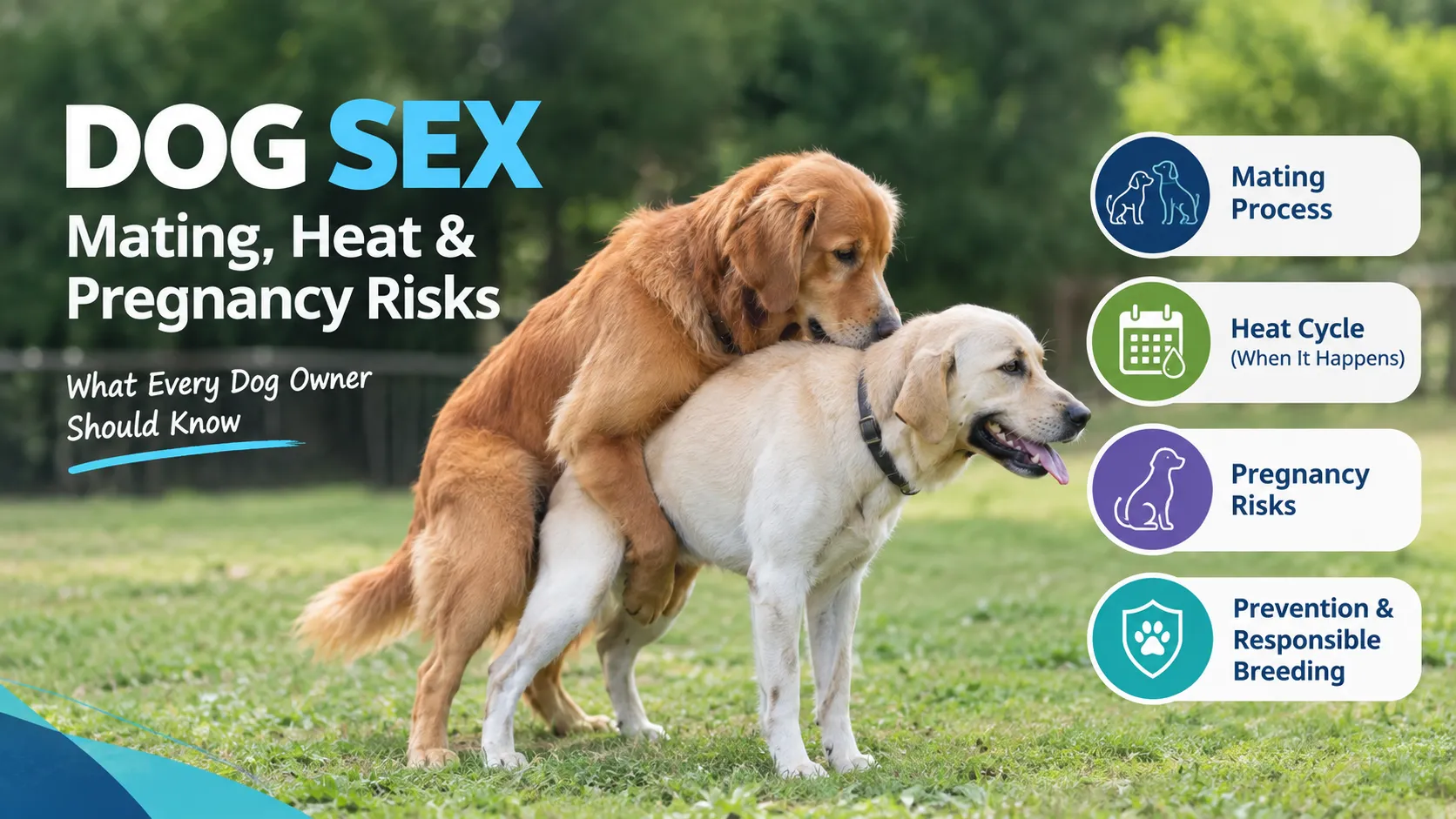
Dog Sex Explained: Mating, Heat Cycles, Ties & Pregnancy Prevention
“Dog sex” can mean much more than one question: mating, mounting, heat cycles, fertility, accidental mating, or pregnancy risk. If you’re trying to understand what is happening with your dog, the most important answers depend on the situation. This guide explains dog mating in clear, practical language, including how the female heat cycle works, why dogs may become stuck together, whether pregnancy can happen after one mating or without a tie, and what to do after accidental mating. You’ll also learn how to prevent unwanted pregnancy and what responsible breeding involves—so you can understand the behavior without relying on common myths or risky shortcuts.
Searching for “Dog Sex” can lead to very different questions. You may be trying to understand whether your dog is male or female, why dogs mount, what happens during mating, whether a female is in heat, or what to do after an accidental mating.
This guide focuses on the practical side of canine reproduction: dog mating, heat cycles, fertility, mating ties, accidental pregnancy, prevention, and responsible breeding. It is written for adult dog owners who want clear, calm, veterinarian-aligned information without confusing myths or unnecessary graphic detail.
If a mating has already happened, jump directly to “Accidental Dog Mating: What to Do Next.”
1. Dog Sex: What Does This Search Term Actually Mean?
The phrase “dog sex” is unusually broad. Different owners use it to describe biological sex, mounting behavior, mating, heat, fertility, or an unexpected pregnancy.
Understanding the question behind the search makes it easier to find the right answer.
Common meanings of “dog sex”
| What you may mean | Best topic to explore |
| Is my dog male or female? | Biological sex identification |
| Why is my dog mounting? | Mounting behavior |
| Is my female dog in heat? | Heat-cycle signs |
| What happens when dogs mate? | Canine mating process |
| Why are dogs stuck together? | Copulatory tie |
| Can one mating cause pregnancy? | Pregnancy risk |
| My dogs mated accidentally | Mismating guidance |
| I want to breed my dog | Responsible breeding |
The important distinction is that mounting does not automatically mean mating, and a mating tie does not by itself prove pregnancy.
For owners dealing with an actual mating event, veterinary guidance is more useful than relying on internet myths or a generic calendar.
Quick answer
“Dog sex” is best understood as a broad search term covering canine biological sex, reproductive behavior, mating, heat cycles, fertility, pregnancy, and breeding.
2. Male or Female Dog: How to Identify Your Dog’s Biological Sex
Knowing whether your dog is male or female is the foundation for understanding reproductive behavior.
For adult dogs, external anatomy usually makes biological sex relatively straightforward, but puppies can sometimes be harder for inexperienced owners to identify correctly.
Male dogs
A male dog generally has a penis and prepuce on the underside of the abdomen. The testicles are normally located in the scrotum after descent.
Female dogs
A female dog has a vulva located below the anus. The vulva can become noticeably swollen during heat.
Why puppies can be confusing
Very young puppies have less obvious physical development, and owners may misinterpret normal anatomy.
If you are uncertain, a veterinarian can identify your puppy’s sex during a routine examination.
Important point
Biological sex and reproductive behavior are not the same thing.
A dog can display mounting behavior regardless of whether they are intact, neutered, male, or female. Behavior alone should therefore not be used to determine biological sex.
3. Dog Mounting vs. Dog Mating: What’s the Difference?
One of the biggest misconceptions surrounding “dog sex” is assuming that every mounting event represents an attempt to reproduce.
It doesn’t.
Mounting can occur for several behavioral or reproductive reasons, and context matters.
Mounting may happen because of:
- Excitement
- Play
- Stress
- Arousal
- Habit
- Social interaction
- Hormonal behavior
- Reproductive motivation
Female dogs can mount, and neutered or spayed dogs can also continue mounting.
Mounting is not proof of mating.
A dog can mount another dog without successful penetration or reproduction.
Conversely, reproduction can occur without the classic prolonged tie owners expect.
When mounting deserves attention.
Talk with your veterinarian or a qualified behavior professional if mounting becomes:
- Sudden and excessive
- Difficult to interrupt
- Associated with aggression
- Associated with pain
- Compulsive
- Accompanied by genital irritation
- A major source of conflict with other animals
The goal should be safe management rather than punishment.
4. Why Do Dogs Mount or Hump?
The question “Why does my dog hump?” is closely related to the broader “dog sex” search but requires a behavioral answer.
Mounting is not automatically evidence that your dog is trying to reproduce.
Common explanations
Excitement: Some dogs mount when overstimulated during play or greetings.
Stress: Anxiety or emotional arousal can trigger repetitive behaviors.
Habit: A dog may repeat mounting simply because the behavior has become established.
Hormones: Intact dogs may display reproductive behavior, particularly around a female in heat.
Social interaction: Mounting can appear during interactions between dogs without representing a straightforward attempt at breeding.
What should you do?
Avoid turning the behavior into a confrontation.
Instead:
- Calmly interrupt the interaction.
- Redirect your dog.
- Increase appropriate exercise and enrichment.
- Identify triggers.
- Separate dogs when necessary.
- Seek professional help if the behavior becomes persistent or aggressive.
The idea that every instance of mounting is simply about “dominance” is too simplistic to explain the behavior accurately.
5. Understanding the Female Dog Heat Cycle
A female dog’s heat cycle, also called the estrous cycle, determines when she may become receptive to mating and potentially pregnant.
The timing varies considerably between individual dogs and can differ by breed, size, age, and reproductive history.
The four main stages
| Stage | What happens |
| Proestrus | Hormonal preparation, swelling,g and discharge may occur |
| Estrus | Female may become receptive to mating |
| Diestrus | Post-estrus hormonal phase |
| Anestrus | Reproductive resting period |

The period owners commonly call “being in heat” includes proestrus and estrus.
How often does heat occur?
Many female dogs cycle approximately twice per year, but intervals can vary significantly. Some breeds and individual dogs may cycle less frequently.
Why individual timing matters
There is no universal calendar that can reliably tell every owner when their dog is fertile.
That is particularly important if the goal is either preventing pregnancy or planning a responsible breeding.
6. How to Tell When a Female Dog Is in Heat
Recognizing heat can help owners prevent accidental mating and understand behavior changes.
Common signs can include:
- Vulvar swelling
- Vaginal discharge
- Increased urination
- Increased licking
- Increased attraction from male dogs
- Changes in appetite
- Restlessness
- Clinginess
- Changes in behavior
- Tail positioning during receptive periods
Not every dog displays the same signs, and some cycles can be subtle or difficult for owners to recognize.
Heat is not just about bleeding.
A common mistake is assuming that visible bleeding tells you exactly when pregnancy is possible.
The reproductive cycle is controlled by hormonal changes, and fertility does not correspond perfectly to the amount or color of discharge.
A practical owner rule
If your female dog is intact and you do not want a litter, treat the entire heat period as a pregnancy-prevention situation.
Keep her supervised and prevent contact with intact males.
7. When Are Dogs Fertile During the Heat Cycle?
Fertility is one of the most misunderstood parts of canine reproduction.
The fertile period depends on ovulation, which varies between dogs. A generic “day 10” or “day 12” rule should not be treated as a universal guarantee.
Veterinary reproductive evaluation can use tools such as progesterone testing and vaginal cytology to help determine reproductive timing.
Why calendar counting can fail
Two dogs can show similar outward signs while having different internal reproductive timing.
That means:
Bleeding ≠ exact fertility prediction.
Likewise:
Accepting a male ≠ a precise ovulation measurement.
Can a dog become pregnant during her first heat?
Yes, pregnancy can occur during a first heat.
However, responsible breeding should not be based simply on the ability to become pregnant. Responsible breeders consider physical maturity, health screening, temperament, genetics, and veterinary guidance before breeding.
Can one mating cause pregnancy?
Yes.
A single mating can potentially result in pregnancy, so owners should not assume that “it only happened once” means pregnancy is impossible.
8. How Dog Mating Works: The Canine Mating Process
Canine mating is a biological reproductive process rather than simply a mounting event.
It generally involves courtship behavior, mounting, intromission, ejaculation, and sometimes a temporary copulatory tie.
Courtship
Dogs may communicate through:
- Scent
- Urine marking
- Body language
- Vocalization
- Proximity
- Receptive behavior
Female dogs in heat release chemical signals that can attract intact males.
Mounting and mating
Mounting alone does not guarantee successful reproduction.
During reproductive mating, penetration and ejaculation may occur, followed by a temporary tie in some cases.
Why dogs may turn around
During a copulatory tie, the dogs may rotate so they face in opposite directions.
This can look alarming to owners seeing it for the first time.
The most important response is to remain calm and never attempt to forcibly separate them.
9. Why Do Dogs Get Stuck Together After Mating?
The phrase “dogs stuck together” usually refers to the canine copulatory tie.
During mating, swelling of the male reproductive anatomy and muscular contractions can temporarily keep the dogs connected.
Is the tie normal?
Yes, a tie can be a normal part of canine mating.
It can look frightening, particularly if the owner has never seen it before.
What should you do?
- Stay calm.
- Keep people away.
- Prevent other dogs from approaching.
- Avoid sudden movement.
- Do not pull the dogs apart.
- Allow natural separation.
Forced separation can cause injury.
Does a tie guarantee pregnancy?
No.
A tie does not prove pregnancy.
Likewise, absence of a tie does not eliminate pregnancy risk. This is one of the most important misconceptions to correct.
10. Dogs Stuck Together: What Should You Do?
If you discover two dogs tied after mating, your priority should be safety.
The safest immediate response
| Situation | Recommended response |
| Dogs are calm | Keep the environment quiet and wait |
| Dogs are moving excessively | Calmly prevent dangerous movement |
| Other dogs are approaching | Remove other animals from the area |
| Owner wants to separate them | Do not pull them apart |
| Severe pain or injury occurs | Contact an emergency veterinarian |
| Mating was accidental | Contact your veterinarian promptly |
What not to do
Do not:
- Pull the dogs apart
- Pour substances onto them
- Try internet “separation” tricks
- Hit or frighten either dog
- Force movement
- Attempt unverified home remedies
The safest approach during a normal tie is patience.
After separation
Once the dogs naturally separate, prevent further mating and contact your veterinarian if pregnancy is unwanted.
Prompt veterinary advice is particularly important after accidental mating because available options depend on the circumstances and timing.
11. Can a Dog Get Pregnant After One Mating?
Yes.
A single mating can be enough for pregnancy, depending on where the female is within her reproductive cycle and other biological factors.
Does mating frequency determine pregnancy?
Not reliably.
More mating events do not create a simple mathematical guarantee of pregnancy.
Likewise, one mating cannot be dismissed as harmless.
Does a tie guarantee pregnancy?
No.
The tie is part of the mating process, but it is not a pregnancy test.
What if the mating was accidental?
Contact your veterinarian as soon as possible.
Do not wait for visible pregnancy signs before asking about your options.
Veterinary sources specifically recommend prompt professional advice after an accidental mating.
What if the dogs did not tie?
Pregnancy can still be possible.
This is why owners should not use the presence or absence of a tie as their only method of assessing pregnancy risk.
12. Can Dogs Get Pregnant Without a Mating Tie?
Yes.
A common myth is:
“If the dogs didn’t get stuck, pregnancy can’t happen.”
That is incorrect.
A tie is not required for pregnancy to be possible.
Why this matters
Suppose your female dog was mounted by an intact male, the dogs separated quickly, and there was no visible tie.
You should not automatically assume the reproductive risk is zero.
What should an owner do?
If pregnancy is unwanted:
- Separate the dogs.
- Prevent another mating.
- Record approximately when the event happened.
- Contact your veterinarian.
- Follow professional advice about pregnancy prevention or confirmation.
Avoid attempting to manage a possible mismating with unverified internet remedies.
13. Accidental Dog Mating: What to Do Next
Accidental mating can be stressful, but panic rarely helps.
The most useful thing an owner can do is move quickly from uncertainty to professional advice.
Immediate action plan
Step 1: Separate the dogs safely after natural separation.
If they are still tied, do not forcibly separate them.
Step 2: Prevent another mating.
A female can remain receptive during the heat period, so another mating may be possible.
Step 3: Record what happened.
Note:
- Approximate date
- Approximate time
- Whether a tie occurred
- How long the dogs appeared connected
- Whether either dog was injured
- Whether the male and female are intact
Step 4: Contact a veterinarian promptly.
Your veterinarian can explain appropriate options based on the individual dog and timing.
Step 5: Avoid home remedies.
Do not administer hormones, medications, or internet-recommended treatments without veterinary direction.
When it becomes urgent
Seek immediate veterinary assistance if the dog has:
- Heavy bleeding
- Severe pain
- Significant injury
- Collapse
- Extreme distress
- Severe weakness
- Abnormal discharge
- Other concerning symptoms
14. How to Prevent Unwanted Dog Pregnancy
Prevention is much easier than dealing with an accidental pregnancy after the event.
For an intact female in heat, direct contact with intact males should be avoided. Leash control, secure barriers, supervision, and careful planning are important.
Practical prevention checklist
- Keep your dog on a leash.
- Avoid off-leash dog parks during heat.
- Avoid unsupervised outdoor time.
- Secure gates and fences.
- Keep intact males and females separated.
- Do not rely on dog diapers as contraception.
- Supervise interactions carefully.
- Discuss spay/neuter decisions with your veterinarian.
Why dog diapers are not contraception
A diaper may help manage discharge and household cleanliness, but it should not be treated as a reliable reproductive barrier.
Long-term prevention
For owners who do not intend to breed their dogs, discuss sterilization with a veterinarian.
The appropriate timing can depend on factors such as breed, size, age, lifestyle, and individual health considerations.
15. Responsible Dog Breeding: What Owners Should Know
Responsible breeding begins long before mating.
A breeding decision should involve health, temperament, genetics, reproductive planning, finances, and the welfare of both the parents and puppies.
Before breeding, consider:
Veterinary assessment
Have the prospective parents evaluated appropriately.
Breed-specific health testing
Health screening should reflect known risks within the breed.
Genetic considerations
Responsible breeding should consider inherited disease risks and appropriate genetic testing.
Temperament
Behavior and temperament matter as much as appearance.
Physical maturity
The ability to reproduce does not automatically mean a dog is ready for responsible breeding.
Reproductive planning
Veterinary reproductive specialists can help with ovulation timing and reproductive evaluation.
Emergency planning
Owners should have a realistic plan for complications during pregnancy, birth, and neonatal care.
Puppy placement
Responsible breeding includes planning for suitable homes and a lifetime welfare strategy.
Should a female be bred during her first heat?
Responsible breeding guidance generally discourages breeding a female during her first heat because she is still developing.
Breeding is more than producing puppies.
A responsible breeder should be prepared for:
- Veterinary costs
- Pregnancy complications
- Possible Caesarean delivery
- Neonatal care
- Genetic health concerns
- Puppy socialization
- Appropriate homes
- Long-term responsibility
The goal should be healthy dogs and responsible lifelong outcomes—not simply producing a litter.
More to Explore: https://namenesty.com/cock-ring/
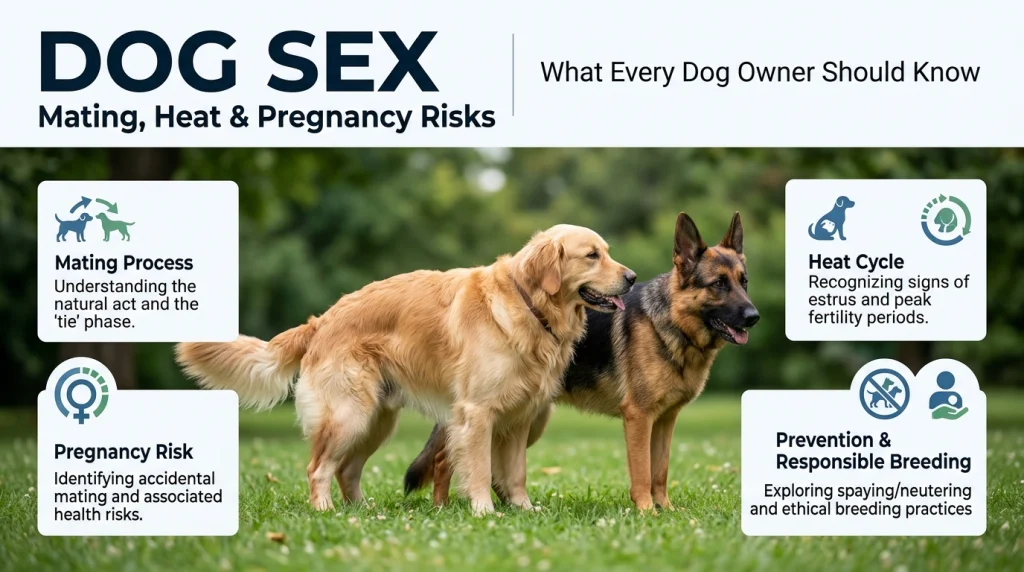
So Dog sex explained: understand canine mating, heat cycles, pregnancy risks, and safer responsible-breeding practices.
Dog Sex and Mating: Quick Comparison Table
| Question | Short answer |
| Does mounting always mean mating? | No |
| Can female dogs mount? | Yes |
| Can neutered dogs mount? | Yes |
| Can a dog become pregnant after one mating? | Yes |
| Is a tie required for pregnancy? | No |
| Should tied dogs be forcibly separated? | No |
| Are dog diapers contraception? | No |
| Can first-heat pregnancy happen? | Yes |
| Is bleeding an exact fertility indicator? | No |
| Can heat cycles vary between dogs? | Yes |
| Is calendar-only breeding reliable? | No |
| Should accidental mating be discussed with a vet? | Yes |
Dog Heat, Mating & Pregnancy: Owner Decision Framework
Use this simple framework when deciding what information you need.
| Your situation | Your priority |
| Female dog showing heat signs | Prevent unwanted mating |
| Male dog suddenly obsessed with female | Separate safely |
| Dogs are currently tied | Do not forcibly separate |
| Accidental mating occurred | Contact veterinarian promptly |
| No tie occurred | Pregnancy may still be possible |
| You want to know fertility timing | Veterinary reproductive testing |
| You want to breed responsibly | Health screening + veterinary planning |
| Dog seems sick after heat | Veterinary assessment |
| You do not want future litters | Discuss individualized sterilization |
When to Call a Veterinarian
Not every reproductive behavior is an emergency, but certain situations deserve professional attention.
Contact a veterinarian promptly after:
- Accidental mating
- Suspected unwanted pregnancy
- Significant injury during mating
- Unusual reproductive discharge
- Severe pain
- Sudden weakness
- Vomiting
- Fever
- Marked lethargy
- Increased thirst or urination
- Abdominal discomfort
- Foul-smelling discharge
Pyometra, a serious uterine infection, can occur after a heat cycle and requires urgent veterinary care. Warning signs can include lethargy, vomiting, increased drinking or urination, appetite changes, and abnormal or foul-smelling discharge.
Dog Reproductive Terms Explained
| Term | Meaning |
| Estrous cycle | The reproductive cycle of a female dog |
| Heat/season | Common term for the reproductive period |
| Proestrus | Early reproductive phase |
| Estrus | Phase when the female may be receptive to mating |
| Diestrus | Post-estrus hormonal phase |
| Anestrus | Reproductive resting period |
| Ovulation | Release of eggs from the ovaries |
| Progesterone | Hormone important in reproductive timing and pregnancy |
| LH | Luteinizing hormone involved in ovulation |
| Copulatory tie | Temporary physical connection during canine mating |
| Mismating | Unintended mating |
| Stud | Male used for breeding |
| Dam | Female parent |
| Gestation | Pregnancy period |
| Whelping | Giving birth to puppies |
| Pyometra | Potentially life-threatening uterine infection |
People Also Ask
No. The term “heat” generally refers to the reproductive cycle of female dogs. Male dogs can remain fertile and may respond strongly to females in heat.
The temporary connection is called a copulatory tie. It can occur because of anatomical swelling and muscular contractions during mating.
The duration can vary. Owners should not try to force separation. If the dogs appear severely distressed or injured, contact a veterinarian.
Yes. A tie is not required for pregnancy.
Yes. One mating can potentially result in pregnancy.
Female dogs can display mounting behavior, but pregnancy requires sperm from a male.
Yes. Neutered dogs can continue mounting because behavior can have hormonal, learned, social, or excitement-related components.
No. A diaper can help manage discharge but should not be relied upon as contraception.
Visible behavior or physical changes immediately after mating cannot reliably confirm pregnancy. A veterinarian can advise on appropriate pregnancy-confirmation methods and timing.
Responsible breeding guidance generally recommends against breeding during the first heat because the female may still be physically immature.
No. Visible discharge does not provide a universally reliable fertility calendar. Veterinary reproductive assessment can provide more accurate timing information.
Key Takeaways
“Dog sex” is a broad search term, but most reproductive questions are better answered through specific topics such as dog mating, heat cycles, mounting behavior, fertility, accidental mating, and pregnancy prevention.
The most important points are:
- Mounting does not always mean mating.
- Female dogs can become pregnant during heat.
- One mating can potentially result in pregnancy.
- A mating tie does not prove pregnancy.
- Pregnancy can occur without a visible tie.
- Never forcibly separate dogs during a normal mating tie.
- Dog diapers should not be treated as contraception.
- Calendar-based fertility predictions are not universally reliable.
- Accidental mating should be discussed with a veterinarian promptly.
- Responsible breeding requires health, temperament, genetic, and reproductive planning.
How to Choose the Right Information for Your Situation
If you’re simply curious about canine reproduction, start with the heat cycle and mating process sections.
If your dog is mounting another dog, read mounting vs. mating first.
So if two dogs are currently stuck together, skip directly to the dogs stuck together section and focus on safety.
If accidental mating already happened, contact your veterinarian rather than waiting for pregnancy signs.
If you’re considering breeding, start with Responsible Breeding rather than simply trying to identify the “best day.”
The best reproductive decision is one based on the individual dog—not an internet shortcut.
Final Thought
The strongest answer to a search like “dog sex” is not a sensational explanation. It is a clear path from confusion to understanding.
Whether you’re trying to recognize a heat cycle, understand mounting, respond to an accidental mating, prevent pregnancy, or plan responsible breeding, the safest approach is to focus on the dog’s individual health, behavior, reproductive stage, and welfare.











2 thoughts on “Dog Sex Explained: Mating, Heat & Pregnancy Risks”