Introduction
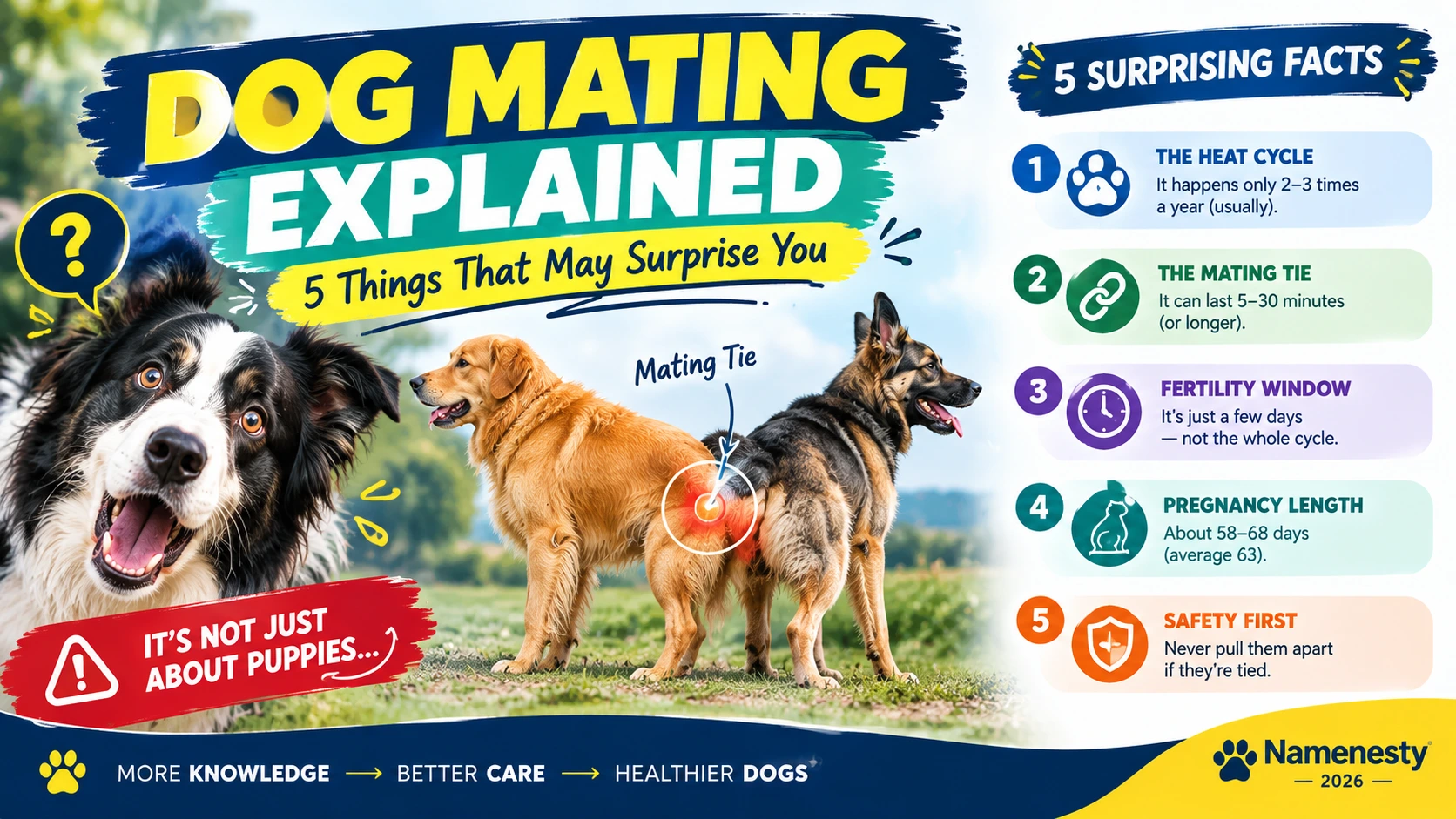
Dog Mating can be confusing, especially when two dogs suddenly become tied together. Is it normal? Can pregnancy happen without a tie? When is a female actually fertile, and what should you do after an accidental mating? This guide answers those questions clearly, without myths or confusing jargon.
You’ll learn how the canine heat cycle works, why the breeding tie happens, how pregnancy is confirmed, and which situations need veterinary attention. Whether you’re a curious dog owner or researching responsible breeding, understanding the facts can help you respond calmly, avoid harmful interventions, and make better decisions for the dogs involved.
Dog mating is a topic that can create confusion quickly. Some owners are simply curious about canine reproduction, while others arrive after seeing two dogs temporarily joined together and wondering whether something is wrong.
The good news is that a mating tie can be a normal part of canine reproduction. The important part is understanding what is normal, what should never be attempted at home, when pregnancy is possible, and when veterinary help matters.
This guide explains dog mating in clear, responsible language—from the female heat cycle and fertile window to the breeding tie, accidental mating, pregnancy confirmation, and responsible breeding decisions.
Important: Never force two dogs apart during a mating tie. Forced separation can cause injury. If either dog appears seriously distressed or injured, contact a veterinarian promptly.
Dog Mating Explained: Heat, Tie, Timing, Pregnancy & Safety
1. Dog Mating: What Happens When Dogs Mate?
Dog mating usually occurs when an intact female reaches the receptive part of her reproductive cycle. During this period, hormonal and scent changes can attract male dogs, while the female may show behaviors such as standing for a male or moving her tail to the side.
A normal mating may include mounting followed by a temporary copulatory tie, sometimes described by owners as the dogs being “stuck together.” The tie is a biological part of canine reproduction, not automatically a sign that something has gone wrong.
15 social captions
- Dog mating is biology—not a mystery.
- Understanding canine reproduction starts with the heat cycle.
- A mating tie can look alarming when you have never seen one before.
- Learn the science before assuming something is wrong.
- Canine reproduction is more complex than a simple calendar date.
- Heat timing matters when breeding is planned.
- A tie can happen naturally during dog mating.
- Responsible breeding starts long before mating day.
- Curiosity is good; responsible pet education is better.
- Know what is normal before panic takes over.
- Dog owners deserve clear answers about reproduction.
- Mating does not automatically mean pregnancy.
- One event can raise many questions—this guide answers them.
- Canine reproduction deserves accurate, welfare-first information.
- Learn the process, understand the risks, protect the dogs.
2. How Do Dogs Mate? The Process Explained
Dog mating normally begins with communication and courtship rather than immediately progressing to mating. Scent, sniffing, and receptive behavior can signal that a female is in the appropriate stage of her cycle.
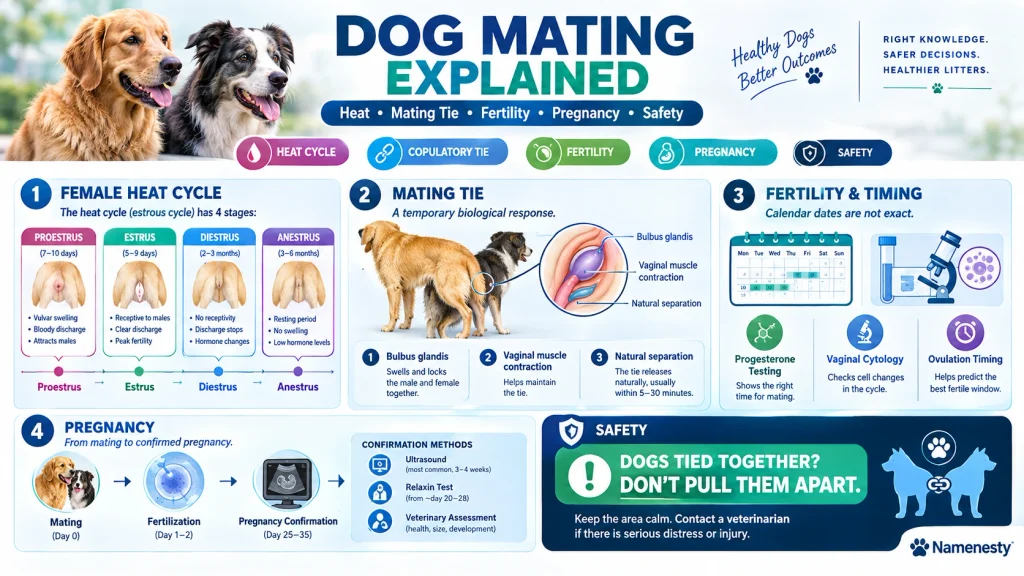
If mating proceeds, a male may mount the female. A temporary tie can then develop when the male’s bulbus glandis enlarges and the surrounding vaginal muscles contract. The dogs may remain joined for several minutes and sometimes longer before separating naturally.
15 social captions
- From scent signals to the mating tie, canine reproduction follows a biological sequence.
- What looks unusual often has a straightforward anatomical explanation.
- Dog mating begins with communication, not just mounting.
- The heat cycle helps explain canine reproductive behavior.
- Canine anatomy explains the famous mating “tie.”
- Understanding the process makes unexpected situations less frightening.
- Reproductive behavior has biological triggers behind it.
- A calm explanation beats internet myths every time.
- Learn what canine mating actually involves.
- Biology explains what owner assumptions often misunderstand.
- The mating process is driven by timing, hormones,s and anatomy.
- Responsible pet education starts with accurate reproductive facts.
- A simple explanation can prevent a lot of panic.
- Know the process before making conclusions.
- Canine reproduction is science worth understanding.
3. Why Do Dogs Get Stuck Together During Mating?
The “stuck together” stage is known as a copulatory tie. During mating, the male’s bulbus glandis swells while the female’s vaginal muscles contract around it.
Because of this normal anatomical response, the dogs may not be able to separate immediately. The tie usually ends naturally as the swelling subsides. VCA reports that a common tie lasts around five to ten minutes, while the Royal Kennel Club notes that duration can vary.
15 social captions
- Why do dogs get stuck together? Anatomy has the answer.
- The mating tie is a biological response, not a broken system.
- “Stuck” does not automatically mean injured.
- The canine breeding tie has a real anatomical cause.
- Panic is understandable; forced separation is not.
- Nature created the tie as part of canine reproduction.
- When dogs tie, patience matters more than panic.
- Canine anatomy can look strange without being abnormal.
- The breeding tie is one of the most misunderstood parts of dog mating.
- Learn the biology behind the moment owners often fear.
- Normal reproduction can look surprising.
- The tie should end naturally.
- Don’t turn a normal process into an avoidable injury.
- Understand the tie before trying to intervene.
- Sometimes the safest action is simply staying calm.
4. What Should You Do When Dogs Are Stuck Together?
If two dogs are tied, stay calm and keep the environment quiet. Move children and other animals away if possible, and minimize sudden movement.
Do not pull the dogs apart, pour water on them, shout, or use objects to force separation. VCA warns that forced separation can cause serious injury. After an accidental mating, contact your veterinarian promptly to discuss appropriate options.
What to do
| Situation | Safer response |
| Dogs are tied | Keep the area calm |
| Dogs are panicking | Reduce noise and movement |
| Someone suggests pulling them apart | Do not do it |
| Water is suggested | Do not use it to force separation |
| Serious distress or injury | Contact a veterinarian |
| Mating was accidental | Call your veterinarian promptly |
15 social captions
- Dogs tied together? Stay calm first.
- The safest intervention may be no physical intervention.
- Never pull dogs apart during a natural mating tie.
- Quiet surroundings can help reduce panic.
- Your reaction matters when dogs are frightened.
- Put safety before speed.
- A calm owner can prevent an already stressful situation from getting worse.
- Skip the internet tricks and call a veterinarian when needed.
- Tie first. Panic later? Better: don’t panic at all.
- Responsible pet care means knowing what not to do.
- Water does not solve a mating tie.
- Yelling can increase stress instead of fixing the problem.
- Give the dogs time to separate naturally.
- Know the emergency signs before you need them.
- Calm, careful, informed—that is the right response.
5. Can a Dog Get Pregnant Without a Tie?
Yes. Pregnancy can occur without a prolonged mating tie. This is sometimes described as slip mating, where penetration occurs but the dogs separate before a tie develops.
A tie therefore should not be treated as a pregnancy test, and the absence of a tie should not be assumed to eliminate pregnancy risk.
15 social captions
- No tie does not automatically mean no pregnancy.
- The absence of a breeding tie is not a guarantee.
- Slip mating can still matter.
- Pregnancy depends on reproductive biology—not just what owners observe.
- Don’t use the tie as a pregnancy test.
- A mating can be significant even when dogs separate quickly.
- What you see is not always the full reproductive picture.
- Canine fertility involves timing, sperm survival, and ovulation.
- One visual detail cannot answer every pregnancy question.
- When accidental mating happens, ask a veterinarian—not a rumor.
- No tie? Pregnancy may still be possible.
- Reproduction is more complicated than a single visible event.
- The right answer starts with understanding fertility.
- Don’t rely on myths to assess pregnancy risk.
- Veterinary guidance beats guesswork.
6. Is Your Dog Ready to Mate? Signs and Considerations
Sexual maturity is not the same thing as responsible breeding readiness. A dog may be capable of reproduction before it is mature enough for carefully planned breeding.
The Royal Kennel Club emphasizes health testing, suitability, and responsible preparation before breeding. VCA notes that standard practice is generally to wait beyond the first heat for planned breeding rather than treating the earliest possible fertility as a breeding target.
A responsible decision includes:
- Physical maturity
- Veterinary assessment
- Breed-specific health screening
- Temperament considerations
- Genetic risk review
- Pregnancy and emergency planning
- Long-term puppy welfare
15 social captions
- Being fertile is not the same as being ready to breed responsibly.
- Responsible breeding starts with maturity.
- Health should come before a litter.
- A beautiful dog is not automatically a suitable breeding dog.
- Breed responsibly, not impulsively.
- Genetics matter long after the mating is over.
- Temperament belongs in the breeding conversation.
- A litter creates a responsibility—not just a cute photo opportunity.
- Responsible breeding begins with honest questions.
- Before mating, think beyond mating day.
- Veterinary planning matters.
- Puppy welfare starts before conception.
- Breeding decisions should consider the whole lifespan.
- Don’t confuse reproductive ability with breeding readiness.
- Good breeding begins with preparation.
7. The Female Dog Heat Cycle and Mating Window
The female reproductive cycle includes distinct stages. Proestrus is commonly associated with vulvar swelling and bloody discharge. Estrus is the receptive stage, when breeding can occur.
Cycle timing differs between individual dogs. VCA reports that heat intervals can vary and that estrus itself can also vary considerably.
Basic cycle view
| Stage | What owners may notice |
| Proestrus | Swelling, discharge, male interest |
| Estrus | Receptivity, standing, flagging |
| Diestrus | Receptivity ends |
| Anestrus | Resting interval before another cycle |
15 social captions
- A dog’s heat cycle is a process, not a single day.
- Not every heat cycle looks the same.
- Learn proestrus, estrus, diestrus and anestrus.
- Visible bleeding does not tell the whole fertility story.
- Heat signs can help—but they are not perfect timing tools.
- Every dog has an individual reproductive rhythm.
- The fertile window deserves careful attention.
- Understanding estrus can prevent accidental breeding.
- Female reproductive cycles are more nuanced than calendar myths.
- Learn the stages before planning the mating.
- Heat is temporary; responsible decisions are long-term.
- Watch behavior, record dates, and involve your veterinarian.
- Dog owners often notice the cycle before understanding it.
- The better you understand heat, the better you can manage it.
- Reproductive education makes pet ownership safer.
8. When Is a Female Dog Most Fertile?
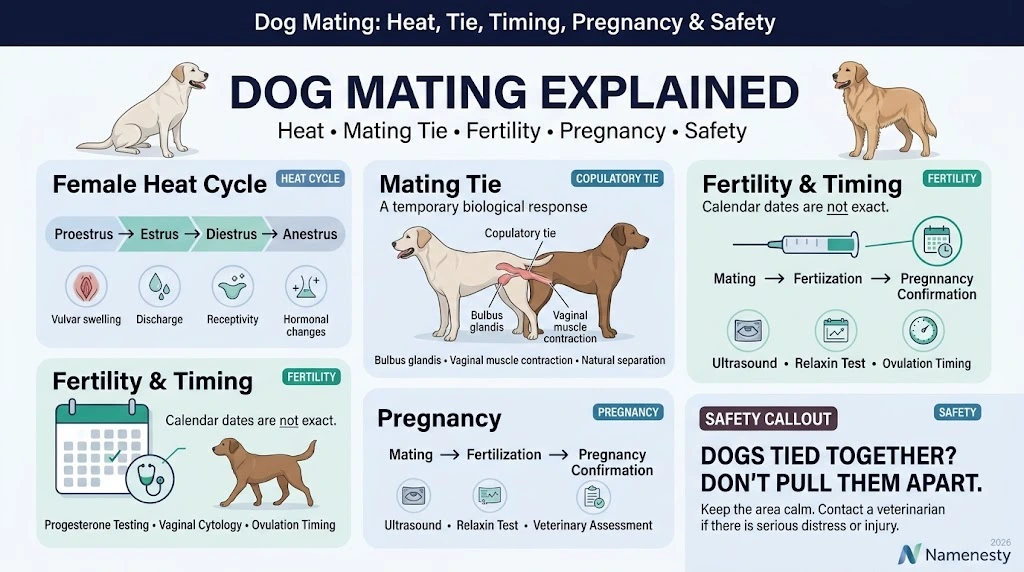
There is no universal “magic day” that works perfectly for every dog. Calendar rules can provide a rough framework, but ovulation varies among individual females.
Veterinary tools such as vaginal cytology and hormone testing, including progesterone testing, can provide more useful information for planned breeding. The Royal Kennel Club and VCA both describe veterinary testing as a way to improve reproductive timing.
15 social captions
- Day 10 is not a universal fertility guarantee.
- Fertility timing can vary from dog to dog.
- Calendar counting is not the same as reproductive testing.
- Progesterone testing can add valuable timing information.
- Vaginal cytology can help assess the reproductive stage.
- Planned breeding deserves more than guesswork.
- The fertile window is biological, not social-media simple.
- Heat calendars are useful records—not perfect predictions.
- Timing matters when breeding is intentional.
- Better timing starts with better information.
- Know the difference between heat signs and ovulation data.
- Veterinary testing can turn uncertainty into useful evidence.
- One calendar formula cannot fit every dog.
- Reproductive timing is individual.
- When timing matters, talk to a veterinarian.
9. Dog Mating Behavior: Signs of Receptivity
Behavioral signs can help owners understand where a female may be in her reproductive cycle. These can include standing for a male, tail flagging, scent marking, frequent urination, and increased interest in male dogs.
These behaviors are clues—not definitive pregnancy or ovulation tests. Veterinary assessment is more reliable when breeding timing needs to be precise.
15 social captions
- Tail flagging can be a clue to receptivity.
- Dog mating behavior often starts with scent and signals.
- Behavior can provide clues without providing certainty.
- Frequent urination can communicate reproductive information.
- Male dogs may detect a female in heat before humans notice.
- Receptive behavior is part of canine communication.
- Scent is a major part of canine reproduction.
- Observe behavior without assuming too much from one sign.
- A dog’s body language can tell part of the story.
- Reproduction is communication plus biology.
- Learn the signs, then confirm what matters professionally.
- Canine behavior is nuanced.
- Standing, flagging, and scent changes can accompany estrus.
- Good pet education starts with observation.
- Watch the whole pattern—not one isolated behavior.
10. What Happens After Dog Mating?
After planned mating, owners should let the dogs settle and continue appropriate heat management. The female can potentially mate with another intact male while she remains in estrus.
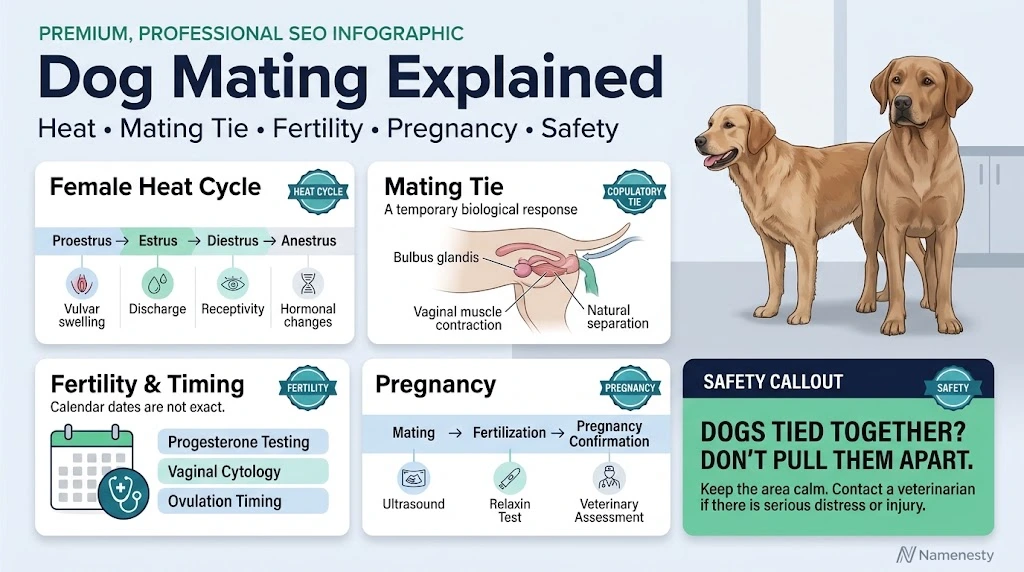
After a mating, behavior alone cannot confirm pregnancy. Veterinary testing is the dependable way to assess pregnancy. VCA reports that pregnancy generally lasts around nine weeks, with an average gestation period of approximately 63 days.
15 social captions
- Mating day is not the end of the responsibility.
- What happens after breeding matters too.
- Keep an intact female securely separated from other males during heat.
- Pregnancy confirmation should come from veterinary assessment.
- Appetite changes alone cannot prove pregnancy.
- Tiredness is not a pregnancy test.
- Responsible breeding includes post-mating care.
- Record mating dates carefully.
- Good planning continues after conception.
- A possible pregnancy deserves a real follow-up plan.
- Don’t let assumptions replace veterinary care.
- The post-mating period is a time for observation, not guessing.
- Breeding creates responsibilities that last for weeks.
- Preparation makes pregnancy management easier.
- Track the timeline from mating to veterinary confirmation.
11. How to Tell If Dog Mating Was Successful
The presence of a tie does not prove conception. Likewise, early behavioral or physical changes are not enough to establish pregnancy.
Veterinary options can include ultrasound and pregnancy-specific blood testing. VCA notes that ultrasound may detect pregnancy in some dogs from around three weeks, while examinations after approximately day 28 are generally more reliable.
Pregnancy confirmation at a glance
| Method | Main purpose |
| Ultrasound | Pregnancy confirmation and assessment |
| Relaxin blood test | Pregnancy hormone detection |
| Later imaging | Fetal development and litter assessment |
15 social captions
- A successful tie is not the same as confirmed pregnancy.
- The only way to know is to test appropriately.
- Pregnancy signs can overlap with normal hormonal changes.
- Veterinary testing turns uncertainty into evidence.
- Ultrasound can provide valuable pregnancy information.
- Early guessing can create unnecessary worry.
- Don’t count puppies from behavior alone.
- Pregnancy confirmation belongs in the veterinary timeline.
- One mating does not answer the pregnancy question.
- Reproductive biology takes time to confirm.
- False pregnancy can confuse owners.
- Good records make veterinary follow-up easier.
- Trust testing over assumptions.
- Pregnancy is confirmed medically—not by social-media clues.
- When in doubt, get the right test at the right time.
12. Accidental Dog Mating: What Should You Do?
Accidental mating can happen quickly, especially when a female is in heat, and intact dogs are not securely separated.
If the dogs are tied, do not force them apart. After separation, contact your veterinarian as soon as possible to discuss the situation and available options. Avoid internet “home remedies” or attempting medical treatment yourself.
Accident-prevention checklist
- Secure physical separation
- Supervised outdoor access
- Secure doors and fencing
- Controlled leash walks
- No reliance on diapers as contraception
- Veterinary advice after an accidental mating
15 social captions
- Accidental mating can happen in seconds.
- Prevention begins with secure separation during heat.
- Dog diapers manage discharge; they are not birth control.
- An unplanned mating deserves prompt veterinary advice.
- Skip dangerous home remedies.
- Secure management matters more than luck.
- Heat can attract determined male dogs.
- Never assume a fence is enough without checking its security.
- Responsible pet care includes preventing accidental litters.
- When an accident happens, call the vet.
- One escape can create a complicated situation.
- Good management protects dogs and owners alike.
- Don’t wait for internet advice to replace professional guidance.
- Prevention is easier than dealing with an unplanned pregnancy.
- Be prepared before the next heat cycle begins.
13. Responsible Dog Breeding: Health Checks Before Mating
Responsible breeding involves much more than choosing two dogs that can reproduce.
Breed-specific health screening is important because different breeds have different inherited health concerns. The OFA’s CHIC program is built around breed-specific testing protocols established with participating parent clubs. A CHIC number means the recommended tests were completed and the results were made publicly available; it does not itself mean that every result was normal.
Responsible preparation may include:
- Veterinary examination
- Breed-specific genetic screening
- Orthopedic or eye assessments where appropriate
- Infectious-disease screening
- Temperament review
- Pedigree considerations
- Inbreeding-risk assessment
- Pregnancy and emergency planning
The Royal Kennel Club also emphasizes reducing avoidable inherited-risk and inbreeding concerns when selecting breeding pairs.
15 social captions
- Responsible breeding starts with health testing.
- “Healthy-looking” is not the same as health-screened.
- Breed-specific testing matters.
- Genetics can shape a puppy’s future before it is born.
- Responsible breeders plan beyond the litter announcement.
- Health records are more meaningful than appearance alone.
- Temperament belongs in breeding decisions.
- A CHIC number documents testing—it does not guarantee normal results.
- Better breeding starts with better information.
- Puppy welfare begins before pregnancy.
- Breed standards are only one part of responsible selection.
- Genetic responsibility is part of modern breeding.
- Good breeding asks difficult questions before saying yes.
- Health should never be an afterthought.
- Breed for welfare, preparation, and long-term responsibility.
14. Dog Mating Problems: When to Call a Veterinarian
Most mating questions can be answered calmly, but certain signs deserve prompt professional attention.
Seek veterinary help for severe pain, collapse, marked distress, visible injury, heavy or unusual bleeding, serious illness signs, or a penis that remains exposed or swollen after separation. A female who repeatedly refuses mating and appears painful should not be forced. The Royal Kennel Club specifically warns against forcing mating.
Vet red flags
| Red flag | Why it matters |
| Severe pain | Possible injury or medical problem |
| Collapse or marked weakness | Potential emergency |
| Heavy/persistent bleeding | Requires assessment |
| Visible injury | Needs veterinary examination |
| Penis remains exposed/swollen | Prompt veterinary attention may be needed |
| Extreme distress | Stress, pain or trauma |
| Fever, vomiting or severe lethargy | Possible illness |
15 social captions
- Not every mating problem should be handled at home.
- Severe pain is a reason to call the vet.
- Visible injury should never be ignored.
- Heavy bleeding deserves professional attention.
- A penis that stays exposed after mating needs assessment.
- Extreme panic can turn a reproductive event into an emergency.
- Never force a female who is refusing because she may be distressed or painful.
- Pet safety comes before breeding plans.
- Know the red flags before you need them.
- When the situation looks abnormal, call the veterinarian.
- Internet advice cannot examine an injured dog.
- Prompt care can matter when something goes wrong.
- Calm observation is useful; serious symptoms are not a wait-and-see game.
- Responsible owners know when to step back and seek help.
- Veterinary care belongs in every responsible breeding plan.

15. Dog Mating FAQs: Pregnancy, Tie, Timing and Safety
This section answers common questions in direct, search-friendly language while keeping the focus on safe canine reproductive care.
A mating tie may last several minutes and can sometimes last substantially longer. VCA describes five to ten minutes as common, while the Royal Kennel Club notes considerable variation. Do not force separation.
Yes. A fertile female can become pregnant after a first mating. That does not mean breeding a young dog during her first heat is automatically appropriate.
Yes. Pregnancy can occur after mating without a prolonged tie.
Vocalization can happen, but distress, fear,r or pain should not be ignored. A female should never be forced to mate.
No. Heat refers to the female estrous cycle. Male dogs can still respond strongly to females in heat and may become restless, distracted, or try to escape.
Timing depends on the testing method and individual dog. VCA notes that ultrasound may detect pregnancy from around three weeks in some cases, with examinations after about day 28 generally more reliable.
15 social captions
- Dog mating questions deserve real answers, not myths.
- How long does the tie last? It varies.
- Can pregnancy happen without a tie? Yes.
- Can a dog become pregnant from one mating? Yes, if fertile.
- Do male dogs go into heat? No.
- Can behavior prove pregnancy? Not reliably.
- When can a vet confirm pregnancy? Timing depends on the test.
- Why are dogs tied? Normal reproductive anatomy explains it.
- Should you pull dogs apart? No.
- Are heat calendars exact? No.
- Is every first heat a breeding opportunity? No.
- Can diapers prevent pregnancy? No.
- Should an unwilling female be forced to mate? Never.
- What matters after accidental mating? Prompt veterinary advice.
- The best reproductive answers are accurate, calm, and evidence-based.
Caption Selection Framework
Not every social post needs the same type of caption. Match your wording to the audience, platform, and purpose.
| Goal | Caption style | Best use |
| Education | Direct + factual | Instagram, Facebook |
| Quick explanation | Short + clear | Reels, TikTok |
| Myth correction | Question + answer | Threads, X-style posts |
| Owner safety | Urgent but calm | Facebook, Instagram |
| Breeder education | Professional | Facebook groups, blogs |
| Infographic | Compact + informative | Pinterest, Instagram |
| Veterinary awareness | Trust-focused | Facebook, LinkedIn-style educational content |
Why these captions work
Educational pet captions perform better as useful communication when they answer a real question, create clarity, or help owners avoid a mistake. The strongest examples in this article deliberately avoid exaggerated claims and focus on specific information such as the mating tie, fertility timing, pregnancy confirmation, or emergency warning signs.
For AI-powered discovery systems, concise statements with a clearly defined topic are also easier to summarize accurately than vague, sensational language.
Which caption suits my post?
Use a short explanatory caption when the image already contains the main information.
Use a question-led caption when the Reel or infographic answers a common misconception.
So Use a safety-focused caption when discussing tied dogs or accidental mating.
Also use a responsible-breeding caption when your audience is breeders, veterinary professionals, or experienced dog owners.
Use a myth-busting caption when your post corrects assumptions such as “no tie means no pregnancy.”
Platform-Specific Caption Tips
Instagram works well for concise educational captions paired with a strong visual. Put the key fact early, then add a short explanation.
Example:
“Dogs stuck together? Stay calm. A mating tie can be a normal part of canine reproduction—never pull the dogs apart.”
TikTok
TikTok captions should complement the video rather than repeat every spoken detail.
Example:
“Dog mating explained in 30 seconds: the tie is normal, but forced separation is not.”
Facebook is useful for longer pet-owner explanations, especially when the audience may be dealing with an accidental mating or first-time breeding situation.
Example:
“If you have ever wondered why dogs become temporarily stuck together during mating, here is the simple biological explanation—and what owners should never do.”
Snapchat
Keep the message extremely short and visual.
Example:
“Dog mating tie? Don’t pull them apart.”
Reels
Use the first sentence as the hook.
Example:
“Seeing two dogs tied together can be scary—but here’s what every dog owner should know.”
Pinterest captions should align tightly with the infographic topic.
Example:
“Dog Mating Guide: Heat Cycle, Breeding Tie, Pregnancy Signs & Safety”
Dog Mating Caption Style Comparison
| Caption style | Best for | Emotional angle | Main benefit |
| Educational | Informational posts | Curiosity | Builds understanding |
| Safety | Emergency content | Reassurance | Reduces unsafe intervention |
| Myth-busting | Question posts | Surprise | Corrects misconceptions |
| Breeding | Breeder education | Responsibility | Encourages planning |
| Pregnancy | Follow-up content | Uncertainty | Clarifies testing |
| Veterinary | Health posts | Trust | Encourages professional care |
Search Journey Coverage
A complete dog-mating resource should not stop at “how dogs mate.” Users may continue searching for:
- dog heat cycle
- fertile window
- accidental mating
- dog pregnancy
- pregnancy testing
- false pregnancy
- breeding health tests
- whelping
- newborn puppy care
- infectious disease screening
- preventing accidental pregnancy
That broader journey is important because the supplied competitor analysis identified the strongest opportunity as a complete pillar experience rather than a narrow mating explainer.
More Explore : https://namenesty.com/dog-sex/
People Also Ask
It usually refers to a normal copulatory tie caused by swelling of the male’s bulbus glandis and contraction of the female’s vaginal muscles.
No. Forced separation can cause injury. Keep the area calm and allow natural separation.
Yes. A tie is not required for pregnancy to be possible.
Veterinary timing depends on the test. Ultrasound may detect pregnancy from around three weeks in some cases, with later examinations often more reliable.
A female can become pregnant during her first heat, but early fertility should not automatically be treated as readiness for responsible breeding.
Secure physical separation during heat is essential. Supervision, secure doors and fencing, controlled walks, and discussion of sterilization with a veterinarian can all be part of prevention.
Responsible Dog Breeding Checklist
Before planned breeding, review the whole picture:
Health
Both dogs should receive appropriate veterinary assessment and breed-specific health screening. OFA/CHIC resources emphasize that screening protocols differ by breed.
Timing
Do not rely on a single calendar rule. Veterinary testing can improve confidence in reproductive timing.
Infectious disease
Ask your veterinarian whether infectious-disease screening is appropriate, including consideration of Brucella canis based on risk and circumstances.
Temperament and genetics
Responsible selection goes beyond looks, color, or popularity. Breed-specific inherited risks and compatibility deserve attention.
Financial planning
Prepare for routine veterinary care as well as unexpected pregnancy or delivery complications.
Puppy welfare
Have a real plan for nutrition, neonatal care, socialization, placement,t and long-term support.
Information Gain: What Most Quick Dog-Mating Articles Miss
A simple mating article may explain the tie but leave out the decisions that matter most.
The more useful questions are:
What if the mating was accidental?
Contact a veterinarian promptly rather than trying internet remedies.
What if the dogs did not tie?
Pregnancy can still be possible.
What if the female is young?
Fertility does not equal responsible breeding readiness.
What if the dog looks pregnant?
Visible changes are not enough for reliable confirmation.
What if the breeding pair is healthy-looking?
Appearance does not replace breed-specific health screening.
What if the female refuses?
Never force mating; refusal can indicate stress, incompatibility, or pain.
Conclusion
Understanding dog mating helps owners respond calmly to a subject that can otherwise seem confusing or alarming. The breeding tie, heat cycle, fertility window and post-mating period all have straightforward biological explanations—but responsible decisions require more than knowing the basic mechanics.
For planned breeding, health screening, veterinary timing, disease-risk management, temperament, genetics, pregnancy planning, and lifelong puppy welfare should all be considered before mating takes place.
For accidental mating, the priority is simple: avoid unsafe physical intervention, contact a veterinarian promptly, and follow professional advice.
The most useful social content on this topic should educate rather than sensationalize. A clear caption, accurate infographic, and responsible explanation can help dog owners understand reproduction without spreading myths or encouraging unsafe intervention.