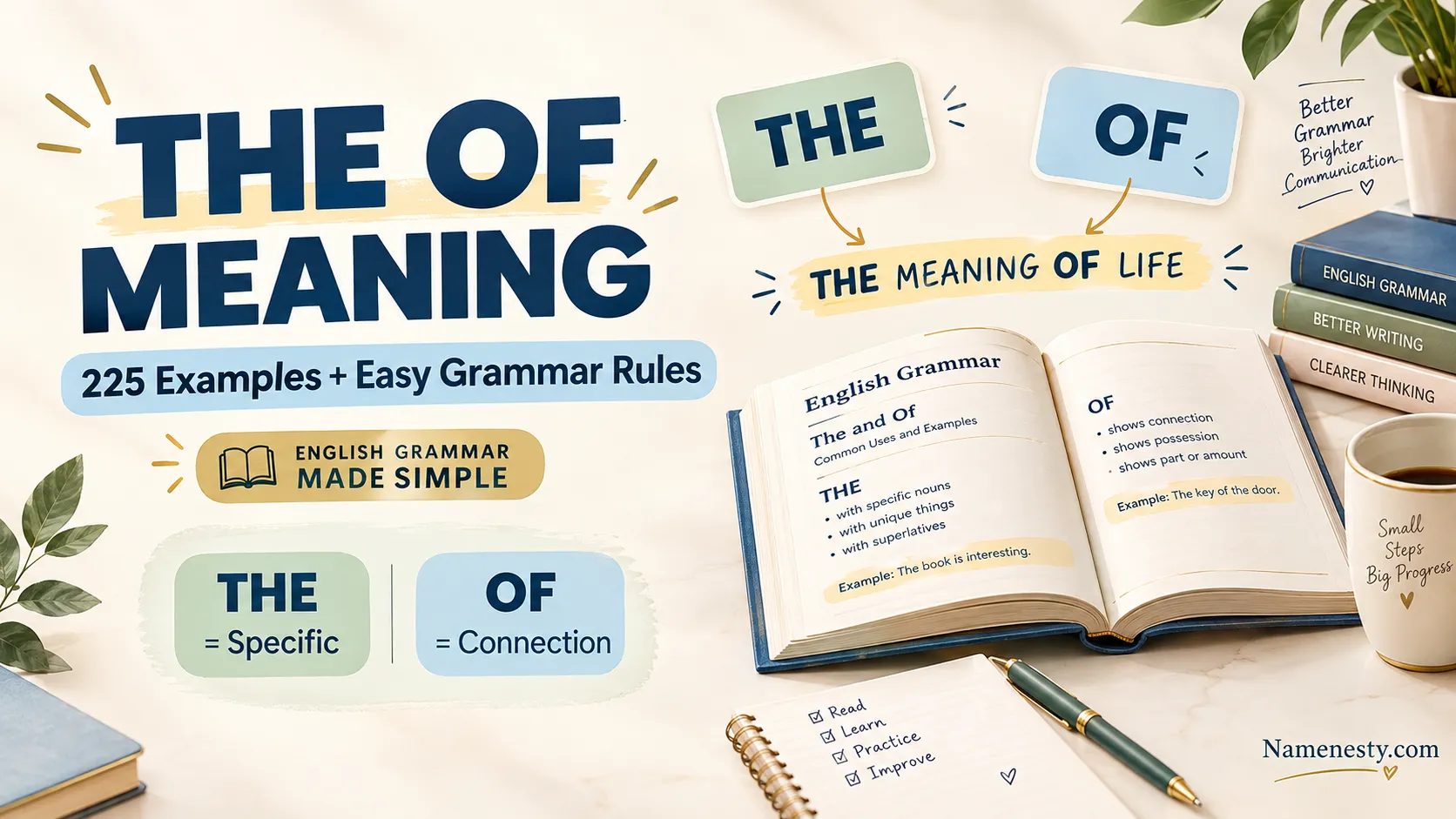
The Meaning of ” The “: What “The” and “Of” Mean Together in English
Ever wondered what “the of meaning” actually means in English? You’re not alone! Many English learners get confused when they see phrases like “the meaning of life,” “the end of the road,” or “the love of my life.” Here’s the secret: “the” and “of” have different jobs, but they often work together to create clear, meaningful expressions. In this beginner-friendly guide, you’ll discover 225 practical examples, simple grammar rules, common mistakes, and everyday expressions. Whether you’re improving your English, writing Instagram captions, or preparing for exams, this guide will help you understand these words and use them with confidence.
Have you ever read a phrase like “the meaning of life,” “the end of the road,” or “the love of my life” and wondered why English uses both the and of?
Understanding the meaning of ” the of ” is easier than it might seem. These two short words perform different jobs, but they frequently appear in the same noun phrase to communicate something specific.
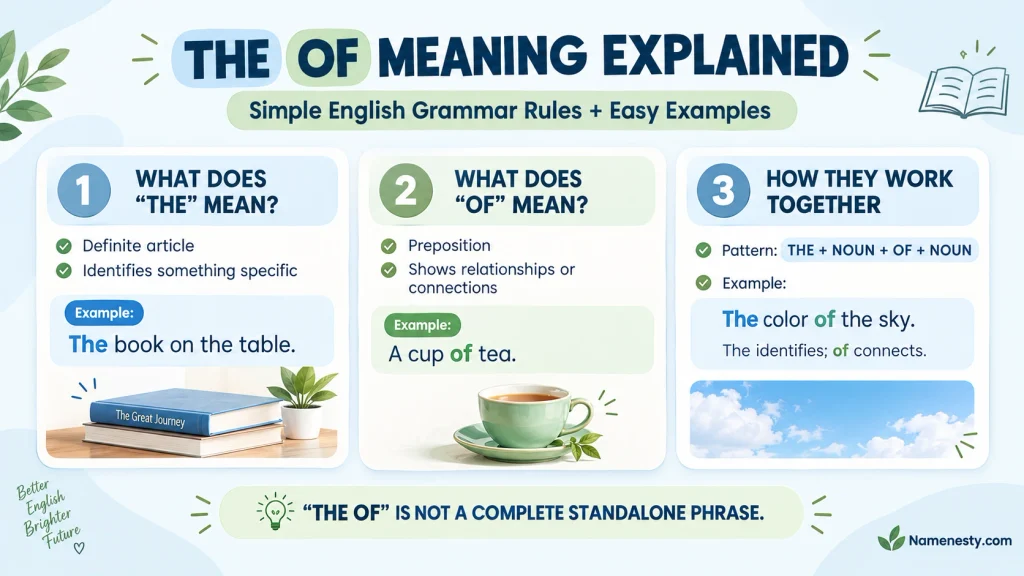
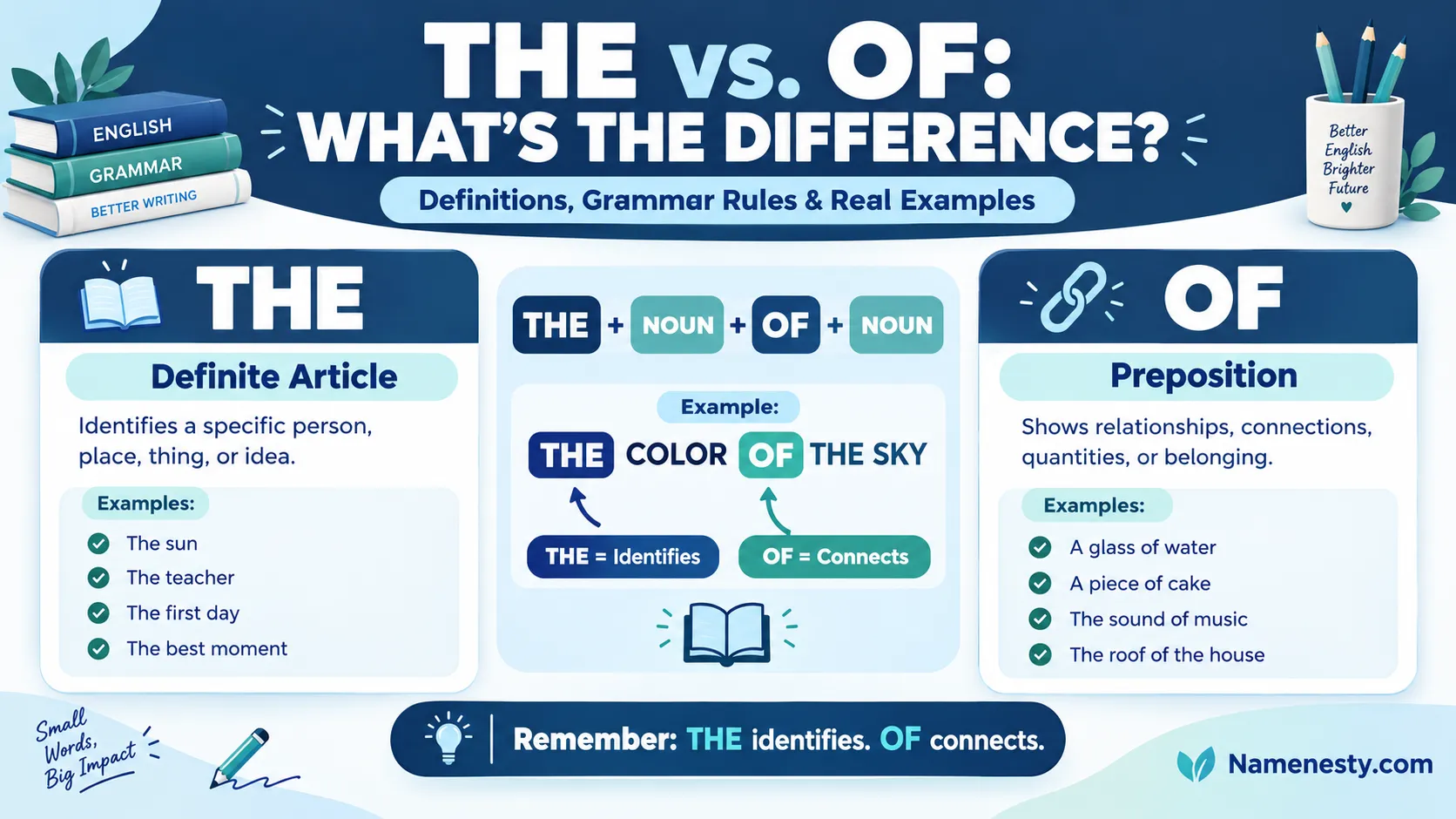
Quick answer: “The of” has no independent grammatical meaning in standard English. “The” is a definite article that identifies a particular person or thing, while “of” is a preposition that expresses a relationship, connection, quantity, or other association. Together, they often appear in the structure the + noun + of + noun, such as “the color of the sky.”
This guide explains their meanings, differences, and everyday uses with 225 practical examples. You’ll also discover how these expressions appear in conversations, Instagram captions, TikTok videos, writing, and familiar English sayings.
Understanding the Basic Grammar
How “the” and “of” work together
the
Identifies something specific
meaning
The main noun
of life
Explains the relationship
Example: “the meaning of life”
The British Council explains that the is used when a noun refers to something identifiable from the situation, previous mention, or shared knowledge. Cambridge Dictionary also distinguishes the from a and an based on whether the reference is identifiable.
LearnEnglish
1. What Is “The Of Meaning” in English Grammar?
The expression “the of meaning” is not a standard English phrase. People searching for it are often trying to understand how “the” and “of” work in a sentence.
These examples introduce familiar noun phrases and show how the words create meaning through their context.
15 basic examples:
- The name of the book — identifies a book’s title.
- The color of the sky — describes the sky’s color.
- The end of the story — identifies its final part.
- The beginning of the journey — marks where a journey starts.
- The sound of the rain — identifies a sound produced by rain.
- The shape of the moon — describes the moon’s visible form.
- The smell of fresh coffee — identifies a familiar aroma.
- The purpose of the meeting — explains why a meeting happens.
- The price of the ticket — identifies a ticket’s cost.
- The title of the article — names a particular article.
- The owner of the house — identifies who owns the house.
- The result of the test — refers to a test’s outcome.
- The location of the school — tells where a school is.
- The history of the city — refers to a city’s past.
- The meaning of the message — explains what a message communicates.
Why these examples work: The first noun identifies the main concept, while the phrase beginning with of supplies more information about it.
2. What Do “The” and “Of” Mean in Simple English?
Although both words are extremely common, they belong to different grammatical categories.
“The” helps identify a noun. “Of” links a word or phrase to something else. These examples show their different functions.
15 simple examples:
- The sun is shining. — “The” identifies the sun.
- The door is open. — A particular door is open.
- The teacher is speaking. — A specific teacher is speaking.
- The movie starts tonight. — A known movie is starting.
- The phone is ringing. — An identifiable phone is ringing.
- A cup of water — “Of” indicates the cup’s contents.
- A piece of paper — “Of” identifies the material or whole.
- A group of friends — “Of” identifies the group members.
- A bowl of soup — “Of” identifies what the bowl contains.
- A slice of bread — “Of” describes a portion.
- The cover of the notebook — connects a cover to its notebook.
- The wheels of the bicycle — connects parts to a whole.
- The voice of the singer — connects a voice to its source.
- The pages of the magazine — identifies parts of a magazine.
- The taste of chocolate — identifies a characteristic of chocolate.
Remember: “The” generally answers which one? while “of” helps answer connected to what, part of what, or containing what?
3. How to Use “The” and “Of” Together in Sentences
You can use these words naturally in everyday conversations without thinking about complex grammar rules.
Notice how the examples identify particular things and describe their connections.
15 everyday sentences:
- The keys to the office are with the manager.
- The windows of the classroom are open.
- The name of your favorite song sounds familiar.
- The beginning of the film was exciting.
- The smell of dinner filled the kitchen.
- The handle of the suitcase is broken.
- The roof of the building needs repairs.
- The pages of this book are beautifully illustrated.
- The temperature of the water is perfect.
- The address of the restaurant is on the invitation.
- The schedule of the event changed yesterday.
- The quality of the camera impressed me.
- The details of the agreement are important.
- The results of the competition surprised everyone.
- The atmosphere of the café feels peaceful.
These sentences work well in spoken English, school assignments, emails, and descriptive writing.
4. Understanding the “The + Noun + Of + Noun” Grammar Pattern
One useful structure for English learners is the + noun + of + noun phrase.
The noun after the names the main idea. The of phrase provides a relationship or identifies what the idea concerns. The second noun phrase may contain another article, a possessive, or no article.
15 grammar pattern examples:
- The capital of Pakistan
- The population of the city
- The president of the club
- The director of the company
- The author of this novel
- The center of the universe
- The edge of the table
- The surface of the ocean
- The entrance of the museum
- The rhythm of the music
- The importance of education
- The benefits of regular exercise
- The effects of climate change
- The development of technology
- The future of artificial intelligence
Not every noun followed by of requires the. Compare “a student of history” with “the history of the university.” The appropriate article depends on the intended meaning and context.
5. What Does “The” Mean? Definition, Rules, and Examples
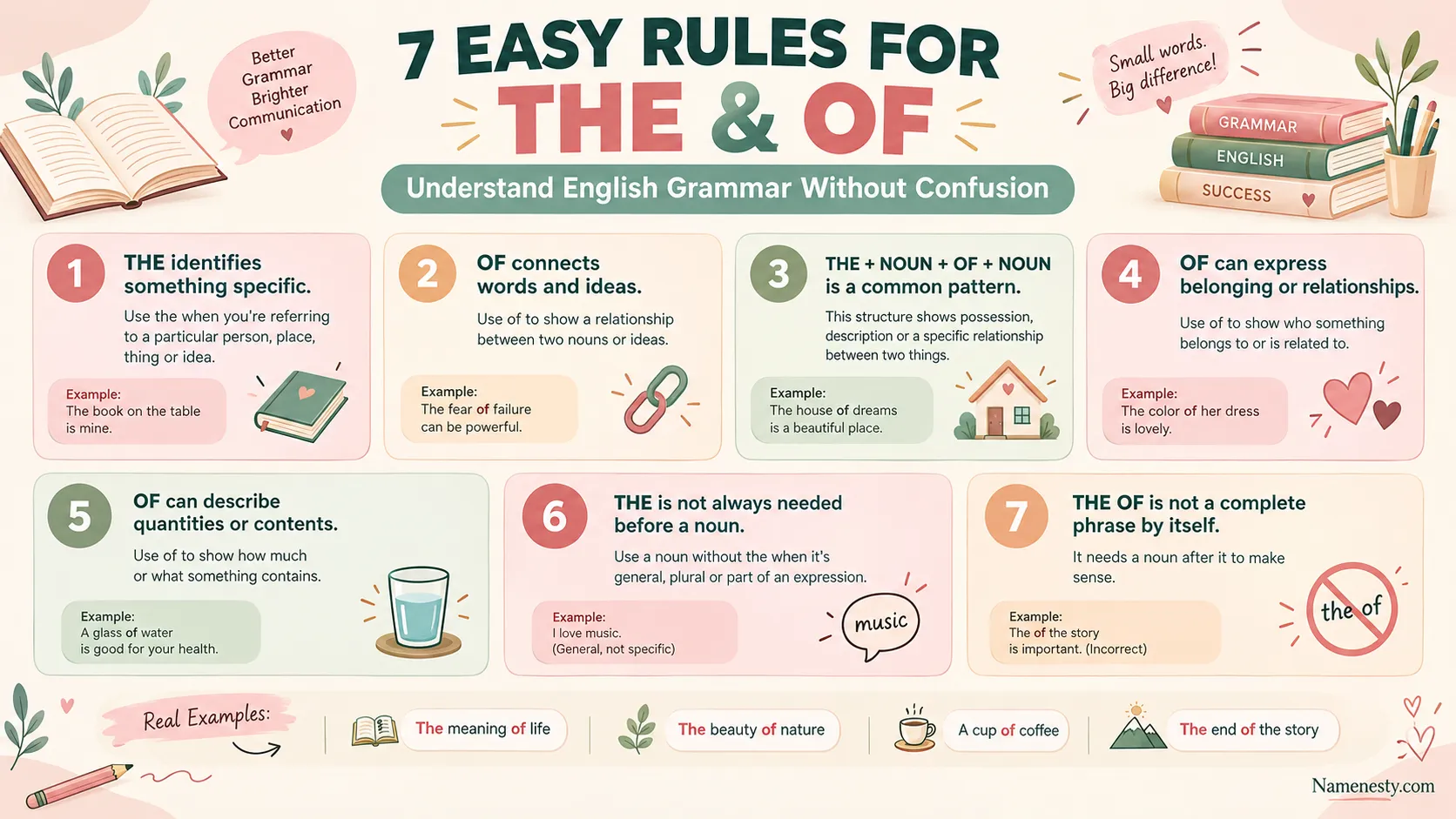
“The” is the definite article in English. It can appear before singular nouns, plural nouns, and uncountable nouns when the context makes their reference identifiable.
The following examples illustrate several common situations.
15 examples of “the”:
- The moon looks bright tonight. — A unique celestial object.
- The bag on the chair is mine. — Identified by its location.
- The girl wearing glasses is my sister. — Identified by description.
- The water in this bottle is cold. — A particular quantity of water.
- The students in our class are preparing. — An identified group.
- The restaurant we visited was excellent. — Previously identified.
- The first chapter is interesting. — An ordinal expression.
- The tallest building is visible from here. — A superlative.
- The internet has changed communication. — A familiar system.
- The piano needs tuning. — A particular instrument.
- The train leaves at eight. — An identifiable service.
- The manager called this morning. — A known role-holder.
- The answer to your question is simple. — An identified answer.
- The photo you shared looks amazing. — Identified by a relative clause.
- The best part of the trip was the sunset. — A superlative phrase.
For more detailed rules, see the British Council’s definite article guide.
6. What Does “Of” Mean? Uses, Functions, and Examples
“Of” is a preposition that can express belonging, composition, quantity, source, relationship, and other connections.
Its meaning depends on the words surrounding it, so translating it as “belonging to” in every sentence would be misleading.
15 examples of “of”:
- A glass of milk — contents.
- A packet of biscuits — contents.
- A bunch of flowers — collection.
- A team of designers — group membership.
- A piece of advice — quantity expression.
- A sheet of metal — material.
- A ring of silver — material.
- A friend of mine — personal relationship.
- The daughter of a musician — family relationship.
- The works of Shakespeare — authorship.
- The city of Lahore — identifying a city by name.
- The cause of the delay — cause or explanation.
- The fear of failure — the object of fear.
- The study of language — subject of study.
- The arrival of the guests — event involving the guests.
Learning these relationships is more useful than memorizing one fixed translation for of.
7. Why Does “The” Come Before “Of” in English Phrases?
Strictly speaking, “the” does not usually come immediately before “of.” A noun or another appropriate word normally appears between them.
An of phrase can help identify a noun, making it appropriate when the speaker means something specific.
15 examples of identified noun phrases:
- The front of the house
- The back of the classroom
- The bottom of the drawer
- The top of the staircase
- The middle of the afternoon
- The side of the road
- The corner of the room
- The entrance of the building
- The exit of the tunnel
- The opening of the exhibition
- The conclusion of the report
- The theme of the conference
- The objective of the lesson
- The summary of the discussion
- The outcome of the investigation
Important distinction: An of phrase does not automatically make the noun compulsory. For example, both “a photo of the city” and “the photo of the city” can be grammatical, but they identify the photo differently.
8. The Difference Between “The Of” and “Of The” Explained
“The … of …” and “of the” are not competing grammatical rules. They describe different portions of a noun phrase.
In “the cover of the book,” the first the identifies the cover, of introduces a relationship, and the second the identifies the book.
| Pattern | Example | Explanation |
| The + noun + of + noun | The capital of France | Identifies a capital and its country |
| Of + the + noun | A picture of the garden | Identifies what the picture shows |
| The + noun + of + the + noun | The roof of the house | Connects two identifiable things |
| A + noun + of + noun | A student of literature | Describes a student’s field |
| Noun + of + possessive | A friend of mine | Describes a personal relationship |
15 examples for comparison:
- The cover of the book — a particular book cover.
- A photograph of the mountains — a photograph showing mountains.
- The population of the country — a country’s population.
- A map of the city — a map representing the city.
- The door of the garage — a particular garage door.
- A view of the ocean — a scene showing the ocean.
- The title of the film — the film’s title.
- A recording of the concert — a recording capturing the concert.
- The temperature of the room — the room’s temperature.
- A description of the product — information describing the product.
- The history of the region — the region’s past.
- A collection of the artist’s paintings — a group of paintings.
- The design of the website — the website’s design.
- An illustration of the process — a picture explaining a process.
- The meaning of the sentence — what the sentence communicates.
Writing tip: Instead of memorizing the two word orders separately, identify the main noun and determine what each following phrase describes.
9. 15 Common English Expressions Using “The” and “Of”
English contains many familiar expressions using the and of. Some have straightforward meanings, while others are idioms that cannot be understood through literal translation alone.
These expressions are useful for conversations, creative writing, Instagram captions, and memorable quotes.
15 popular expressions and meanings:
- The love of my life — someone you love deeply.
- The best of both worlds — the advantages of two different situations.
- The end of the road — the point where something finishes.
- The beginning of something beautiful — the start of a promising experience.
- The time of your life — an exceptionally enjoyable experience.
- The tip of the iceberg — a small visible part of a much larger issue.
- The calm before the storm — a quiet period before trouble or intense activity.
- The heart of the matter — the central issue.
- The middle of nowhere — a remote or isolated location.
- The light of my life — someone who brings great happiness.
- The chance of a lifetime — a rare and valuable opportunity.
- The center of attention — the person or thing everyone notices.
- The beauty of simplicity — the appeal of keeping things uncomplicated.
- The power of positive thinking — the potential influence of an optimistic mindset.
- The story of my life — an expression often used when something repeatedly happens to you.
Social media tip: Expressions such as “the beginning of something beautiful” and “the beauty of simplicity” can make short, relatable captions without requiring a long explanation.
10. The Meaning of “The Meaning Of” With Everyday Examples
“The meaning of” is a common English phrase used when asking about a word, statement, event, experience, or concept.
Here, the identifies the meaning being discussed, while of introduces the subject whose meaning we want to understand.
15 examples with explanations:
- The meaning of happiness — what happiness represents.
- The meaning of friendship — what friendship involves.
- The meaning of success — how success is understood.
- The meaning of kindness — what being kind involves.
- The meaning of respect — what respect represents.
- The meaning of honesty — what it means to be truthful.
- The meaning of loyalty — what being loyal involves.
- The meaning of freedom — what freedom represents.
- The meaning of responsibility — what responsibility involves.
- The meaning of gratitude — what it means to be thankful.
- The meaning of forgiveness — what forgiving someone involves.
- The meaning of confidence — what it means to feel self-assured.
- The meaning of commitment — what dedication involves.
- The meaning of personal growth — what self-development involves.
- The meaning of life — a philosophical question about life’s purpose or significance.
These expressions are especially useful in reflective essays, motivational posts, educational articles, and discussions about personal values.
11. How “The” and “Of” Show Possession, Relationships, and Connections
One of the most useful functions of of is expressing relationships between people, objects, places, and ideas.
Some constructions can also be rewritten using possessive forms, although the two forms are not always equally natural.
15 examples of relationships:
- The bicycle of my neighbor — my neighbor’s bicycle.
- The signature of the author — the author’s signature.
- The opinion of the teacher — the teacher’s opinion.
- The decision of the committee — the committee’s decision.
- The mission of the organization — the organization’s mission.
- The culture of the community — the community’s culture.
- The reputation of the brand — the brand’s reputation.
- The goals of the project — the project’s goals.
- The traditions of the family — the family’s traditions.
- The responsibilities of the leader — the leader’s responsibilities.
- The achievements of the students — the students’ achievements.
- The structure of the bridge — the bridge’s structure.
- The ingredients of the recipe — the recipe’s ingredients.
- The message of the poem — the poem’s message.
- The identity of the character — the character’s identity.
Natural English tip: With people, possessive forms often sound more conversational. For example, “my neighbor’s bicycle” is usually more natural than “the bicycle of my neighbor.” However, of constructions are frequently useful with abstract nouns, objects, organizations, and formal descriptions.
12. Common Mistakes When Using “The” and “Of” in English
English learners sometimes add the unnecessarily, omit of, or confuse it with other words.
The following corrections highlight common mistakes and show how to form natural sentences.
15 mistakes and corrections:
| # | Incorrect | Correct |
| 1 | What is the of meaning? | What is the meaning of this? |
| 2 | The name the book is interesting. | The name of the book is interesting. |
| 3 | The roof house is damaged. | The roof of the house is damaged. |
| 4 | She is afraid the dark. | She is afraid of the dark. |
| 5 | Most the students passed. | Most of the students passed. |
| 6 | One my friends called. | One of my friends called. |
| 7 | The life is beautiful. | Life is beautiful. |
| 8 | I need a glass of water. | I need a glass of water. |
| 9 | He could of helped us. | He could have helped us. |
| 10 | This is the best of the two options | This is the best of the two options. |
| 11 | The price this shirt is high. | The price of this shirt is high. |
| 12 | The beginning the movie was slow. | The beginning of the movie was slow. |
| 13 | She is proud her work. | She is proud of her work. |
| 14 | The reason the delay is unclear. | The reason for the delay is unclear. |
| 15 | We discussed its meaning. | We discussed its meaning. |
These corrections are based on standard English usage. Some errors involve missing prepositions, while others involve article choice, verb patterns, or word combinations.
Important: Not every English relationship uses of. For instance, “the reason for the delay” is natural, and “the reason of the delay” is generally not.
13. How to Use “The” and “Of” in Daily Conversations and Writing
You don’t need complicated vocabulary to use these structures effectively.
They appear naturally in conversations, schoolwork, professional emails, storytelling, and social media posts. The following examples demonstrate their flexibility.
15 practical sentences and caption ideas:
- The highlight of my day was seeing you smile.
- The best part of this trip is the company.
- The sound of laughter makes everything better.
- The beauty of this place is hard to describe.
- The joy of learning something new never gets old.
- The secret of a peaceful morning is a slower start.
- The excitement of starting over feels incredible.
- The value of genuine friendship becomes clearer with time.
- The charm of this little café keeps bringing me back.
- The magic of golden hour makes every photo glow.
- The feeling of finally reaching my goal is unforgettable.
- The rhythm of the city keeps me inspired.
- The comfort of home is exactly what I needed.
- The energy of this moment deserves a memory.
- The simplicity of today is what made it special.
Where to use these examples: Instagram photo captions, TikTok voiceovers, Facebook updates, Threads reflections, Pinterest quote graphics, WhatsApp statuses, and personal blog writing.
For short-form social content, the most effective choice is usually the phrase that accurately matches the image, emotion, and intended audience—not simply the longest or most dramatic sentence.
14. Easy Grammar Exercises to Practice “The” and “Of”
Practicing English grammar through short sentences can help you recognize patterns more quickly.
Complete each sentence using the, of, both, or neither. A few questions also require choosing the correct phrase rather than inserting a single word.
15-Question Grammar Quiz
Choose the correct word to complete each sentence.
0/15 answered
1. ___ cover of the notebook is blue.
The
Of
No word
2. I drank a cup ___ tea.
the
of
No word
3. She is one ___ my closest friends.
of
the
No word
4. ___ sky looks beautiful tonight.
The
Of
No word
5. The meaning ___ this word is unclear.
the
of
No word
6. ___ life is full of surprises.
The
Of
No word
7. I love the sound ___ rain.
of
the
No word
8. The first page ___ the report is missing.
the
of
No word
9. Most ___ the guests arrived early.
of
the
No word
10. ___ sun rises in the east.
Of
The
No word
11. This is a photo ___ the garden.
of
the
No word
12. ___ beginning of the story is exciting.
The
Of
No word
13. I bought a bag ___ rice.
the
of
No word
14. ___ education is important.
The
Of
No word
15. The best part ___ the evening was the music.
of
the
No word
Check my answers
Reset
These 15 exercises complete the collection of 225 categorized examples and practice items. They are designed to teach the grammar behind the keyword rather than adding unrelated captions for volume.
15. People Also Ask About “The Of Meaning”.
“The of” is not a standalone grammatical expression in standard English. Usually, people asking this question want to understand the use of ” the ” and of in phrases such as “the meaning of life” or “the top of the mountain.”
Not as a complete standalone phrase. In ordinary English, the introduces a noun phrase, while of introduces a prepositional phrase. A construction such as “the color of the sky” is grammatical.
“The” is a definite article used to identify something. “Of” is a preposition that expresses relationships, including possession, composition, quantity, and connection.
We use of after many nouns to introduce related information. For example, “the roof of the house” identifies the house connected to the roof, while “the cause of the accident” identifies what the cause relates to.
It refers to the significance or purpose of human existence. Grammatically, the identifies the meaning under discussion, and of life tells us what the meaning concerns.
Yes. They appear together frequently in English. For example: “The results of the exam were published yesterday.”
How to Choose the Right “The” and “Of” Expression
Understanding grammar becomes easier when you choose words based on the message you want to communicate.
| Your purpose | Recommended pattern | Example |
| Identify a particular thing | The + noun | The photograph |
| Express a relationship | Noun + of + noun | A piece of advice |
| Identify something through another thing | The + noun + of + noun | The purpose of education |
| Express quantity | Quantity + of + noun | A bottle of water |
| Describe an experience | The + noun + of + phrase | The joy of traveling |
| Write an emotional caption | The + feeling + of + phrase | The beauty of being yourself |
A simple three-step selection framework
Step 1: Identify your main idea. Are you discussing a person, object, feeling, quantity, or relationship?
Step 2: Decide whether the noun is identifiable. If your audience knows which thing you mean, the may be appropriate. If you are introducing one unspecified countable item, a or an may be more suitable.
Step 3: Check the relationship. If the noun naturally takes an of phrase, use it to explain the connection. Do not force of into expressions that require another preposition.
How to Use These Expressions on Social Media
Although “the of meaning” is primarily a grammar-related search, understanding this structure can improve social media writing.
| Platform | Recommended writing style | Example |
| Short, aesthetic, emotional | The beauty of little moments. | |
| TikTok | Conversational, relatable | The struggle of waking up early is real. |
| Personal, descriptive | The best part of our weekend was being together. | |
| Snapchat | Brief, spontaneous | The mood of today: unbothered. |
| Simple, expressive | The peace of being home. | |
| Inspirational, evergreen | The power of small beginnings. | |
| Threads | Reflective, conversational | The hardest part of growing is letting go. |
| Reels | Clear, engaging hooks | The secret of my morning routine. |
These are creative examples, not claims of guaranteed engagement or current viral performance. An effective caption should match the content, audience, and intended emotion.
For personal branding, consistent language and a recognizable tone usually matter more than adding unnecessary words or hashtags.
Key Takeaways: Understanding “The Of Meaning”
The central lesson is that “the” and “of” have different grammatical functions, even when they appear together in a phrase.
- The is a definite article that helps identify a person, thing, or concept.
- Of is a preposition that expresses relationships and connections.
- The + noun + of + noun is a common English structure, but not a universal rule.
- Of the is a normal sequence within longer phrases.
- Article choice depends on context, not simply on whether of follows.
- Practicing complete sentences is more useful than memorizing isolated words.
When choosing an expression for writing, speaking, or social media, prioritize clarity and natural English.
Conclusion
Understanding the of meaning begins with a simple distinction: the identifies something, while of introduces a relationship.
From “the meaning of life” to “the beauty of small moments,” these words help build expressions that communicate precise information, personal experiences, and emotions.
Use the 225 examples and exercises in this guide to recognize common patterns, avoid frequent mistakes, and write more confidently. Bookmark this article for future reference, and explore more English meaning guides and creative writing ideas on Namenesty.com.