
Physical Touch Love Language: Meaning, Signs, Examples, and Healthy Ways to Express It
If a single hug can turn your whole Day Around, but your partner would rather sit across the room than next to you, you’re not imagining a problem — you’re living a mismatch that has a name. Physical touch is one of the five love languages, and it’s also the most misunderstood: most people assume it’s really just a polite way of talking about sex. It isn’t. It’s about hand-holding on a walk, a shoulder squeeze during a hard week, sitting close on the couch for no reason at all. Here’s what it actually means — and what to do if you and your partner don’t match.
If a hug from your partner makes your whole day better, or you feel a little lost when the people you love stop reaching for your hand, you might already know the answer before you finish reading: physical touch could be your love language. It’s one of the five categories popularized by Gary Chapman’s The 5 Love Languages, and it’s also one of the most misunderstood — often reduced to a stand-in for sex, when in reality it covers everything from a supportive shoulder squeeze to sitting close on the couch.
This guide explains what the physical touch love language means, how to recognize it in yourself, real examples organized by the situations where they matter most, and — just as importantly — how to navigate it with consent, boundaries, and respect for people who experience touch differently than you do.
What Is the Physical Touch Love Language?
A simple definition
Physical touch as a love language describes people who feel most loved, safe, and connected through affectionate physical contact — and who often express their own care the same way. It’s one of five relationship “languages” in Chapman’s framework, alongside words of affirmation, acts of service, receiving gifts, and quality time.
How can physical touch express and receive love??
For someone with this preference, touch works in both directions: they feel loved when a partner initiates it, and they instinctively use it to comfort, celebrate, or reassure the people around them. A hand on the back during a hard conversation can communicate more than a paragraph of words.
Why physical touch is not the same as sex
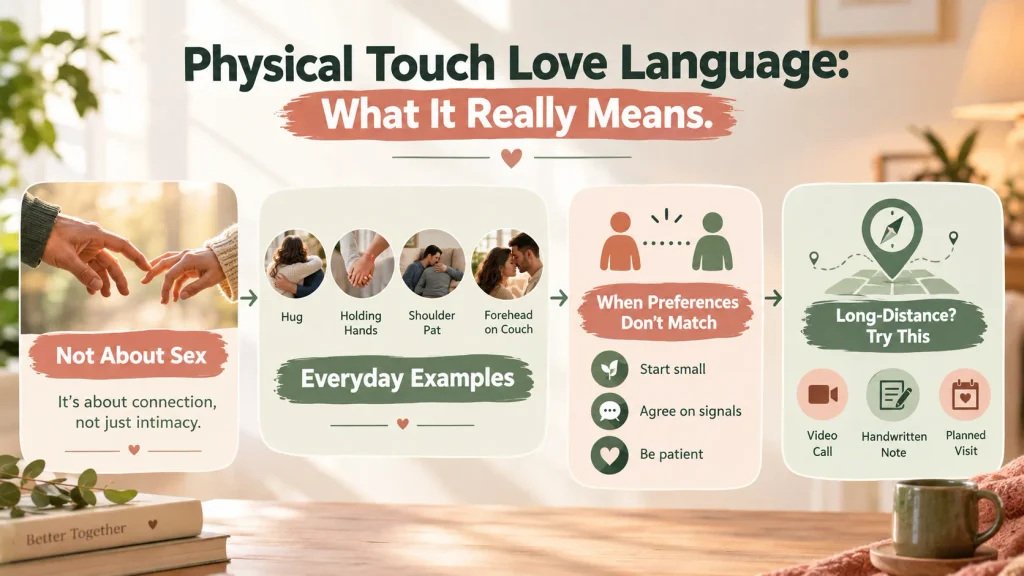
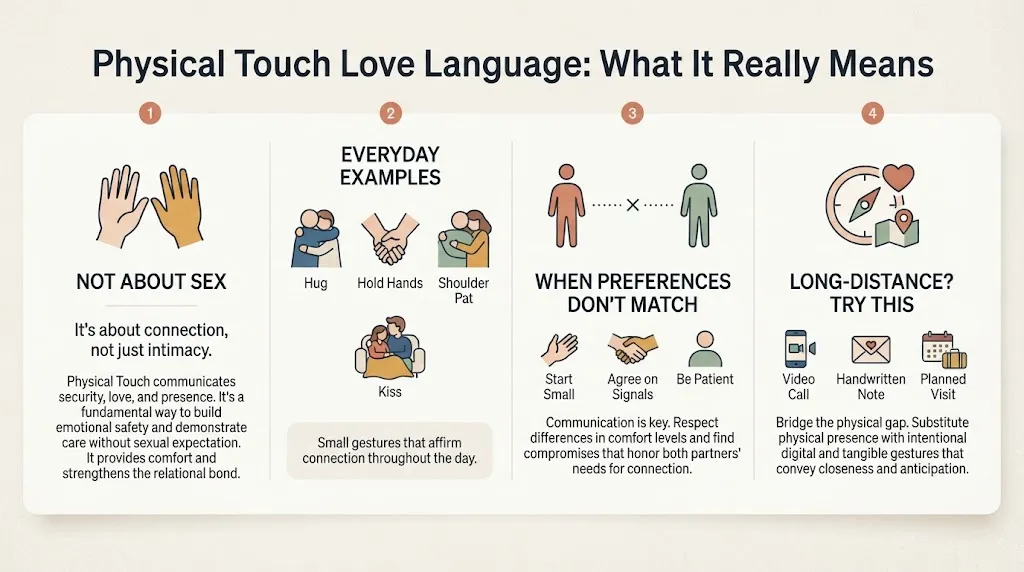
This is the single most important clarification in the entire topic. Physical touch as a love language is primarily about affectionate, everyday contact — hugs, hand-holding, leaning against someone on the couch. Sexual intimacy can be part of it for romantic partners, but wanting more physical affection is not the same as wanting more sex, and conflating the two is one of the most common (and most damaging) misunderstandings partners run into.
How it fits into the five love languages
Most people relate to more than one language, with physical touch as one influence among several. Treating it as a fixed, singular “type” oversimplifies real relationships — it’s better used as a shared vocabulary for a conversation than as a rigid label.
What Counts as Physical Touch?
Physical touch spans a much wider range of contact than most people initially assume. It helps to think of it across several categories:
| Category | Examples | Typical Setting |
| Everyday nonsexual touch | Hand on the shoulder, brushing hair back, a squeeze of the hand | Anytime, any relationship |
| Romantic touch | Cuddling, forehead kisses, slow dancing in the kitchen | Romantic partners |
| Sexual intimacy | Physical closeness that is explicitly sexual | Consenting adult partners only |
| Comfort and reassurance | A hug during bad news, holding hands in a waiting room | Moments of stress or grief |
| Public displays of affection | Holding hands in public, a quick kiss goodbye | Varies by comfort level and culture |
| Friendship and family touch | A side hug, a pat on the back, a parent’s hand on a child’s shoulder | Non-romantic relationships |
Recognizing this range matters because a person can fully embrace physical touch as their love language while still having zero interest in more sexual touch, or being very comfortable with sexual intimacy but not with public affection. There’s no single “correct” mix.
Signs Physical Touch May Be Your Love Language
- You feel especially close to someone right after a hug, cuddle, or hand-hold — more than after a compliment or a gift.
- You notice, and miss, the absence of touch when a partner or friend pulls away or becomes distant physically.
- Small, spontaneous gestures (a hand on your back while cooking) mean more to you than planned, expensive ones.
- You naturally reach for touch to comfort other people — you hug a crying friend before you think to say anything.
- During stress, your instinct is to seek physical closeness rather than to talk it out or be given space.
- You likely also value other love languages, and that’s completely normal — this is a primary preference, not your only one.
Physical Touch Love Language Examples
Rather than one long undifferentiated list, it helps to organize examples by why the touch is happening — the intent tells you what’s appropriate for the moment and the relationship.
Greeting and goodbye: A warm hug hello, a hand squeeze before parting, a kiss on the cheek at the door.
Everyday connection: Holding hands while walking, resting a head on a shoulder during a movie, sitting close on the couch instead of on separate ends.
Reassurance during hard moments: A hand on the back during a difficult phone call, holding hands in a hospital waiting room, a silent hug when words aren’t enough.
Celebration: A tight hug after good news, a spontaneous spin or high-five, pulling someone in close when they’ve done something they’re proud of.
Playfulness: A light tickle fight, a playful shoulder bump, dancing together in the kitchen for no reason.
Romantic affection: Forehead kisses, cuddling before sleep, holding hands across the table at dinner.
Sexual intimacy: Physical closeness that is explicitly sexual, always contingent on enthusiastic, ongoing consent between partners.
Low-intensity options: For people who feel overwhelmed by intense touch, a light hand on the arm, sitting shoulder-to-shoulder, or a brief hand squeeze can communicate the same care with less sensory intensity.
How to Speak This Love Language
- Ask what kinds of touch feel good — don’t assume; preferences vary even among people who share this love language.
- Start with specific, low-pressure gestures — a hand on the arm or a hug hello is easier to calibrate than something more intense.
- Build it into everyday routines — a hug when someone leaves for work, holding hands on a walk, sitting close during a show.
- Match the touch to the moment — celebratory touch, comforting touch, and romantic touch aren’t interchangeable.
- Pair touch with words and actions — physical affection lands best alongside genuine attention, not as a substitute for it.
- Check in instead of assuming — “Is this okay?” or “Do you want a hug right now?” keeps touch welcome rather than presumed.
Consent and Boundaries
This is the part that matters more than any list of gestures, and it deserves to be central rather than a footnote.
- Every person, every Type of touch, every time. Comfort with one form of contact (a hug) doesn’t imply comfort with another (a kiss, a hand on the leg).
- Consent can be withdrawn at any moment, even mid-gesture, without needing to justify why.
- A partner’s love language is never a justification for unwanted contact. “This is how I show love” doesn’t override someone else’s “no” or “not right now.”
- “No” to touch isn’t rejection of the relationship — it can simply mean the wrong moment, the wrong setting, or a different mood.
- Public affection and private affection are separate agreements. Someone can be fully comfortable with cuddling at home and still prefer no PDA in public — that’s not a contradiction.
- Sexual touch requires its own explicit, enthusiastic, ongoing consent, distinct from any comfort with nonsexual affection.
- Simple signals help. Agreeing on a quick, low-stakes way to say “more,” “not now,” or “stop” removes the awkwardness of having to explain in the moment.
When Partners Have Different Touch Preferences
A frequent, genuinely hard situation: physical touch is your love language, but your partner isn’t naturally physical. A workable process looks like this:
- Name the specific behavior, not a vague feeling — “I’d love it if we held hands on walks” is easier to act on than “I need more affection.”
- Ask when and where touch feels most comfortable for the other person; timing and setting matter as much as the gesture itself.
- Start small. A brief hand-hold or a hug hello is a lower bar than expecting spontaneous cuddling.
- Agree on simple signals for more, less, or a pause, so neither person has to guess.
- Look for non-touch alternatives that still say “I care” — a note, a favorite meal, focused attention — while you build toward more comfortable touch over time.
- Avoid keeping score. Turning this into a tally of who “gave” more affection erodes trust rather than closing the gap.
- Consider couples counseling if the mismatch causes ongoing hurt or resentment; a therapist can help translate needs neither partner can quite put into words alone.

Physical Touch in Different Relationships
Love language isn’t exclusively romantic, though most articles treat it that way.
- Romantic partners and spouses: the widest range of touch, from everyday affection to sexual intimacy, all still governed by ongoing consent.
- Dating relationships: touch typically builds gradually as comfort and trust develop.
- Friends: a supportive hug, a shoulder bump, sitting close during a hard conversation — completely normal and unrelated to romance.
- Family members: a hand on the shoulder, a hug hello, comforting contact during difficult times.
- Parent-child affection: age-appropriate, always with the child’s comfort respected, never forced (“go hug your aunt” pressure can teach kids their boundaries don’t count).
- Professional and social settings: touch is generally minimized or avoided entirely, regardless of someone’s personal love language, out of respect for context and other people’s comfort.
Physical Touch in Long-Distance Relationships
Distance removes the easiest tool in a touch-oriented person’s toolkit, which is exactly why this deserves its own section rather than a passing mention.
- Talk openly about what kind of touch you miss most — naming it makes the absence easier to acknowledge together.
- Build anticipation for visits with a loose plan for the first physical greeting, so it’s not left to chance.
- Create small rituals during calls — a “goodnight” routine, watching something at the same time — that substitute for physical closeness with shared presence.
- Send something tangible, like a worn hoodie, a handwritten note, or a small object that carries a physical association.
- Be patient when reconnecting in person. After time apart, physical closeness can feel briefly unfamiliar even between people who miss it — that’s normal, not a red flag.
Physical Touch, Sexuality, and Emotional Intimacy
Affection and sexual desire are related but distinct, and blurring them causes real friction.
- Wanting more affection is not the same as wanting more sex. A partner asking for more hugs or hand-holding may be asking for emotional closeness, full stop.
- Nonsexual touch matters on its own. It communicates safety and care independent of any sexual context.
- Discuss sexual boundaries directly and separately from everyday affection — don’t assume one conversation covers both.
- Watch for entitlement. Neither a love language nor a relationship status entitles anyone to touch they haven’t agreed to.
- If affection and sex have become tangled (“I only get touched when it leads somewhere”), that’s worth naming directly with a partner, and worth bringing to a counselor if it persists.
Touch Preferences, Trauma, and Sensory Differences
Not everyone experiences touch the same way, and that’s not a flaw to fix.
- Touch aversion or sensory sensitivity can make even affectionate touch feel overwhelming; lighter, predictable touch is often easier than sudden or intense contact.
- Autistic and neurodivergent preferences vary widely — some people love deep pressure (like a firm hug) and dislike light touch, or the reverse. Asking directly is always better than guessing.
- Chronic pain, illness, or disability can change what kinds of touch are comfortable day-to-day; flexibility matters more than consistency here.
- Trauma-informed communication means never assuming past comfort with touch guarantees present comfort, and always leaving room to say no without explanation.
- When to seek support: if touch-related distress is significant or persistent, a qualified therapist can help — this article is not a substitute for professional guidance.
How to Tell If Physical Touch Is Not Your Love Language
- You feel most cared for through verbal reassurance, practical help, or quality time — touch is nice, but not what moves the needle for you.
- You’re comfortable with affection only in specific, chosen contexts rather than as a general pattern.
Explore More: https://namenesty.com/2192-2sex-horse-with-horse/
- You can feel deeply connected to someone with very little physical contact at all.
- Your preferences may simply shift over time — with stress, life stage, or the relationship itself — and that’s normal, not a sign anything is wrong.
- How to say this to a partner: “Touch isn’t really how I feel most loved, but I still want to be close to you — can we talk about what does work for me?” frames it as information, not rejection.
People Also Ask
No. Most physical touch in this love language is Nonsexual — hugs, hand-holding, sitting close — though sexual intimacy can be part of it for romantic partners.
Yes, a hug is one of the clearest everyday examples, whether between partners, friends, or family.:
Yes. Supportive, nonsexual touch like a hug or a hand on the shoulder is completely normal in friendships and doesn’t imply anything romantic.:
Name specific gestures (“I’d love more hand-holding on walks”) rather than a vague feeling, and ask when and where it feels comfortable for them too.:
Start with low-pressure gestures, agree on simple signals, look for non-touch ways to show care in the meantime, and consider counseling if the gap causes ongoing hurt.:
No — wanting more affection is about emotional connection and is separate from sexual desire, even though the two can overlap for some cou.pl:es
Yes, most people relate to several; physical touch is often a primary preference alongside others rather than the only one.
Key Takeaways
- Physical touch as a love language is about affectionate connection first — sexual intimacy is only one part of it, not the whole of it.
- Consent governs every form of touch, every time, regardless of relationship status or love language.
- Mismatched preferences are common and workable with specific communication, small steps, and patience — not guilt or scorekeeping.
- The concept applies well beyond romance, including friendships and family relationships.
- Preferences can shift with stress, health, trauma, or life stage, and that’s normal rather than a warning sign.
Next steps: If you’re Identifying Your own love language, take note of which examples above resonated most and bring them into a real conversation with the people close to you — the framework is only useful once it’s spoken out loud. If you’re navigating a mismatch with a partner, start with the smallest, lowest-pressure gesture on this list and build from there.










1 thought on ““Physical Touch Love Language (It’s Not About Sex)””