Oversight vs Oversite: The Real Difference (And Why Almost Everyone Gets It Wrong)
If you’ve typed “oversite” into an email and then paused, wondering if autocorrect just saved you or ruined you — you’re not alone.
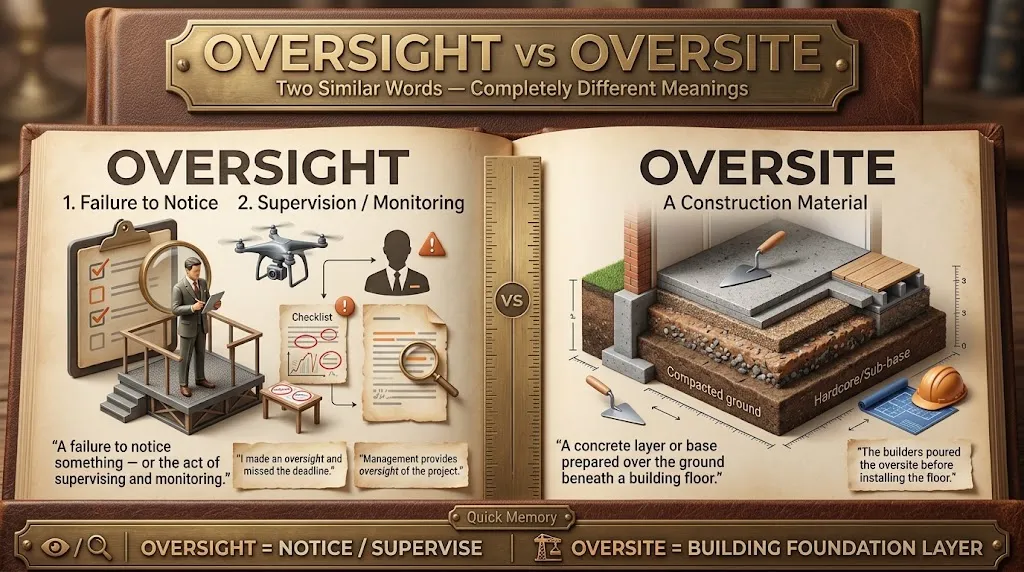
Here’s the short version: “oversight” is the word you almost always want. It means supervision, or a mistake made by accident. “Oversite” is a narrow, mostly-British construction term for a layer of concrete laid under a floor. They are not interchangeable, and one of them you’ll use maybe once in your life unless you work in construction.
Let’s settle this properly — with real definitions, real etymology, and enough examples that you’ll never have to second-guess yourself again.
What Does “Oversight” Mean?
Oversight is a noun with two distinct — almost opposite — meanings that have coexisted in English for centuries.
1. Supervision or management (watchful care)
This is oversight as responsibility. Merriam-Webster’s primary definition is <cite index=”17-1″>watchful and responsible care, alongside regulatory supervision</cite>. You’ll see this sense constantly in government, corporate governance, and project management:
- The Senate committee provides oversight of federal spending.
- Regulatory oversight of the banking sector tightened after the crisis.
2. An accidental mistake or omission
This is oversight as error — something missed, not on purpose. Merriam-Webster also lists <cite index=”17-1″>an inadvertent omission or error</cite> as a core meaning, and Dictionary.com frames it as a mistake made specifically <cite index=”24-1″>when you’re not paying full attention</cite>.
- Leaving her name off the invite list was a simple oversight.
- The missing signature was an oversight, not an attempt to avoid the contract.
- If a person or committee “has oversight of” something, it’s meaning #1. If something “was an oversight,” it’s meaning #2.
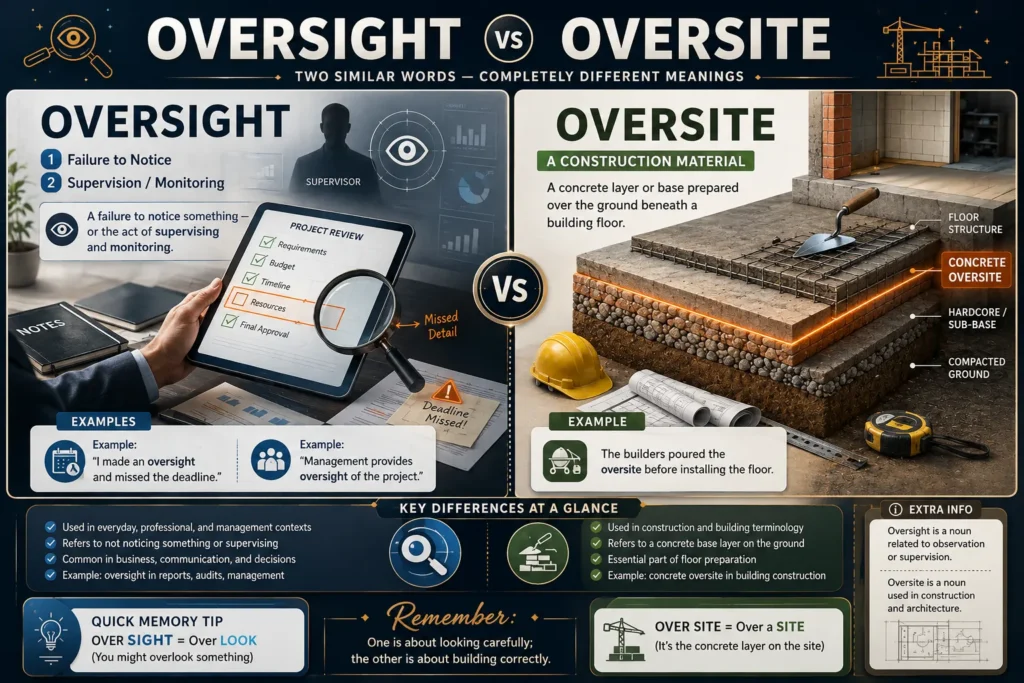
What Does “Oversite” Mean?
Oversite is a real word — it’s just not a synonym for “oversight,” and it belongs almost entirely to one industry: construction.
Its jobs are to level the ground, block rising damp, and give workers a stable surface to build on. In the trade it’s also called blinding concrete or lean-mix concrete, and it’s typically <cite index=”27-1″>poured directly onto prepared ground or hardcore before the main structural elements are installed, usually ranging from about 50mm to 100mm thick</cite>.
- The crew poured the oversite concrete before laying the damp-proof membrane.
- Building regs require a minimum thickness for the oversite on ground-bearing slabs.
Oversight vs Oversite: Quick Answer Table
| Oversight | Oversite | |
| Meaning | Supervision/management, or an accidental mistake | A concrete/hardcore layer laid on prepared ground before flooring |
| Word class | Noun | Noun (technical term) |
| Field | Everyday English, business, government, law | Construction, architecture, civil engineering |
| Frequency | Very common | Rare — niche jargon |
| Correct in general writing? | Yes, always | Almost never — use “oversight” instead |
| Also called | — | Blinding concrete, lean-mix concrete, concrete oversite |
If you’re not writing about a building’s foundation, the word you need is oversight. That covers roughly 99% of cases where this mix-up happens.
Origin and Etymology of “Oversight”
“Oversight” descends from the Old English verb oferseon — literally “to look down upon, keep watch over, survey” — built from ofer (“over”) and seon (“to see”). <cite index=”19-1″>The sense “to supervise, to superintend” is attested from the mid-1400s</cite>. Crucially, the verb “oversee” always carried a subtle double meaning: to watch closely, but also — by extension — to look past or over something and fail to catch it. <cite index=”19-1″>That double sense didn’t fully survive in the verb “oversee,” but it survives in the noun “oversight.”</cite>
<cite index=”22-1″>The Oxford English Dictionary’s earliest recorded use of the noun “oversight” dates to before 1400, appearing in Cursor Mundi, a 14th-century Northumbrian poem</cite> — meaning this word has been doing double duty in English for over 600 years. It’s not a modern coincidence; it’s baked into the word’s DNA.
Origin and History of “Oversite” in Construction
This term isn’t a typo that became accepted; it has real construction history. According to a UK construction glossary, once <cite index=”31-1″>Portland cement went into continuous production toward the end of the 19th century, it became practical to cover a building site with a layer of concrete as a solid, level base for floors and a barrier against rising damp</cite>. By the early 1900s this had become standard practice, <cite index=”31-1″>with a roughly 100mm concrete oversite becoming the accepted norm</cite>. Post-WWII timber shortages pushed the practice further, as <cite index=”31-1″>raised timber ground floors were largely abandoned in favor of solid, ground-supported floors laid directly on the concrete oversite</cite>.
Oversight vs Oversite: Side-by-Side Examples
| Sentence | Correct word | Why |
| The board exercises ______ over all major purchases. | oversight | Supervision |
| Forgetting the attachment was an honest ______. | oversight | Mistake/omission |
| Workers laid the ______ concrete before the slab. | oversite | Construction layer |
| Congress increased ______ of the agency’s spending. | oversight | Regulatory supervision |
| The architect specified 75mm of ______ under the ground floor. | oversite | Construction layer |
| It was pure ______ that the deadline was missed. | oversight | Mistake |
Pronunciation and Word Forms
- Oversight: /ˈoʊ.vərˌsaɪt/ — OH-ver-syte (rhymes with “sight,” not “site” the way people assume — they’re actually homophones, which is exactly why the confusion exists)
- Oversite: pronounced identically to “oversight” — OH-ver-syte
- Plural of oversight: oversights (e.g., “several oversights in the audit”)
- Related verb: oversee (not “to oversight” — that usage is nonstandard)
- Related adjective: none standard; “overseeing” is used adjectivally
Is “Oversite” a Real Word?
Yes — but with two important caveats:
- It’s a legitimate, established term in construction and civil engineering, particularly in British English. It’s not slang and not an error within that field.
- Outside construction, if you write “oversite” when you mean supervision or a mistake, it is simply incorrect — a misspelling of “oversight,” not a valid alternate spelling.
So “is oversite a word” has a context-dependent answer, and that’s exactly why the confusion persists: the word is real, just extremely narrow.
Common Mistakes and How to Avoid Them
- Writing “oversite” for a business or legal error. “That was a bad oversite on the report” → should be oversight. Autocorrect won’t always catch this because both words exist.
- Writing “oversight” for the construction layer. “The oversight concrete needs to cure for 48 hours” → should be oversite concrete. Rare, but it happens in technical writing done by non-specialists.
- Assuming “oversite” is always wrong. It isn’t — it’s just field-specific. Calling it a flat-out misspelling in every context (as some guides do) is itself inaccurate.
- Mishearing in speech. The two words are near-homophones, which is why the error shows up far more often in transcribed or dictated text than in careful, typed writing.
Simple Memory Tricks to Remember the Difference
Oversight → “sight” — think of watching something with your eyes: supervision, or something you failed to see.
Oversite → “site” — think of a construction site: land, ground, buildings.
If your sentence has nothing to do with land, buildings, or concrete, you want “oversight.” No exceptions.
Synonyms for Oversight
Because oversight carries two meanings, its synonyms split accordingly:
For supervision/management: <cite index=”21-1″>supervision, management, stewardship</cite>, monitoring, governance, control, administration, review
For a mistake/omission: <cite index=”21-1″>negligence, an unintentional departure from accuracy</cite>, error, lapse, slip, omission
Synonyms and Related Terms for Oversite
- Blinding concrete
- Lean-mix concrete
- Sub-base
- Ground-bearing layer
- Foundation layer
- Concrete oversite
These are all specific to construction contexts, since “oversite” has no general-English synonyms.
Oversight vs Oversee vs Overlook
- Oversight (noun) — the supervision itself, or the mistake. “She has oversight of the team.”
- Oversee (verb) — the action of supervising. “She oversees the team.”
- Overlook (verb) — usually means to fail to notice something, though it can also mean “to have a view over” (as in “the balcony overlooks the garden”). Interestingly, “overlook” carries the same double-meaning quirk as “oversight” — both a helping and a failing sense trace back to the same “look over” root.
Quick rule: if you need a verb, it’s oversee (never “oversight” as a verb, despite occasional informal use — it’s nonstandard). If you need the noun for the act or the mistake, it’s oversight.
British English vs American English Usage
- Oversight: used identically in both British and American English — no regional divide.
- Oversite: overwhelmingly a British term. It shows up regularly in UK building regulations and construction documentation. American technical writing tends to favor “sub-base” or “blinding layer” instead, so US readers are far less likely to encounter “oversite” at all.
Which Word Should You Use in a Sentence?
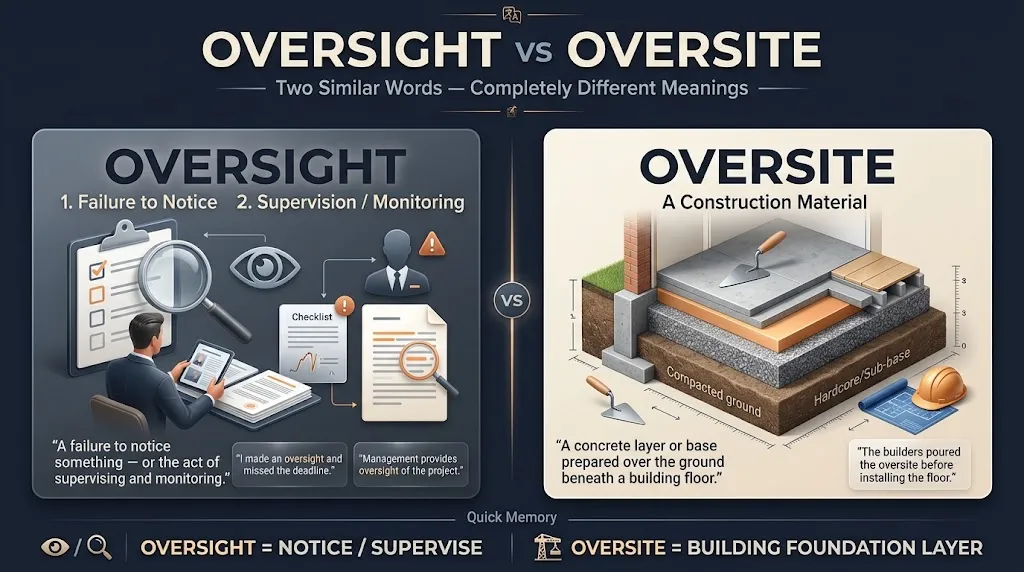
- Writing about supervision, management, or governance? → oversight
- Writing about an accidental mistake or something missed? → oversight
- Writing about a concrete layer under a building’s floor? → oversite
- Not sure, and not writing about construction? → oversight — it’s correct roughly 99% of the time
Explore More: https://namenesty.com/nty-meaning-in-text/
People Also Ask
Outside of construction, yes — treat it as an error. Inside construction and civil engineering, “oversite” is a correct, standalone technical term with its own distinct meaning, so it depends entirely on the field you’re writing in.
Both are pronounced almost identically — roughly “OH-ver-syte.” The written spelling is what carries the meaning, not the sound, which is exactly why this confusion is so common in speech-to-text and quick typing.
It’s a thin layer (typically 50–100mm) of concrete or hardcore laid over prepared ground before a floor slab is installed. It levels the ground, blocks rising damp, and provides a stable working surface for the rest of the build.
No. The standard verb is “oversee” (“she oversees the project”). “Oversight” is a noun only; using it as a verb is nonstandard, even though it occasionally appears that way informally.
Oversights — used for multiple instances of either supervision or mistakes. “Oversite” is rarely pluralized since it typically refers to a single continuous layer rather than a countable object.
Oversight, essentially always. Reserve “oversite” strictly for construction and engineering documentation, and only if your audience will recognize the technical term.
Mainly British. It appears far more often in UK construction and building-regulations documents than in American technical writing, where terms like “sub-base” or “blinding layer” are sometimes preferred instead.
They’re not fully unrelated — both ultimately involve the idea of something laid “over” something else (over + sight, over + site). But they evolved through completely different paths: one from Old English “to see over,” the other from modern construction jargon meaning literally “over the building site.”
Conclusion
“Oversight” and “oversite” aren’t variant spellings of the same idea — they’re two unrelated words that happen to sound alike. Oversight covers supervision and honest mistakes, and it’s the word you need in virtually every business, legal, academic, or everyday context. Oversite is a real but narrow construction term for the concrete layer beneath a floor, and outside that field, it’s simply the wrong word. When in doubt, default to oversight — you’ll be right almost every time.