Another Word for Understand: 75+ Synonyms, Meanings & Examples
Looking for another word for understand that sounds more natural, professional, or precise? Whether you’re writing an academic essay, composing a business email, or expressing empathy in a conversation, the right synonym can make all the difference. Words like comprehend, grasp, appreciate, and recognize offer useful alternatives, but each carries a slightly different meaning. Choosing the wrong one can make your sentence sound awkward or change your intended message. In this guide, you’ll discover 75+ synonyms for understand, explore their meanings, compare formal and informal alternatives, and learn how to use each word correctly in real-life sentences.
Finding another word for understand can make your writing clearer, more natural, and more precise. Whether you are writing an academic essay, replying to a professional email, explaining an idea, or showing empathy toward someone, the best synonym depends on what you actually mean.
The most useful alternatives include comprehend, grasp, follow, appreciate, recognize, realize, perceive, fathom, interpret, and get. Each has a slightly different meaning, so choosing the right one matters more than using a sophisticated word.
In this guide, you will discover synonyms organized by context, simple definitions, real-world examples, common mistakes, and practical ways to choose the right word.
1. What Is Another Word for Understand? (Best Synonyms at a Glance)
The best synonym for understand depends on whether you mean knowing information, following an explanation, recognizing a fact, or relating to someone’s feelings.
Here are ten useful alternatives to start with.
| Synonym | Meaning | Example |
| Comprehend | Understand information mentally | She comprehended the lesson. |
| Grasp | Understand the main idea | He grasped the concept quickly. |
| Follow | Understand an explanation or process | I follow your reasoning. |
| Appreciate | Recognize importance or significance | We appreciate the risks involved. |
| Realize | Become aware of a fact | I realized my mistake. |
| Recognize | Identify or acknowledge something | She recognized the pattern. |
| Perceive | Become aware of something | He perceived a change in tone. |
| Fathom | Understand something difficult | I cannot fathom the decision. |
| Interpret | Explain or determine meaning | They interpreted the results differently. |
| Get | Understand in everyday conversation | I get what you mean. |
Best quick choices: Use comprehend for formal writing, grasp for an idea, follow for an explanation, appreciate for significance, and get for casual conversation.
Remember that these words are related, not perfectly interchangeable. The sentence determines which one fits.
2. 15 Common Synonyms for Understand With Meanings
If you need a quick vocabulary list, these 15 alternatives cover many everyday, academic, and professional situations.
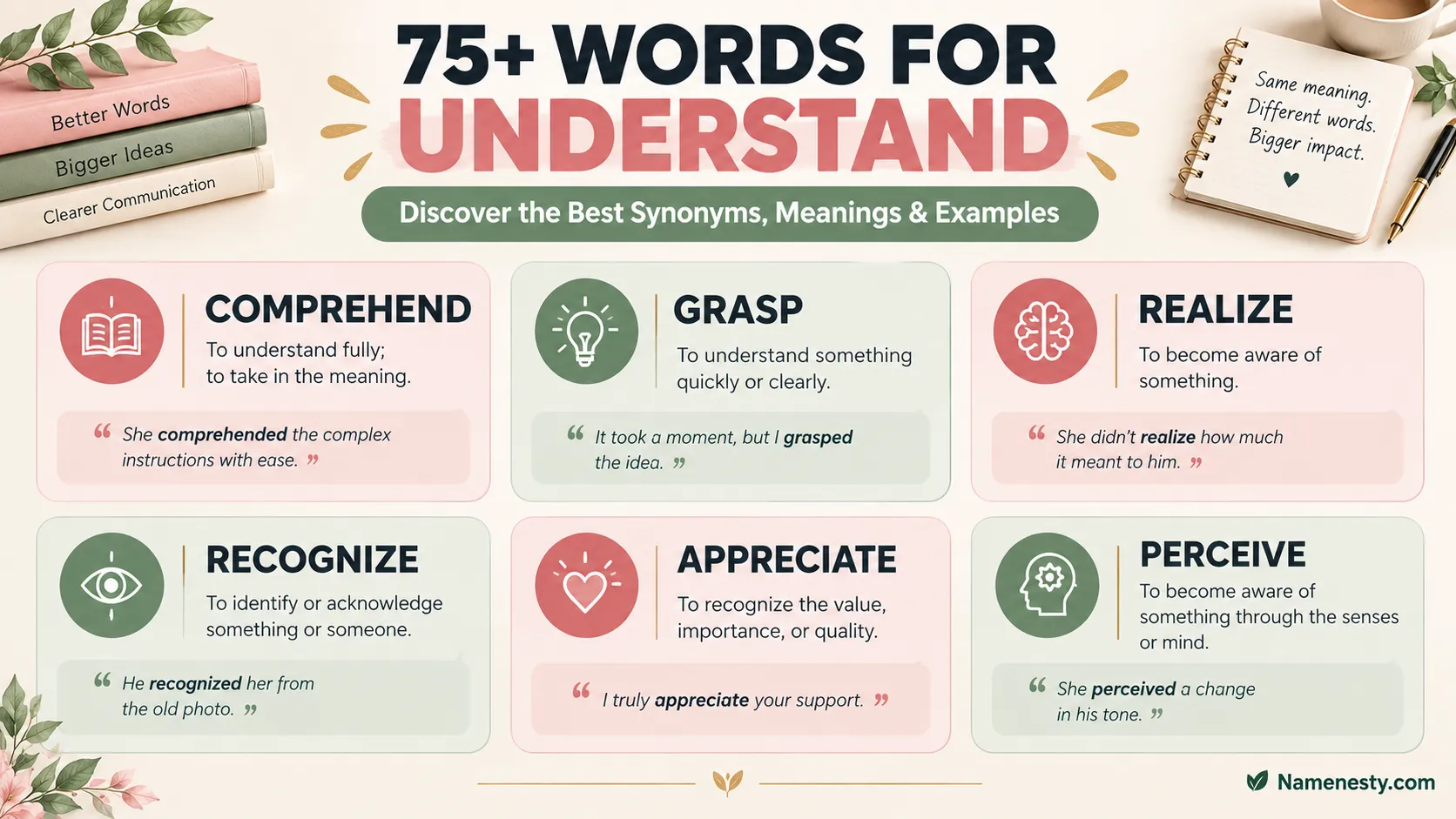
- Comprehend — understand information or an idea.
- Grasp — understand the essential point.
- Follow — understand a speaker’s reasoning or instructions.
- Appreciate — recognize importance, difficulty, or significance.
- Realize — become conscious of a fact.
- Recognize — identify or acknowledge something.
- Perceive — become aware of something through thought or observation.
- Fathom — understand something complicated or puzzling.
- Interpret — determine or explain the meaning of something.
- Discern — notice or distinguish something that may not be obvious.
- Get — understand, especially in informal conversation.
- Figure out — discover an answer through thought or effort.
- Make sense of — understand confusing information.
- Take in — absorb or process information.
- Relate to — understand or connect with someone’s experience.
Examples in natural sentences
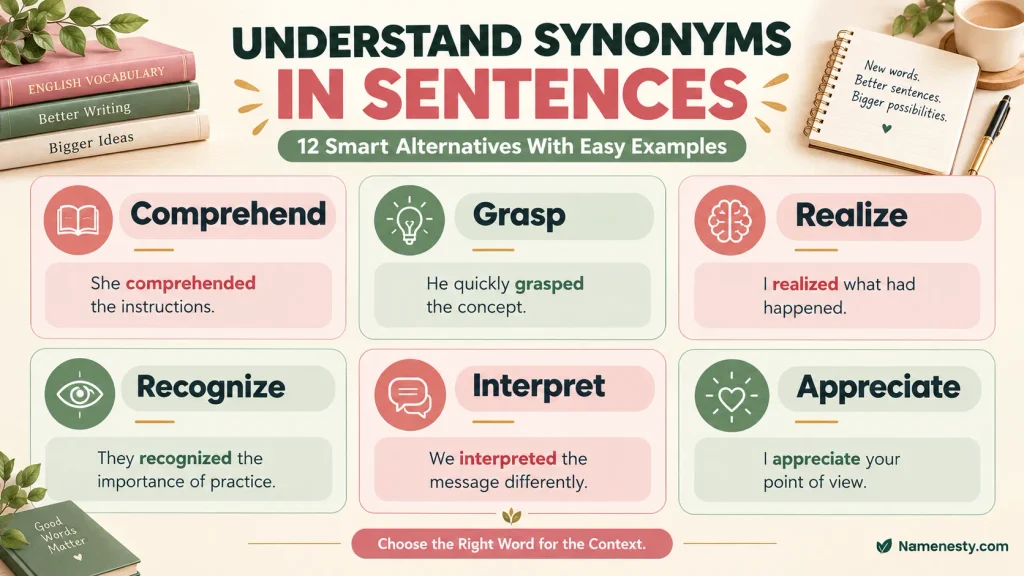
- “I comprehend the principles behind the theory.”
- “She quickly grasped the main idea.”
- “I can follow your argument.”
- “We appreciate how serious this issue is.”
- “He finally realized what had happened.”
- “I cannot fathom why they refused.”
- “Let’s make sense of these results together.”
- “I can relate to what you’re going through.”
For everyday writing, understand remains an excellent choice. Replace it only when another word expresses your intended meaning more accurately.
3. Formal Words for Understand in Professional and Academic Writing
Formal synonyms can strengthen essays, reports, presentations, and business correspondence. However, a formal word should improve precision rather than make the sentence unnecessarily complicated.
| Formal alternative | Best use | Example |
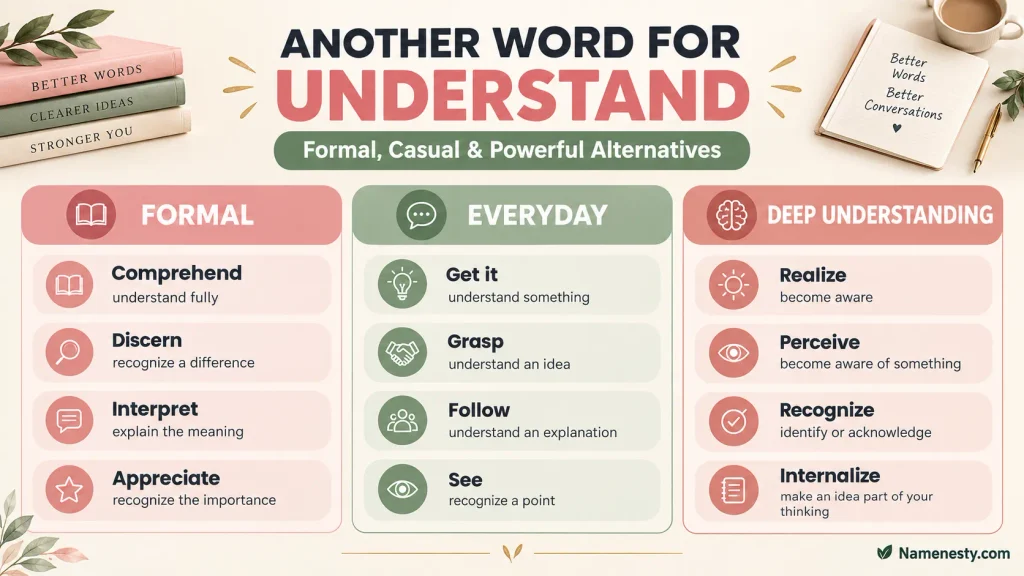
| Comprehend | Complex information | Students must comprehend the underlying theory. |
| Appreciate | Importance or seriousness | The management team appreciates the potential risks. |
| Discern | Subtle differences or patterns | Researchers discerned a trend in the findings. |
| Interpret | Meaning of evidence or information | The analyst interpreted the results cautiously. |
| Recognize | Acknowledging a fact or limitation | The report recognizes several limitations. |
| Perceive | Awareness or impression | Customers perceive the service as reliable. |
| Ascertain | Establishing something through investigation | The investigation sought to ascertain the cause. |
| Deduce | Concluding reasoning | We can deduce the likely outcome from the evidence. |
| Acknowledge | Recognizing a fact or concern | The author acknowledges the potential limitations. |
| Identify | Establishing what something is | The review identified the main problem. |
Which formal synonym should you choose?
- For a difficult theory, choose comprehend.
- For the significance of a decision, choose appreciate.
- For interpreting evidence, choose interpret.
- For spotting subtle differences, choose discern.
- For recognizing a concern, choose acknowledge.
- For determining the cause of a problem, choose ascertain.
Writing tip: Do not replace understand with ascertain when you simply mean knowing something. Ascertain suggests finding out or establishing information, usually through investigation.
4. Informal Synonyms for Understand in Everyday English
In conversations, text messages, dialogue, and casual emails, simple expressions often sound more natural than formal vocabulary.
| Informal alternative | Meaning | Example |
| Get | Understand something | I get what you’re saying. |
| See | Understand a point | I see what you mean now. |
| Catch on | Learn or understand gradually | She caught on after a few examples. |
| Figure out | Find an answer | I figured out how the tool works. |
| Make out | Understand something unclear | I couldn’t make out his words. |
| Take in | Absorb information | It was a lot to take in. |
| Get the picture | Understand the overall situation | Now I get the picture. |
| Get the point | Understand the main message | I get the point you’re making. |
| Follow along | Keep up with an explanation | I can follow along with the tutorial. |
| Wrap your head around | Understand something complicated | I’m trying to wrap my head around the new rules. |
Examples for everyday conversation
Instead of saying, “I understand your explanation,” you could say:
- “I get it now.”
- “Okay, I see what you mean.”
- “That makes sense.”
- “I’m following you.”
- “I think I’ve got the picture.”
- “Give me a minute to process that.”
These expressions work especially well in dialogue, social posts, messages, and informal discussions. In a formal report, however, comprehend, interpret, or understand may be more appropriate.
5. Another Word for Understand in Different Contexts
A synonym that works in one sentence may sound awkward in another. The most reliable approach is to identify the kind of understanding you want to express.
| Context | Recommended word or phrase | Example |
| Understanding an idea | Grasp | She grasped the central concept. |
| Understanding a lesson | Comprehend | The class comprehended the material. |
| Following a discussion | Follow | I follow your argument. |
| Understanding importance | Appreciate | They appreciate the consequences. |
| Becoming aware | Realize | He realized the deadline had changed. |
| Identifying a pattern | Recognize | We recognized the recurring problem. |
| Understanding a mystery | Fathom | Nobody could fathom the strange result. |
| Understanding someone’s feelings | Empathize with | I empathize with people in that situation. |
| Solving a problem | Figure out | She figured out the solution. |
| Understanding unclear information | Make sense of | We made sense of the confusing instructions. |
| Understanding a document | Interpret | The lawyer interpreted the clause. |
| Following instructions | Follow | Please follow the safety procedure. |
Why context matters
Consider these two sentences:
- “I understand the risks.”
- “I appreciate the risks.”
The first communicates knowledge of the risks. The second emphasizes awareness of their importance or seriousness.
Both sentences can be correct, but they do not communicate the same thing. This distinction is particularly useful in professional writing, where precision matters.
6. Synonyms for Understanding Someone’s Feelings and Emotions
When you want to express emotional understanding, a purely intellectual synonym may not communicate enough. Words related to empathy, compassion, and personal connection are often more appropriate.
| Word or phrase | Emotional meaning | Example |
| Empathize with | Imagine or share another person’s feelings | I empathize with what you’re experiencing. |
| Relate to | Connect with a similar experience | I can relate to your struggles. |
| Sympathize with | Feel concern or compassion | We sympathize with the affected families. |
| Appreciate | Recognize someone’s difficulty or perspective | I appreciate how difficult this decision is. |
| See where someone is coming from | Understand their perspective | I see where you’re coming from. |
| Be sensitive to | Recognize another person’s feelings or needs | Good managers are sensitive to employees’ concerns. |
| Acknowledge | Recognize someone’s feelings or concerns | I acknowledge your frustration. |
| Identify with | Feel a strong personal connection | Many readers identify with her story. |
| Respect | Treat another person’s perspective seriously | I respect your point of view. |
| Listen to | Pay attention to what someone communicates | I’m listening to your concerns. |
Understanding versus empathizing
Understanding someone’s situation does not always mean experiencing the same emotions.
For example:
- “I understand why you’re upset” communicates recognition of the reason.
- “I empathize with how you’re feeling” emphasizes emotional connection.
- “I sympathize with your situation” expresses concern or compassion.
- “I respect your perspective” communicates consideration without necessarily agreeing.
These distinctions are useful in personal relationships, workplace conversations, customer support, and sensitive messages.
7. Another Word for “I Understand” in Emails and Conversations
Sometimes the search is not for a synonym of understand but for a more natural way to respond to another person.
The right phrase depends on whether you are acknowledging instructions, expressing empathy, confirming agreement, or asking for clarification.
| Situation | Alternative expression | Example |
| Professional acknowledgment | Understood | Understood. I’ll send the revised file today. |
| Confirming instructions | That’s clear | That’s clear; I’ll follow the updated process. |
| Casual conversation | Got it | Got it! I’ll meet you at six. |
| Following an explanation | I follow | I follow your reasoning. |
| Showing empathy | I hear you | I hear you, and I recognize your concerns. |
| Recognizing a valid point | That’s a fair point | That’s a fair point; let’s review the proposal. |
| Confirming agreement | We’re on the same page | We’re on the same page about the timeline. |
| Acknowledging concerns | I understand your concern | I understand your concern and will look into it. |
| Requesting clarification | Let me make sure I understand | Let me make sure I understand your main point. |
| Confirming receipt | I’ve taken note of that | I’ve taken note of the updated requirements. |
Professional email example
Instead of a brief, potentially vague reply:
Subject: Project Timeline
Understood. I’ll update the project timeline to reflect the revised deadline and share the updated version by Thursday.
Copy reply
This version works because it confirms understanding and clarifies the next action. In professional communication, demonstrating what you understood is often more useful than merely saying “I understand.”
8. Powerful Words for Fully Understanding Something
If you want to express complete understanding, choose a phrase that reflects the depth of your knowledge. Not every alternative means the same thing as fully understand.
| Word or phrase | What it communicates | Example |
| Comprehend fully | Understand all important aspects | She comprehended the argument fully. |
| Grasp completely | Understand the essential idea | He grasped the concept completely. |
| Master | Develop a high level of skill or knowledge | She mastered the technique through practice. |
| Have a thorough understanding of | Possess detailed knowledge | He has a thorough understanding of the subject. |
| Know inside out | Know something extremely well; informal | She knows the software inside out. |
| Be well-versed in | Have extensive knowledge of a subject | He is well-versed in financial analysis. |
| Internalize | Absorb an idea or principle deeply | Students internalized the central lesson. |
| Get to the bottom of | Discover the underlying cause | We need to get to the bottom of this issue. |
| See the full picture | Understand the wider situation | The additional data helped us see the full picture. |
| Have a firm grasp of | Understand a subject confidently | She has a firm grasp of the fundamentals. |
Is “master” another word for “fully understand”?
Sometimes, but not always. Master usually implies strong command of a subject or skill, often developed through practice. You can understand the basic principles of a language without mastering it.
- Explore More: https://namenesty.com/consider-synonym/
Similarly, internalize suggests that an idea has been absorbed deeply enough to influence your thinking or behavior.
Choose the phrase that matches the level of knowledge you want to communicate.
9. Academic Synonyms for Understand in Essays and Research Papers
Academic writing benefits from precise verbs that describe what a writer, student, researcher, or reader actually does.
| Intended meaning | Useful academic verb | Example |
| Understand a concept | Comprehend | Students must comprehend the theoretical framework. |
| Explain the meaning of evidence | Interpret | The researchers interpreted the results cautiously. |
| Examine an issue carefully | Analyze | The study analyzes the causes of the decline. |
| Judge significance or quality | Evaluate | The paper evaluates the proposed method. |
| Consider importance | Appreciate | Readers should appreciate the limitations of the model. |
| Identify a pattern | Discern | The analysis discerns a pattern across the samples. |
| Conclude reasoning | Deduce | We can deduce a possible explanation from these findings. |
| Establish a cause | Determine | The experiment determined the most likely cause. |
| Recognize a limitation | Acknowledge | The authors acknowledge the study’s limitations. |
| Assess the meaning of results | Assess | The report assesses the implications of the findings. |
Improve an academic sentence.
Original: “This paper helps readers understand the impact of climate change on coastal communities.”
Possible revision: “This paper examines the impact of climate change on coastal communities.”
Why it works: Examines tells readers what the paper does. It is not merely a more formal synonym; it describes the academic action more precisely.
Another example:
Original: “The researchers understood the results.”
More precise: “The researchers interpreted the results in light of previous studies.”
The second sentence provides additional information about how the researchers made sense of the findings.
Academic writing rule: Prefer verbs such as analyze, evaluate, interpret, and assess when they describe a specific intellectual action. Use understand or comprehend when understanding itself is the intended meaning.
10. Another Word for Understand in a Sentence: Examples
The best way to learn synonyms is to see how they work in complete sentences. The examples below demonstrate alternatives for school, work, relationships, and everyday situations.
1. Understand a difficult idea
Original: “It took me a while to understand the theory.”
Alternative: “It took me a while to grasp the theory.”
Natural
2. Understand an explanation
Original: “I understand your argument.”
Alternative: “I follow your argument.”
Natural
3. Understand a person’s feelings
Original: “I understand what you’re going through.”
Alternative: “I can relate to what you’re going through.”
Contextual
4. Understand a serious situation
Original: “We understand the risks.”
Alternative: “We appreciate the risks involved.”
Contextual
5. Understand a confusing report
Original: “I cannot understand these figures.”
Alternative: “I cannot make sense of these figures.”
Natural
More sentence examples
6. The children quickly caught on to the rules of the game.
7. I finally figured out why the application kept crashing.
8. She could not fathom his decision to leave without explaining.
9. The team recognized the importance of early planning.
10. We need to interpret the findings carefully.
11. He realized that he had misunderstood the instructions.
12. I can see why you prefer the first option.
13. It took several readings to comprehend the passage.
14. The manager acknowledged the employees’ concerns.
15. After the demonstration, everyone had a better grasp of the process.
Notice that these examples do not simply replace one word with another. They also adjust the sentence to preserve natural English.
11. Alternative Phrases for Understanding That Sound More Natural
A phrase can sometimes express understanding more clearly than a single word. These expressions are especially useful when you want your writing to sound conversational, professional, or supportive.
| Alternative phrase | Best situation | Example |
| Make sense of | Confusing information | I’m trying to make sense of the instructions. |
| Wrap your head around | A complicated idea; informal | It took time to wrap my head around the new system. |
| Get your head around | A challenging concept; informal | She’s getting her head around the new requirements. |
| See the point of | Understanding a purpose or reason | I can see the point of this exercise. |
| Be clear on | Confirming details | Are we clear on the deadline? |
| Be aware of | Knowing a fact or risk | Everyone should be aware of the potential risks. |
| Have a grasp of | Understanding a subject | He has a solid grasp of the fundamentals. |
| Be on the same page | Shared understanding | Let’s make sure we’re on the same page. |
| See eye to eye | Agreement or shared views | We don’t always see eye to eye, but we respect each other. |
| Get the hang of | Learning how to do something | You’ll get the hang of the software soon. |
| Put two and two together | Infer a conclusion from clues | She put two and two together and solved the mystery. |
| Connect the dots | Recognize how separate facts relate | The report helped us connect the dots. |
| See where someone is coming from | Understand another perspective | I see where you’re coming from. |
| Take something on board | Consider and absorb information | I’ll take your feedback on board. |
| Read between the lines | Infer an unstated meaning | You need to read between the lines. |
Which phrases should you use?
Choose “make sense of” when information is confusing, “get the hang of” when someone is learning a skill, and “be on the same page” when people need a shared understanding.
For formal documents, avoid overusing idioms such as “wrap your head around.” In reports and academic papers, straightforward language is generally clearer.
12. Understand vs. Comprehend vs. Grasp: Key Differences
Although understand, comprehend, and grasp are closely related, they have different tones and common uses.
| Feature | Understand | Comprehend | Grasp |
| Main meaning | Know the meaning or reason | Mentally process information | Capture the essential idea |
| Tone | Neutral and versatile | More formal | Direct and expressive |
| Common use | Everyday and professional writing | Academic and complex material | Concepts, ideas, and principles |
| Example | I understand the rules. | I comprehend the theory. | I grasp the main idea. |
| Best quality | Natural in most situations | Formal precision | Emphasizes the central point |
What is the difference between “understand” and “comprehend”?
Understand is the more versatile everyday word. Comprehend often sounds more formal and is particularly useful when discussing complex ideas, information, or explanations.
What is the difference between “understand” and “grasp”?
Grasp often emphasizes successfully capturing the essential idea. It can suggest a quick or clear understanding, although the word does not necessarily mean the understanding happened instantly.
What is the difference between “understand” and “appreciate”?
Appreciate can mean recognizing the importance, seriousness, or value of something. It may communicate more awareness of significance than the neutral word understand.
Example:
- “I understand the deadline.” — I know what the deadline is.
- “I appreciate the urgency.” — I recognize why the matter needs prompt attention.
The best word is the one that preserves your intended meaning, not necessarily the one that sounds most sophisticated.
13. Common Synonym Mistakes to Avoid When Using Understand
Not every related word can replace understand in every sentence. Some alternatives introduce a different meaning, while others require different grammar.
| Incorrect or awkward usage | Better alternative | Explanation |
| I comprehend you. | I understand you. | Comprehend is generally more natural with ideas or information. |
| I realized the instructions. | I understood the instructions. | Realize means becoming aware of something. |
| She empathized the situation. | She empathized with the situation. | Empathize normally takes with. |
| I am understanding the lesson. | I understand the lesson. | Understand is normally used as a stative verb. |
| I fathom the simple joke. | I get the joke. | Fathom often suits something puzzling or difficult. |
| I appreciate the equation. | I understand the equation. | Appreciate may imply recognizing value rather than simply knowing the meaning. |
| I mastered the instructions. | I understood the instructions. | Mastered suggests developing strong command or skill. |
| I assumed what you meant. | I understood what you meant. | Assume means accepting something as true without necessarily verifying it. |
| I interpreted the person. | I understood the person. | Interpret usually requires a particular action, meaning, behavior, or statement to interpret. |
| I sympathize your feelings. | I sympathize with your feelings. | Sympathize commonly takes with. |
A simple rule for better word choice
Before replacing understand, ask yourself three questions:
- Does the alternative preserve the original meaning?
- Does it fit the grammar of the sentence?
- Does it sound natural for the intended audience?
If the answer to any question is no, keep understand or rewrite the sentence.
14. How to Choose the Best Synonym for Understand
Choosing the right alternative becomes easier when you identify the situation, audience, and degree of understanding you want to communicate.
Use this quick selector to find a suitable word.
Find your best synonym.
Choose the context and what you mean by “understand.”
What is the context?
Formal or academic writing
Everyday conversation
Professional email or meeting
Understanding someone’s feelings
What do you want to express?
Understanding an idea or concept
Following an explanation
Recognizing importance or significance
Making sense of something confusing
Connecting with someone’s experience
RECOMMENDED WORD OR PHRASE
Comprehend / Grasp
Use “comprehend” for a formal tone and “grasp” to emphasize understanding the central idea. “Get” works well in casual conversation.
Example: She quickly grasped the main concept.
- Explore More: https://namenesty.com/regularly-captions/
Copy recommendation
Which synonyms work best on different platforms?
If you are writing for different audiences, adjust your word choice to suit the format.
| Platform or format | Recommended wording | Why it works |
| Instagram captions | Get it, see the point, relate to | Short and conversational |
| TikTok captions | Finally get it, figured it out | Direct and relatable |
| Facebook posts | Understand, appreciate, relate to | Suitable for a wide audience |
| Snapchat messages | Got it, I see, makes sense | Brief and natural |
| WhatsApp messages | Understood, got it, I follow | Easy to use in everyday communication |
| LinkedIn posts | Recognize, appreciate, comprehend | Professional when used appropriately |
| Academic papers | Comprehend, interpret, analyze | More precise for scholarly discussion |
| Business emails | Understood, acknowledge, appreciate | Clear and professional |
There is no universally best-performing synonym for social media. Engagement depends on the content, audience, timing, and context. The recommendations above are based on tone and readability, not guaranteed engagement results.
15. People Also Ask About Synonyms for Understand
Comprehend is a strong alternative for formal writing, while grasp works well for understanding an idea. Follows suits explanations, appreciate emphasizes significance, and get is natural in casual conversation.
Depending on the sentence, use comprehend, appreciate, recognize, interpret, or acknowledge. For a professional email, however, “Understood” is often clearer and more natural than a more elaborate alternative.
The simplest alternatives include get, see, know, and make sense of. For example, “I understand” can become “I get it” or “I see what you mean” in a casual conversation.
You can use comprehend fully, grasp completely, master, or have a thorough understanding of. Choose master when you mean strong command of a subject or skill, not merely knowing its meaning.:
Use empathize with, relate to, sympathize with, or see where someone is coming from. Each expression emphasizes a different aspect of emotional or personal understanding.:
Comprehend is a direct formal alternative. Depending on the sentence, interpret, analyze, assess, or recognize may communicate the intended academic action more precisely.
Conclusion: Choose the Right Word for Understand
The best alternative to understand is the word that expresses your intended meaning clearly and naturally.
- Choose comprehend for formal or complex ideas.
- Choose grasp for understanding the central point.
- Choose follow for explanations and reasoning.
- Choose appreciate for importance or significance.
- Choose realize for becoming aware of something.
- Choose empathize with for emotional understanding.
- Choose get for everyday conversation.
- Choose make sense of for confusing information.
Before selecting a synonym, consider your audience, tone, and sentence structure. A precise, familiar word is often more effective than an impressive word that changes the meaning.
Bookmark this guide for your next essay, email, vocabulary exercise, or writing project, and explore more English word meanings and synonym guides on Namenesty.com.








2 thoughts on “Another Word for Understand: 75+ Powerful Alternatives”