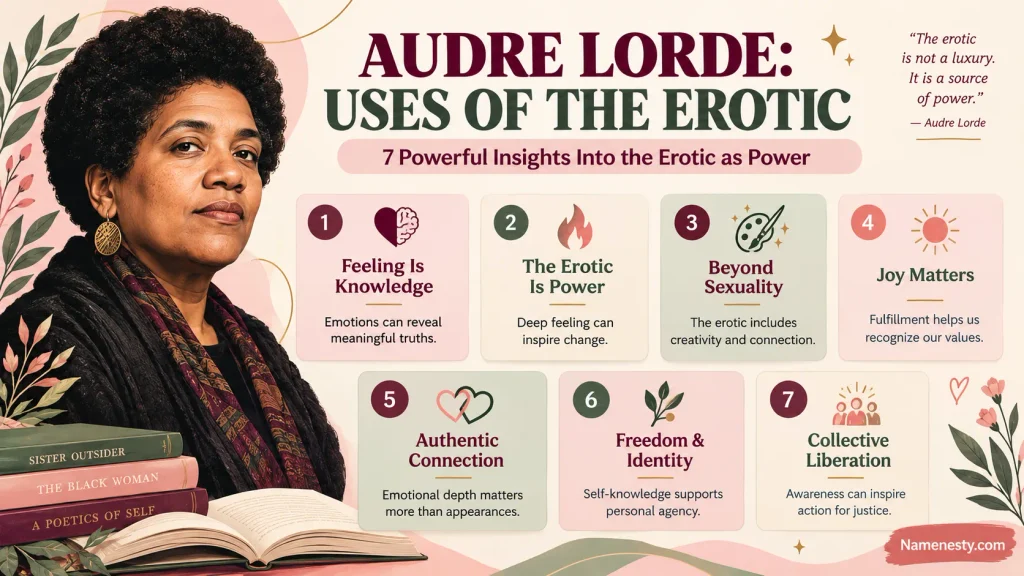
Audre Lorde’s “Uses of the Erotic”: Summary, Meaning, Analysis & 225 Inspired Captions
What if your deepest feelings were actually your greatest source of power? In Uses of the Erotic, Audre Lorde challenges everything society teaches us about pleasure, identity, creativity, and freedom. Her groundbreaking essay reveals why the erotic is far more than sexuality—it is a powerful force for self-knowledge, connection, and liberation. But what does Lorde really mean by erotic power, and why does her message still matter today? This complete guide explores seven essential insights, explains the essay’s central themes, and shares 225 original, thought-provoking captions inspired by her philosophy. Discover the deeper meaning behind her revolutionary ideas.
SEO recommendation: Use Title 1 and Meta Description 1 for the strongest alignment with the keyword’s educational search intent. Title 3 and Meta Description 2 are better suited to promoting the article’s caption collection.
What if your deepest feelings were not distractions from your power, but one of its most important sources?
That question lies at the heart of Audre Lorde’s Uses of the Erotic: The Erotic as Power, a landmark feminist essay that challenges how society understands pleasure, emotional knowledge, creativity, and liberation.
Lorde argues that the erotic is much more than sexual attraction. It is a deeply felt capacity for joy, awareness, connection, and meaningful living. When people recognize this capacity, they may become less willing to accept relationships, workplaces, and social systems that diminish their humanity.
Originally presented in 1978 and later included in Sister Outsider (1984), the essay remains important in feminist theory, literature, and conversations about identity and freedom.
In this guide, you’ll discover the essay’s meaning, central argument, major themes, historical context, and contemporary relevance. You’ll also find 225 original captions organized around its ideas, suitable for thoughtful Instagram posts, TikTok videos, Reels, Pinterest graphics, and personal reflections.
1. What Is Audre Lorde’s “Uses of the Erotic” About?
Uses of the Erotic explores how deeply felt experience can become a source of knowledge, creativity, and resistance. Lorde challenges the assumption that emotions and pleasure are less valuable than detached reasoning.
The essay is not primarily about sexual attraction. Its wider argument concerns what happens when people take their own experiences seriously and refuse to live without meaning.
15 original captions inspired by this theme
- My feelings are not distractions; they are part of my understanding.
- There is power in knowing what makes you feel alive.
- A meaningful life begins with paying attention.
- Feeling deeply does not make my voice smaller.
- I refuse to confuse emotional silence with strength.
- Some of the greatest discoveries happen within.
- My inner world deserves more than occasional attention.
- The courage to feel can become the courage to change.
- I am learning to recognize what truly nourishes me.
- A life without connection is not the freedom I seek.
- My emotional depth belongs in the conversation.
- I want a life that feels meaningful, not merely impressive.
- There is wisdom in experiences we are taught to dismiss.
- The things that move us can also move us forward.
- Real empowerment begins when we stop abandoning ourselves.
2. Who Was Audre Lorde? Her Life, Feminism, and Literary Legacy
Audre Lorde (1934–1992) was an American poet, essayist, librarian, and activist who described herself as Black, lesbian, mother, warrior, and poet. Her writing challenged racism, sexism, homophobia, and other forms of oppression.
Her work demonstrates how poetry, personal experience, and political analysis can illuminate one another. These original captions celebrate intellectual courage and self-definition without pretending to reproduce Lorde’s voice.
15 original captions about identity and courage
- My identity is not a footnote to someone else’s story.
- Every part of my experience deserves a voice.
- I will not make myself smaller to fit a narrow definition.
- Courage sometimes begins with naming who you are.
- My story contains more than one truth.
- Difference is not a weakness waiting to be corrected.
- I carry histories that deserve to be heard.
- My voice belongs wherever decisions are made.
- I can honor my roots while imagining new possibilities.
- Refusing silence is sometimes an act of creation.
- There is strength in living beyond a single label.
- My perspective matters even when it challenges tradition.
- I choose honesty over the comfort of invisibility.
- Identity is not a limitation on what I can become.
- I want my words to open doors for someone else.
3. Audre Lorde’s “Uses of the Erotic”: Complete Essay Summary
Lorde begins by examining how Western patriarchal society has discouraged women from trusting the erotic as a source of power. She then redefines the erotic as a capacity for profound feeling and satisfaction that extends into work, art, relationships, and everyday experience.
Her argument progresses toward social change: once people understand what fuller living can feel like, they gain a stronger basis for questioning deprivation, exploitation, and injustice.
15 original captions about understanding and transformation
- Awareness is the beginning, not the end, of change.
- What I recognize today can transform tomorrow.
- I am no longer willing to call emptiness success.
- The life I imagine should make room for feeling.
- Understanding myself changes what I am prepared to accept.
- Growth begins when old definitions stop fitting.
- I am questioning everything that taught me to disappear.
- A different future begins with a different standard.
- Meaning cannot be measured by productivity alone.
- I want my choices to reflect what I truly value.
- New understanding deserves new action.
- Some lessons change the way you see everything.
- I am building a life that makes room for my humanity.
- Knowledge becomes powerful when it changes our decisions.
- The future should offer more than survival.
4. What Does Audre Lorde Mean by the Erotic?
For Lorde, the erotic is a profound capacity for feeling and satisfaction, not simply a synonym for sexuality. It may be experienced through creativity, shared connection, physical awareness, intellectual discovery, or meaningful work.
The key is depth of experience. Lorde asks readers to consider how fully they participate in life rather than evaluating experiences solely by external rewards.
15 original captions about emotional depth
- I want to be present for the life I am living.
- Not every beautiful experience needs an audience.
- Some moments are valuable because we feel them fully.
- Depth will always matter more to me than display.
- I am rediscovering the beauty of paying attention.
- The ordinary becomes extraordinary when I am truly present.
- There is more to pleasure than what can be purchased.
- I trust the quiet experiences that leave me changed.
- A meaningful moment does not need to be dramatic.
- I want to create with my whole attention.
- My joy is worth understanding, not just chasing.
- Presence turns routine into possibility.
- Feeling alive is different from simply staying busy.
- I am learning the difference between excitement and fulfillment.
- The deepest experiences rarely need the loudest explanation.
5. The Erotic as Power: Audre Lorde’s Central Argument Explained
Lorde’s central insight is that deep feeling can provide information about what people value, need, and refuse to surrender. That knowledge can become a source of agency when it shapes choices and collective action.
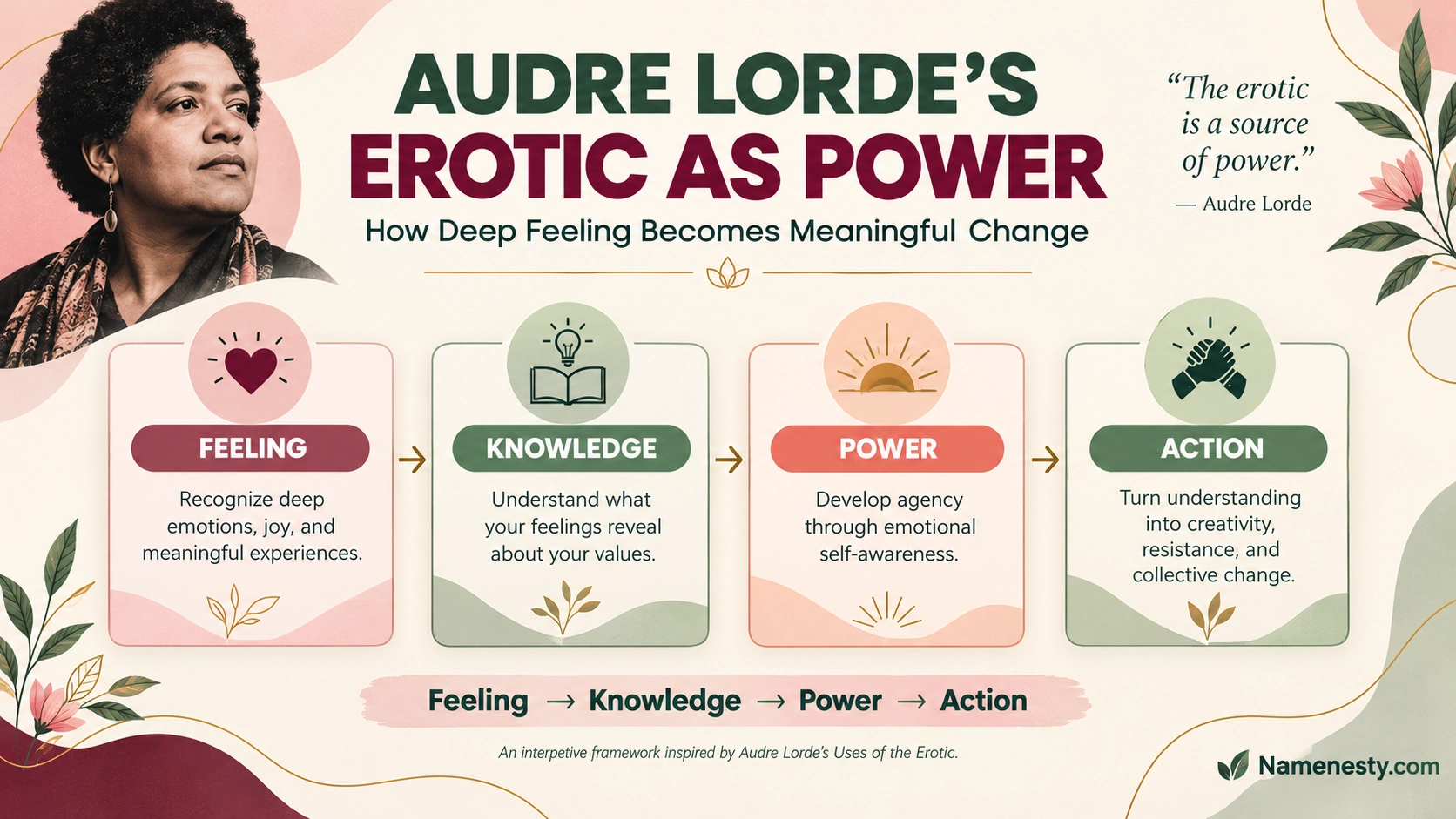
A useful interpretation of the essay follows four connected stages: feeling, knowledge, power, and action. This framework helps explain why Lorde’s argument is political rather than simply motivational.
| Stage | Meaning | Everyday illustration |
| Feeling | Recognizing a meaningful experience | Noticing genuine fulfillment |
| Knowledge | Understanding what the experience reveals | Identifying an important value |
| Power | Developing the confidence to act | Establishing a boundary |
| Action | Turning insight into change | Improving conditions with others |
15 original captions about personal power
- I do not need to disconnect from myself to become strong.
- My power grows when my choices reflect my values.
- Self-knowledge is more useful when I act on it.
- I am replacing automatic obedience with thoughtful decisions.
- Strength can begin with an uncomfortable realization.
- I know more about my needs than I once allowed myself to admit.
- I am turning awareness into meaningful movement.
- Power is not always loud; sometimes it is a clear boundary.
- I can listen inward and still work outward.
- My choices should not require the disappearance of my identity.
- The courage to question is a form of agency.
- I want power that creates possibility for others.
- I am learning to trust what experience has taught me.
- Change becomes real when conviction meets action.
- My voice is strongest when it reflects my deepest values.
6. Erotic vs. Pornographic: Understanding Audre Lorde’s Key Distinction
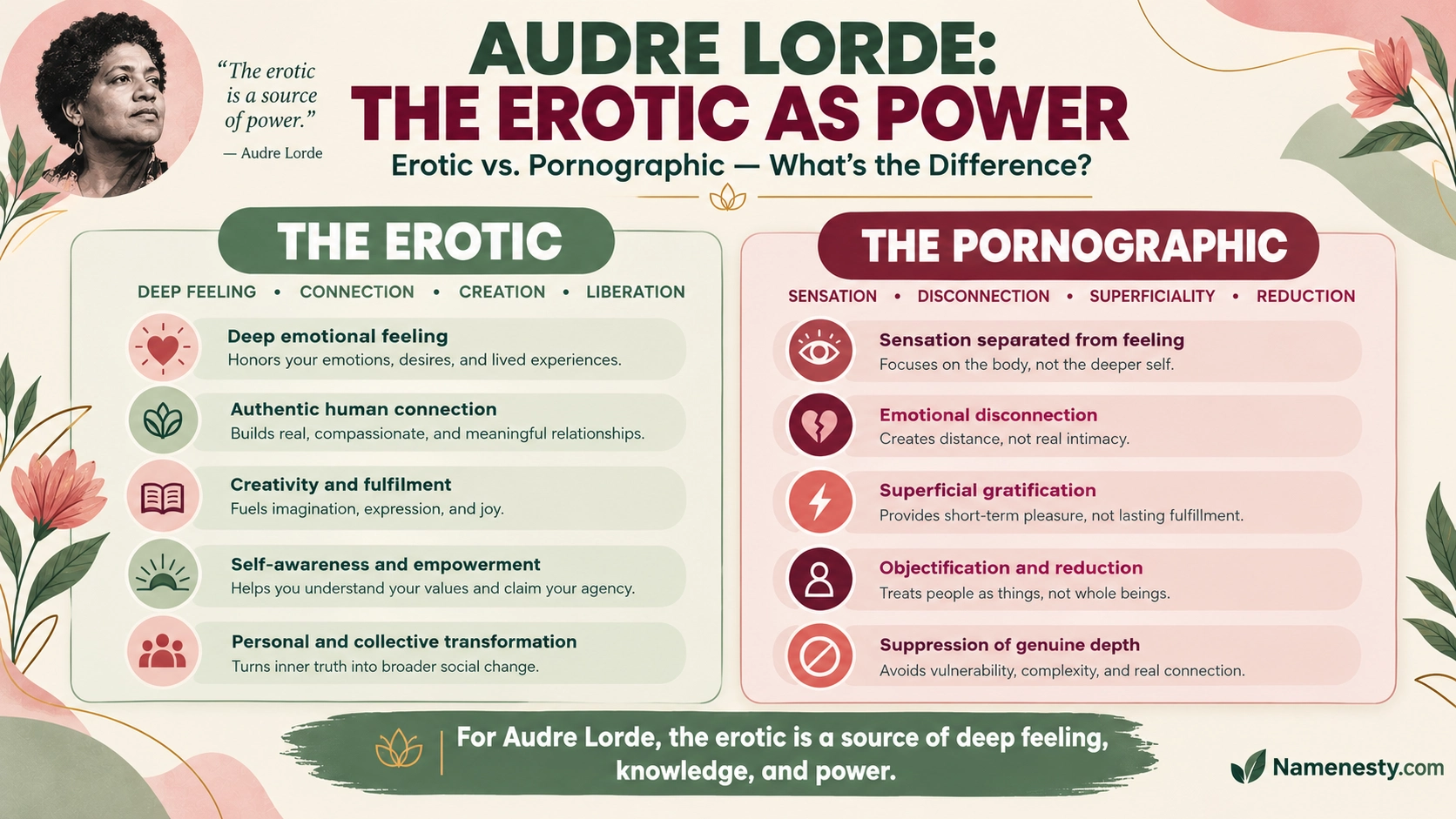
One of the most discussed arguments in Uses of the Erotic is Lorde’s distinction between the erotic and the pornographic. In her framework, the erotic involves genuine feeling and connection, whereas the pornographic represents sensation separated from emotional depth.
- Explore More: https://namenesty.com/arouse-synonym/
This is Lorde’s particular feminist critique, not an uncontested definition of pornography. Her distinction invites readers to question whether an experience supports meaningful connection or reduces people to objects of consumption.
| The erotic in Lorde’s framework | The pornographic in Lorde’s critique |
| Depth of feeling | Sensation detached from feeling |
| Meaningful connection | Emotional disconnection |
| Creative empowerment | Reduction or objectification |
| Self-knowledge | Disregard for emotional experience |
| Shared satisfaction | Superficial gratification |
15 original captions about authenticity and connection
- I choose connection that sees the whole person.
- Attention is not the same thing as intimacy.
- Real closeness requires more than being noticed.
- I want relationships where honesty has room to breathe.
- Being admired is different from being understood.
- Depth cannot be replaced by constant stimulation.
- I value the people who care about my inner world.
- Not every exciting experience is a fulfilling one.
- Genuine connection leaves space for mutual respect.
- I would rather be understood than endlessly observed.
- The best relationships make room for the complete person.
- I am choosing substance over spectacle.
- Emotional presence is something I refuse to underestimate.
- What looks impressive is not always what feels meaningful.
- Connection becomes powerful when nobody has to disappear.
7. 15 Powerful Audre Lorde–Inspired Quotes About the Erotic and Liberation
Lorde’s writing is frequently shared on Instagram, Pinterest, and other platforms. However, popular quote graphics sometimes omit context or attribute modern inspirational statements to historical writers.
The following 15 statements are original reflections inspired by themes in her essay. They are not authentic Audre Lorde quotations. Use them for educational graphics, reading reflections, or personal captions without attaching her name as the speaker.
15 original quote-style captions
- “The freedom to feel is part of the freedom to become.”
- “Joy can reveal the life we have been taught not to imagine.”
- “A powerful voice begins with an honest relationship to the self.”
- “What nourishes your humanity deserves your attention.”
- “Deep connection is not a luxury reserved for easier days.”
- “A meaningful life cannot be built entirely from expectations.”
- “The heart can raise questions that society would rather ignore.”
- “Creativity grows where experience is allowed to speak.”
- “Knowing your worth should change what you are willing to accept.”
- “The most important transformations begin beyond appearances.”
- “A feeling becomes a resource when we learn from it.”
- “Liberation asks us to imagine more than the absence of pain.”
- “Your inner life is not separate from the world you help create.”
- “Power becomes meaningful when it expands another person’s freedom.”
- “The courage to live fully can inspire the courage to resist.”
Attribution note: All 15 lines above are original Namenesty-style creative writing, not excerpts from Lorde’s essay.
8. Major Themes in “Uses of the Erotic”: Pleasure, Identity, and Freedom
Lorde connects pleasure with emotional knowledge, identity, creative energy, and political freedom. She argues that profound satisfaction can establish a standard against which people evaluate their experiences and the conditions imposed on them.
This means joy is not simply an escape from difficulty. It can help people recognize the difference between a life they have been conditioned to tolerate and one that supports their humanity.
15 original captions about joy and freedom
- Joy deserves a place in my definition of freedom.
- I am allowed to imagine a life beyond endurance.
- My happiness does not have to justify its existence.
- Freedom means more when I can recognize myself within it.
- I am learning what genuine satisfaction feels like.
- The moments that restore me are worth protecting.
- I refuse to treat meaningful pleasure as an afterthought.
- There is beauty in discovering what truly matters.
- I want a future that makes space for wonder.
- My dreams should reflect my values, not just expectations.
- I can appreciate small joys while working toward larger change.
- Pleasure and purpose do not have to compete.
- The freedom to create is part of the freedom to live.
- I am not measuring my life only by what I accomplish.
- A fuller life begins with believing more is possible.
9. How Audre Lorde Connects the Erotic to Feminism and Women’s Empowerment
Lorde’s essay challenges traditions that portray women’s emotional and sensual experiences as sources of shame, weakness, or danger. She argues that reclaiming the erotic can help women develop self-knowledge and resist forms of control.
Her argument is rooted in Black feminist thought and must not be reduced to a generic message about confidence. It concerns who is allowed to feel, speak, create, and exercise power in society.
15 original captions about empowerment and equality
- Empowerment means having a voice in the decisions that shape my life.
- I will not apologize for taking my own experience seriously.
- Equality requires more than permission to participate.
- My ambitions and my humanity belong together.
- I can be compassionate without surrendering my boundaries.
- No one should have to become invisible to be accepted.
- I celebrate women who make room for other women.
- My independence does not require emotional isolation.
- I deserve opportunities that do not demand self-erasure.
- I am more than the expectations placed upon me.
- Respect should never depend on how quietly I exist.
- A stronger community begins when every voice can be heard.
- My creativity is not something to minimize.
- I want progress that includes those historically excluded.
- Real empowerment changes possibilities, not just appearances.
10. The Role of Joy, Desire, and Emotional Knowledge in Lorde’s Philosophy
Lorde treats feeling as a source of information. When people experience deep joy, fulfillment, disappointment, or alienation, those experiences can reveal what matters to them.
This does not mean every feeling is automatically correct. Rather, feelings deserve thoughtful examination because they can identify needs, values, and conditions that abstract measures of success overlook.
15 original captions about emotional intelligence
- I am learning to listen before dismissing what I feel.
- My emotions deserve reflection, not automatic judgment.
- Some forms of clarity begin with a difficult feeling.
- I can honor my feelings without letting them make every decision.
- Understanding myself is an ongoing practice.
- I want to know why certain moments bring me peace.
- Noticing my reactions helps me recognize my values.
- Emotional awareness is a skill I am still developing.
- I am making space for feelings that do not have easy names.
- Sometimes discomfort points toward a question worth asking.
- Joy can teach me as much as disappointment.
- I am curious about the experiences that leave me fulfilled.
- There is wisdom in reflection after an intense moment.
- I can feel strongly and still think carefully.
- My inner experience is worth exploring with patience.
11. How the Erotic Challenges Racism, Patriarchy, and Capitalism
Lorde’s political argument challenges systems that suppress feeling, restrict autonomy, and separate people from meaningful work. Her critique connects individual experience to social structures rather than treating fulfillment as purely a matter of personal attitude.
In this context, the erotic becomes politically significant when awareness helps people question exploitation, discrimination, and the expectation that they should endure dehumanizing conditions.
15 original captions about justice and resistance
- A just society should make room for everyone’s humanity.
- I refuse to mistake unequal treatment for the natural order.
- Meaningful change begins when accepted limits are questioned.
- Our differences should not determine whose dignity matters.
- I want workplaces that value people beyond their output.
- Justice requires listening to experiences we have overlooked.
- Progress is incomplete when it leaves entire communities behind.
- Solidarity grows through understanding, not forced sameness.
- I can challenge unfairness without losing my compassion.
- The future deserves more than recycled inequalities.
- A person’s worth cannot be calculated from their productivity.
- I believe in change that reaches beyond individual success.
- Respect should be built into systems, not offered as a favor.
- Shared freedom requires attention to unequal conditions.
- Resistance becomes meaningful when it helps build something better.
12. Audre Lorde’s “Uses of the Erotic” in Sister Outsider: Historical Context
Lorde presented Uses of the Erotic: The Erotic as Power at the Fourth Berkshire Conference on the History of Women in 1978. The essay subsequently appeared as a pamphlet and was included in her 1984 collection Sister Outsider: Essays and Speeches.
Understanding this historical context is important. Lorde was writing amid feminist debates about sexuality, racial inequality, women’s experiences, and political organizing. Her ideas were interventions in those debates, not simply timeless motivational advice.
1978 — Conference presentation
Lorde presents her argument about the erotic as a source of power.
1984 — Sister Outsider
The essay appears in the influential collection published by Crossing Press.
Today — Continuing interpretation
The essay is studied in feminist philosophy, literary criticism, and cultural theory.
15 original captions about history and intellectual legacy
- The ideas we inherit deserve both attention and examination.
- History becomes meaningful when we ask what it teaches us today.
- Every generation has questions it must learn to answer.
- I am grateful for the thinkers who challenged accepted limits.
- The past can illuminate problems we still need to solve.
- A powerful idea can outlive the moment that inspired it.
- Reading history helps me recognize unfinished conversations.
- Intellectual courage leaves a legacy beyond a single lifetime.
- I want to understand where today’s debates began.
- Some books continue to ask questions long after publication.
- Learning from earlier voices helps sharpen my own.
- Historical context turns a famous statement into a deeper argument.
- Ideas travel across generations, but their origins still matter.
- The writers who questioned their world help us question ours.
- Remembering history is one way to think more carefully about change.
13. Why “Uses of the Erotic” Still Matters in Modern Society
Lorde’s ideas remain relevant to discussions about emotional well-being, creative expression, workplace culture, identity, and political agency. Her essay encourages readers to consider whether contemporary definitions of success allow room for genuine fulfillment.
Social media makes this question especially interesting. Online visibility can reward polished appearances, while Lorde’s framework directs attention toward the quality and meaning of lived experience.
15 original captions for modern Instagram and TikTok posts
- Less performance, more presence.
- My worth exists beyond the algorithm.
- I am choosing experiences over endless comparison.
- A meaningful life cannot be reduced to engagement numbers.
- Offline fulfillment is still a beautiful achievement.
- I want my creativity to reflect more than passing trends.
- Not every part of my life needs to become content.
- I am protecting the moments that belong only to me.
- Authenticity requires more than a carefully written bio.
- My happiness is not a competition with someone else’s highlights.
- I am learning to create without constantly measuring approval.
- The best version of my life is not necessarily the most visible.
- I want my digital voice to reflect my real values.
- Being connected online should not mean feeling disconnected within.
- Some of my greatest successes will never appear on a screen.
14. How to Apply Audre Lorde’s Erotic Philosophy to Everyday Life
Lorde’s ideas can inspire practical reflection in creative work, relationships, education, and community life. The goal is not to turn her political theory into a simplistic self-improvement formula.
Instead, readers can examine whether their activities allow meaningful participation, whether their relationships support mutual recognition, and how their experiences might inform choices that benefit themselves and others.
- Explore More: https://namenesty.com/do-you-really-need-a-partner/
15 original captions about mindful living and meaningful action
- Today I am choosing what aligns with my values.
- Small decisions can reflect important commitments.
- I am making room for creativity without demanding perfection.
- My boundaries help protect what matters most.
- I want my relationships to support mutual growth.
- Rest can help me return to meaningful work with greater clarity.
- I am questioning habits that no longer serve my purpose.
- A thoughtful conversation can become the beginning of change.
- I want to participate in my life, not merely manage it.
- My time deserves more than automatic obligations.
- I am learning to recognize when something feels genuinely worthwhile.
- Caring for myself and caring for others can belong together.
- I choose projects that allow me to contribute something meaningful.
- I am replacing constant urgency with deliberate attention.
- Every day offers another opportunity to live with intention.
15. People Also Ask About Audre Lorde’s “Uses of the Erotic”
Lorde argues that the erotic is a profound source of feeling, knowledge, creativity, and power. Reclaiming this capacity can help people challenge oppression and pursue more meaningful lives.
Erotic power refers to the agency that can develop when people recognize and act upon their capacity for deep feeling, fulfillment, and connection.
No. Lorde’s concept includes emotional awareness, creativity, work, spirituality, relationships, and political action.
Within her argument, pornography represents sensation detached from genuine feeling. She contrasts that with the depth and connection she associates with the erotic.
The essay appears in Sister Outsider: Essays and Speeches, published by Crossing Press in 1984.
It challenges the suppression and devaluation of women’s feelings and knowledge, connecting personal experience to wider structures of inequality.
Yes, as a modern interpretation. Her work can inspire more thoughtful expression, but it should not be reduced to a strategy for increasing likes or followers.
How to Choose the Best Audre Lorde–Inspired Caption
A meaningful caption should communicate a clear idea rather than merely sound inspirational. For posts inspired by Uses of the Erotic, prioritize accuracy, emotional relevance, and thoughtful engagement.
| Caption style | Best use case | Recommended platform |
| Short and reflective | Minimalist photos, personal updates | Instagram, Threads |
| Deep and philosophical | Literary reflections, thoughtful carousels | Instagram, Pinterest |
| Empowering | Identity, confidence, personal growth | TikTok, Facebook |
| Educational | Book reviews, essay explanations | Instagram, LinkedIn |
| Emotional | Personal stories, meaningful experiences | Reels, Snapchat |
| Question-based | Discussion posts, reading communities | Threads, Facebook |
| Justice-focused | Educational advocacy and community discussion | Instagram, TikTok |
A Simple Caption Writing Formula
Hook
Catch attention
Insight
Add meaning
Question
Invite reflection
Example:
“Joy can teach us what kind of life we want to build. Audre Lorde’s work invites us to consider feeling as a source of knowledge. What experiences have helped you recognize what matters most?”
Use the caption as an invitation to conversation, not as a substitute for explaining the original author’s ideas.
How to Use These Captions Across Social Media
Instagram: Pair a short reflective caption with a photograph, a book-cover image you have permission to use, or a thoughtfully designed educational carousel. Add source attribution when discussing Lorde’s ideas.
TikTok and Reels: Open with a question such as “What did Audre Lorde mean by the erotic?” Explain the distinction between deep feeling and mere sensation, then direct viewers to the full essay.
Pinterest: Create clean, readable quote graphics using the original captions above. Label them as reflections inspired by Lorde, rather than quotations by her.
Facebook and Threads: Use discussion-oriented captions that invite readers to share interpretations, experiences, and questions.
There is no universally highest-performing caption style. Engagement depends on audience, presentation, relevance, and platform context. Choose captions for clarity and audience fit before trying to optimize for reach.
Conclusion: Why Audre Lorde’s “Uses of the Erotic” Matters
Audre Lorde’s Uses of the Erotic: The Erotic as Power offers a challenging and enduring argument: deep feeling is not merely a private experience but a potential source of knowledge, creative agency, and political transformation.
Her essay encourages readers to question social expectations that dismiss emotion, separate people from meaningful work, or limit their ability to experience genuine fulfillment.
The most important takeaway is that Lorde’s erotic is not simply about pleasure, confidence, or self-care. It is about recognizing human capacities that can help individuals and communities imagine—and pursue—more liberating ways of living.
For students and researchers, the essay remains an important contribution to feminist thought. For content creators, it offers inspiration for more thoughtful conversations about identity, creativity, connection, and freedom.
Bookmark this guide for its explanations and 225 original captions, but return to Lorde’s original work whenever you want to understand her argument in its full historical and political context











4 thoughts on “Audre Lorde Uses of the Erotic: Summary & 225 Captions”