
What Is a Platonic Friendship? Meaning, Signs, Boundaries, and Examples
You’ve probably used the word “platonic” a hundred times without ever really defining it. But the moment your friendship gets complicated — a lingering hug, a partner who seems uneasy, a feeling you can’t quite name — the definition suddenly matters. Is attraction allowed? Does physical affection change anything? Where’s the actual line?
Here’s the honest answer: even relationship experts don’t fully agree. But there is a clear, useful framework — one built on intention and behavior, not rigid rules — that can tell you exactly where your friendship stands. Let’s break it down.
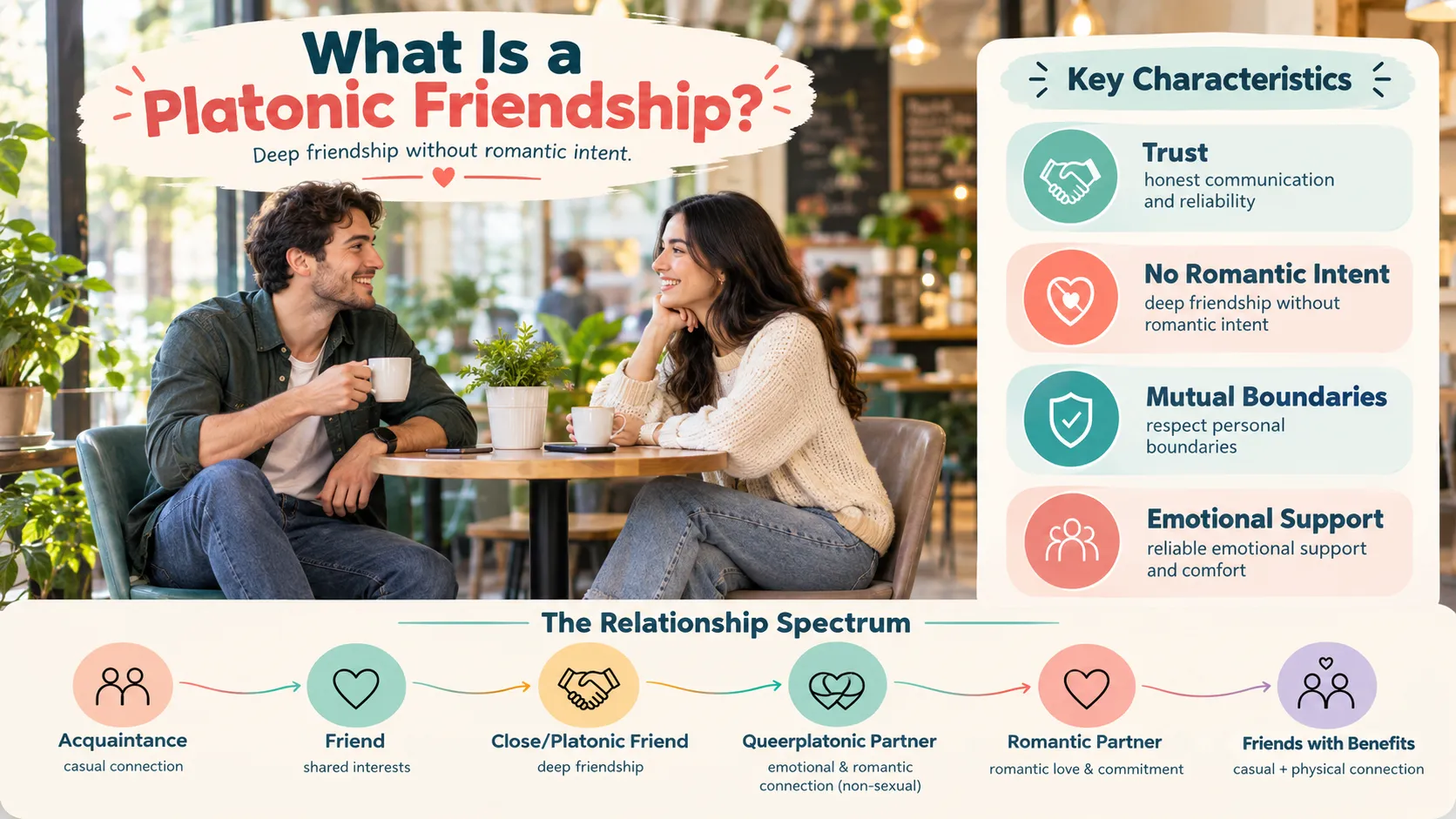
A platonic friendship is a close, emotionally meaningful relationship between people that doesn’t involve romantic or sexual intent. It can be just as deep as a romantic relationship — full of trust, vulnerability, and genuine care — but the connection stays rooted in friendship rather than romance.
That’s the short version. The longer, more honest version is that “platonic” isn’t always a clean line. People disagree about whether occasional attraction disqualifies a friendship from being platonic, whether physical affection changes anything, and where the boundary actually sits. This guide untangles that — with a framework, not just a rulebook.
A simple definition
If you need one sentence: a platonic friendship is a relationship built on emotional closeness and mutual care, without romantic or sexual involvement, where both people understand and accept that boundary.
What “platonic” means today
In everyday use, “platonic” has drifted from its philosophical roots into a practical shorthand: close, but not romantic. People use it to describe best friends, “work spouses,” childhood friends, roommates, and friendships that formed after a breakup — any relationship where deep affection exists without a romantic frame around it.
Platonic friendship in one sentence
Not romance. Not sex. Still real, still deep, still worth protecting.
What platonic friendship is — and is not
Emotional intimacy is not the same as romance
You can tell a platonic friend things you’ve never told anyone else. You can cry in front of them, celebrate with them, rely on them during a crisis. None of that makes the relationship romantic — emotional intimacy is a feature of close friendship, not proof of romantic feeling.
Affection and physical touch: when it can still be platonic
Hugs, hand-holding, cuddling during a movie, resting your head on a friend’s shoulder — these can exist comfortably in a platonic friendship, especially in cultures and friend groups where physical affection is simply how closeness is expressed. What keeps it platonic isn’t the absence of touch; it’s the absence of romantic or sexual intent behind it, and mutual comfort with where the line sits.
Can platonic friends feel attraction?
This is where competitors disagree, so here’s a clearer framework: a fleeting feeling of attraction doesn’t automatically end a friendship’s platonic status. What matters is intention and behavior. A friendship stays platonic when neither person acts on the feeling, pursues it, or lets it change how they treat the other person’s other relationships. A friendship stops being platonic when both people knowingly act on romantic or sexual feelings together.
Why mutual understanding matters more than labels
Two friends can define “platonic” slightly differently and still be fine, as long as they’re roughly on the same page about intent and boundaries. Trouble starts when one person assumes the relationship is purely platonic and the other is quietly hoping for more — which is less a “platonic vs. not” problem and more a communication gap.
Where the term comes from
Plato and platonic love
The word traces back to the Greek philosopher Plato, whose writings (particularly the Symposium) explored love as something that could exist on a higher, non-physical plane — a connection built on shared appreciation of ideas, virtue, and beauty rather than bodily desire.
How modern use differs from the original philosophical idea
Plato wasn’t describing modern friendship — his framework was a philosophical model of love and desire. The everyday phrase “platonic relationship” is a much later simplification: people kept the “non-physical, non-romantic” core of the idea and applied it to ordinary friendships. Worth knowing, but not something to overexplain — readers searching this term want the modern meaning, not a philosophy lecture.
Signs of a healthy platonic friendship
- Trust, honesty, and reciprocal effort — both people show up, follow through, and put in comparable effort over time.
- Emotional safety and acceptance — you can be inconsistent, tired, or struggling without fear of judgment.
- Shared support without romantic expectation — comfort and encouragement flow both ways, with no unspoken debt attached.
- Respect for time, privacy, and other relationships — a platonic friend doesn’t compete with your partner, family, or need for space; they make room for all of it.
Platonic friendship examples
- Close friends who share emotional support — the friend you call first with good or bad news, with no romantic subtext.
- A cross-gender or same-gender friendship — platonic closeness isn’t defined by who’s “allowed” to be attracted to whom; it exists across every gender and orientation combination.
- A work friendship with clear professional limits — a “work spouse” dynamic: high trust, inside jokes, mutual reliance, kept firmly within professional boundaries.
- Friendship after dating or a breakup — exes who’ve genuinely moved past the romantic chapter and rebuilt something new on different terms.
- Long-distance platonic friendship — closeness maintained through calls, messages, and visits, with distance testing (and often proving) the friendship’s depth.
Platonic friendship vs. other relationships
| Relationship type | Romantic intent | Sexual involvement | Key distinction |
|---|---|---|---|
| Platonic friendship | No | No | Deep closeness, no romantic/sexual pursuit |
| Romantic relationship | Yes | Often | Explicit romantic commitment |
| Friends with benefits | Usually no | Yes | Physical involvement without romantic commitment |
| Emotional affair | Often unacknowledged | No | Emotional intimacy that crosses a partner’s boundaries |
| Romantic friendship | Ambiguous/intense | No | Historically close, passionate friendship without physical romance |
| Queerplatonic relationship | Non-romantic but committed | Varies | A committed partnership deliberately outside the romantic/platonic binary |
| Acquaintance/casual friend | No | No | Lower emotional investment and closeness |
A quick way to place a relationship on the spectrum: acquaintance → friend → close/platonic friend → queerplatonic partner → romantic partner → friends with benefits — moving roughly from low emotional investment to high romantic/sexual investment, though queerplatonic relationships intentionally sit outside that line rather than on it.
Boundaries that keep the friendship healthy
- Talk about expectations early — a short, direct conversation (“I want us to stay friends, nothing more”) prevents months of ambiguity later.
- Decide what physical affection feels comfortable — what’s fine for one friendship (hugs, cuddling) may feel like too much in another; check in rather than assume.
- Set limits around flirting and sexual jokes — playful banter is fine until it starts functioning as a substitute for romantic pursuit.
- Be transparent with romantic partners when appropriate — secrecy around a close friendship tends to create more suspicion than the friendship itself ever would.
- Protect time for friendships, partners, family, and yourself — a healthy platonic friendship doesn’t require sacrificing other relationships to sustain it.
- Revisit boundaries when circumstances change — a new relationship, a move, or a shift in feelings is a normal reason to recheck, not a sign something’s wrong.
Script to borrow: “I really value our friendship, and I want to make sure we’re on the same page about flirting/texting/physical affection — how do you see it?”
How to build and maintain platonic friendships
When feelings change
Signs the relationship may no longer feel platonic
Wanting more one-on-one time than usual, feeling jealous of their romantic partner, thinking about them romantically, or feeling disappointed when nothing happens after time together — none of these are shameful, but they’re worth noticing honestly.
How to tell a friend you have feelings
Be direct, low-pressure, and clear that the friendship matters regardless of their answer: “I’ve noticed I have feelings for you. I don’t need anything to change, but I wanted to be honest instead of letting it sit unspoken.”

What to do if feelings are not mutual: Permit yourself
Permit yourself to feel disappointed, and give the friendship a little space if you need it — that’s not a failure, it’s self-respect. Most friendships can survive an honest disclosure; what damages them is prolonged unspoken tension.
When distance can help
A short pause — skipping a few hangouts, easing off constant messaging — can help feelings settle before deciding whether the friendship can return to its old rhythm.
Can a friendship become platonic again?
Often, yes. Once feelings are acknowledged (rather than hidden) and both people agree on what they want going forward, many friendships do settle back into a stable, platonic footing — sometimes even stronger for having been tested.
Navigating a partner’s concerns
- Validate concerns without minimizing the friendship — “I hear that this makes you uneasy” and “this friendship matters to me” can both be true at once.
- Avoid secrecy and defensiveness — hiding messages or hangouts reads as guilt, even when nothing is happening.
- Make room for group time and introductions — letting a partner get to know the friend directly tends to dissolve a lot of imagined tension.
- Recognize controlling behavior versus reasonable boundaries — a partner asking for transparency is reasonable; a partner demanding you end healthy friendships is a different, more serious issue.
Benefits of platonic friendship
Research on social connection consistently links supportive friendships to greater resilience and emotional well-being — though it’s worth being precise rather than sweeping about what that means.
- Social support and belonging — a sense of being known and accepted outside a romantic context.
- Perspective beyond romantic relationships — friends often offer a clarity that’s harder to get from a partner.
Explore More: https://namenesty.com/love-line-captions/
- Resilience during stress and life transitions — having multiple close relationships tends to soften hard periods.
- Avoiding overdependence on one relationship — spreading emotional needs across several people reduces pressure on any single relationship, romantic or otherwise.
People Also Ask
Yes — platonic love is a real, well-documented form of deep Affection and care that doesn’t involve romance or sex.
Sometimes, if neither acts on it and both are comfortable with where things stand — though sustained mutual attraction often puts real strain on staying “just friends.”
Yes, and many do. Transparency with a spouse and mutual respect for the marriage tend to be what keeps it healthy.:
Cuddling and platonic sleepovers can be, depending on the friendship and both people’s comfort. Kissing (beyond a cultural greeting) generally crosses into romantic/physical territory for most people.
Yes, once both people have genuinely moved past romantic feelings and renegotiated the relationship on new terms — it usually takes real time and honesty to get there.
An informal term for a friend who feels like a once-in-a-lifetime, deeply understanding connection — without romantic involvement.:
Not quite. “Friend-zoned” implies one person wanted romance and didn’t get it; a platonic friendship is simply one where neither person is seeking romance in the first place.
Key Takeaways
- A platonic friendship is Close and emotionally real, but intentionally non-romantic and non-sexual.
- Occasional attraction doesn’t automatically disqualify a friendship — intention and behavior are what matter most.
- Clear, early conversations about boundaries prevent most of the confusion competitors’ articles warn about.
- Platonic friendships exist across every gender, orientation, and relationship status — not just as a “could-we-date” default.











2 thoughts on “What Is a Platonic Friendship? The Real Definition”