YK Meaning in Text: What It Really Means (2026 Guide)
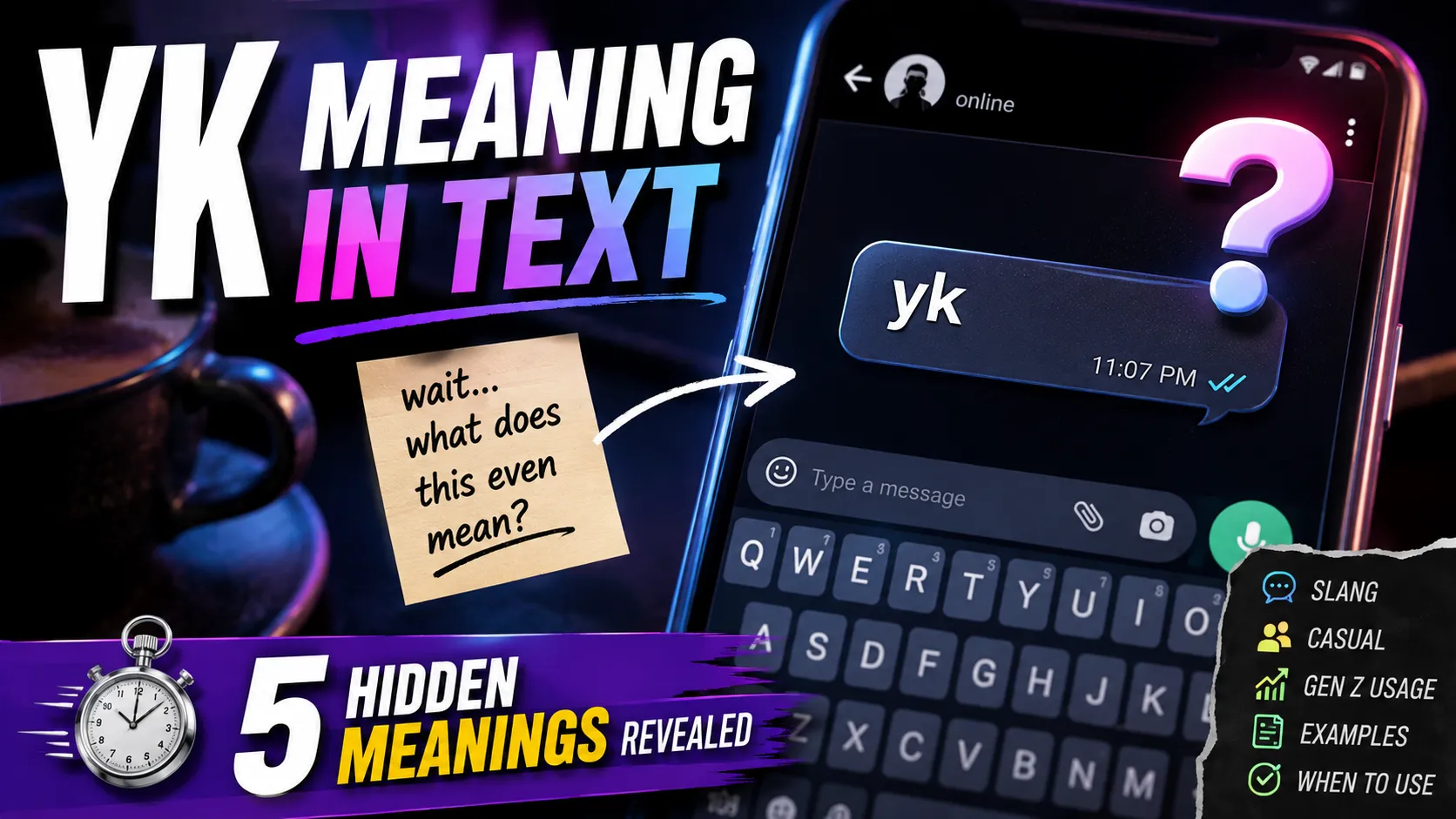
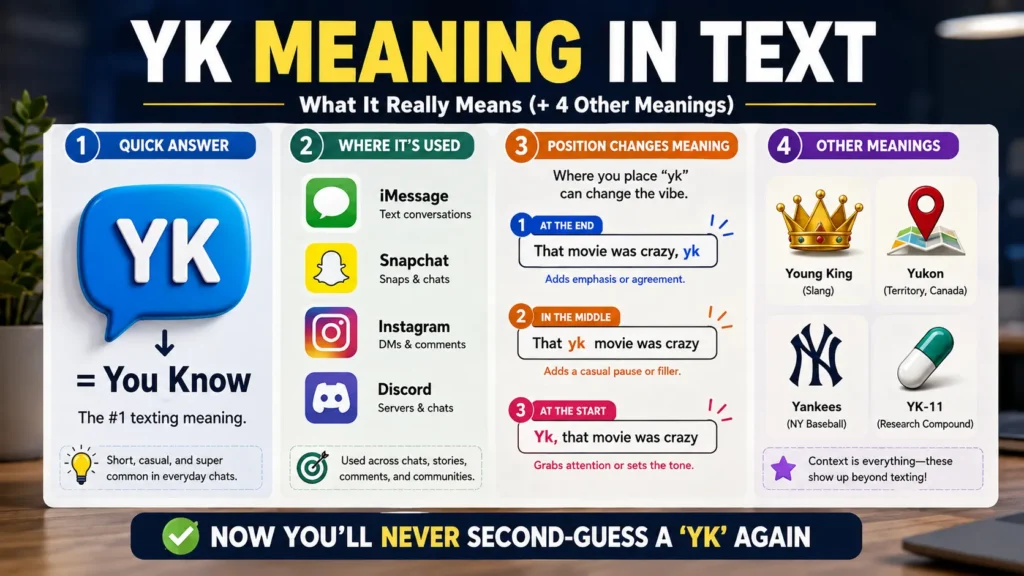
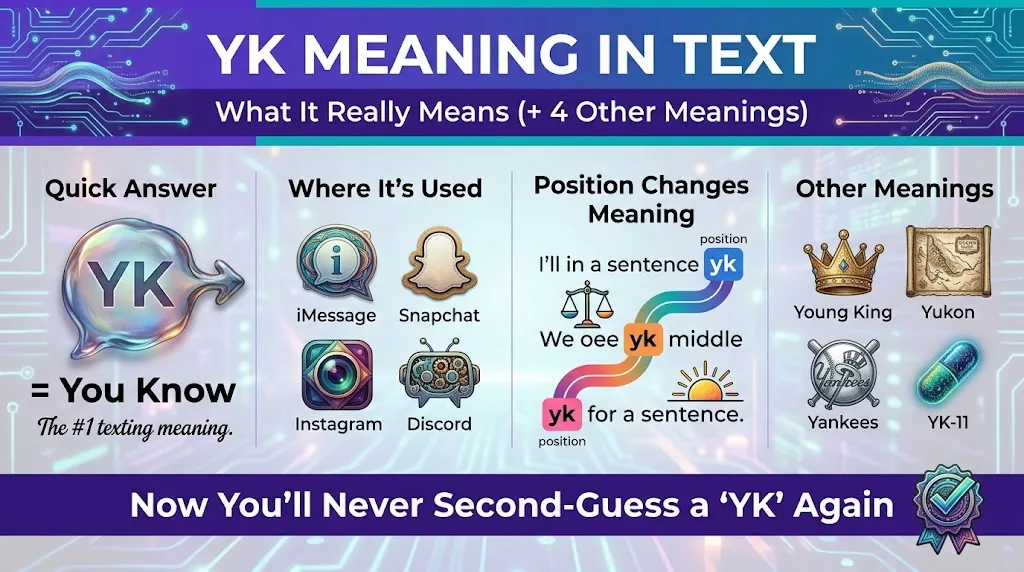
Quick answer: In texting and social media, YK Stands For “you know.” It’s a filler abbreviation people add to a sentence to signal shared understanding, soften a statement, or keep a message feeling casual — the text version of trailing off with “…you know?” at the end of a sentence.
That’s the short version. But where “yk” sits in a sentence, what punctuation follows it, and which platform it showed up on can all shift what it’s actually doing. That’s what this guide breaks down — plus the handful of situations where YK doesn’t mean “you know” at all.
1. What Does YK Mean in Text?
“YK” is shorthand for “you know” — the vast majority of the time. It isn’t a formal acronym hiding a longer phrase; it’s a compressed version of something people already say constantly out loud.
Two things make it different from something like “brb” or “lol”:
- It has no fixed job in a sentence. It can open a sentence, close one, or sit in the middle as a verbal pause.
- It carries tone, not new information. “YK” rarely adds facts — it adds emotional flavor: casualness, assumed agreement, hesitation, or emphasis.
That’s why the same two letters can feel different depending on where they land. “I’m just tired, yk” and “yk what, forget it” are using the word for two different jobs.
2. YK Full Form and Pronunciation
The full form of YK is simply “you know.” There’s no official, dictionary-agreed long form beyond that — unlike “lol” (laugh out loud) or “btw” (by the way), which have one settled expansion.
When spoken aloud, it’s usually pronounced by spelling the letters — “why-kay.” It’s also written far more often in lowercase (“yk”) than capitalized (“YK”) in fast, casual typing. Capitalization doesn’t change the meaning.
3. Quick Meaning Summary
| Attribute | Detail |
| Full form | You know |
| Type | Informal texting slang / filler |
| Common platforms | iMessage, Snapchat, Instagram, TikTok, Discord |
| Tone | Casual, conversational, assumes shared understanding |
| Formality | Not appropriate for professional writing |
| Closest related term | IYKYK (“if you know, you know”) |
| Alternate meanings | Young King, Yukon, Yankees, YK-11 (rare, context-dependent) |
4. Origin and History of YK
“YK” grew out of three overlapping shifts in digital communication:
SMS character limits (early-to-mid 2000s). Early text messages were capped at 160 characters, and typing on a 9-key keypad (T9) was slow. Dropping vowels and shortening common phrases — “u,” “r,” “brb,” “idk” — became habitual. “You know” naturally compressed into “yk.”
Instant messaging and chat rooms. AIM, MSN Messenger, and early chat rooms normalized a whole vocabulary of clipped shorthand that later moved onto phones.
Smartphones reinforced the habit rather than killing it. Even once full keyboards and autocorrect made “you know” just as fast to type, “yk” had already become a stylistic choice rather than a shortcut — signaling informality on purpose.
“You know” was already common in spoken English long before texting existed. Texting didn’t invent the phrase — it just gave it a two-letter shortcut.
5. Why Is YK So Popular in Texting?
- It mimics real speech. People say “you know” constantly out loud; “yk” just recreates that verbal habit in text.
- It softens statements. Adding “yk” makes a sentence feel less blunt or direct.
- It saves time and effort. Two letters versus eight — useful even with modern keyboards and autocorrect.
- It signals closeness. Using casual filler like “yk” implies familiarity and comfort between the people texting.
- It fills the gap left by tone of voice. Texting has no inflection or body language, so small words like “yk” carry emotional nuance that would otherwise be lost.
6. How YK Is Used in a Sentence (Position Matters)
At the end of a sentence — the classic use, functioning like “…right?” or “…you know?” said out loud. Invites agreement or assumes the other person already gets it.
“I just need a break this weekend, yk.”
In the middle of a sentence — acts as a pause or softener, similar to saying “like” mid-thought. Often signals hesitation.
“I might skip the party tonight, yk, just feeling off.”
At the start of a sentence — punchier, often signals a shift in tone, mild frustration, or a change of mind.
“Yk what, never mind.”
As a standalone reply — usually means “you know [what I mean],” closer to “yeah, exactly” than an actual question.
7. Punctuation Guide: yk vs yk, vs yk? vs yk.
| Form | How it typically reads |
| yk (no punctuation) | Flat, casual, low-emphasis filler |
| yk, | A conversational pause mid-sentence |
| yk? | An actual check-in — “does that make sense?” |
| yk. | Slightly more final or clipped, sometimes flat |
| YK (all caps) | Adds emphasis or intensity, sometimes sarcasm |
Punctuation isn’t an exact science in texting, but it is a real signal worth reading before assuming someone’s tone.
8. YK Meaning on Social Media
- iMessage / SMS: Mostly used mid-conversation between people who already know each other — casual and filler-heavy.
- Snapchat: Common in captions and short replies where space is limited.
- Instagram: Frequent in comments and DMs as a quick, low-effort way to agree or relate.
- TikTok: Often paired with humor or sarcasm, sometimes stretched (“ykkkk”) to mimic vocal emphasis.
- Discord / gaming chats: Used functionally, often to confirm a shared plan rather than as emotional filler.
9. Real-Life Examples of YK in Conversations
“Running late, traffic is insane rn, yk how it is downtown.”
Caption: “best day yk 💛”
“this is literally me yk”
“rotate to B, yk the drill”
“It’s not that deep, yk, just annoying.”
“Yk, I don’t think I’m going anymore.”
10. Other Meanings of YK
“You know” covers the vast majority of cases, but “YK” isn’t exclusive to it. Depending on context, you may also see:
- Young King — an informal compliment used mostly in social captions and comments.
- Yukon — the Canadian territory’s standard geographic/postal abbreviation, used in travel, addresses, or government writing — never in casual chat.
- Yankee(s) — occasional sports shorthand, though “NYY” is more standard.
- YK-11 — a research compound (SARM) referenced in some fitness/bodybuilding forums; a product name, not slang.
- Initials or usernames — “YK” is a common two-letter combo, so it also appears as someone’s initials, gamer tag, or brand shorthand with no slang meaning at all.
If it’s a message from a friend, “you know” is almost always the right read. In captions, forum posts, or addresses, check the context first.
11. YK vs Similar Texting Abbreviations
| Abbreviation | Full form | How it differs from YK |
| IYKYK | If you know, you know | Refers to an inside joke or shared experience, not a filler word |
| YKWIM | You know what I mean | A stronger, more direct request for confirmation |
| IK | I know | A reaction/agreement, not a self-softener |
| IDK | I don’t know | Opposite function — signals uncertainty, not shared understanding |
| FR | For real | Emphasizes sincerity, doesn’t soften a statement |
| NGL | Not gonna lie | Flags honesty before an admission |
| TBH | To be honest | Flags honesty before an opinion |
YK softens or assumes; most of these others confirm, emphasize, or flag honesty. IYKYK is the closest relative but refers to exclusivity, not filler.
12. How to Reply to YK
- If it feels like agreement/venting: “yk fr” or “ikr” matches the energy.
- If it feels like a real check-in (“yk?”): “yeah I get it” or “yk, same” confirms you followed.
- If you genuinely don’t understand: Just ask — “wait what do you mean?” “Yk” is inherently vague by design, so clarifying isn’t rude.
13. Is It Rude or Unprofessional to Use YK?
Not rude — but register-sensitive.
Fine to use:
- Texting friends, casual DMs, social captions, group chats
- Informal Slack/Discord messages with people you know well
Avoid using it:
- Professional emails, cover letters, client-facing messages
- First messages to someone you don’t know well
- Any writing meant to sound precise or formal
Quick test: if you’d naturally say “…you know?” out loud in that sentence, “yk” fits. If the sentence needs to stand on its own professionally, drop it.
14. Common Mistakes People Make With YK
- Reading it as a real question every time — usually it’s rhetorical.
- Assuming capitalization changes meaning — it doesn’t.
- Missing platform context — the same letters mean different things in a Yukon travel article vs. a friend’s text.
- Using it in professional writing, where it reads as too casual.
- Confusing it with IYKYK — related in spirit, not interchangeable.
15. Is YK Still Popular in 2026?
Yes. “Yk,” alongside “fr,” “ngl,” and “idk,” remains standard texting vocabulary across iMessage, Snapchat, Instagram, and TikTok. It hasn’t faded like some novelty slang because it mirrors a phrase people already say constantly out loud, rather than being tied to one app or meme cycle — that grounding in real speech is why it keeps outlasting trend-driven terms.
Explore More : https://namenesty.com/mf-meaning-in-text/
People Also Ask
What does YK mean in a text message from a girl or guy? The same thing regardless of who sends it — “you know.” Gender doesn’t change the meaning; tone comes from the rest of the message.
Does YK mean something different on Snapchat than in texting? No, the core meaning stays “you know.” What changes is usage pattern — more caption use on Snapchat/TikTok, more mid-conversation use in direct texts.
Is YK the same as IYKYK? No. “YK” is a general filler meaning “you know.” “IYKYK” specifically refers to an inside joke or experience only certain people will understand.
Can YK stand for anything other than “you know”? Rarely — mostly “Young King” in captions, “Yukon” in geographic writing, or unrelated initials/usernames.
Is it okay to use YK at work? It’s best avoided in professional emails or client communication since it reads as too casual.
Why do people use YK if it doesn’t add real information? Because texting lacks tone of voice and body language. Filler words like “yk” recreate the rhythm of spoken conversation and make a message feel more natural.
How do you respond when someone just texts “yk?” Treat it as a soft check-in rather than a literal question — a short “yeah, I get it” or a matching casual reply both work.
Conclusion
“YK” is one of texting’s smallest words carrying the biggest job: recreating the natural, casual rhythm of spoken conversation inside a short message. In nearly every case, it simply means “you know” — but its exact feel shifts with sentence position, punctuation, and platform, and in rare contexts it can mean something entirely different, like Young King or Yukon. Once you know how to read those small signals, you’ll never have to second-guess a bare “yk” again.