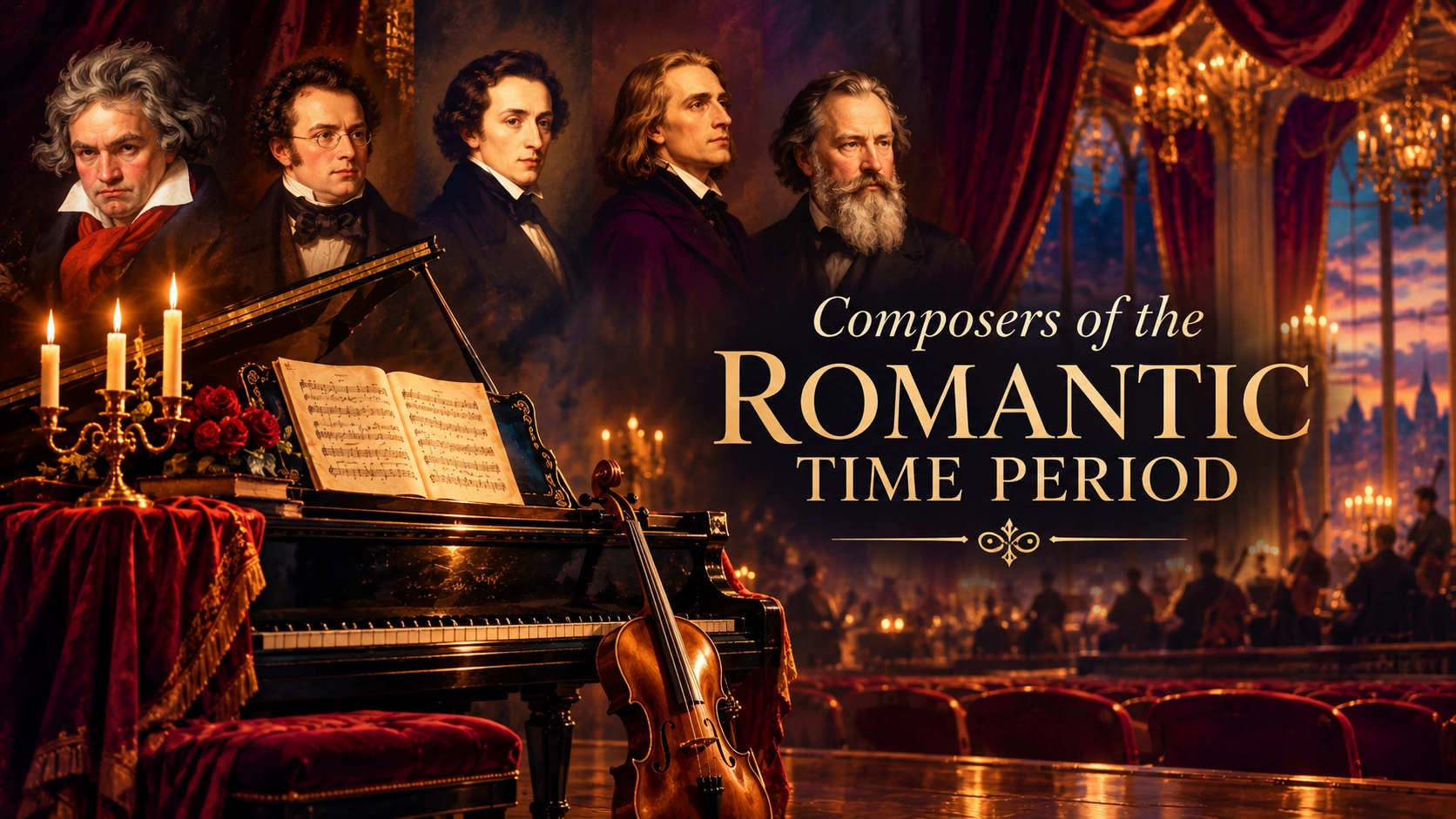
Composers of the Romantic Time Period: The Ultimate Guide (1820–1910)
If you’ve ever felt a piece of music sweep you up before you even knew its name, there’s a good chance it came from the Romantic era. Running roughly from 1820 to 1910, this is when composers stopped writing to satisfy formal balance and started writing to move people — capturing heartbreak, nationalism, and the supernatural in sound. The composers of the Romantic period didn’t just write beautiful music; they invented the emotional language that film scores and streaming playlists still borrow from today. Here’s the complete guide, organized by era, instrument, and the names too many lists leave out.
If you’ve ever felt a piece of music sweep you up before you even knew its name, there’s a good chance it came from the Romantic era. Running roughly from 1820 to 1910, this is the period when composers stopped writing primarily to satisfy formal balance and started writing to move people — to capture heartbreak, nationalism, nature, and the supernatural in sound. The composers of the Romantic time period didn’t just write beautiful music; they invented the emotional vocabulary that film scores, video game soundtracks, and even pop ballads still borrow from today.
This guide goes beyond the usual “top 10” list. You’ll get a clear timeline of how the era evolved, more than 25 composers organized by phase and specialty, the women often left out of shorter lists, a starter playlist of essential works, and straight answers to the questions people actually search for.
What Defines the Romantic Time Period in Music?
The Romantic era followed the Classical era (think Mozart and Haydn) and came before Modernism. Composers working in this style shared a few defining traits:
- Emotional intensity and individual expression — music as a personal, often autobiographical statement
- Expanded orchestras and richer, more chromatic harmony
- Program music — instrumental works that tell a story or paint a scene
- Nationalism — folk melodies and cultural identity woven into “serious” concert music
- The rise of the virtuoso performer — artists like Liszt and Paganini became the first true classical celebrities
Where Classical-era composers prized balance and restraint, Romantic composers reached for the sublime: nature, literature, love, death, and national identity all became legitimate subjects for a symphony.
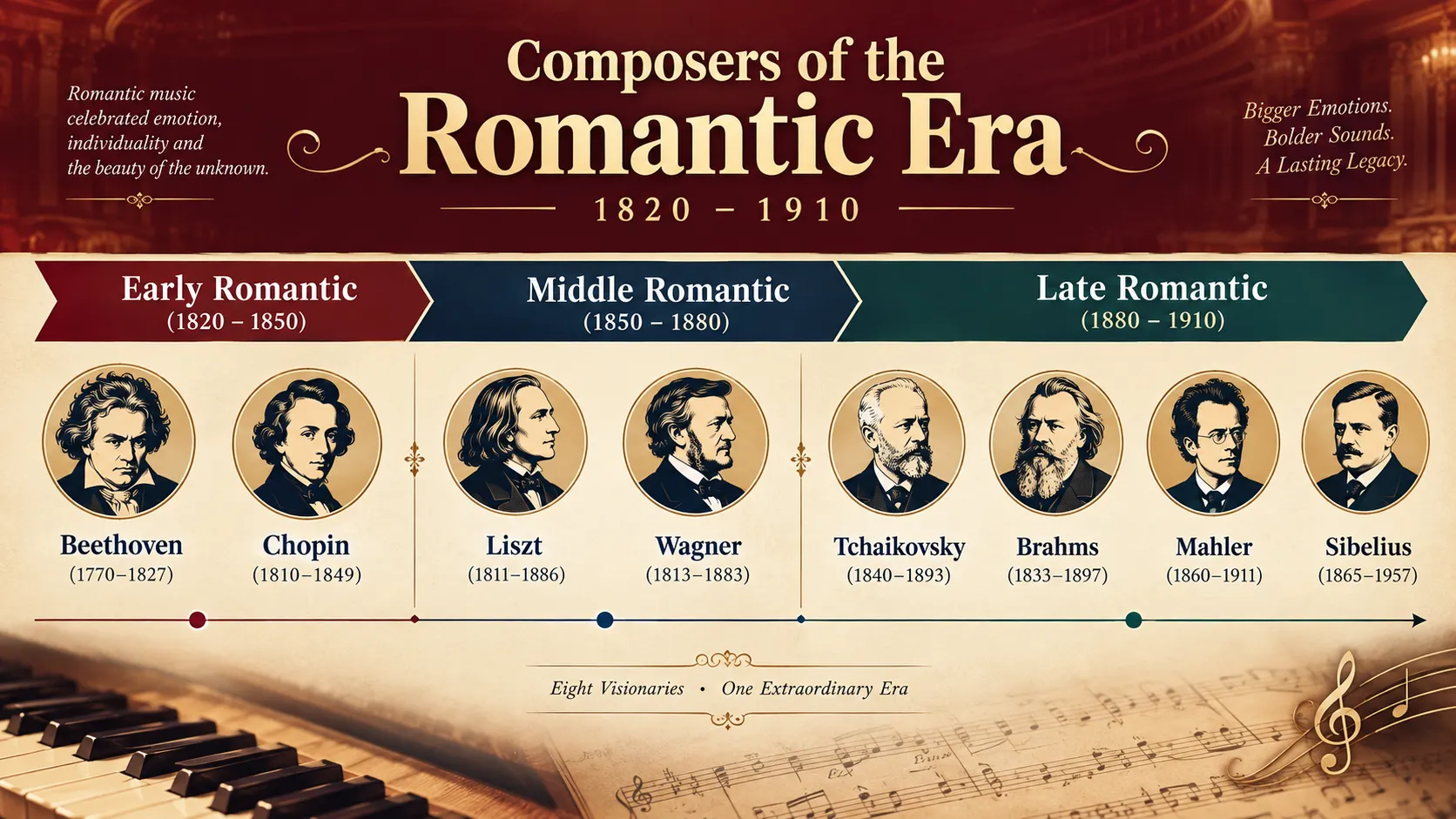
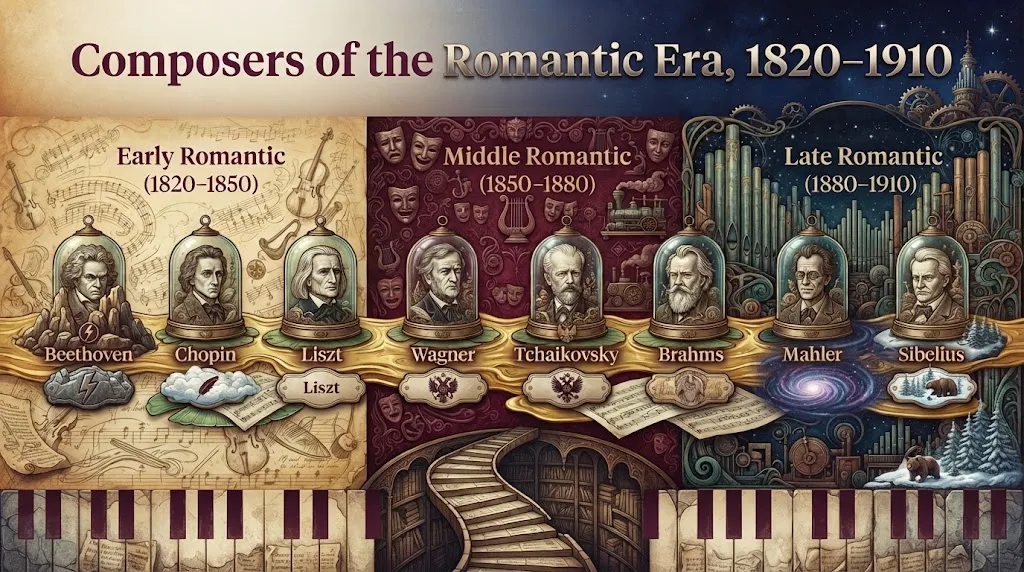
Romantic Era Timeline: Early, Middle & Late Phases
Splitting the era into three phases makes it much easier to hear how the style evolved.
Early Romantic (c. 1820–1850)
Beethoven’s late works, Schubert, Mendelssohn, Chopin, Schumann, and Berlioz define this phase — a transition out of Classical forms, marked by the rise of the Lied (art song) and short, expressive piano pieces.
High/Middle Romantic (c. 1850–1880)
Liszt, Wagner, Verdi, Brahms, Tchaikovsky, and Dvořák dominate here, alongside grand opera, the symphonic poem, and the first strong nationalist schools — including Russia’s “Mighty Five” and the Czech nationalist movement.
Late Romantic (c. 1880–1910+)
Mahler, Richard Strauss, Rachmaninoff, Sibelius, and Puccini push the era to its emotional and technical limits with massive symphonies and extreme chromatic harmony — building the bridge into Modernism.
The 25+ Most Important Composers of the Romantic Time Period
The Household Names
| Composer | Lifespan | Nationality | Signature Works | Why They Matter |
| Ludwig van Beethoven | 1770–1827 | German | Symphony No. 9, “Moonlight” Sonata | Bridged the Classical and Romantic eras; expanded the symphony’s emotional and structural scope |
| Frédéric Chopin | 1810–1849 | Polish | Nocturnes, Ballades, Mazurkas | Redefined solo piano music with poetic intimacy |
| Franz Liszt | 1811–1886 | Hungarian | Hungarian Rhapsodies, Transcendental Études | Pioneered the solo piano recital and the symphonic poem |
| Richard Wagner | 1813–1883 | German | The Ring Cycle, Tristan und Isolde | Reinvented opera with leitmotifs and the “total artwork” concept |
| Pyotr Ilyich Tchaikovsky | 1840–1893 | Russian | Swan Lake, Symphony No. 6 “Pathétique” | Blended Russian emotional depth with Western symphonic form |
Essential Early Romantic Composers
- Franz Schubert (1797–1828) — over 600 Lieder, including “Erlkönig”; the “Unfinished” Symphony
- Felix Mendelssohn (1809–1847) — A Midsummer Night’s Dream incidental music, Violin Concerto in E minor
- Fanny Mendelssohn Hensel (1805–1847) — 460+ works, many published under her brother’s name due to the era’s gender norms
- Robert Schumann (1810–1856) — Carnaval, Kinderszenen; a tireless champion of Brahms and Chopin
- Clara Schumann (1819–1896) — Piano Concerto in A minor; a leading virtuoso performer and editor of Robert’s legacy
- Hector Berlioz (1803–1869) — Symphonie fantastique; expanded orchestral size and pioneered program music
Middle Romantic Powerhouses
- Johannes Brahms (1833–1897) — four symphonies, A German Requiem; Romantic in feeling, classical in restraint
- Giuseppe Verdi (1813–1901) — La Traviata, Aida, Otello; the king of Italian opera
- Antonín Dvořák (1841–1904) — Symphony No. 9 “From the New World,” Slavonic Dances
- Edvard Grieg (1843–1907) — Peer Gynt suites, Piano Concerto in A minor; steeped in Norwegian folk melody
- Bedřich Smetana (1824–1884) — Má vlast (including “Vltava”); the father of Czech nationalist music
- Modest Mussorgsky (1839–1881) — Boris Godunov, Pictures at an Exhibition; a leading voice of Russia’s “Mighty Five”
Late Romantic Giants
- Gustav Mahler (1860–1911) — nine symphonies, including the “Resurrection”; stretched the symphony to a cosmic scale
- Richard Strauss (1864–1949) — Also sprach Zarathustra, Salome
- Sergei Rachmaninoff (1873–1943) — Piano Concerto No. 2; lush melody paired with formidable virtuosity
- Jean Sibelius (1865–1957) — Finlandia, Violin Concerto; the sound of Finnish nationalism
- Giacomo Puccini (1858–1924) — La Bohème, Tosca, Madama Butterfly
- Anton Bruckner (1824–1896) — nine symphonies of monumental, spiritual scale
Often Overlooked But Essential
- Amy Beach (1867–1944) — the first American woman to compose and publish a symphony (the Gaelic Symphony, 1896)
- Gabriel Fauré (1845–1924) — Requiem, nocturnes; a bridge toward Impressionism
- Camille Saint-Saëns (1835–1921) — Carnival of the Animals, the “Organ” Symphony
- Jules Massenet (1842–1912) — Manon, Werther
- Hugo Wolf (1860–1903) — psychologically probing, harmonically advanced Lieder
Romantic Composers by Instrument & Genre
This organization helps if you already know what you love — piano, opera, orchestral works, or song.
- Piano specialists: Chopin, Liszt, Schumann, Brahms, Rachmaninoff, Grieg
- Opera masters: Verdi, Wagner, Puccini, Bizet (Carmen), Massenet
- Symphony & tone-poem innovators: Beethoven, Mahler, Bruckner, Richard Strauss, Smetana, Dvořák
- Lieder (art song) composers: Schubert, Schumann, Brahms, Hugo Wolf, Mahler
- Nationalist schools: Czech (Smetana, Dvořák, Janáček), Russian (the “Mighty Five,” Tchaikovsky), Norwegian (Grieg), Finnish (Sibelius), Polish (Chopin, Moniuszko)
Female Composers of the Romantic Era You Should Know
Women faced enormous structural barriers to publishing and performing, yet several left a lasting mark:
- Fanny Mendelssohn Hensel — much of her output was released under her brother Felix’s name; over 460 works
- Clara Schumann — a celebrated touring virtuoso who also composed and safeguarded her husband Robert’s legacy
- Amy Beach — the first American woman to have a symphony performed and published
- Cécile Chaminade (1857–1944) — known for widely performed salon pieces, one of the few women composers commercially published in her lifetime
10 Essential Romantic Works to Start With
A short, no-wrong-answers listening list for newcomers:
- Beethoven — Symphony No. 9, “Choral”
- Schubert — “Erlkönig”
- Chopin — Nocturne in E-flat Major, Op. 9 No. 2
- Liszt — Hungarian Rhapsody No. 2
- Wagner — “Ride of the Valkyries” (from Die Walküre)
- Tchaikovsky — Swan Lake
- Brahms — Symphony No. 1 in C minor
- Dvořák — Symphony No. 9, “From the New World”
- Mahler — Symphony No. 2, “Resurrection”
- Rachmaninoff — Piano Concerto No. 2
How Romantic Composers Changed Music Forever
- Expanded the emotional range of music — personal struggle, nature, and the sublime all became fair subjects
- Stretched or broke Classical forms — symphonies grew longer and looser
- Created new genres — the symphonic poem, the character piece, the song cycle, and Wagner’s music drama
- Turned performers into stars — Liszt and Paganini were arguably the first celebrity musicians
- Laid the groundwork for film scoring — Wagner’s leitmotifs and Berlioz’s and Strauss’s program music directly shaped the orchestral language of composers like John Williams and Hans Zimmer
Why Romantic Music Still Matters Today
- Streaming playlists built around “Romantic piano” or “epic classical” remain some of the most-streamed classical categories.
- Film and TV scores — John Williams (Star Wars), Howard Shore (The Lord of the Rings), and Hans Zimmer all draw heavily on Romantic-era orchestration and leitmotif technique.
Explore More: https://namenesty.com/couples-sex-games/
- Piano competitions still lean on Chopin, Liszt, and Rachmaninoff as core repertoire
- Wellness and focus playlists frequently use Romantic-era pieces for their emotional depth and long melodic lines
People Also Ask
Most sources place it between roughly 1820 and 1910, though some extend it to around 1930 to include composers like Rachmaninoff and the early works of Sibelius.
Q:2 Who were the main composers of the Romantic period?
The most-cited core group includes Beethoven, Schubert, Chopin, Liszt, Schumann, Brahms, Wagner, Verdi, Tchaikovsky, Dvořák, Mahler, and Rachmaninoff.
Emotional, individualistic expression; larger orchestras and more chromatic harmony; program music and nationalism; and the rise of the virtuoso performer and new musical forms like the symphonic poem and the Lied.
Beethoven is most often cited as the most influential figure of the era, though Chopin remains dominant in piano repertoire and Wagner is considered the most revolutionary force in opera.
Yes. Fanny Mendelssohn Hensel, Clara Schumann, Amy Beach, and Cécile Chaminade all produced significant bodies of work despite the era’s steep barriers for women.
Their techniques — leitmotifs, program music, and expanded orchestration — directly shaped film scores, video game soundtracks, and even elements of progressive rock.
Conclusion: Key Takeaways
- The Romantic era (c. 1820–1910) shifted music from Classical balance toward personal, emotional, and often nationalist expression.
- The period breaks cleanly into Early, Middle, and Late phases, each with its own defining composers and innovations.
- Beyond the household names (Beethoven, Chopin, Wagner, Tchaikovsky), the era includes important nationalist voices and long-overlooked women composers like Clara Schumann and Amy Beach.
- If you’re new to the era, start with the 10-work listening list above, then branch out by instrument or genre based on what resonates.
- This music isn’t a museum piece — it’s still shaping the film scores and playlists you hear every day.
Bookmark this guide as your starting point, and use the genre and instrument groupings above to go deeper into whichever corner of the Romantic era speaks to you.










1 thought on “Romantic Era Composers: The Complete 1820–1910 Guide”