
What Is Intimacy in a Relationship? Meaning, Types, Signs, and How to Build It
Intimacy is the mutual sense of Closeness, trust, emotional safety, and connection that lets two people feel known, accepted, and responded to by each other. It’s not one thing — it shows up as emotional openness, physical affection, sexual connection, shared meaning, and more. And it’s not the same as sex, love, or constant togetherness, even though people often use those words interchangeably.
If you’re here because something feels off — you feel distant from your partner, you’re not sure your relationship has “real” intimacy, or you want the language to talk about it — this guide walks through what intimacy actually means, the different forms it takes, how to recognize when it’s healthy versus when it’s missing (or unhealthy), and concrete ways to build or rebuild it.
What Does Intimacy Mean in a Relationship?
At its core, intimacy is a feeling — closeness, safety, being understood — but it’s also a process. It’s built through repeated moments of one person sharing something (a feeling, a need, a fear) and the other person responding with care instead of judgment. Do that enough times, and trust accumulates. Trust makes the next act of vulnerability feel safer. That’s the loop that creates intimacy.
Four ingredients show up in almost every healthy intimate bond:
- Trust — a reasonable confidence that your partner won’t use your openness against you.
- Vulnerability — the willingness to show feelings, needs, or fears that could be judged or rejected.
- Responsiveness — your partner actually engaging with what you share, not deflecting or minimizing it.
- Mutual respect — care that doesn’t require you to abandon your own boundaries to receive it.
Intimacy doesn’t require telling your partner everything. Having private thoughts, friendships, or feelings you haven’t shared yet doesn’t cancel out intimacy — it’s normal, healthy individuality. Intimacy is about the quality of what’s shared and how it’s received, not the volume.
What Intimacy Is Not
A lot of confusion about intimacy comes from conflating it with things that overlap but aren’t the same.
- Intimacy is not the same as sex. You can have sex with little emotional closeness, and you can have deep emotional intimacy with little or no sexual activity.
- Intimacy is not the same as love. You can love someone — a parent, a friend — without every dimension of intimacy being present, and people can feel intense intimacy early on before love has had time to develop.
- Intimacy is not emotional dependency. Needing one person to regulate all of your emotions, or feeling unable to function without constant reassurance, is a different pattern than mutual closeness — one that tends to strain rather than strengthen a relationship.
- Intimacy is not constant togetherness. Time apart, separate interests, and individual friendships don’t erode intimacy; in most relationships they support it.
- Intimacy is not the absence of conflict. Some of the closest couples argue — what matters is whether conflict gets repaired.
- Intimacy is not pressure to disclose or be physical. If openness or touch is being extracted through guilt, persistence, or fear rather than offered freely, that’s not intimacy — it’s coercion, and it deserves a different kind of attention (more on this below).
The Different Types of Intimacy
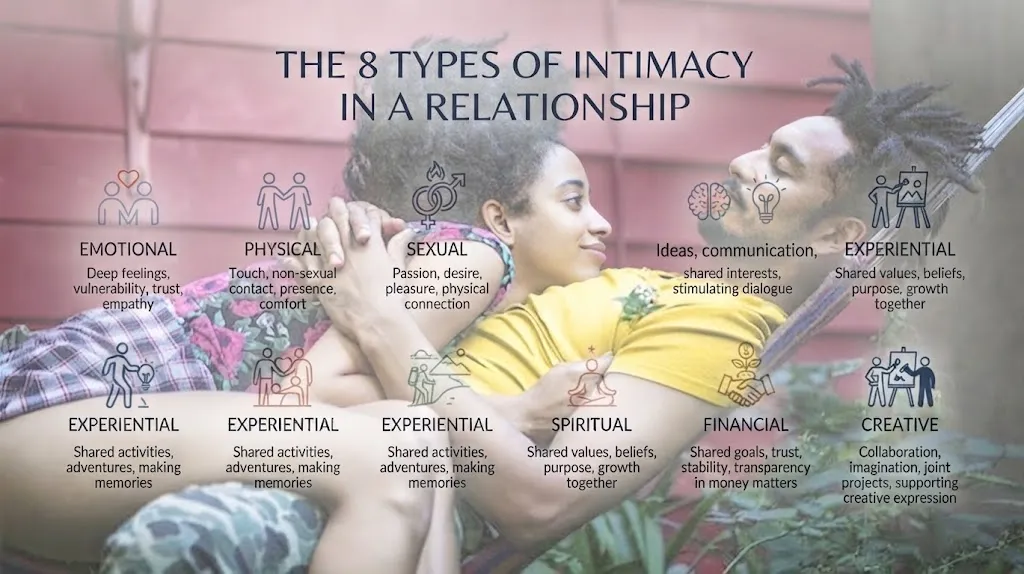
Researchers and clinicians generally describe intimacy as multi-dimensional. A relationship can be strong in some areas and weaker in others — that’s normal, not a red flag by itself.
| Type | What it looks like | One way to strengthen it |
| Emotional | Sharing feelings, fears, and needs; feeling understood | Ask “what’s actually going on for you?” and just listen |
| Physical | Nonsexual touch — hugs, holding hands, sitting close | Add small physical check-ins to your daily routine |
| Sexual | Consensual sexual connection, communication, and comfort | Talk openly about preferences and boundaries, not just during conflict |
| Intellectual | Exchanging ideas, debating, respecting each other’s minds | Ask a genuinely curious question you don’t know the answer to |
| Experiential | Bonding through shared activities and memories | Try something new together, even something small |
| Spiritual | Shared or respected beliefs, values, and sense of meaning | Talk about what “a good life” means to each of you |
| Financial/Practical | Trust and teamwork around money, logistics, and responsibilities | Have one honest, blame-free money conversation |
| Creative/Crisis | Making things together; showing up for each other under stress | Notice how you each behave when things go wrong — and talk about it |
No relationship needs to max out every category. What matters more is whether the types you both value are actually present, and whether you’re roughly aligned on which ones matter most.
Emotional Intimacy, Explained
Emotional intimacy is usually the one people mean when they say a relationship “lacks intimacy.” It’s the sense that you can say something true and vulnerable and be met with care instead of dismissal, ridicule, or advice you didn’t ask for.
A few things that quietly build or block it:
- Emotional availability vs. emotional openness. Availability is being willing to engage when your partner brings something up. Openness is initiating that sharing yourself. Relationships need both, and partners often default to different ones.
- Validation builds closeness faster than solutions do. When someone shares something hard, the instinct to jump to advice can (unintentionally) communicate “let’s move past this” instead of “I’m with you in this.” Try acknowledging the feeling first — “That sounds really frustrating” — before offering fixes, and ask if they want input at all.
- How you respond to vulnerability sets the pattern. If a partner shares something and gets criticized, minimized, or used against them later, they’ll share less next time — not because they don’t trust the relationship in general, but because that specific behavior got punished.
Physical and Sexual Intimacy
This is one of the most misunderstood areas, so it’s worth separating clearly.
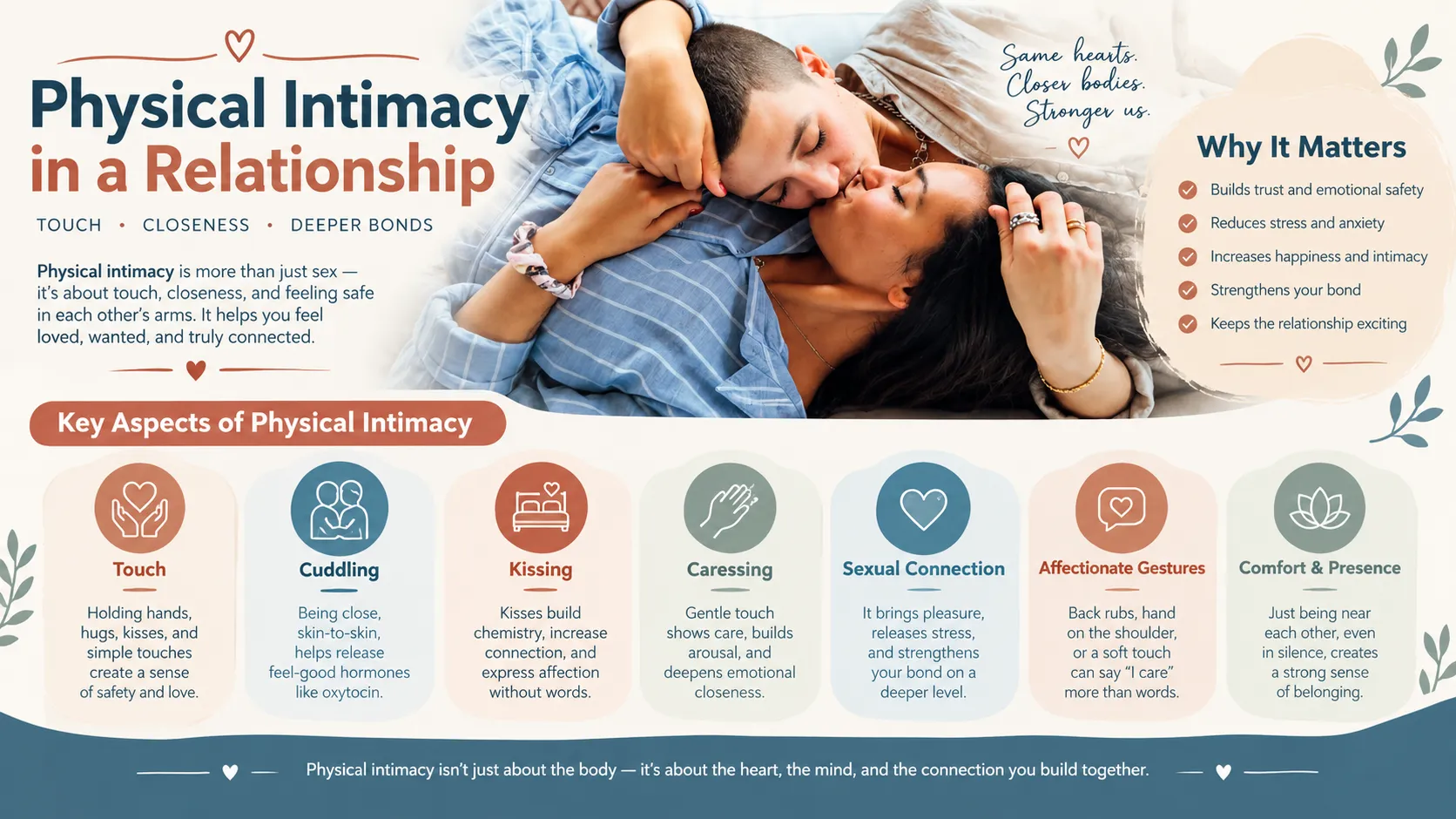
Physical intimacy is any nonsexual touch that communicates closeness — a hand on the back, cuddling, holding hands. Sexual intimacy includes physical touch but also the communication, consent, comfort, and emotional context around sex — not just the act itself.
A few clarifications competitors rarely spell out:
- Sex can happen without intimacy. People can have technically satisfying sex with little emotional connection.
- Intimacy can exist without sex. Couples with health conditions, mismatched desire, different life stages, or asexual partners can have deeply intimate relationships without frequent (or any) sex.
- Desire differences are common, not automatically a crisis. Mismatched libido is one of the most frequent sources of tension in long-term relationships — it usually responds better to open conversation than to silence or pressure.
- Physical intimacy can be maintained through illness, pregnancy, aging, disability, or medication changes by shifting what “physical closeness” looks like rather than treating it as all-or-nothing.
- Consent applies throughout a relationship, not just at the start. Ongoing comfort, checking in, and the ability to say no without consequence are part of healthy sexual intimacy at any stage.
Signs of Healthy Intimacy
- You can bring up something honest without bracing for punishment.
- You feel genuinely heard, not just heard out.
- When you’re vulnerable, it’s met with care rather than mockery or later use against you.
- Affection — physical or sexual — feels mutual, not obligatory or one-sided.
- You can hold boundaries and still feel close.
- After conflict, there’s a path back to connection, not just silence or avoidance.
- You feel known, not managed or controlled.
Signs Your Relationship May Lack Intimacy
- Conversations stay logistical — schedules, chores, bills — and rarely go deeper.
- One or both of you avoid bringing up anything emotionally difficult.
- You feel lonely even when you’re in the same room.
- Affection has become rare, routine, or something you brace for rather than want.
- Vulnerable moments in the past have been weaponized in later arguments.
- Conflict doesn’t resolve — it repeats or gets buried.
- There’s secrecy, persistent criticism, contempt, or a low-grade sense of fear.
A note on nuance: having a few of these signs occasionally doesn’t mean a relationship is failing — most couples go through low-intimacy stretches during stress, illness, or major life changes. It’s the pattern over time, not a single hard week, that’s worth paying attention to.
Healthy Intimacy vs. Unhealthy Closeness
Not all closeness is healthy, and this distinction is one competitors rarely make clearly.
| What it looks like | |
| Healthy intimacy | Mutual, gradual, consensual, respectful, and emotionally safe |
| Oversharing | Disclosing intensely before trust has actually developed |
| Emotional dependency | Relying on one person for all emotional regulation |
| Enmeshment | Loss of individual identity; blurred or absent boundaries |
| Coercion | Pressure — through guilt, persistence, or fear — to disclose, touch, or have sex |
| Trauma bonding | Attachment reinforced through repeated cycles of harm and reconciliation |
If what you’re experiencing looks more like the right-hand column — especially coercion or trauma bonding — that’s not a “communication issue” to work through with exercises. It’s worth talking to a professional, and if there’s any pattern of intimidation or control, safety planning comes before anything else.
Why Intimacy Matters
Closeness and connection are consistently linked, in relationship research, to greater support during hard times, higher relationship satisfaction, and a stronger sense of security. Emotional intimacy in particular tends to make conflict easier to repair, because disagreements happen against a backdrop of trust rather than suspicion.
It’s worth being careful with claims here — intimacy isn’t a guarantee against relationship problems, and correlational research doesn’t prove that more intimacy always causes better outcomes for every couple. But the general pattern — that people who feel close to their partner tend to report more relationship satisfaction and less loneliness — shows up consistently across relationship psychology sources.
What Gets in the Way of Intimacy
- Lack of trust, often from past betrayal or inconsistent behavior
- Fear of rejection or abandonment, which can make vulnerability feel unsafe
- Insecure attachment patterns (anxious or avoidant), shaped by earlier relationships
- Poor communication, especially unclear or indirect expression of needs
- Criticism, contempt, and defensiveness during conflict
- Unresolved conflict that keeps resurfacing
- Infidelity or betrayal
- Stress — finances, work, caregiving — that leaves little energy for connection.
- Trauma, including earlier relationship or childhood experiences
- Mental health factors, such as anxiety, depression, or substance use
- Chronic illness or medication effects
- Abuse or coercive control — a category that needs specialist support, not self-help exercises
If several of these are present, it’s rarely about a single fix — it usually takes addressing the underlying barrier, not just adding more “closeness” on top of it.
How to Build More Intimacy
- Start with Emotional safety. Nothing else works if vulnerability gets punished.
- Try short daily check-ins — even two minutes of “how are you, really?”
- Practice active listening — reflect back what you heard before responding.
- Ask before giving advice. “Do you want ideas, or do you just want me to listen?”
- Use “I” statements for feelings and needs instead of accusations.
- Express specific appreciation — not “thanks for everything,” but “thank you for noticing I was stressed this morning.”
- Ask deeper (but appropriate) questions — about values, fears, hopes, not just logistics.
- Create device-free time, even 20 minutes, without distraction.
- Build shared experiences — new activities create bonding memories faster than routine ones.
- Talk about values and the future, not just the present.
- Offer nonsexual affection regularly, not only as a lead-in to sex.
- Talk openly about sexual preferences and boundaries outside of the bedroom, not just in the moment.
- Repair quickly after conflict rather than letting distance settle in.
- Consider couples counseling — not just as a last resort, but as a proactive tool.
Conversation Starters That Build Intimacy
Sometimes the hardest part is finding the words. A few to borrow or adapt:
- “I feel closest to you when we have uninterrupted time together — can we protect more of that?”
- “When I share something vulnerable, I need empathy before advice. Can I ask for that?”
- “Would you be open to talking about how connected we’ve felt lately?”
- “I want more physical affection, but I don’t want either of us to feel pressured — can we figure out what feels good for both of us?”
- “What helps you feel emotionally safe with me?”
Framing requests around your own experience (“I feel,” “I need”) rather than accusations (“you never”) tends to keep these conversations from turning into conflict.
How to Rebuild Intimacy After Disconnection
Rebuilding looks different depending on what caused the distance.
- After an argument or rough patch: Name what changed, stop replaying the same fight, and rebuild trust through small, consistent behavior rather than one big gesture.
- After infidelity: This usually needs a longer, structured process — transparency, patience, and often professional support — since trust has to be rebuilt from a specific breach, not just general distance.
- After emotional withdrawal: Start with small, low-pressure moments of connection rather than expecting an immediate return to full closeness.
- After a desire mismatch or sexual rejection: Separate the physical conversation from blame — mismatched desire is common and workable when both partners can talk about it without shame.
- After trauma: Go at the pace of the person who needs more safety, and involve a trauma-informed professional if progress stalls.
- With an anxious or avoidant attachment pattern: Understanding the pattern (rather than treating it as a character flaw) usually helps both partners respond more effectively.
Important: couples exercises and “just talk it out” advice are not appropriate when there’s active abuse, intimidation, or coercive control. In that situation, safety planning and specialist support need to come first — this isn’t a communication problem to solve at home.

Intimacy at Different Relationship Stages and Contexts
- New relationships: Intimacy often builds faster emotionally than it should be rushed physically or in disclosure — pacing matters.
- Long-term relationships: Intimacy can flatten into routine; deliberately protecting novelty and vulnerability keeps it alive.
- After marriage or parenthood: Logistics can crowd out connection — scheduling intimacy isn’t unromantic; it’s realistic.
Explore More: https://namenesty.com/sex-near-me-captions/
- Long-distance relationships: Emotional and intellectual intimacy often have to carry more weight, since physical intimacy is limited.
- During major life stress (illness, job loss, grief): Intimacy needs often increase even as the capacity to offer it decreases — naming that mismatch out loud helps.
- Friendships and family relationships: Intimacy isn’t exclusive to romantic partners — many of the same principles (trust, vulnerability, responsiveness) apply.
- LGBTQ+, nonmonogamous, and asexual relationships: The same core ingredients of intimacy apply, though the specific forms (and what “enough” looks like) can differ from conventional assumptions.
People Also Ask
A mutual sense of closeness and trust that lets two people feel known and accepted by each other — built through vulnerability that’s met with care.
Emotional, physical, sexual, intellectual, experiential, spiritual, and often financial/practical and creative — most relationships are stronger in some than others.
Yes. Sex is one possible expression of physical and Sexual intimacy, but emotional, intellectual, and other forms of intimacy exist independently of sexual activity.
It can continue, but low intimacy over a long period is strongly linked to lower relationship satisfaction and loneliness within the relationship — most couples benefit from addressing it rather than ignoring it.:
There’s no fixed timeline — it depends on how consistently vulnerability is met with a caring response. Trust accumulates through repetition, not through a single conversation.
Fear of intimacy is often linked to past rejection, betrayal, or insecure attachment patterns formed in earlier relationships — it’s a common and workable pattern, not a permanent trait.
Try leading with your own feelings and needs rather than criticism — for example, “I’ve been feeling distant lately, and I miss feeling close to you. Can we talk about it?”
Key Takeaways
- Intimacy is a multi-dimensional feeling and process — not one thing, and not the same as sex or love.
- No relationship needs every type of intimacy maxed out; alignment on what matters to both partners matters more than checking every box.
- Healthy intimacy is mutual and consensual — closeness gained through pressure, guilt, or fear is a different (and concerning) pattern.
- Barriers to intimacy usually need to be addressed directly, not papered over with more “togetherness.”
- Rebuilding intimacy looks different depending on the cause of the disconnection — and abuse or coercion isn’t something to work through with self-help exercises.
If this resonated because something Specific feels off in your relationship, it may help to talk it through with a therapist or couples counselor — this guide is meant to give you language and a starting point, not to replace professional support.
This article is for informational and educational purposes only and is not a substitute for professional relationship, medical, or mental health advice.











1 thought on “What Is Intimacy, Really? 8 Types Most Couples Miss”